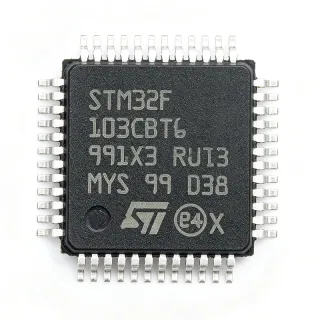
PIC16LF15325T-E/STVAO - 14KB Flash 8-bit MCU, AEC-Q100, TSSOP-14 | Microchip
MPN: PIC16LF15325T-E/STVAO ✓ Active| Qty | Unit Price | Extended |
|---|---|---|
| 1 | $2.45 | $2.45 |
| 10 | $2.2 | $22.00 |
| 100 | $1.95 | $195.00 |
| 500 | $1.72 | $860.00 |
| 1,000 | $1.5 | $1,500.00 |
PIC16LF15325T-E/STVAO Overview
A microcontroller (MCU) is a single-chip computer that integrates a CPU core, program and data memory, and a rich set of peripheral interfaces. The PIC16 family uses a RISC-based 8-bit core optimized for deterministic interrupt response and low-power operation, and is positioned within the broader taxonomy as: PIC16 -> 8-bit PIC microcontroller -> PIC MCU -> microcontroller -> embedded processor -> semiconductor. The "LF" prefix denotes the wide-voltage, low-power variant supporting operation down to 1.8V, while the "F" version is the 2.3V-5.5V counterpart.
Key features include 12 programmable I/O pins, 4 PWM channels, 2 EUSART modules, 1 SPI and 1 I2C peripheral, a 10-bit ADC with computation, and zero-cross detection. The TSSOP-14 footprint measures 4.40mm wide, making it among the smallest packages in the PIC16 lineup while still exposing 12 GPIO. AEC-Q100 Grade 1 qualification supports automotive operating temperature ranges and reliability requirements.
The architecture pairs a 14-bit instruction word with a hardware stack of 16 levels and a 49-instruction set, enabling compact code generation. XLP technology delivers nanoWatt sleep currents, while the Peripheral Pin Select (PPS) system allows digital peripheral I/O mapping to any GPIO, simplifying PCB routing in space-constrained designs.
Typical applications include automotive body and lighting modules, sensor interface nodes, IoT edge devices, low-power remote controls, and battery-powered instrumentation. Engineers frequently select this part when AEC-Q100 qualification and TSSOP-14 footprint are both required.
When designing, allocate the NRST, ICSPDAT/ICSPCLK, and Vpp/MCLR pins according to Microchip's programming and in-circuit debug guidelines to preserve board-level reprogrammability. Use the MPLAB X IDE and XC8 compiler for firmware development.
This page synthesizes distributor pricing, drop-in alternatives, and practical design notes not found in the standalone manufacturer datasheet, giving engineers a single-page decision aid.
Drop-in alternatives for PIC16LF15325T-E/STVAO — same package, pin-to-pin compatible. Different-package parts requiring PCB rework are excluded.
Variants in this series
Same-series models that are drop-in compatible with PIC16LF15325T-E/STVAO (same form factor and footprint) — differing in ADC, Comparators, Core, Package, DAC.
Quick Comparison Tool — Select alternative parts for side-by-side comparison:
PIC16LF15325T-I/STVAO
✅ Drop-In📋 Reference alternative (not in catalog)
PIC16LF15325T-E/ST
✅ Drop-In📋 Reference alternative (not in catalog)
PIC16LF15325-I/P
✅ Drop-In✓ In Stock
$0.92 / Unit
View Datasheet →PIC16F15325T-E/STVAO
✅ Drop-In📋 Reference alternative (not in catalog)
PIC16LF15324-I/P
✅ Drop-In✓ In Stock
$0.78 / Unit
View Datasheet →PIC16LF15325T-E/STVAO Maximum Ratings & Electrical Characteristics
| Core | PIC 8-bit RISC |
| Program Memory (Flash) | 14 KB (8K x 14 words) |
| Data Memory (RAM) | 1 KB |
| CPU Speed | 32 MHz |
| Operating Voltage Range | 1.8 V to 3.6 V (LF variant) |
| Programmable I/O Pins | 12 |
| PWM Channels | 4 |
| Communication Peripherals | 2x EUSART, 1x SPI, 1x I2C |
| ADC | 10-bit with computation |
| DAC | 5-bit |
| Comparators | Yes |
| Complementary Waveform Generator (CWG) | Yes |
| Configurable Logic Cells (CLC) | Yes |
| Automotive Qualification | AEC-Q100 (Grade 1, -40C to +125C) |
| Package | 14-TSSOP (4.40mm width) |
| Mounting Type | Surface Mount |
| RoHS Status | Compliant |
| Lead-Free Status | Lead free |
PIC16LF15325T-E/STVAO Pin Configuration
| Pin 1 | RA3/MCLR/VPP — GPIO RA3 / Master Clear (reset, active low) / Programming voltage |
| Pin 2 | RA4/ANA4 — GPIO RA4 / Analog channel 4 |
| Pin 3 | RA5/ANA5 — GPIO RA5 / Analog channel 5 |
| Pin 4 | RA0/ANA0 — GPIO RA0 / Analog channel 0 |
| Pin 5 | RA1/ANA1 — GPIO RA1 / Analog channel 1 |
| Pin 6 | RA2/ANA2 — GPIO RA2 / Analog channel 2 |
| Pin 7 | VSS — Ground reference |
| Pin 8 | RA6 — GPIO RA6 |
| Pin 9 | RA7 — GPIO RA7 |
| Pin 10 | RB0 — GPIO RB0 |
| Pin 11 | RB1 — GPIO RB1 |
| Pin 12 | RB2 — GPIO RB2 |
| Pin 13 | RB3 — GPIO RB3 |
| Pin 14 | VDD — Positive supply voltage (1.8V-3.6V) |
Typical Applications
PIC16LF15325T-E/STVAO is suitable for 6 applications: Automotive Body Electronics, Battery-Powered IoT Sensor Nodes, LED Lighting Controllers, Industrial Sensor Transmitters, Remote Control and HMI Keypads, Medical and Wellness Wearables.
Automotive Body Electronics
The PIC16LF15325T-E/STVAO is well suited for automotive body control modules including lighting controllers, door modules, and seat controllers. Its AEC-Q100 Grade 1 qualification and -40C to +125C operating range satisfy automotive under-hood and cabin reliability requirements. The 14KB Flash comfortably fits typical body-control firmware with CAN-LIN gateway state machines, while the 12 GPIO and PPS pin mapping minimize PCB trace congestion. The 10-bit ADC with computation and integrated comparators enable direct sensor signal conditioning for temperature, humidity, and position sensors, eliminating external analog front-end ICs.
Recommended
Battery-Powered IoT Sensor Nodes
The "LF" wide-voltage 1.8V-3.6V operation and nanoWatt XLP deep-sleep current make the PIC16LF15325T-E/STVAO ideal for battery-powered IoT sensor nodes running from a single lithium primary cell or 2x AA alkaline. Sleep currents below 100 nA extend battery life to 5-10 years in duty-cycled sensing applications. The 12 GPIO plus I2C/SPI/EUSART allow direct connection of environmental sensors (temperature, humidity, accelerometers) without external glue logic. The TSSOP-14 footprint is small enough for coin-cell sensor packages, and the AEC-Q100 grade lets the same firmware serve both consumer and automotive telematics SKUs.
Recommended
LED Lighting Controllers
The PIC16LF15325T-E/STVAO's four PWM channels and Complementary Waveform Generator (CWG) make it a strong fit for LED lighting drivers including automotive DRL, tail, and interior lighting. The CWG generates complementary PWM outputs with programmable dead-band, directly driving half-bridge MOSFET gates for high-current LED strings without external timing ICs. The 5-bit DAC and comparators implement constant-current regulation in a closed loop, while the 32 MHz CPU handles DMX, DALI, or LIN lighting protocols. The AEC-Q100 qualification supports OEM automotive lighting modules, and the TSSOP-14 package fits inside compact lamp housings.
Recommended
Industrial Sensor Transmitters
The PIC16LF15325T-E/STVAO suits 4-20 mA loop-powered and industrial field sensor transmitters requiring deterministic response. Its 10-bit ADC with computation (ADC2) handles ratiometric bridge, RTD, and thermocouple measurements directly, with hardware oversampling improving effective resolution. The EUSART peripherals implement HART, RS-485, or LIN physical layers, while the AEC-Q100 grade supports factory automation installations with wide temperature swings. The TSSOP-14 package and integrated CLC (Configurable Logic Cells) replace external glue logic for signal conditioning, reducing BOM and board area in compact DIN-rail transmitter modules.
Recommended
Remote Control and HMI Keypads
The PIC16LF15325T-E/STVAO is appropriate for automotive key fobs, garage door remotes, and small HMI keypad controllers. Its nanoWatt XLP sleep mode keeps quiescent current under 100 nA, allowing CR2032 coin cells to last the shelf life of the product. The CWG and CLC peripherals implement custom IR or sub-GHz protocol bit-banging without external encoder ICs, while the 12 GPIO directly scan 4x4 or 5x5 matrix keypads. The TSSOP-14 package fits inside compact remote-control enclosures, and the AEC-Q100 grade lets OEMs reuse the same firmware across consumer and automotive fob SKUs.
Recommended
Medical and Wellness Wearables
Although not FDA-cleared, the PIC16LF15325T-E/STVAO is suitable for non-critical medical and wellness wearable designs such as fitness bands, temperature patches, and patient monitoring accessories. The 1.8V-3.6V LF supply matches single-cell lithium-polymer battery rails, and the low sleep current extends wearable battery life. The 10-bit ADC with computation captures pulse, SpO2, and temperature sensor signals, while the TSSOP-14 package fits inside wristband form factors. AEC-Q100 qualification helps OEMs reuse validated firmware across consumer wearables and adjacent automotive health-monitoring SKUs.
Recommended
Recommended Products Summary
Engineering reference data for PIC16LF15325T-E/STVAO — comparison, design guidance, and compliance information.
Selection Guide
Comparison with Alternatives
| Parameter | This Product | PIC16LF15325T-I/STVAO | PIC16LF15325T-E/ST | PIC16F15325T-E/STVAO | PIC16LF15324-I/P |
|---|---|---|---|---|---|
| Brand | Microchip Technology | Microchip Technology | Microchip Technology | Microchip Technology | Microchip Technology |
| Package | 14-TSSOP (4.40mm) | 14-TSSOP (4.40mm) | 14-TSSOP (4.40mm) | 14-TSSOP (4.40mm) | 14-TSSOP (4.40mm) |
| Operating Voltage | 1.8 V to 3.6 V | 1.8 V to 3.6 V | 1.8 V to 3.6 V | 2.3 V to 5.5 V | 1.8 V to 3.6 V |
| Flash Memory | 14 KB | 14 KB | 14 KB | 14 KB | 7 KB |
| RAM | 1 KB | 1 KB | 1 KB | 1 KB | 512 B |
| CPU Speed | 32 MHz | 32 MHz | 32 MHz | 32 MHz | 32 MHz |
| AEC-Q100 | Yes (Grade 1, -40C to +125C) | Yes (industrial, -40C to +85C) | No (extended -40C to +125C) | Yes (Grade 1) | No (industrial) |
| GPIO | 12 | 12 | 12 | 12 | 12 |
| PWM Channels | 4 | 4 | 4 | 4 | 4 |
Key Differentiators
- AEC-Q100 Grade 1 automotive qualification in TSSOP-14 (vs PIC16LF15325-I/P)
- Wide 1.8V-3.6V supply for battery-powered designs (vs PIC16F15325T-E/STVAO)
- 14KB Flash with full CIP peripheral integration (vs PIC16LF15324-I/P)
- Compact TSSOP-14 footprint with 12 GPIO (vs Larger PIC16F variants in SOIC-20 or QFN packages)
Design Notes
For battery-powered designs, leverage the nanoWatt XLP deep-sleep mode with the RTC running from LFINTOSC at 32 kHz to achieve quiescent currents below 100 nA. Configure unused GPIO as outputs driven low (not high-impedance inputs) to avoid floating-pin leakage. Use the PPS peripheral pin select to map wake-up sources to specific GPIOs, enabling direct sensor-trigger wake-ups without external interrupts. Estimated: at 100 nA sleep and 3.0V supply, a 220 mAh CR2032 cell lasts approximately 8-10 years in duty-cycled 0.1% active operation.
Place a 100 nF decoupling capacitor as close as possible to the VDD pin (pin 14) with a short trace to the VSS pin (pin 7). For ADC accuracy, add a 10 uF bulk capacitor near the supply pins and route analog traces (ANA0-ANA5) away from digital switching signals. The TSSOP-14 thermal pad is not present on this package, so standard 2oz copper pour under the IC is sufficient for thermal relief. Keep the MCLR/VPP line short and add a 10 kohm pull-up to VDD to enable ICSP in-circuit programming.
Do not connect ICSPCLK or ICSPDAT to loads that exceed 5 mA - these pins are multiplexed with GPIO and have limited drive strength during programming. When using the ADC, ensure the acquisition time is configured for the source impedance of the sensor; high-impedance sources (>5 kohm) require extended acquisition times or a buffer op-amp. The LF variant cannot operate above 3.6V - over-voltage on VDD will damage the device. For automotive designs, add a TVS diode on VDD and place the MCLR capacitor no closer than 1 cm to prevent ESD-induced resets during transient testing.
Use a ground plane on the bottom layer directly under the MCU to provide low-impedance return paths. Route the 32 MHz system clock trace (if using external crystal) on the top layer with a guard ground on both sides to minimize EMI radiation. For CLC and CWG peripheral outputs, route the complementary PWM traces with matched length to within 2 mm to prevent duty-cycle distortion. The Peripheral Pin Select (PPS) feature allows remapping digital peripherals to alternate GPIO, which can be used to simplify PCB routing in dense designs by relocating signals after layout.
Compliance Information
AEC-Q100 Grade 1 qualified per the VAO suffix. RoHS compliant and lead-free per Microchip product page. Halogen-free per industry-standard Microchip green packaging compliance.