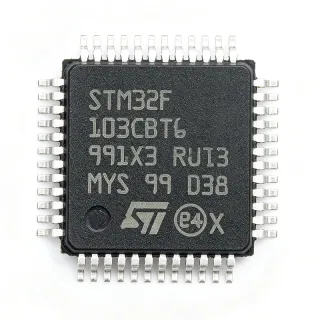
PIC17C42A-16I/PQ - 8-bit 16MHz OTP MCU 4KB | Microchip 44-MQFP
MPN: PIC17C42A-16I/PQ ✗ End of Life| Qty | Unit Price | Extended |
|---|---|---|
| 1 | $12.48 | $12.48 |
| 10 | $11.75 | $117.50 |
| 100 | $10.95 | $1,095.00 |
| 500 | $9.85 | $4,925.00 |
| 1,000 | $8.95 | $8,950.00 |
PIC17C42A-16I/PQ Overview
What is an 8-bit OTP microcontroller? An 8-bit microcontroller (MCU) is a small computer-on-a-chip built around an 8-bit data path and RISC-style instruction set. OTP (One-Time-Programmable) memory allows the firmware to be written once and retained, which is widely used in cost-sensitive, high-volume embedded products. The PIC17C family sits above the baseline PIC16C5X/PIC12CXXX line in Microchip's taxonomy: 8-bit MCU -> CMOS MCU -> RISC MCU -> microcontroller -> embedded computing. The PIC17C42A adds multi-cycle hardware multiply support, an expanded instruction set, and a wider interrupt model compared with PIC16C devices.
Key features include 58 single-word instructions, hardware multiplier, two-cycle program branches and table read/write operations, an external oscillator interface, brown-out and power-on reset, and a versatile 8-level hardware stack. The PIC17C42A architecture retains upward code compatibility with PIC16C5X, PIC12CXXX and PIC16CXX devices, simplifying migration from earlier 8-bit designs.
Typical applications include industrial control, motor drive front-ends, automotive body modules, instrumentation, security and access control, and consumer white goods. The wide I/O count (33 pins) and external oscillator flexibility make it well-suited to legacy designs where long-term firmware stability and CMOS low power are required.
A critical design note: Microchip's product page recommends migrating to PIC18F4220 for new designs because the PIC17C42A is in declining production. Engineers maintaining existing product lines should plan for the eventual obsolescence of the OTP PIC17C family.
Drop-in alternatives for PIC17C42A-16I/PQ — same package, pin-to-pin compatible. Different-package parts requiring PCB rework are excluded.
Variants in this series
Same-series models that are drop-in compatible with PIC17C42A-16I/PQ (same form factor and footprint) — differing in Core Architecture, Package, Mounting Type, Program Memory Type, Family.
Quick Comparison Tool — Select alternative parts for side-by-side comparison:
PIC17C42A-16E/PQ
✅ Drop-In✓ In Stock
$6.08 / Unit
View Datasheet →PIC17C42A-16/PQ
✅ Drop-In📋 Reference alternative (not in catalog)
PIC17C42AT-16I/PQ
✅ Drop-In✓ In Stock
$6.95 / Unit
View Datasheet →PIC17C42AT-16E/PQ
✅ Drop-In✓ In Stock
$5.4 / Unit
View Datasheet →PIC17C42A-25I/PQ
✅ Drop-In ⚠️ Specs Unverified📋 Reference alternative (not in catalog)
PIC17C42A-16I/PQ Maximum Ratings & Electrical Characteristics
| Product Family | PIC17C |
| Core | 8-bit RISC PIC |
| Maximum CPU Speed | 16 MHz (33 MHz clock input on -33 version) |
| Instruction Cycle | 121 ns (single-cycle, except branches and table reads/writes which are 2-cycle) |
| MIPS | 8.25 MIPS |
| Program Memory | 4 KB OTP EPROM (2K x 16 words) |
| RAM | 232 bytes |
| Data EEPROM | Not present |
| I/O Pins | 33 |
| Number of Instructions | 58 single-word |
| Hardware Multiplier | Yes (8 x 8 in single cycle) |
| Oscillator Type | External |
| Package | 44-MQFP (10x10 mm), J-Lead (PQ suffix) |
| Operating Temperature | -40C to +85C (Industrial, 'I' suffix) |
| Mounting Type | Surface Mount |
PIC17C42A-16I/PQ Pin Configuration
| Pin 1 | OSC1/CLKIN — External oscillator input |
| Pin 2 | OSC2/CLKOUT — Oscillator output |
| Pin 3 | MCLR/VPP — Master clear / programming voltage input |
| Pin 4 | RA0/INT0 — Port A bit 0 / external interrupt 0 |
| Pin 5 | RA1/INT1 — Port A bit 1 / external interrupt 1 |
| Pin 6 | RA2/INT2 — Port A bit 2 / external interrupt 2 |
| Pin 7 | RA3/INT3 — Port A bit 3 / external interrupt 3 |
| Pin 8 | RA4/T0CKI — Port A bit 4 / Timer 0 clock input |
| Pin 9 | RA5 — Port A bit 5 |
| Pin 10 | VSS — Ground |
| Pin 11 | VDD — Positive supply |
| Pin 12 | RB0 — Port B bit 0 |
| Pin 13 | RB1 — Port B bit 1 |
| Pin 14 | RB2 — Port B bit 2 |
| Pin 15 | RB3 — Port B bit 3 |
| Pin 16 | RB4 — Port B bit 4 |
| Pin 17 | RB5 — Port B bit 5 |
| Pin 18 | RB6 — Port B bit 6 |
| Pin 19 | RB7 — Port B bit 7 |
| Pin 20 | VSS — Ground |
| Pin 21 | VDD — Positive supply |
| Pin 22 | RC0 — Port C bit 0 |
| Pin 23 | RC1 — Port C bit 1 |
| Pin 24 | RC2 — Port C bit 2 |
| Pin 25 | RC3 — Port C bit 3 |
| Pin 26 | RC4 — Port C bit 4 |
| Pin 27 | RC5 — Port C bit 5 |
| Pin 28 | RC6 — Port C bit 6 |
| Pin 29 | RC7 — Port C bit 7 |
| Pin 30 | VSS — Ground |
| Pin 31 | VDD — Positive supply |
| Pin 32 | RD0 — Port D bit 0 |
| Pin 33 | RD1 — Port D bit 1 |
| Pin 34 | RD2 — Port D bit 2 |
| Pin 35 | RD3 — Port D bit 3 |
| Pin 36 | RD4 — Port D bit 4 |
| Pin 37 | RD5 — Port D bit 5 |
| Pin 38 | RD6 — Port D bit 6 |
| Pin 39 | RD7 — Port D bit 7 |
| Pin 40 | RE0 — Port E bit 0 |
| Pin 41 | RE1 — Port E bit 1 |
| Pin 42 | RE2 — Port E bit 2 |
| Pin 43 | RE3 — Port E bit 3 |
| Pin 44 | RE4 — Port E bit 4 |
Typical Applications
PIC17C42A-16I/PQ is suitable for 6 applications: Industrial Control Systems, Automotive Body Electronics, Security & Access Control, Consumer Appliance Control, Instrumentation & Measurement, HVAC Building Automation.
Industrial Control Systems
The PIC17C42A-16I/PQ fits industrial control systems because its 33 digital I/O lines can drive relay arrays, solenoid valves, and sensor inputs directly, while the 4 KB OTP program memory holds ladder-logic-equivalent firmware with comfort to spare. The 16 MHz clock (8.25 MIPS) executes PID loops and state-machine sequencing within tight scan times. Industrial -40C to +85C operation tolerates cabinet temperatures in factory environments. Pair with the UL-recognized design practice of optocouplers on outputs.
Recommended
Automotive Body Electronics
The PIC17C42A-16I/PQ is suitable for automotive body controllers (window lift, mirror adjust, lighting) where its 33 I/O count and 232-byte RAM support multi-load management. The CMOS low-power design suits always-on subsystems powered directly from the 12 V bus with linear regulation. For new automotive designs Microchip recommends migrating to PIC18F4220 (AEC-Q100 capable), but existing platforms with validated PIC17C firmware remain in production through 2026 inventory.
Recommended
Security & Access Control
The PIC17C42A-16I/PQ supports security and access-control panels (keypad readers, mag-lock controllers, alarm panels) because the 4 KB OTP holds encrypted challenge-response tables and the 33 I/O directly interfaces to magnetic-stripe readers, keypads, and relay-controlled locks. The single-cycle 121 ns instruction cycle executes DES/AES-style authentication within sub-100 ms windows. The PIC17C42A is widely deployed in legacy security panels where re-certification cost exceeds migration benefit.
Recommended
Consumer Appliance Control
The PIC17C42A-16I/PQ drives consumer appliance mainboards (washing machines, microwave ovens, dishwashers) where the 33 I/O lines connect directly to push-buttons, seven-segment displays, triac drivers, and water-level/temperature sensors. The 8.25 MIPS throughput executes motor-control algorithms and timing-critical user-interface state machines without jitter. The OTP program memory locks firmware at production, preventing field modification and protecting manufacturer IP.
Recommended
Instrumentation & Measurement
The PIC17C42A-16I/PQ integrates well into portable test instruments (multimeters, calipers, hand-held meters) where the PIC17C's low quiescent current and 232-byte RAM support measurement buffering, LCD driving, and serial output. The 16 MHz clock executes fixed-point arithmetic for RMS and averaging calculations. The industrial -40C to +85C grade supports outdoor or factory-floor temperature exposure.
Recommended
HVAC Building Automation
The PIC17C42A-16I/PQ operates as a thermostat/zone-controller MCU in HVAC building automation because its 33 I/O can directly drive triac outputs for damper/valve control and read analog thermistor inputs. The 4 KB OTP holds complete PID control tables and Modbus/ASCII communication stacks. Industrial -40C to +85C operation handles plenum and rooftop environments. Microchip's reference firmware library provides tested peripheral drivers for HVAC subsystem developers.
Recommended
Recommended Products Summary
Engineering reference data for PIC17C42A-16I/PQ — comparison, design guidance, and compliance information.
Selection Guide
Comparison with Alternatives
| Parameter | This Product | PIC17C42A-16E/PQ | PIC17C42A-16/PQ | PIC17C42AT-16I/PQ | PIC17C42AT-16E/PQ |
|---|---|---|---|---|---|
| Brand | Microchip Technology | Microchip Technology | Microchip Technology | Microchip Technology | Microchip Technology |
| Package | 44-MQFP (PQ) | 44-MQFP (PQ) - same | 44-MQFP (PQ) - same | 44-MQFP (PQ) - same | 44-MQFP (PQ) - same |
| Maximum Clock Frequency | 16 MHz | 16 MHz | 16 MHz | 16 MHz | 16 MHz |
| Operating Temperature | -40C to +85C (Industrial) | -40C to +125C (Extended) | 0C to +70C (Commercial) | -40C to +85C (Industrial) | -40C to +125C (Extended) |
| Program Memory | 4 KB OTP | 4 KB OTP | 4 KB OTP | 4 KB OTP | 4 KB OTP |
| RAM | 232 bytes | 232 bytes | 232 bytes | 232 bytes | 232 bytes |
| I/O Pins | 33 | 33 | 33 | 33 | 33 |
| Lifecycle Status | NRND | NRND | NRND | NRND | NRND |
Key Differentiators
- Industrial temperature grade for industrial designs (vs PIC17C42A-16/PQ)
- Wider industrial temperature range margin than extended grade (I is sufficient for most embedded uses) (vs PIC17C42A-16E/PQ)
- Identical die and package as PIC17C42AT-16I/PQ (vs PIC17C42AT-16I/PQ)
Design Notes
Estimated: Add a 100 nF decoupling capacitor within 5 mm of each VDD/VSS pair (the 44-MQFP layout dedicates 3 VDD and 3 VSS pins distributed around the package for this purpose). A bulk 10 uF tantalum or aluminum-polymer capacitor at the board-level supply input is required because PIC17C's switching I/O can produce transient current steps of 20-40 mA per pin. Place a 100 uF reservoir if the upstream regulator is more than 50 mm away.
PIC17C42A's OTP memory is one-time-programmable - any code bug requires physical replacement of the MCU. Invest in a JW (windowed) engineering prototype for firmware development, then transition to PQ/P packages for production. Bug-bricking OTP parts in the field is a known failure mode in legacy PIC17C designs. Maintain a small inventory of pre-programmed parts or use PIC17C42A-16E/PQ variants for production units with verified firmware.
Estimated: The PIC17C42A-16I/PQ at maximum 16 MHz core speed with all 33 I/O toggling at full CMOS load (20 mA per pin, 0.5 pF pin capacitance) draws approximately 30-40 mA. With a typical 5V supply and 16 MHz, internal power dissipation is well below 250 mW. The 44-MQFP package thermal resistance is approximately 50 C/W; in still air at 25C ambient, junction temperature rise is around 12 C - well within the industrial -40C to +85C envelope.
Keep the MCLR/VPP pin trace short and route the external reset supervisor signal away from the OSC1/OSC2 oscillator traces. The 44-MQFP package has J-leads (PQ suffix) and requires a land pattern with 0.8 mm pitch. Apply a ground plane on the layer directly beneath the part and stitch vias around the perimeter for thermal spreading. Ensure the OSC1/OSC2 traces are no longer than 10 mm to prevent EMI susceptibility.
Compliance Information
RoHS, REACH, lead-free and halogen-free status not specified in the provided web data. The part predates many modern environmental compliance programs (datasheet dated 1996). Microchip's modern product pages typically list compliance; for the legacy PIC17C42A-16I/PQ, request a Material Declaration Sheet from Microchip support. Not AEC-Q100 qualified - automotive body modules requiring AEC-Q100 must migrate to PIC18F4220.