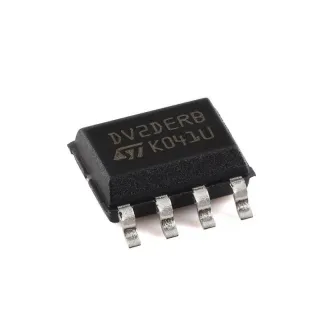
QPM1002 - 8.5-10.5GHz GaN X-Band T/R FEM 3W | Qorvo
MPN: QPM1002 ✓ Active| Qty | Unit Price | Extended |
|---|---|---|
| 1 | $145 | $145.00 |
| 10 | $132 | $1,320.00 |
| 100 | $118 | $11,800.00 |
| 500 | $106 | $53,000.00 |
| 1,000 | $96 | $96,000.00 |
QPM1002 Overview
A front-end module (FEM) is a highly integrated RF building block that sits between the antenna and the transceiver in a radar system. In an X-Band phased array radar, the FEM performs three critical functions: amplifying weak received echoes (LNA path), amplifying transmitted pulses (PA path), and switching between the two (T/R switch). Integrating all three on a single GaN-on-SiC die reduces board area, assembly variation, and lattice-spacing constraints compared to discrete multi-chip solutions.
According to the Qorvo datasheet, the receive path delivers 25 dB of small-signal gain with a low noise figure of 2.2 dB, maximizing radar detection range against small targets. The transmit path provides 33 dB of small-signal gain and can deliver 3 W of saturated output power with a power-added efficiency (PAE) of 32%. The ANT port tolerates up to 2 W of input power, eliminating the need for an external limiter diode and its associated insertion loss.
The module is fabricated on Qorvo's QGaN25 0.25 um GaN-on-SiC process. The high thermal conductivity die-attach, combined with the over-molded QFN package, allows reliable operation in high-temperature environments typical of airborne and ground-based phased array antennas.
Typical applications include X-Band phased array radar transmit/receive (T/R) channels, marine and weather radar, and airborne surveillance systems where compact size and high power density are mandatory.
Design consideration: the high power density of GaN requires a well-designed thermal path; the exposed package paddle must be soldered to a low-thermal-resistance via array in the PCB.
This page synthesizes distributor sourcing data, drop-in alternative guidance, and practical design notes not found in the manufacturer datasheet.
Drop-in alternatives for QPM1002 — same package, pin-to-pin compatible. Different-package parts requiring PCB rework are excluded.
Variants in this series
Same-series models that are drop-in compatible with QPM1002 (same form factor and footprint) — differing in Package, Process Technology.
Quick Comparison Tool — Select alternative parts for side-by-side comparison:
QPM1002SR
✅ Drop-In✓ In Stock
Contact for price
View Datasheet →QPM1002 Specifications (manufacturer-published)
| Frequency Range | 8.5 GHz to 10.5 GHz |
| Product Type | GaN MMIC Front-End Module (T/R Module) |
| Integrated Functions | T/R switch + LNA + PA |
| Rx Small-Signal Gain | 25 dB |
| Rx Noise Figure | 2.2 dB |
| Tx Small-Signal Gain | 33 dB |
| Saturated Output Power (Psat) | 3 W |
| Power-Added Efficiency (PAE) | 32% |
| Max ANT Port Input Power | 2 W |
| Process Technology | QGaN25 0.25 um GaN-on-SiC |
| Package | 5 x 5 mm QFN, over-mold encapsulant, surface mount |
| Mounting Type | Surface Mount |
QPM1002 Interfaces & Connectors
No manufacturer-published interface list is available for QPM1002. Refer to the manufacturer documentation for connector and header details.
Refer to the manufacturer documentation for the full expansion header pinout and connector pin numbering.
Typical Applications
QPM1002 is suitable for 6 applications: X-Band Phased Array Radar T/R Channels, Marine and Navigation Radar, Weather Radar Systems, Airborne Surveillance and Fire-Control Radar, Test and Measurement Radar Front Ends, Ground-Based Security and Perimeter Radar.
X-Band Phased Array Radar T/R Channels
The QPM1002 is purpose-built for X-Band phased array radar transmit/receive channels operating across 8.5 GHz to 10.5 GHz. Its 5 x 5 mm QFN footprint directly addresses the tight lattice spacing required behind the antenna face of an active electronically scanned array (AESA), where hundreds of T/R modules must fit at element pitch. The integrated 3 W GaN PA provides per-element transmit power with 32% PAE, reducing total array dissipation, while the 2.2 dB noise figure LNA maximizes detection range for small RCS targets. Because the T/R switch, LNA, and PA are monolithically integrated on Qorvo's QGaN25 0.25 um GaN-on-SiC process, channel-to-channel amplitude and phase consistency improve, which directly preserves array beam-steering accuracy. The 2 W ANT port survivability removes external limiter diodes, saving insertion loss and board area on every element. Thermal design via the exposed paddle and via array is the key layout task.
Recommended
Marine and Navigation Radar
Commercial marine and navigation radar transponders in the 9.3 to 9.5 GHz X-Band band fit well inside the QPM1002's 8.5 to 10.5 GHz coverage. The module's 3 W saturated transmit power and 33 dB Tx gain simplify the transmit chain drive requirements, often allowing direct drive from a moderate-output upconverter. On the receive side, the 2.2 dB noise figure improves target visibility of small craft, buoys, and weather clutter at long range, which is the primary performance driver for marine radar. The over-molded 5 x 5 mm QFN package withstands the temperature swings and vibration of mast-mounted antenna units, and the 2 W ANT port rating provides robustness against leakage and nearby-transmitter overload without an external limiter. A single GaN module replacing discrete LNA, PA, and switch stages shortens the RF assembly and improves production consistency for mid-volume radar manufacturers.
Recommended
Weather Radar Systems
X-Band weather radar requires both high transmit power for precipitation penetration and a very low receive noise floor to resolve weak reflectivity returns; the QPM1002 addresses both in one module. The 3 W Psat GaN PA supports the pulsed transmit requirements of compact Doppler weather radars, while the 2.2 dB noise figure and 25 dB Rx gain preserve sensitivity for light-rain and drizzle detection. The 32% PAE reduces the thermal load inside sealed radome-mounted units where convective cooling is limited, an important advantage of GaN-on-SiC over GaAs alternatives. Fast T/R switching between the integrated PA and LNA paths enables short minimum-range performance needed for near-field weather observation. Using the QPM1002EVB1 evaluation board allows system engineers to validate pulse timing, duty cycle, and thermal behavior before finalizing the radar front-end PCB layout.
Recommended
Airborne Surveillance and Fire-Control Radar
Airborne X-Band radar systems impose the harshest combined constraints on size, weight, temperature, and reliability, and the QPM1002 is engineered for exactly this environment. The GaN-on-SiC QGaN25 process provides high power density (3 W from a 5 x 5 mm package) and proven high-temperature operation via its high thermal conductivity die-attach, reducing the cooling budget per T/R channel. The tight-lattice-friendly QFN outline lets designers pack array elements at the spacing needed for agile beam steering in fire-control and surveillance applications. Receive-path performance of 25 dB gain and 2.2 dB noise figure supports long-range detection, while 2 W ANT port survivability tolerates the high leakage environment of a dense array during transmit bursts. For defense programs requiring documented screening, the QPM1002SR variant offers the identical electrical and mechanical interface with a higher-assurance flow.
Recommended
Test and Measurement Radar Front Ends
Instrumentation vendors building X-Band radar test sets, RCS measurement benches, and radar target simulators can use the QPM1002 as a compact, repeatable front end covering 8.5 to 10.5 GHz. The 33 dB Tx gain and 3 W output provide enough drive for cable and antenna losses in bench setups, while the 2.2 dB noise figure and 25 dB Rx gain keep the instrument noise floor low for measuring weak scattering returns. Integration of switch, LNA, and PA in one package removes the channel-to-channel amplitude variations that plague discrete bench front ends, improving measurement repeatability. The evaluation board QPM1002EVB1 provides a ready-made reference with the recommended bias sequencing and RF layout, which shortens integration time. Because the module is surface-mount, it can also be embedded directly into custom fixture electronics rather than remaining a lab-only subassembly.
Recommended
Ground-Based Security and Perimeter Radar
Ground surveillance and perimeter-security radars in the 9 to 10 GHz region benefit from the QPM1002's balance of transmit power and receive sensitivity. The 3 W GaN transmit path supports detection of personnel and vehicles at several kilometers with modest antenna aperture, and the 2.2 dB noise figure LNA ensures small moving targets remain above the noise floor at low elevation angles where ground clutter dominates. The module's over-molded QFN package and high-temperature GaN-on-SiC construction tolerate the unattended, outdoor enclosure environments typical of fixed security installations, where cooling is passive and temperature excursions are wide. The 2 W ANT port input rating provides resilience against co-site transmitters and lightning-induced leakage without added limiter components. Its compact footprint allows multi-beam or MIMO security radar architectures within a single small enclosure.
Recommended
Recommended Products Summary
Engineering reference data for QPM1002 — comparison, design guidance, and compliance information.
Selection Guide
Comparison with Alternatives
| Parameter | This Product | QPM1002SR |
|---|---|---|
| Package | 5 x 5 mm QFN, over-mold | 5 x 5 mm QFN - same |
| Brand | Qorvo | Qorvo |
| Frequency Range | 8.5 - 10.5 GHz | 8.5 - 10.5 GHz |
| Saturated Output Power | 3 W | 3 W |
| Rx Gain | 25 dB | 25 dB |
| Noise Figure | 2.2 dB | 2.2 dB |
| Tx Gain | 33 dB | 33 dB |
| Screening Level | Standard commercial flow | High-reliability screened flow |
| Process Technology | QGaN25 0.25 um GaN-on-SiC | QGaN25 0.25 um GaN-on-SiC |
Key Differentiators
- Integrated T/R switch, LNA, and PA on a single GaN die (vs QPM1002SR (and discrete multi-chip solutions))
- 2 W ANT port input survivability (vs Conventional GaAs FEMs with lower port ratings)
- GaN-on-SiC thermal advantage (vs QPM1002SR-equivalent GaAs front-end modules)
Design Notes
The QPM1002 dissipates significant heat as a GaN PA delivering 3 W Psat at 32% PAE; DC input power substantially exceeds RF output. The 5 x 5 mm QFN relies on its exposed paddle and high thermal conductivity die-attach for heat extraction. Design the PCB under the module with an array of thermal vias connecting the paddle to internal ground planes and, where possible, to an external heatsink or chassis. Per the Qorvo datasheet, the package with over-mold encapsulant is designed for high-temperature operation, but junction temperature budget still governs long-term MTBF. Estimated: every extra 10 C of sustained junction temperature roughly doubles electromigration-driven failure rate, so prioritize paddle solder coverage above 90%.
Lay out the RF paths (ANT, Tx out, Rx in) on a 50-ohm controlled-impedance line matched to the board material at 9.5 GHz center frequency, keeping transitions short and via fences tight along the microstrip. Ground every package ground pin and surround the module with stitching vias to minimize ground inductance, which degrades Tx gain flatness and Rx noise figure at X-Band. Follow the QPM1002EVB1 evaluation board layout as the reference; Qorvo's application layout embodies the recommended bias decoupling and RF grounding that produced the datasheet performance numbers.
GaN devices are sensitive to gate bias sequencing and gate-voltage overshoot; apply the recommended negative gate bias before or simultaneously with the drain voltage per the QPM1002 datasheet power-up procedure, and never operate the PA into an open or shorted load without checking stability. Although the ANT port tolerates 2 W, repeated operation beyond this can damage the switch path. Do not substitute a generic limiter ahead of the port without re-verifying insertion loss, since the integrated 2 W survivability is intended to remove the limiter stage entirely.
Compliance Information
Compliance status was not stated in the sourced web data; confirm RoHS/REACH status on the official Qorvo product page or by requesting a compliance certificate from Qorvo.