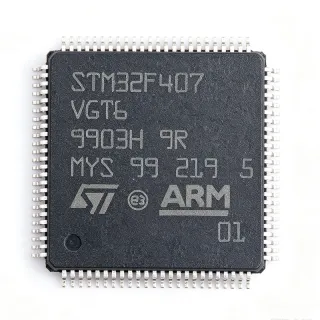
STM32F373VCT6 - ARM Cortex-M4 256KB Flash MCU | STMicroelectronics
MPN: STM32F373VCT6 ✓ Active| Qty | Unit Price | Extended |
|---|---|---|
| 1 | $8.75 | $8.75 |
| 10 | $7.95 | $79.50 |
| 100 | $6.85 | $685.00 |
| 500 | $5.95 | $2,975.00 |
| 1,000 | $5.25 | $5,250.00 |
STM32F373VCT6 Overview
What is an ARM Cortex-M4 microcontroller? It is a 32-bit processor core designed for embedded systems, featuring a single-cycle multiply-accumulate (MAC) unit, hardware divide, and optional single-precision floating-point unit (FPU). The Cortex-M4 is part of the ARM Cortex-M family, which includes the M0, M0+, M3, M4, and M7 cores, each offering different performance and power trade-offs. In the hierarchy of embedded processing, the Cortex-M4 sits above the M3 in DSP capability and below the M7 in raw performance, making it a popular choice for applications requiring both control and signal processing.
Key features of the STM32F373VCT6 include a 16-bit advanced motor-control timer, two 12-bit DACs, three 16-bit sigma-delta ADCs (with up to 21 channels), and a 12-bit ADC with up to 16 channels. It also provides multiple communication interfaces: two I2C, three USARTs, two SPIs, one CAN, and one USB 2.0 full-speed device. The device supports a wide range of clock sources, including an internal 8 MHz RC oscillator, an external 4-32 MHz crystal, and a 32 kHz RTC oscillator.
The STM32F373VCT6 is built on ST's advanced 90nm process technology, offering low power consumption with multiple low-power modes (Sleep, Stop, Standby). The integrated FPU accelerates floating-point arithmetic, which is beneficial for control algorithms and sensor data processing. The sigma-delta ADCs provide high-resolution measurement capabilities, making the device suitable for precision instrumentation and energy metering.
Typical applications include motor control (e.g., field-oriented control of brushless DC motors), industrial automation (PLC, sensors), medical devices (patient monitoring), and smart grid (energy metering). The combination of high-resolution ADCs, DACs, and advanced timers enables precise analog signal generation and measurement.
When designing with this device, ensure proper decoupling of the VDD and VDDA pins with 100nF capacitors placed close to the pins. The VDDA pin must be connected to a clean analog supply to achieve the specified ADC performance. Also, consider the use of the internal voltage regulator and the recommended external capacitor on VCAP pins for stable core voltage.
Drop-in alternatives for STM32F373VCT6 — same package, pin-to-pin compatible. Different-package parts requiring PCB rework are excluded.
Variants in this series
Same-series models that are drop-in compatible with STM32F373VCT6 (same form factor and footprint) — differing in Core, Timers, Package, ADC, Communication Interfaces.
Quick Comparison Tool — Select alternative parts for side-by-side comparison:
STM32F373VBT6
✅ Drop-In ⚠️ Specs Unverified📋 Reference alternative (not in catalog)
STM32F303VCT6
✅ Drop-In ⚠️ Specs Unverified📋 Reference alternative (not in catalog)
STM32F103VCT6
✅ Drop-In ⚠️ Specs Unverified✓ In Stock
$2.68 / Unit
View Datasheet →LPC1768FBD100
✅ Drop-In ⚠️ Specs Unverified📋 Reference alternative (not in catalog)
STM32F373VCT6 Maximum Ratings & Electrical Characteristics
| Core | ARM Cortex-M4 with FPU |
| Maximum Clock Frequency | 72 MHz |
| Flash Memory | 256 KB |
| SRAM | 32 KB |
| Supply Voltage Range | 2.0 V to 3.6 V |
| Package | LQFP-100 (14x14 mm) |
| Operating Temperature Range | -40C to +85C |
| Number of I/O Pins | 86 |
| ADC Resolution | 12-bit (up to 16 channels) and 16-bit sigma-delta (up to 21 channels) |
| DAC Resolution | 12-bit (2 channels) |
| Timers | Advanced 16-bit motor control timer, multiple general-purpose timers |
| Communication Interfaces | 2x I2C, 3x USART, 2x SPI, 1x CAN, 1x USB 2.0 FS |
| DMA Channels | 12 |
| Low Power Modes | Sleep, Stop, Standby |
| RoHS Status | Compliant |
STM32F373VCT6 Pin Configuration
| Pin 1 | VBAT — Backup battery supply for RTC and backup registers |
| Pin 2 | PC13 — GPIO or RTC output |
| Pin 3 | PC14 — GPIO or OSC32_IN |
| Pin 4 | PC15 — GPIO or OSC32_OUT |
| Pin 5 | PF0 — GPIO |
| Pin 6 | PF1 — GPIO |
| Pin 7 | NRST — Reset (active low) |
| Pin 8 | VDD — Digital power supply |
| Pin 9 | VSS — Digital ground |
| Pin 10 | VDDA — Analog power supply |
| Pin 11 | VREF+ — ADC reference voltage positive |
| Pin 12 | VREF- — ADC reference voltage negative |
| Pin 13 | PA0 — GPIO/ADC input |
| Pin 14 | PA1 — GPIO/ADC input |
| Pin 15 | PA2 — GPIO/USART2_TX |
| Pin 16 | PA3 — GPIO/USART2_RX |
| Pin 17 | PA4 — GPIO/SPI1_NSS |
| Pin 18 | PA5 — GPIO/SPI1_SCK |
| Pin 19 | PA6 — GPIO/SPI1_MISO |
| Pin 20 | PA7 — GPIO/SPI1_MOSI |
Typical Applications
STM32F373VCT6 is suitable for 6 applications: Motor Control, Industrial Automation, Medical Devices, Smart Grid and Energy Metering, Audio Processing, IoT and Smart Home.
Motor Control
The STM32F373VCT6 is ideal for motor control applications such as field-oriented control (FOC) of brushless DC motors. Its advanced 16-bit motor control timer generates precise PWM signals, while the 16-bit sigma-delta ADCs provide high-resolution current sensing. The FPU accelerates the complex mathematical computations required for FOC algorithms, enabling smooth and efficient motor operation. In a typical setup, the MCU reads phase currents via shunt resistors and sigma-delta ADCs, computes the rotor position, and updates PWM duty cycles in real-time. The high-resolution ADCs ensure accurate torque control, and the multiple timers allow for synchronized sampling. Compared to using external ADCs, the integrated sigma-delta ADCs reduce component count and PCB area. Designers should ensure proper isolation between power and control sections and use appropriate gate drivers for the inverter stage.
Recommended
Industrial Automation
In industrial automation, the STM32F373VCT6 serves as the central controller for PLCs, sensors, and actuators. Its multiple communication interfaces (CAN, USART, SPI, I2C) allow seamless integration with industrial networks such as Modbus and CANopen. The 12-bit DACs can generate analog control signals for valves and actuators, while the high-resolution ADCs monitor process variables like temperature and pressure. The device's robust operating temperature range (-40C to +85C) and low power modes make it suitable for harsh environments. In a typical PLC, the MCU reads inputs from sensors, executes control logic, and drives outputs via relays or transistors. The FPU enables fast PID control loops, and the DMA channels offload data transfer, improving real-time performance. Designers should consider using optocouplers for isolation between the MCU and high-voltage industrial interfaces.
Recommended
Medical Devices
The STM32F373VCT6 is well-suited for medical devices such as patient monitors, infusion pumps, and diagnostic equipment. Its high-resolution sigma-delta ADCs enable precise measurement of physiological signals like ECG and blood pressure. The FPU accelerates signal processing algorithms for filtering and analysis. The device's low power consumption is critical for battery-powered portable devices. In a patient monitor, the MCU acquires analog signals from sensors, processes them to extract vital signs, and displays them on an LCD. The USB interface allows data transfer to a host computer for further analysis. The multiple timers can generate precise timing for drug delivery in infusion pumps. Designers must ensure compliance with medical safety standards (e.g., IEC 60601) and use appropriate isolation for patient-connected circuits.
Recommended
Smart Grid and Energy Metering
The STM32F373VCT6 is ideal for smart grid applications such as energy meters and power quality analyzers. Its 16-bit sigma-delta ADCs provide high accuracy for measuring voltage and current, essential for revenue-grade metering. The device's DSP capabilities (FPU and MAC) enable real-time computation of power, energy, and harmonics. The multiple communication interfaces (UART, SPI, I2C) support connectivity to PLC modems or wireless modules for data transmission. In an energy meter, the MCU samples voltage and current waveforms, calculates RMS values and power, and stores data in Flash. The low power modes help meet energy efficiency requirements. Designers should use precision voltage and current sensors (e.g., shunt resistors or current transformers) and ensure proper calibration for accuracy.
Recommended
Audio Processing
The STM32F373VCT6 can be used in audio processing applications such as active noise cancellation, audio effects, and voice recognition. Its FPU accelerates DSP algorithms like FFT and filtering. The 12-bit DACs can output analog audio signals, and the I2S interface (via SPI) connects to external audio codecs. The high-resolution ADCs can capture audio signals with good fidelity. In an audio effects processor, the MCU reads audio samples, applies effects (e.g., reverb, equalization), and outputs the processed signal. The DMA channels enable efficient data transfer between peripherals and memory. Designers should pay attention to analog ground layout to minimize noise and use high-quality audio codecs for best performance.
Recommended
IoT and Smart Home
The STM32F373VCT6 is suitable for IoT and smart home devices such as smart thermostats, security systems, and home automation hubs. Its low power modes and wide supply voltage range enable battery-powered operation. The multiple communication interfaces (UART, SPI, I2C) connect to Wi-Fi, Bluetooth, and Zigbee modules. The high-resolution ADCs can read sensors for temperature, humidity, and light. In a smart thermostat, the MCU reads temperature sensors, controls heating/cooling relays, and communicates with a cloud server via Wi-Fi. The FPU can process sensor data for predictive algorithms. Designers should optimize power consumption by using sleep modes and wake-up timers, and ensure secure communication protocols.
Recommended
Recommended Products Summary
Engineering reference data for STM32F373VCT6 — comparison, design guidance, and compliance information.
Selection Guide
Comparison with Alternatives
| Parameter | This Product | STM32F373VBT6 | STM32F303VCT6 | STM32F103VCT6 | LPC1768FBD100 |
|---|---|---|---|---|---|
| Package | LQFP-100 | LQFP-100 | LQFP-100 | LQFP-100 | LQFP-100 |
| Brand | STMicroelectronics | STMicroelectronics | STMicroelectronics | STMicroelectronics | NXP Semiconductors |
| Core | ARM Cortex-M4 with FPU | ARM Cortex-M4 with FPU | ARM Cortex-M4 with FPU | ARM Cortex-M3 | ARM Cortex-M3 |
| Flash Memory | 256 KB | 128 KB | 256 KB | 256 KB | 512 KB |
| SRAM | 32 KB | 32 KB | 40 KB | 48 KB | 64 KB |
| ADC Resolution | 12-bit and 16-bit sigma-delta | 12-bit and 16-bit sigma-delta | 12-bit | 12-bit | 12-bit |
| DAC | 2x 12-bit | 2x 12-bit | 2x 12-bit | None | 1x 10-bit |
| Communication Interfaces | 2x I2C, 3x USART, 2x SPI, 1x CAN, 1x USB | 2x I2C, 3x USART, 2x SPI, 1x CAN, 1x USB | 2x I2C, 3x USART, 2x SPI, 1x CAN, 1x USB | 2x I2C, 3x USART, 2x SPI, 1x CAN, 1x USB | 2x I2C, 4x UART, 2x SPI, 2x CAN, 1x USB |
Key Differentiators
- Integrated 16-bit sigma-delta ADCs (vs STM32F303VCT6)
- Cortex-M4 with FPU (vs STM32F103VCT6)
- Advanced motor control timer (vs LPC1768FBD100)
Design Notes
The STM32F373VCT6 requires a stable power supply. Connect a 100nF ceramic capacitor and a 4.7uF tantalum capacitor to each VDD pin, and a 1uF capacitor to VDDA. The VCAP pins must be connected to a 2.2uF capacitor for internal regulator stability. Ensure the power supply can handle the peak current during Flash programming or high-speed operation.
For optimal ADC performance, separate the analog ground (VSSA) from the digital ground (VSS) and connect them at a single point. Place the VDDA and VREF+ pins with dedicated filtering capacitors (100nF and 1uF) close to the pins. Use a ground plane to minimize noise and ensure proper decoupling of all power pins.
Do not leave unused GPIO pins floating; configure them as outputs or enable internal pull-ups/pull-downs to avoid excessive current consumption. When using the sigma-delta ADCs, ensure the input signal is within the common-mode range and use appropriate anti-aliasing filters. Also, be aware that the internal RC oscillator has limited accuracy; for precise timing, use an external crystal.
Compliance Information
RoHS compliant per STMicroelectronics. Not AEC-Q100 qualified; for automotive, consider STM32F373VCT6 with extended temperature range or other automotive-grade MCUs.