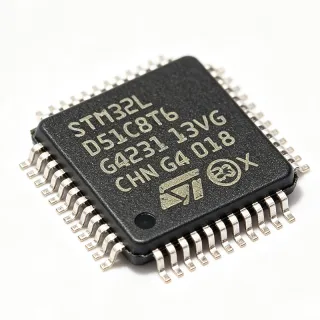
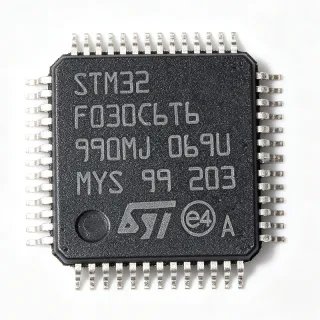
STM32L151C8T6 - 32-bit ARM Cortex-M3 MCU, 64KB Flash | STMicroelectronics
MPN: STM32L151C8T6 ✓ Active| Qty | Unit Price | Extended |
|---|---|---|
| 1 | $5.5369 | $5.54 |
STM32L151C8T6 Overview
What is a microcontroller? A microcontroller (MCU) is a compact integrated circuit designed to govern a specific operation in an embedded system. It integrates a processor core, memory (Flash and SRAM), and programmable input/output peripherals on a single chip. The STM32L151C8T6 belongs to the STM32L1 family, which is part of the broader STM32 portfolio of 32-bit ARM Cortex-M microcontrollers. This hierarchy places it within the ARM Cortex-M3 core category, known for its balance of performance and power efficiency, and ultimately within the semiconductor industry's embedded processing segment.
Key features include multiple low-power modes (Sleep, Low-power Run, Low-power Sleep, Stop with RTC, Standby with RTC), a 12-bit ADC with 16 channels, two 12-bit DACs, and a rich set of communication interfaces including I2C, SPI, USART, and USB 2.0. The device also integrates a real-time clock (RTC) with backup registers, and a variety of timers including advanced-control, general-purpose, and basic timers. Its ultra-low-power design achieves typical current consumption as low as 230 µA in Run mode at 32 MHz and 1.1 µA in Standby mode with RTC, enabling extended battery life.
Technically, the STM32L151C8T6 is built on a 130 nm process technology, which contributes to its low leakage and power efficiency. The Cortex-M3 core includes a hardware divider and single-cycle multiply, and supports Thumb-2 instruction set for code density. The device features a nested vectored interrupt controller (NVIC) for deterministic interrupt handling, and a memory protection unit (MPU) for enhanced application robustness. The embedded Flash supports read-while-write, allowing firmware updates without halting execution.
Typical applications include portable medical devices (e.g., glucose meters, pulse oximeters), smart sensors for IoT nodes, industrial process control, and consumer electronics such as fitness trackers and smartwatches. Its low-power modes and rich analog peripherals make it particularly suited for applications requiring long battery life and precise analog measurements.
When designing with this MCU, pay careful attention to the power supply decoupling: place a 100 nF capacitor close to each VDD pin and a 4.7 µF capacitor on the main supply. Also, configure the clock source appropriately—using the internal 16 MHz HSI oscillator can save cost, but for accurate timing, an external 32.768 kHz crystal for the RTC is recommended.
This page synthesizes distributor pricing, drop-in alternatives, and practical design notes not found in the ST datasheet, providing a comprehensive resource for engineers evaluating the STM32L151C8T6.
Drop-in alternatives for STM32L151C8T6 — same package, pin-to-pin compatible. Different-package parts requiring PCB rework are excluded.
Quick Comparison Tool — Select alternative parts for side-by-side comparison:
STM32L151C8T6A
✅ Drop-In📋 Reference alternative (not in catalog)
STM32L151CBT6
✅ Drop-In📋 Reference alternative (not in catalog)
STM32L151C6T6
✅ Drop-In📋 Reference alternative (not in catalog)
STM32L151C8T6 Maximum Ratings & Electrical Characteristics
| Core | ARM Cortex-M3 |
| Max Clock Frequency | 32 MHz |
| Flash Memory | 64 KB |
| SRAM | 16 KB |
| Supply Voltage | 1.8 V to 3.6 V |
| Package | LQFP-48 (7x7 mm) |
| Operating Temperature | -40C to +85C |
| ADC | 12-bit, 16 channels |
| DAC | 12-bit, 2 channels |
| Communication Interfaces | I2C, SPI, USART, USB 2.0 |
| Timers | Advanced, general-purpose, basic |
| RTC | Yes, with backup registers |
| Low-power Modes | Sleep, Low-power Run, Low-power Sleep, Stop, Standby |
| Standby Current | 1.1 µA (with RTC) |
| RoHS Status | Compliant |
STM32L151C8T6 Pin Configuration
| Pin 1 | VBAT — Backup battery supply |
| Pin 2 | PC13 — GPIO / RTC tamper |
| Pin 3 | PC14 — GPIO / OSC32_IN |
| Pin 4 | PC15 — GPIO / OSC32_OUT |
| Pin 5 | OSC_IN — External clock input |
| Pin 6 | OSC_OUT — External clock output |
| Pin 7 | NRST — Reset (active low) |
| Pin 8 | VSSA — Analog ground |
| Pin 9 | VDDA — Analog power supply |
| Pin 10 | PA0 — GPIO / ADC_IN0 |
| Pin 11 | PA1 — GPIO / ADC_IN1 |
| Pin 12 | PA2 — GPIO / ADC_IN2 / USART2_TX |
| Pin 13 | PA3 — GPIO / ADC_IN3 / USART2_RX |
| Pin 14 | PA4 — GPIO / ADC_IN4 / DAC_OUT1 |
| Pin 15 | PA5 — GPIO / ADC_IN5 / DAC_OUT2 |
| Pin 16 | PA6 — GPIO / ADC_IN6 / SPI1_MISO |
| Pin 17 | PA7 — GPIO / ADC_IN7 / SPI1_MOSI |
| Pin 18 | PB0 — GPIO / ADC_IN8 |
| Pin 19 | PB1 — GPIO / ADC_IN9 |
| Pin 20 | PB2 — GPIO / BOOT1 |
| Pin 21 | PB10 — GPIO / I2C2_SCL |
| Pin 22 | PB11 — GPIO / I2C2_SDA |
| Pin 23 | PB12 — GPIO / SPI2_NSS |
| Pin 24 | PB13 — GPIO / SPI2_SCK |
| Pin 25 | PB14 — GPIO / SPI2_MISO |
| Pin 26 | PB15 — GPIO / SPI2_MOSI |
| Pin 27 | PA8 — GPIO / MCO |
| Pin 28 | PA9 — GPIO / USART1_TX |
| Pin 29 | PA10 — GPIO / USART1_RX |
| Pin 30 | PA11 — GPIO / USB_DM |
| Pin 31 | PA12 — GPIO / USB_DP |
| Pin 32 | PA13 — GPIO / SWDIO |
| Pin 33 | PA14 — GPIO / SWCLK |
| Pin 34 | PA15 — GPIO / JTDI |
| Pin 35 | PB3 — GPIO / JTDO |
| Pin 36 | PB4 — GPIO / NJTRST |
| Pin 37 | PB5 — GPIO / I2C1_SMBA |
| Pin 38 | PB6 — GPIO / I2C1_SCL |
| Pin 39 | PB7 — GPIO / I2C1_SDA |
| Pin 40 | BOOT0 — Boot mode selection |
| Pin 41 | PB8 — GPIO / I2C1_SCL |
| Pin 42 | PB9 — GPIO / I2C1_SDA |
| Pin 43 | VSS — Ground |
| Pin 44 | VDD — Power supply |
| Pin 45 | PC0 — GPIO / ADC_IN10 |
| Pin 46 | PC1 — GPIO / ADC_IN11 |
| Pin 47 | PC2 — GPIO / ADC_IN12 |
| Pin 48 | PC3 — GPIO / ADC_IN13 |
Typical Applications
STM32L151C8T6 is suitable for 6 applications: Portable Medical Devices, Smart Sensors for IoT, Industrial Process Control, Consumer Electronics, Smart Home Automation, Test and Measurement Equipment.
Portable Medical Devices
The STM32L151C8T6 is ideal for portable medical devices such as glucose meters, pulse oximeters, and blood pressure monitors. Its ultra-low-power operation (230 µA in Run mode, 1.1 µA in Standby) extends battery life, critical for patient convenience. The integrated 12-bit ADC with 16 channels enables precise sensor readings, while the 12-bit DAC can generate analog control signals for actuators. The device's multiple low-power modes allow the system to sleep between measurements, conserving energy. Communication interfaces like I2C and USART facilitate data transfer to displays or external storage. The Cortex-M3 core provides sufficient processing power for signal filtering and algorithms, while the MPU enhances reliability in medical applications. Designers can leverage the RTC for timestamping and the backup registers for storing calibration data. The wide supply voltage range (1.8V to 3.6V) accommodates various battery chemistries, including lithium-ion and alkaline. Overall, the STM32L151C8T6 balances performance, power, and analog integration, making it a strong choice for battery-powered medical devices.
Recommended
Smart Sensors for IoT
In IoT applications, the STM32L151C8T6 serves as the central controller for smart sensors, aggregating data from temperature, humidity, and motion sensors. Its low-power modes enable battery-powered operation for years, with standby current of 1.1 µA. The device's multiple communication interfaces (I2C, SPI, USART) allow seamless connection to various sensor modules and wireless transceivers (e.g., LoRa, BLE). The 12-bit ADC with 16 channels can directly interface with analog sensors, while the DAC can output analog control signals. The Cortex-M3 core efficiently runs sensor fusion algorithms, and the MPU provides memory protection for robust operation. The RTC with backup registers enables scheduled wake-ups and data logging. The wide supply voltage range (1.8V to 3.6V) supports battery and energy-harvesting sources. The STM32L151C8T6's rich peripheral set and low power consumption make it an excellent choice for edge nodes in IoT networks, where energy efficiency and connectivity are paramount.
Recommended
Industrial Process Control
The STM32L151C8T6 is well-suited for industrial process control applications such as PLCs, motor controllers, and monitoring systems. Its robust design operates over -40C to +85C, suitable for harsh environments. The device's multiple timers, including advanced-control timers, enable precise PWM generation for motor control. The 12-bit ADC with 16 channels can monitor multiple analog signals (e.g., temperature, pressure, current) simultaneously. Communication interfaces like USART and SPI allow interfacing with industrial fieldbuses (e.g., RS-485, CAN via external transceiver). The Cortex-M3 core provides deterministic interrupt handling via the NVIC, essential for real-time control. The MPU enhances system reliability by preventing memory corruption. The low-power modes are beneficial for energy-efficient operation in remote or battery-backed systems. The wide supply voltage range (1.8V to 3.6V) allows direct connection to 3.3V logic and sensors. Overall, the STM32L151C8T6 offers a balanced combination of performance, peripherals, and reliability for industrial applications.
Recommended
Consumer Electronics
In consumer electronics like fitness trackers, smartwatches, and remote controls, the STM32L151C8T6 provides the processing power and low energy consumption required for always-on devices. Its standby current of 1.1 µA ensures minimal battery drain during idle periods. The device's rich peripheral set includes USB 2.0 for charging and data transfer, I2C for connecting to displays and sensors, and SPI for external memory. The 12-bit ADC can read battery voltage and sensor inputs, while the DAC can generate audio tones or haptic feedback signals. The Cortex-M3 core efficiently handles user interface logic and sensor data processing. The RTC enables timekeeping and alarms, and the backup registers preserve user settings during power loss. The compact LQFP-48 package fits into space-constrained designs. The wide supply voltage range (1.8V to 3.6V) supports single-cell batteries. The STM32L151C8T6's combination of low power, connectivity, and analog features makes it a popular choice for consumer electronics.
Recommended
Smart Home Automation
The STM32L151C8T6 is an excellent choice for smart home devices such as thermostats, smart locks, and lighting controllers. Its low-power modes enable battery-powered operation for months or years. The device's multiple communication interfaces (I2C, SPI, USART) allow integration with various wireless modules (e.g., Zigbee, Z-Wave, BLE) for home automation networks. The 12-bit ADC can read temperature sensors and light sensors, while the DAC can control dimming levels for LED lighting. The Cortex-M3 core runs control algorithms and user interface logic. The RTC with backup registers enables scheduling and event logging. The wide supply voltage range (1.8V to 3.6V) supports battery and mains-powered designs. The STM32L151C8T6's rich peripheral set and low power consumption make it ideal for smart home devices that require reliable, energy-efficient operation.
Recommended
Test and Measurement Equipment
The STM32L151C8T6 is used in portable test and measurement equipment such as multimeters, data loggers, and signal generators. Its high-resolution 12-bit ADC and DAC enable accurate analog measurements and signal generation. The device's multiple timers can generate precise timing signals for frequency measurement and PWM output. Communication interfaces like USART and USB allow data transfer to a PC for analysis. The Cortex-M3 core provides sufficient processing power for digital signal processing and calibration algorithms. The low-power modes are beneficial for battery-operated field instruments. The wide supply voltage range (1.8V to 3.6V) accommodates various power sources. The STM32L151C8T6's combination of analog peripherals, timers, and low power makes it well-suited for portable test equipment.
Recommended
Recommended Products Summary
Engineering reference data for STM32L151C8T6 — comparison, design guidance, and compliance information.
Selection Guide
Comparison with Alternatives
| Parameter | This Product | STM32L151C8T6A | STM32L151CBT6 | STM32L151C6T6 |
|---|---|---|---|---|
| Package | LQFP-48 | LQFP-48 (same) | LQFP-48 (same) | LQFP-48 (same) |
| Flash Memory | 64 KB | 64 KB | 128 KB | 32 KB |
| SRAM | 16 KB | 16 KB | 16 KB | 8 KB |
| Max Clock Frequency | 32 MHz | 32 MHz | 32 MHz | 32 MHz |
| Supply Voltage | 1.8V to 3.6V | 1.8V to 3.6V | 1.8V to 3.6V | 1.8V to 3.6V |
| ADC Channels | 16 | 16 | 16 | 16 |
| DAC Channels | 2 | 2 | 2 | 2 |
| Standby Current | 1.1 µA | 1.1 µA | 1.1 µA | 1.1 µA |
Key Differentiators
- Ultra-low-power operation with 1.1 µA standby current (vs STM32F103C8T6)
- Integrated 12-bit DAC with 2 channels (vs STM32L151C6T6)
- Larger Flash memory (64 KB) vs 32 KB (vs STM32L151C6T6)
Design Notes
Decouple each VDD pin with a 100 nF ceramic capacitor placed as close as possible to the pin. Additionally, place a 4.7 µF capacitor on the main VDD rail. For VDDA, use a 1 µF capacitor and a ferrite bead to isolate analog noise. Ensure VBAT is connected to a backup battery or tied to VDD if not used.
For the LQFP-48 package, ensure proper solder paste stencil design to avoid bridging. Use a 0.5 mm pitch land pattern. Provide a solid ground plane under the MCU to reduce EMI. Keep high-speed signals (SPI, USB) away from the crystal oscillator to prevent interference.
Do not leave the BOOT0 pin floating; tie it to ground through a 10 kΩ resistor for normal boot from Flash. Ensure the NRST pin has a 100 nF capacitor to ground for reliable reset. When using the RTC, connect a 32.768 kHz crystal with 6 pF load capacitors to OSC32_IN/OSC32_OUT.
Compliance Information
RoHS compliant per STMicroelectronics product page. AEC-Q100 not applicable for this commercial-grade MCU.