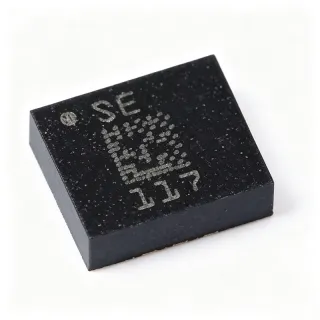
STM32G431K8T6 - 170MHz Arm Cortex-M4F MCU | STMicroelectronics
MPN: STM32G431K8T6 ✓ Active| Qty | Unit Price | Extended |
|---|---|---|
| 1 | $4.32 | $4.32 |
| 10 | $3.89 | $38.90 |
| 100 | $3.46 | $346.00 |
| 500 | $3.11 | $1,555.00 |
| 1,000 | $2.77 | $2,770.00 |
STM32G431K8T6 Overview
A microcontroller (MCU) is a compact integrated circuit designed to govern a specific operation in an embedded system. It contains a processor core, memory (Flash and RAM), and programmable input/output peripherals. The STM32G431K8T6 belongs to the STM32G4 family, which is optimized for mixed-signal control applications. In the hierarchy of embedded systems, it sits above simple 8-bit MCUs but below application processors, offering a balance of performance, power efficiency, and peripheral integration.
Key features include a 128 KB Flash memory and 32 KB SRAM, a 170 MHz Cortex-M4F core with FPU, and a comprehensive set of communication interfaces (SPI, I2C, USART, FDCAN). The device also features a 12-bit ADC with up to 5 MSPS, a 12-bit DAC, and advanced timers with dead-time generation for motor control. Its operating voltage range is 1.71V to 3.6V, and it is available in a 32-pin LQFP package (LQFP32).
The STM32G431K8T6 is built on a high-performance Arm Cortex-M4F core with a single-precision FPU, enabling efficient execution of complex control algorithms. It includes a memory protection unit (MPU) and a nested vectored interrupt controller (NVIC) for deterministic interrupt handling. The device also supports a wide range of clock sources, including an internal 16 MHz RC oscillator and an external crystal, with a PLL for frequency multiplication.
Typical applications include field-oriented control (FOC) of brushless DC motors, digital power supplies (buck, boost, and flyback converters), and industrial automation. Its high-resolution timers and fast ADC make it suitable for power conversion topologies requiring precise PWM generation and current sensing. The device also supports functional safety features, making it suitable for safety-critical applications.
When designing with this MCU, ensure proper decoupling of the VDD pins with 100 nF capacitors and a bulk capacitor. The VDDA pin must be connected to a clean analog supply to maintain ADC accuracy. For motor control applications, use the high-resolution timer (HRTIM) for PWM generation and the ADC injected channels for synchronized current sampling.
Drop-in alternatives for STM32G431K8T6 — same package, pin-to-pin compatible. Different-package parts requiring PCB rework are excluded.
Quick Comparison Tool — Select alternative parts for side-by-side comparison:
STM32G431K6T6
✅ Drop-In ⚠️ Specs Unverified📋 Reference alternative (not in catalog)
STM32G474K8T6
✅ Drop-In ⚠️ Specs Unverified📋 Reference alternative (not in catalog)
STM32G431K8T6 Maximum Ratings & Electrical Characteristics
| Core | Arm Cortex-M4F with FPU |
| Maximum Clock Frequency | 170 MHz |
| Flash Memory | 128 KB |
| SRAM | 32 KB |
| Operating Voltage | 1.71 V to 3.6 V |
| ADC Resolution | 12-bit |
| ADC Speed | 5 MSPS |
| DAC Resolution | 12-bit |
| Number of Timers | 10 |
| Communication Interfaces | SPI, I2C, USART, FDCAN |
| Package | LQFP32 |
| Mounting Type | Surface Mount |
| Operating Temperature | -40C to +85C |
| RoHS Status | Compliant |
| DMA Channels | 16 |
STM32G431K8T6 Pin Configuration
| Pin 1 | VBAT — Battery backup supply |
| Pin 2 | PC14 — GPIO / OSC32_IN |
| Pin 3 | PC15 — GPIO / OSC32_OUT |
| Pin 4 | OSC_IN — External clock input |
| Pin 5 | OSC_OUT — External clock output |
| Pin 6 | NRST — Reset (active low) |
| Pin 7 | VDD — Digital power supply |
| Pin 8 | VSS — Ground |
| Pin 9 | PA0 — GPIO / ADC input |
| Pin 10 | PA1 — GPIO / ADC input |
| Pin 11 | PA2 — GPIO / USART2_TX |
| Pin 12 | PA3 — GPIO / USART2_RX |
| Pin 13 | PA4 — GPIO / DAC_OUT1 |
| Pin 14 | PA5 — GPIO / DAC_OUT2 |
| Pin 15 | PA6 — GPIO / TIM1_CH1 |
| Pin 16 | PA7 — GPIO / TIM1_CH2 |
| Pin 17 | PB0 — GPIO / TIM1_CH3 |
| Pin 18 | PB1 — GPIO / TIM1_CH4 |
| Pin 19 | PB2 — GPIO / BOOT1 |
| Pin 20 | PB10 — GPIO / I2C2_SCL |
| Pin 21 | PB11 — GPIO / I2C2_SDA |
| Pin 22 | PB12 — GPIO / SPI2_NSS |
| Pin 23 | PB13 — GPIO / SPI2_SCK |
| Pin 24 | PB14 — GPIO / SPI2_MISO |
| Pin 25 | PB15 — GPIO / SPI2_MOSI |
| Pin 26 | PA8 — GPIO / TIM1_CH1 |
| Pin 27 | PA9 — GPIO / USART1_TX |
| Pin 28 | PA10 — GPIO / USART1_RX |
| Pin 29 | PA11 — GPIO / CAN_RX |
| Pin 30 | PA12 — GPIO / CAN_TX |
| Pin 31 | VDD — Digital power supply |
| Pin 32 | VSS — Ground |
Typical Applications
STM32G431K8T6 is suitable for 6 applications: Field-Oriented Control (FOC) of Brushless DC Motors, Digital Power Supplies (Buck, Boost, Flyback), Industrial Automation and Control, Digital Power Conversion for Solar Inverters, Battery Management Systems (BMS), Robotics and Drones.
Field-Oriented Control (FOC) of Brushless DC Motors
The STM32G431K8T6 is ideal for FOC motor control due to its 170 MHz Cortex-M4F core, high-resolution timers, and fast 12-bit ADC. In a typical FOC application, the MCU reads phase currents via the ADC, computes the rotor position using an encoder or Hall sensor, and generates PWM signals with dead-time control. The high-resolution timer (HRTIM) provides precise PWM generation with up to 184 ps resolution, enabling smooth and efficient motor operation. The ADC's 5 MSPS sampling rate allows synchronized current measurement, critical for accurate torque control. Compared to lower-performance MCUs, the G431K8T6 reduces torque ripple and improves dynamic response, making it suitable for robotics, drones, and electric vehicles.
Recommended
Digital Power Supplies (Buck, Boost, Flyback)
The STM32G431K8T6 excels in digital power conversion, offering a 12-bit ADC with hardware oversampling and high-resolution timers for precise PWM control. In a buck converter application, the MCU samples output voltage and current, runs a digital control loop (e.g., PID), and adjusts the PWM duty cycle to regulate the output. The HRTIM enables interleaved and multi-phase operation, reducing ripple and improving efficiency. The device's 170 MHz core ensures fast loop execution, achieving high bandwidth and stability. Its wide operating voltage range (1.71V to 3.6V) allows direct supply from the power stage. This makes it suitable for server power supplies, telecom rectifiers, and battery chargers.
Recommended
Industrial Automation and Control
The STM32G431K8T6 is well-suited for industrial automation, providing robust communication interfaces (FDCAN, USART, SPI, I2C) and a rich set of timers. In a PLC or industrial controller, the MCU manages I/O, executes control logic, and communicates with field devices via CAN or Modbus. Its 128 KB Flash allows storing complex firmware, while the 32 KB SRAM supports real-time data processing. The device's operating temperature range (-40C to +85C) ensures reliability in harsh environments. The MPU and NVIC enhance system robustness, making it suitable for safety-critical applications. Compared to older MCUs, the G431K8T6 offers higher performance and lower power consumption.
Recommended
Digital Power Conversion for Solar Inverters
The STM32G431K8T6 is optimized for solar inverter applications, where precise control of power stages is essential. Its high-resolution timers and fast ADC enable maximum power point tracking (MPPT) algorithms and grid synchronization. In a typical solar inverter, the MCU samples PV voltage and current, runs MPPT, and generates PWM for the DC-DC and DC-AC stages. The 170 MHz core ensures fast computation of control loops, improving efficiency and reducing harmonic distortion. The device's multiple ADCs allow simultaneous sampling of multiple channels, simplifying current and voltage sensing. Its robust communication interfaces (FDCAN, USART) enable monitoring and remote control.
Recommended
Battery Management Systems (BMS)
The STM32G431K8T6 is suitable for BMS applications, offering multiple ADCs for voltage and current sensing, and communication interfaces for cell monitoring. In a BMS, the MCU monitors cell voltages, temperatures, and current, and controls balancing and protection circuits. Its 12-bit ADC with 5 MSPS ensures accurate measurements, while the 128 KB Flash allows storing complex state-of-charge algorithms. The device's low power modes help extend battery life. The FDCAN interface enables communication with the main controller. Compared to dedicated BMS ICs, the G431K8T6 offers flexibility and programmability.
Recommended
Robotics and Drones
The STM32G431K8T6 is ideal for robotics and drones, providing high-performance processing and precise motor control. Its 170 MHz Cortex-M4F core with FPU accelerates complex algorithms like sensor fusion and PID control. The device's multiple timers and ADCs enable simultaneous control of multiple motors and sensors. In a drone, the MCU reads IMU data, runs flight control algorithms, and generates PWM for the ESCs. The compact LQFP32 package saves PCB space, and the low power consumption extends flight time. Its robust communication interfaces (SPI, I2C, USART) connect to GPS, telemetry, and other peripherals.
Recommended
Recommended Products Summary
Engineering reference data for STM32G431K8T6 — comparison, design guidance, and compliance information.
Selection Guide
Comparison with Alternatives
| Parameter | This Product | STM32G431K6T6 | STM32G474K8T6 | STM32G431R8T6 |
|---|---|---|---|---|
| Package | LQFP32 | LQFP32 - same | LQFP32 - same | LQFP64 - different |
| Brand | STMicroelectronics | STMicroelectronics | STMicroelectronics | STMicroelectronics |
| Core | Arm Cortex-M4F | Arm Cortex-M4F | Arm Cortex-M4F | Arm Cortex-M4F |
| Maximum Clock Frequency | 170 MHz | 170 MHz | 170 MHz | 170 MHz |
| Flash Memory | 128 KB | 64 KB | 128 KB | 128 KB |
| SRAM | 32 KB | 32 KB | 32 KB | 32 KB |
| ADC Resolution | 12-bit | 12-bit | 12-bit | 12-bit |
| ADC Speed | 5 MSPS | 5 MSPS | 5 MSPS | 5 MSPS |
| DAC Resolution | 12-bit | 12-bit | 12-bit | 12-bit |
| Communication Interfaces | SPI, I2C, USART, FDCAN | SPI, I2C, USART, FDCAN | SPI, I2C, USART, FDCAN | SPI, I2C, USART, FDCAN |
Key Differentiators
- Higher Flash memory (128 KB) compared to STM32G431K6T6 (vs STM32G431K6T6)
- Same package and pinout as STM32G431K6T6 (vs STM32G431K6T6)
- Higher performance than STM32G431K6T6 for motor control (vs STM32G431K6T6)
Design Notes
Decouple each VDD pin with a 100 nF ceramic capacitor placed as close as possible to the pin. Additionally, connect a 4.7 uF bulk capacitor to the main VDD rail. The VDDA pin must be connected to a clean analog supply, typically through a ferrite bead and a 1 uF capacitor, to ensure ADC accuracy. For battery-powered designs, connect VBAT to the battery through a Schottky diode to prevent back-powering.
For the LQFP32 package, ensure the exposed pad (if present) is soldered to the PCB ground plane for thermal and electrical performance. Route high-speed signals (SPI, FDCAN) with controlled impedance and minimize trace lengths. Place the crystal oscillator close to the OSC_IN/OSC_OUT pins with load capacitors as specified in the datasheet. Keep analog and digital grounds separate and connect them at a single point.
Do not exceed the absolute maximum ratings, especially on VDDA and VDD. Ensure the NRST pin is properly pulled up with a 100 nF capacitor to ground to avoid spurious resets. When using the ADC, configure the sampling time appropriately to avoid inaccurate readings. For motor control, use the HRTIM and ADC injected channels to synchronize current sampling with PWM, avoiding sampling during switching transients.
Compliance Information
RoHS compliant per STMicroelectronics product page. Not AEC-Q100 qualified; for automotive, consider STM32G431K8T6Q or similar.