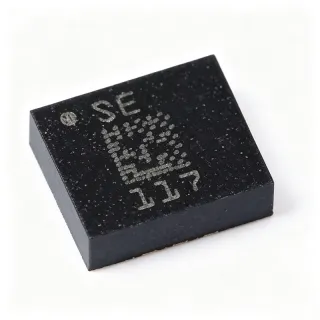
STM32MP135DAC3 - 1GHz Cortex-A7 MPU, TFBGA361 | STMicroelectronics
MPN: STM32MP135DAC3 ✓ Active| Qty | Unit Price | Extended |
|---|---|---|
| 1 | $0 | $0.00 |
| 10 | $0 | $0.00 |
| 100 | $0 | $0.00 |
| 500 | $0 | $0.00 |
| 1,000 | $0 | $0.00 |
STM32MP135DAC3 Overview
A microprocessor unit (MPU) sits at the top of the embedded processing hierarchy, above microcontrollers (MCUs): unlike an MCU, an MPU such as the STM32MP135 series boots a full operating system (typically Linux via OpenSTLinux, ST's official distribution) from external DDR memory and executes application code from external NOR/NAND flash or eMMC. The STM32MP1 family bridges ST's STM32 MCU ecosystem and higher-performance application processors, letting designers reuse STM32 peripherals and development tooling while gaining Linux-class compute.
Key features of the STM32MP135DAC3 include a single Cortex-A7 core clocked up to 1 GHz for high single-thread performance, dual 10/100 Mbps Ethernet MACs for industrial networking and redundant communication, dual CAN FD for vehicle and factory bus connectivity, and an LCD-TFT display controller supporting graphical HMIs. The 2x 12-bit ADCs and 24 timers enable precise motor control and analog acquisition, while the parallel camera interface supports vision-based sensing. Hardware crypto and advanced security features support secure boot and data protection.
Architecturally, the STM32MP135 belongs to the STM32MP1 series entry line, which drops the Cortex-M4 co-processor found on MP157-class parts in favor of a cost-optimized single Cortex-A7 core with a rich peripheral set. This makes it well suited to cost-sensitive smart-industrial nodes that still require a full Linux stack, GUI, and networking.
Typical applications include industrial HMI and control panels (LCD-TFT plus touch), smart meters and gateways (dual Ethernet, CAN FD), and motor drives and power conversion (24 timers, 2x ADC). The device also fits connected audio equipment using its audio interfaces.
For design, budget external DDR3/DDR3L memory, a PMIC power tree (ST recommends STPMIC-class solutions), and boot flash; verify the TFBGA361 footprint against the ST datasheet before layout.
This page adds value beyond the ST datasheet by synthesizing drop-in family alternatives, application pairing guidance, and engineering design notes in a single structured reference.
Drop-in alternatives for STM32MP135DAC3 — same package, pin-to-pin compatible. Different-package parts requiring PCB rework are excluded.
Variants in this series
Same-series models that are drop-in compatible with STM32MP135DAC3 (same form factor and footprint) — differing in Core.
Quick Comparison Tool — Select alternative parts for side-by-side comparison:
STM32MP135DAC1
✅ Drop-In ⚠️ 参数待验证📋 Reference alternative (not in catalog)
STM32MP135DAA3
✅ Drop-In ⚠️ 参数待验证📋 Reference alternative (not in catalog)
STM32MP135DAA1
✅ Drop-In ⚠️ 参数待验证📋 Reference alternative (not in catalog)
STM32MP135FAC3
✅ Drop-In ⚠️ 参数待验证✓ In Stock
$8.64 / Unit
View Datasheet →STM32MP135FAC1
✅ Drop-In ⚠️ 参数待验证📋 Reference alternative (not in catalog)
STM32MP135DAC3 Maximum Ratings & Electrical Characteristics
| Core | Arm Cortex-A7 (32-bit) |
| Maximum Core Frequency | 1 GHz |
| Core Count | 1 |
| Family | STM32MP1 series (STM32MP135 entry line) |
| Display Interface | LCD-TFT controller |
| Camera Interface | Parallel camera interface |
| Ethernet MAC | 2x Ethernet |
| CAN FD Controllers | 2x CAN FD |
| ADC | 2x ADC |
| Timers | 24 timers |
| Audio | Audio interfaces (SAI/I2S class) |
| Security | Crypto and advanced security |
| Operating System Support | OpenSTLinux (Embedded Linux) |
STM32MP135DAC3 standard Pin Configuration Guide
Pin configuration for STM32MP135DAC3 (standard package). This analog component features input, output, and power supply pins. Refer to the manufacturer datasheet for offset null, compensation, and enable pin configurations. Ideal for signal conditioning and amplifier circuits.

No detailed pinout data available for STM32MP135DAC3.
Refer to the datasheet for full pin configuration.
Typical Applications
STM32MP135DAC3 is suitable for 6 applications: Industrial HMI and Control Panels, Industrial Gateways and Smart Meters, Motor Drives and Power Conversion, Vision and Camera-Based Sensing, Connected Audio Equipment, Medical and Laboratory Instrumentation.
Industrial HMI and Control Panels
The STM32MP135DAC3 fits industrial HMI panels because its LCD-TFT display controller drives color touch panels directly while the 1 GHz Cortex-A7 core renders GUIs under OpenSTLinux (Qt/Wayland) without a separate graphics processor. In a typical design the MPU executes the HMI application from external DDR3 while an external eMMC holds the OS image; the parallel camera interface can add operator-vision features such as barcode capture. Its 2x Ethernet MACs let one panel serve both a factory network and a redundant ring topology, cutting switch hardware. Unlike MCU-based HMIs, this MPU-class solution sustains animation-rich UIs, but designers must budget external DRAM and PMIC sequencing, which raises BOM cost relative to small TFT MCU solutions.
Recommended
Industrial Gateways and Smart Meters
For protocol-converting gateways and smart-meter data concentrators, the STM32MP135DAC3 offers 2x Ethernet MACs for WAN/LAN segregation or redundant paths, plus 2x CAN FD controllers to bridge legacy CAN fieldbuses to IP networks. The 1 GHz Cortex-A7 runs OpenSTLinux with full TCP/IP, MQTT, and OPC UA stacks, while 24 timers and 2x ADCs handle local pulse counting and analog metering front-ends. Hardware crypto and advanced security support authenticated firmware updates and meter-data privacy, increasingly required by utility regulations. Designers should pair the MPU with external eMMC for tamper-logged storage and validate the dual-Ethernet PHY timing per ST reference designs; the trade-off is higher static power than an MCU-only concentrator.
Recommended
Motor Drives and Power Conversion
The STM32MP135DAC3 suits Linux-attached motor-drive controllers: its 24 timers provide the complementary PWM channels and dead-time generators needed for three-phase inverters, while the 2x ADCs sample phase currents and DC-bus voltage for field-oriented control executed at the bare-metal/interrupt level. Meanwhile the 1 GHz Cortex-A7 runs the supervisory Linux layer - parameter web servers, EtherCAT/PROFINET gateways over the dual Ethernet MACs, and CAN FD fieldbus interfaces. This split (real-time control plus connectivity) removes a second control chip from many drive architectures. Pay attention to ADC trigger-to-PWM synchronization using timer interconnects as shown in ST reference designs, and confirm interrupt latency budgets since the MP135 entry line lacks the Cortex-M4 co-processor of MP157-class parts.
Recommended
Vision and Camera-Based Sensing
With its parallel camera interface, the STM32MP135DAC3 acquires image streams from CMOS sensors for inspection, presence detection, and simple machine-vision nodes. The 1 GHz Cortex-A7 performs frame preprocessing and object checks under OpenSTLinux using V4L2 pipelines, while dual Ethernet and CAN FD stream results or events to the factory network. This positions the part for low-to-mid frame-rate inspection where a full GPU/ISP vision processor is overkill. Performance-wise, expect the single core to handle QVGA-to-VGA-class frame analysis with efficient fixed-point code; higher resolutions or neural inference should move to multi-core or GPU-equipped MPUs. Hardware crypto can encrypt image data at the edge for privacy-sensitive installations such as access control and occupancy monitoring.
Recommended
Connected Audio Equipment
The STM32MP135DAC3 integrates audio interfaces (SAI/I2S-class) suited to networked audio products: IP speakers, PA zone controllers, and streaming amplifiers. The 1 GHz Cortex-A7 under OpenSTLinux handles audio decoding, network streaming, and control UIs on one core, feeding an external DAC or codec through the audio interface with I2S clocks. Dual Ethernet allows daisy-chained audio-distribution topologies in commercial buildings, and CAN FD can carry audio zoning control in vehicle or industrial contexts. The LCD-TFT controller adds a local status display without extra silicon. Compared to dedicated audio SoCs, the MP135 trades DSP-optimized audio acceleration for Linux connectivity flexibility; designs needing heavy multi-channel DSP should pair it with an external audio DSP while the MPU manages UI and networking.
Recommended
Medical and Laboratory Instrumentation
Benchtop and portable medical instruments benefit from the STM32MP135DAC3's balance of Linux-class processing and deterministic peripherals. The 2x 12-bit ADCs digitize sensor front-ends (pressure, optical, electrochemical), 24 timers coordinate sampling and actuation, and the LCD-TFT controller drives operator touchscreens under OpenSTLinux, which supports medical UI frameworks and data logging to external eMMC. Dual Ethernet links instruments to LIS/hospital networks while hardware crypto supports data-at-rest protection. The parallel camera interface enables microscope-attachment imaging. Regulatory designs should choose the industrial C3 temperature grade order code and validate the power tree against ST reference designs; note that safety-critical loops typically remain in external analog front-ends, with the MPU handling supervision, UI, and connectivity rather than direct therapy control.
Recommended
Recommended Products Summary
Engineering reference data for STM32MP135DAC3 — comparison, design guidance, and compliance information.
Selection Guide
Comparison with Alternatives
| Parameter | This Product | STM32MP135DAC1 | STM32MP135DAA3 | STM32MP135FAC3 | STM32MP135CAF3T |
|---|---|---|---|---|---|
| Package | TFBGA361 | TFBGA361 - same | TFBGA361 - same | TFBGA361 - same | 320-TFBGA (11x11 mm) - different, not drop-in |
| Brand | STMicroelectronics | STMicroelectronics | STMicroelectronics | STMicroelectronics | STMicroelectronics |
| Core | Arm Cortex-A7 (32-bit) | Arm Cortex-A7 | Arm Cortex-A7 | Arm Cortex-A7 | Arm Cortex-A7 |
| Ethernet MACs | 2x | 2x | 2x | 2x | 2x |
| CAN FD | 2x | 2x | 2x | 2x | 2x |
| Timers / ADC | 24 timers, 2x ADC | 24 timers, 2x ADC | 24 timers, 2x ADC | 24 timers, 2x ADC | 24 timers, 2x ADC |
Key Differentiators
- Top speed grade in the STM32MP135 family (vs STM32MP135CAF3T)
- Maximum I/O and peripheral fan-out (vs STM32MP135CAF3T)
- Entry-line cost structure vs MP157-class (vs STM32MP157DAA1)
Design Notes
The STM32MP135DAC3 requires multiple supply rails (core, DDR, I/O, analog) with defined power-up sequencing. ST's reference designs use a PMIC such as the STPMIC-class devices to guarantee correct rail sequencing and to provide DDR termination. Estimated: an MPU at 1 GHz plus DDR3L typically draws on the order of 1-2 W depending on load - do a thermal check with your actual workload rather than relying on worst-case numbers. Verify all rail tolerances and sequencing delays against the official ST datasheet tables before layout sign-off.
A TFBGA361 package with external DDR requires controlled-impedance routing: length-match DDR3/DDR3L byte lanes, keep the DDR bus on inner layers with solid reference planes, and follow ST's hardware design application notes for fly-by/point-to-point topologies. Place decoupling capacitors under the BGA per the ST power distribution network guidance, and keep the 25 MHz crystal (or oscillator) loop short. High-speed Ethernet and LCD-TFT lanes should be length-matched pairs with defined 100-ohm/90-ohm differential impedance per the PHY/display panel requirements.
The STM32MP135 entry line has no on-chip application flash and no Cortex-M4 co-processor (unlike MP157-class parts). Designs assuming internal flash storage or M4-side hard real-time loops will need external boot media and a different real-time strategy. Boot source selection straps (BOOT pins) must be wired correctly for eMMC/NAND/NOR/SD boot - a mis-strapped board will not boot and can be hard to diagnose. Use STM32CubeMX and the STM32 MPU OpenSTLinux Distribution early in the project to validate pin muxing and DDR configuration.
Compliance Information
Compliance data was not present in the provided web data; consult the official ST product page and ST compliance portal for RoHS/REACH status of this order code.