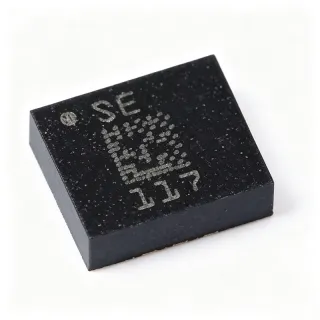
STM32MP135DAF7 - Arm Cortex-A7 1GHz MPU TFBGA320 | ST
MPN: STM32MP135DAF7 ✓ Active| Qty | Unit Price | Extended |
|---|---|---|
| 1 | $8.1 | $8.10 |
| 10 | $6.3 | $63.00 |
| 25 | $5.86 | $146.50 |
| 100 | $5.36 | $536.00 |
| 250 | $5.13 | $1,282.50 |
| 960 | $4.88 | $4,684.80 |
STM32MP135DAF7 Overview
A microprocessor unit (MPU) sits above a microcontroller (MCU) in the embedded-system hierarchy: while an MCU integrates flash and RAM for bare-metal or RTOS execution, an MPU such as the STM32MP135DAF7 boots full operating systems - typically OpenSTLinux, ST's Yocto-based distribution - from external DDR memory and manages rich software stacks, file systems, and networking. The Cortex-A7 core provides high single-thread performance with low power consumption, making it a common choice for HMI panels, gateways, and industrial control.
Key features of the STM32MP135DAF7 include the single Arm Cortex-A7 core at up to 1 GHz, a rich peripheral set with multiple UART, SPI, I2C, CAN-FD, Ethernet MAC, and USB interfaces for connectivity, and integrated graphics-oriented capabilities that support display pipelines in HMI designs. The STM32MP13x line is pin-compatible within its family, enabling designers to scale performance or feature set without PCB redesign.
Technically, the D vs F ordering code distinguishes security/feature variants within the family (the F variant offers an extended feature set, while the D variant is the cost-optimized version); verify the exact cryptographic and security feature delta against the manufacturer datasheet before selection. The part operates over the industrial temperature range and is supplied in a lead-free, RoHS-compliant TFBGA-320 ball grid array.
Typical applications include industrial HMI and human-machine interfaces with touch displays, IoT gateways and edge nodes requiring Ethernet and Linux networking, and motor-control or factory-automation systems that pair the Cortex-A7 with STM32 Cortex-M MCUs for real-time tasks.
A key design consideration: the STM32MP135DAF7 has no internal program memory, so the BOM must include DDR3(L) DRAM, a boot device (eMMC/NAND/NOR/SD), and a proper power tree - ST provides reference designs and PMIC suggestions in its application notes.
This page synthesizes distributor pricing (DigiKey, Mouser, LCSC, and others, as of 2026-09-06), same-family drop-in alternatives, and practical design notes not found in the manufacturer datasheet.
Drop-in alternatives for STM32MP135DAF7 — same package, pin-to-pin compatible. Different-package parts requiring PCB rework are excluded.
Variants in this series
Same-series models that are drop-in compatible with STM32MP135DAF7 (same form factor and footprint) — differing in Core, Core Architecture, Package, Series.
Quick Comparison Tool — Select alternative parts for side-by-side comparison:
STM32MP135FAF7
✅ Drop-In✓ In Stock
$5.46 / Unit
View Datasheet →STM32MP135FAG7
✅ Drop-In📋 Reference alternative (not in catalog)
STM32MP135DAF7T
✅ Drop-In📋 Reference alternative (not in catalog)
STM32MP135DAF7 Maximum Ratings & Electrical Characteristics
| Core | Arm Cortex-A7 |
| Number of Cores | 1 |
| Core Architecture | 32-bit |
| Maximum Clock Frequency | 1 GHz (some distributor listings state 900 MHz - see validation note) |
| Series | STM32MP1 (STM32MP13x line) |
| Product Type | Microprocessor IC (MPU) |
| Package | 320-TFBGA (11 x 11 mm) |
| Mounting Type | Surface Mount |
| Ball Pitch | 0.8 mm |
| GPU/Graphics | Graphics-oriented (per Mouser description) |
| Security Features | D variant (cost-optimized vs F variant) |
| RoHS Status | Compliant |
| Packaging Variant (T suffix) | STM32MP135DAF7T also available (same die, tape-and-reel) |
STM32MP135DAF7 320-tfbga (11 x 11 mm) Pin Configuration Guide
Pin configuration for STM32MP135DAF7 (320-tfbga (11 x 11 mm) package). This digital IC includes GPIO, communication interfaces (UART, SPI, I2C), and power pins. Refer to the manufacturer datasheet for alternate pin functions and configuration options. Essential for embedded system design and PCB layout.

No detailed pinout data available for STM32MP135DAF7.
Refer to the datasheet for full pin configuration.
Typical Applications
STM32MP135DAF7 is suitable for 6 applications: Industrial HMI Panels, IoT Gateways and Edge Nodes, Factory Automation Controllers, Smart Building and Access Control, Medical and Laboratory Instruments, Consumer and Display Appliances.
Industrial HMI Panels
The STM32MP135DAF7 fits industrial human-machine interface designs where a single Arm Cortex-A7 at up to 1 GHz drives touch displays and local GUI frameworks under OpenSTLinux. Its graphics-oriented capabilities noted by Mouser, combined with the rich UART, SPI, I2C, and Ethernet peripherals of the STM32MP13x line, let the MPU render screens, service the touch controller, and talk to PLCs concurrently. Running Linux from external DDR3 and eMMC keeps the BOM lean for cost-optimized panels; using the D-tier part rather than the F tier saves cost where advanced security is not needed.
Recommended
IoT Gateways and Edge Nodes
For IoT gateways, the STM32MP135DAF7 provides Linux networking via its Ethernet MAC and serial interfaces, bridging field buses (CAN-FD, RS-485 over UART) to cloud protocols such as MQTT. The single Cortex-A7 core at 1 GHz handles TLS stacks and lightweight containers typical of edge nodes, while the D-tier variant keeps unit cost near $5-8 at volume (distributor pricing as of 2026-09-06). Designers must provision external DRAM and boot media since the MPU has no internal program flash; ST reference designs show recommended PMIC and memory pairings.
Recommended
Factory Automation Controllers
In factory automation, the STM32MP135DAF7 supervises cell logic, logging, and operator interaction while companion STM32 Cortex-M MCUs execute deterministic motor and I/O control over CAN-FD or SPI links. The 1 GHz Cortex-A7 executes OpenSTLinux with industrial protocol stacks (e.g., Modbus, OPC UA gateways), and the STM32MP13x peripheral set includes multiple timers and communication interfaces for coordination. Its industrial-grade TFBGA-320 package and ST's long-product-lifecycle policy for STM32 MPUs suit multi-year deployment programs requiring stable sourcing.
Recommended
Smart Building and Access Control
Smart building controllers and access panels benefit from the STM32MP135DAF7's combination of Ethernet, USB, and multiple UART/SPI/I2C interfaces for card readers, door relays, and sensors, all managed under a Linux stack with secure over-the-air updates. The D-tier part suits designs where the feature budget prioritizes connectivity over advanced cryptographic acceleration; the pin-compatible F variant can be substituted later on the same PCB if requirements escalate. TFBGA-320 at 0.8 mm pitch integrates cleanly into compact wall-mount controller PCBs.
Recommended
Medical and Laboratory Instruments
Benchtop medical and laboratory instruments use the STM32MP135DAF7 to run local GUIs, data logging, and USB/Ethernet communication while precision analog front-ends are handled by dedicated ADCs and MCUs. The Cortex-A7's Linux environment simplifies implementation of UI frameworks (Qt), file systems, and networked data export, and the MPU's single-core power profile keeps thermal design simple in enclosed instruments. Distributor availability from DigiKey, Mouser, and LCSC (as of 2026-09-06) supports both prototyping and production sourcing for regulated-device programs.
Recommended
Consumer and Display Appliances
Cost-sensitive connected display appliances - smart thermostats with color screens, small point-of-sale terminals, and appliance control heads - leverage the STM32MP135DAF7's graphics-oriented STM32MP13x architecture at a sub-$10 unit price at volume (distributor schedules, 2026-09-06). Running an embedded Linux GUI from eMMC with DDR3L, the 1 GHz Cortex-A7 provides adequate headroom for touch rendering and network services. The family's pin compatibility means OEMs can qualify one PCB and populate D or F tiers per SKU, simplifying inventory and certified-design reuse.
Recommended
Recommended Products Summary
Engineering reference data for STM32MP135DAF7 — comparison, design guidance, and compliance information.
Selection Guide
Comparison with Alternatives
| Parameter | This Product | STM32MP135FAF7 | STM32MP135FAG7 | STM32MP135DAF7T |
|---|---|---|---|---|
| Package | 320-TFBGA (11x11 mm) | 320-TFBGA (11x11 mm) - same | 320-TFBGA (11x11 mm) - same | 320-TFBGA (11x11 mm) - same |
| Brand | STMicroelectronics | STMicroelectronics | STMicroelectronics | STMicroelectronics |
| Core / Cores | Arm Cortex-A7, 1 core, 32-bit | Arm Cortex-A7, 1 core, 32-bit | Arm Cortex-A7, 1 core, 32-bit | Arm Cortex-A7, 1 core, 32-bit |
| Feature / Security Tier | D (cost-optimized) | F (extended feature tier) | F (extended feature tier) | D (cost-optimized) |
| Series | STM32MP1 (STM32MP13x) | STM32MP1 (STM32MP13x) | STM32MP1 (STM32MP13x) | STM32MP1 (STM32MP13x) |
Key Differentiators
- Cost-optimized D tier of the STM32MP13x family (vs STM32MP135FAF7)
- Single-core power and cost profile (vs STM32MP157 (STM32MP15x family))
- Family pin compatibility enables dual-sourcing (vs STM32MP135FAG7 / STM32MP135DAF7T)
Design Notes
The STM32MP135DAF7 requires a multi-rail power tree (core, DDR, I/O rails) since it is an MPU with external memory. ST's STM32MP13x reference designs pair it with a dedicated PMIC or discrete buck regulators; follow the manufacturer reference design rail sequencing to avoid DDR init failures. Estimated: budget roughly 0.5-1 W total system power for a Cortex-A7 at this class under typical load, but confirm against the datasheet power tables for your clock/voltage operating point before sizing regulators.
The 320-ball TFBGA at 0.8 mm pitch needs HDI-capable or fine-line PCB processes. Route DDR3/DDR3L buses with matched lengths per ST's STM32MP13x hardware development application note, keep the DDR traces on inner layers with solid reference planes, and place termination/decoupling per the reference design. Use the ST-provided ballout file for symbol creation - never hand-build a 320-ball symbol, as a single ball-mapping error is extremely costly to fix after layout.
Do not assume the 900 MHz and 1 GHz distributor figures are interchangeable: DigiKey/Mouser list this MPN at 900 MHz-class while ST's store markets the family at 1 GHz. Confirm the speed grade in the official datasheet for your ordering code before closing timing budgets. Also verify the D vs F feature tier - security peripherals differ - before software teams target F-variant libraries on a D-variant board.
Compliance Information
RoHS/lead-free per ST standard catalog categorization for STM32MP1 parts; REACH, halogen-free and conflict-minerals declarations should be obtained from ST's official product compliance documentation.