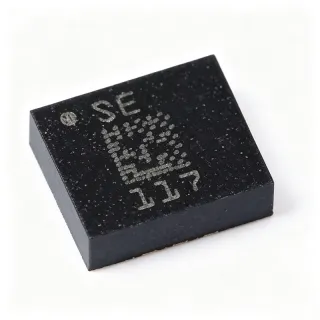
STM32MP135FAF7 - Cortex-A7 1GHz 320-TFBGA MPU | STMicroelectronics
MPN: STM32MP135FAF7 ✓ Active| Qty | Unit Price | Extended |
|---|---|---|
| 1 | $8.99 | $8.99 |
| 10 | $7.03 | $70.30 |
| 25 | $6.53 | $163.25 |
| 100 | $5.99 | $599.00 |
| 250 | $5.73 | $1,432.50 |
| 960 | $5.46 | $5,241.60 |
STM32MP135FAF7 Overview
A microprocessor unit (MPU) sits above the microcontroller (MCU) in the embedded hierarchy: while an MCU integrates flash and SRAM on-chip for bare-metal execution, an MPU like the STM32MP135FAF7 executes a full embedded Linux (OpenSTLinux distribution) and relies on external DDR memories for its working memory. MPUs therefore belong to the broader family of application processors and system-on-chip solutions for smart devices.
Key features of the STM32MP135FAF7 include its 16-bit LPDDR2/LPDDR3 memory controller compliant with JEDEC JESD209-2E and JESD209-3B specifications, an advanced DDR scheduler with three read traffic classes and QoS support, and a TFT color LCD controller for graphics output. Peripherals include multiple UARTs, SPI, I2C, SDMMC, USB 2.0 HS, Ethernet, and CAN-FD interfaces, enabling rich connectivity for industrial gateways and HMI panels.
Technically, the device belongs to the STM32MP13x entry-line of the STM32MP1 family, which focuses on cost-optimized Linux-capable processing. The F code in the part number denotes the highest memory configuration tier of the line, and the 7 suffix indicates the industrial temperature grade. The DDR interface supports full 16-bit or half 8-bit data width operation, allowing designers to trade memory cost against bandwidth in cost-sensitive products.
Typical applications include industrial HMI touch panels, building automation controllers, IoT gateways, and connected devices requiring a secure Linux platform with CAN-FD fieldbus support. Its low-power single-core architecture also suits battery-buffered metering and portable instrumentation.
A key design consideration is DDR memory selection: the LPDDR2/LPDDR3 controller requires careful signal-integrity-aware PCB layout of the 16-bit memory bus, and boot configuration pins must be strapped for the chosen boot device (eMMC, SD card, NAND, or serial flash).
This page synthesizes distributor pricing from DigiKey, Mouser, and LCSC, drop-in same-family alternatives, and practical design notes not found in a single manufacturer datasheet, providing one-stop engineering and procurement information.
Drop-in alternatives for STM32MP135FAF7 — same package, pin-to-pin compatible. Different-package parts requiring PCB rework are excluded.
Variants in this series
Same-series models that are drop-in compatible with STM32MP135FAF7 (same form factor and footprint) — differing in Core, Core Architecture, Package, Series.
Quick Comparison Tool — Select alternative parts for side-by-side comparison:
STM32MP135FAG7
✅ Drop-In ⚠️ 参数待验证📋 Reference alternative (not in catalog)
STM32MP133FAF7
✅ Drop-In📋 Reference alternative (not in catalog)
STM32MP133FAG7
✅ Drop-In📋 Reference alternative (not in catalog)
STM32MP133DAF7
✅ Drop-In📋 Reference alternative (not in catalog)
STM32MP131FAF7
✅ Drop-In ⚠️ 参数待验证📋 Reference alternative (not in catalog)
STM32MP135FAF7 Maximum Ratings & Electrical Characteristics
| Core | Arm Cortex-A7, 1 core |
| Core Architecture | 32-bit ARM |
| Core Frequency | 1 GHz (DigiKey listing); 900 MHz (Mouser listing) |
| Series | STM32MP1 (STM32MP135) |
| DRAM Memory Interface | 16-bit LPDDR2 / LPDDR3 (JEDEC JESD209-2E / JESD209-3B) |
| DDR Data Width | 16-bit full or 8-bit half, programmable |
| Display Interface | TFT LCD controller |
| Fieldbus Interfaces | CAN-FD |
| Package | 320-TFBGA, 11x11 mm |
| Mounting Type | Surface Mount |
| Target Applications | Industrial, Graphics, Security |
STM32MP135FAF7 320-tfbga, 11x11 mm Pin Configuration Guide
Pin configuration for STM32MP135FAF7 (320-tfbga, 11x11 mm package). This digital IC includes GPIO, communication interfaces (UART, SPI, I2C), and power pins. Refer to the manufacturer datasheet for alternate pin functions and configuration options. Essential for embedded system design and PCB layout.

No detailed pinout data available for STM32MP135FAF7.
Refer to the datasheet for full pin configuration.
Typical Applications
STM32MP135FAF7 is suitable for 6 applications: Industrial HMI Touch Panels, IoT and Edge Gateways, Building Automation Controllers, Secure Connected Devices, Smart Metering and Energy Monitoring, Portable and Battery-Buffered Instruments.
Industrial HMI Touch Panels
The STM32MP135FAF7 is purpose-built for human-machine interface panels: its TFT LCD controller drives color touch displays directly, while the 1 GHz Cortex-A7 core has enough headroom for Qt-based GUI frameworks running on OpenSTLinux. The 16-bit LPDDR2/LPDDR3 controller with three-class read QoS keeps graphics frame buffers and application memory flowing without stalls, which is critical for smooth animation at 60 fps. In an HMI design the MPU typically boots from eMMC via SDMMC, stores the Linux root filesystem locally, and exposes CAN-FD or Ethernet to the factory network. Compared with an MCU-driven segment LCD approach, the MP135 adds capacitive multi-touch, vector graphics, and secure remote update capability, at a bill-of-materials cost around $5-9 for the processor alone as of 2026-09-06.
Recommended
IoT and Edge Gateways
For IoT gateways aggregating field devices to the cloud, the STM32MP135FAF7 combines Linux networking (TCP/IP, TLS, MQTT via OpenSTLinux) with CAN-FD and serial interfaces for Modbus, CANopen, and custom sensor buses. The single Cortex-A7 at up to 1 GHz delivers sufficient compute for protocol translation and local analytics without the power budget of a quad-core MPU, easing fanless enclosure design. The hardware security features targeted by the STM32MP13x industrial/security positioning support secure boot and key storage for device identity. DDR is provisioned over the 16-bit LPDDR2/LPDDR3 bus with programmable 8-bit half-width operation, letting cost-optimized gateway designs halve DDR pin count and component cost while retaining adequate bandwidth for gateway traffic profiles.
Recommended
Building Automation Controllers
Building automation controllers need long product lifecycles, fieldbus connectivity, and a UI option - all strengths of the STM32MP135FAF7. Its CAN-FD interfaces link to BACnet-MS/TP-class and CAN-based room controllers, while optional TFT LCD output supports wall-mounted thermostats and zone panels on the same silicon. Running Linux enables standard automation stacks, web configuration servers, and OTA firmware update under a maintained OS. The industrial temperature flow indicated by the F7 ordering code suits unconditioned mechanical rooms and rooftop installations. With the processor priced from roughly $5.46 to $8.99 (as of 2026-09-06), a controller BOM stays competitive against discrete MCU plus external display solutions, while providing a future-proof software platform for 10+ year service lives.
Recommended
Secure Connected Devices
STMicroelectronics positions the STM32MP13x line explicitly for security applications, and the STM32MP135FAF7 carries that positioning into connected products that must protect firmware, data, and device identity. Secure boot chains from ROM code through authenticated FSBL to the Linux kernel, and hardware cryptography accelerates TLS sessions for cloud connectivity. Typical implementations pair the MPU with eMMC boot media and LPDDR3 memory on the 16-bit interface (JESD209-3B compliant), with the QoS scheduler protecting real-time crypto and communication tasks from bursts of graphics or file I/O. For payment terminals, access-control panels, and smart meters, the combination of a mainstream Arm Linux platform with ST's security architecture shortens certification cycles compared with bespoke secure-processor designs.
Recommended
Smart Metering and Energy Monitoring
Smart meters and energy-monitoring units benefit from the STM32MP135FAF7's balance of connectivity, security, and cost. Multiple UARTs and CAN-FD interface to metrology front ends and power-line or RF communication modules, while Linux middleware handles DLMS/COSEM stacks and encrypted data upload. The industrial-grade F7 flow supports outdoor and switchgear cabinet temperatures. Memory bandwidth from the 16-bit LPDDR2 controller (three read traffic classes, per JESD209-2E) is ample for metering workloads, and the programmable 8-bit half-width mode trims DDR cost in high-volume meter deployments where unit economics dominate. At $5.46-$5.99 per unit at 250-1000 piece volumes (as of 2026-09-06), the MP135 fits aggressive metering BOM targets without sacrificing software extensibility for future tariff and firmware features.
Recommended
Portable and Battery-Buffered Instruments
Single-core Cortex-A7 efficiency makes the STM32MP135FAF7 attractive for portable instruments - handheld analyzers, environmental dataloggers, and battery-buffered field devices - where a display and Linux connectivity are required but quad-core power draw is not. The 900 MHz to 1 GHz operating point delivers responsive UI performance while allowing aggressive DVFS scaling between sampling and idle phases, and the LPDDR2 controller supports power-down self-refresh for low-duty-cycle logging applications. TFT LCD output supports integrated screens without an external display bridge. Designers should budget for the DDR bus layout complexity in compact instruments, or use the 8-bit half-width mode to shorten traces and reduce layer count, trading bandwidth that logging workloads rarely need.
Recommended
Recommended Products Summary
Engineering reference data for STM32MP135FAF7 — comparison, design guidance, and compliance information.
Selection Guide
Comparison with Alternatives
| Parameter | This Product | STM32MP135FAG7 | STM32MP133FAF7 | STM32MP133FAG7 | STM32MP133DAF7 | STM32MP131FAF7 |
|---|---|---|---|---|---|---|
| Package | TFBGA-320 (11x11 mm) | TFBGA-320 (11x11 mm) - same | TFBGA-320 (11x11 mm) - same | TFBGA-320 (11x11 mm) - same | TFBGA-320 (11x11 mm) - same | TFBGA-320 (11x11 mm) - same |
| Brand | STMicroelectronics | STMicroelectronics | STMicroelectronics | STMicroelectronics | STMicroelectronics | STMicroelectronics |
| CPU Core | 1x Arm Cortex-A7, 32-bit | 1x Cortex-A7 | 1x Cortex-A7 | 1x Cortex-A7 | 1x Cortex-A7 | 1x Cortex-A7 |
| Core Frequency | Up to 1 GHz | Up to 1 GHz | Up to 1 GHz | Up to 1 GHz | Up to 1 GHz | Up to 1 GHz |
| DRAM Support | 16-bit LPDDR2/LPDDR3 (JESD209-2E/-3B) | 16-bit LPDDR2/LPDDR3 | 16-bit LPDDR2/LPDDR3 | 16-bit LPDDR2/LPDDR3 | 16-bit LPDDR2/LPDDR3 | 16-bit LPDDR2/LPDDR3 |
| Target Segment | Industrial, Graphics, Security | Industrial, Graphics, Security | Industrial, headless | Industrial, headless | Cost-optimized industrial | Entry industrial |
Key Differentiators
- Integrated TFT LCD controller for direct panel drive (vs STM32MP133FAF7)
- Flexible 16-bit/8-bit DDR width saves BOM cost (vs STM32MP133DAF7)
- JEDEC-standard LPDDR2/LPDDR3 controller (vs STM32MP131FAF7)
Design Notes
The 16-bit LPDDR2/LPDDR3 bus is the most layout-critical section of an STM32MP135FAF7 board. Follow ST's DDR3 board design application notes: length-match data byte lanes to within tight skew budgets, route on inner layers with solid reference planes, and honor the fly-by/point-to-point topologies recommended in the datasheet for JESD209-2E/JESD209-3B compliance. The programmable 8-bit half-width mode halves the trace count and eases routing on 4-layer boards at some bandwidth cost - a valid trade-off for logging and gateway workloads.
Boot configuration straps on the TFBGA320 must match the chosen boot device (SDMMC, eMMC, NAND, or serial flash) before power-up; mis-strapped BOOT pins are the most common cause of first-boot failure on STM32MP1 boards. Also plan for the two-stage boot chain: ROM code loads an authenticated FSBL which then starts OpenSTLinux. Validate with ST's STM32CubeProgrammer and the STM32CubeMP13 package rather than hand-rolled loaders, and keep TF-A/U-Boot versions aligned with the OpenSTLinux release you deploy.
A 1 GHz Cortex-A7 in an 11x11 mm TFBGA dissipates on the order of a few hundred milliwatts under typical Linux workloads, well within the capability of a standard PCB copper pour - no heatsink is normally required. However, sustained graphics or crypto workloads raise steady-state power; ensure at least 2 oz outer copper and via stitching under the package land pattern, and verify junction temperature against the datasheet thermal resistance with your enclosure's airflow. Estimated: at 0.5 W dissipation and a typical TFBGA theta_JA near 30-40 C/W, junction rise is roughly 15-20 C above ambient - acceptable for industrial ratings but confirm with the official datasheet value.
Compliance Information
Compliance data not present in the provided verified web data. Confirm RoHS/REACH status on the official STMicroelectronics product page or certificate of conformance.