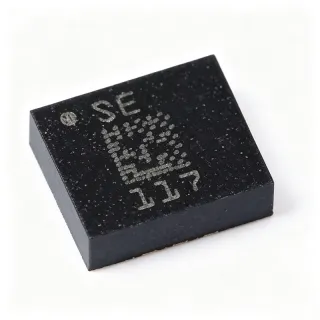
STM32MP153AAD3 - Dual Cortex-A7 650MHz MPU | STMicroelectronics
MPN: STM32MP153AAD3 ✓ Active| Qty | Unit Price | Extended |
|---|---|---|
| 1 | $6.78 | $6.78 |
| 10 | $6.78 | $67.80 |
| 100 | $6.78 | $678.00 |
| 500 | $6.78 | $3,390.00 |
| 1,104 | $6.78 | $7,485.12 |
STM32MP153AAD3 Overview
An MPU (microprocessor unit) sits above a microcontroller (MCU) in the embedded-system hierarchy: it runs full operating systems such as Linux on high-performance application cores, while a tightly coupled Cortex-M4 coprocessor handles deterministic real-time tasks. The STM32MP1 family bridges these worlds on a single die, letting designers share peripherals, memory, and pinout between an open Linux environment and hard-real-time firmware.
Key features include the heterogeneous dual-core architecture (2x Cortex-A7 at 650 MHz plus Cortex-M4 at 209 MHz), a CAN FD interface for industrial and automotive networking, a TFT display controller for graphical HMIs, and the 37 communication interfaces (multiple SPI, I2C, UART, USART, Ethernet MAC, SDMMC, USB) that eliminate external bridge chips.
Technically, the STM32MP153A line is part of the STM32 ecosystem and boots from external DDR memory (LPDDR/DDR3/DDR3L) and eMMC/NAND/NOR/QSPI flash. The Cortex-M4 shares STMicroelectronics proven STM32 peripheral set, so existing STM32 real-time firmware ports directly, and developers use STM32Cube MX tooling plus the OpenSTLinux distribution. Note that the manufacturer datasheet also covers 800 MHz variants in the family; the STM32MP153AAD3 is specified at 650 MHz per distributor listings.
Typical applications include industrial HMI panels driven by the TFT controller, motor control and factory-automation nodes leveraging CAN FD and the M4 coprocessor, IoT gateways running Linux with real-time sensor handling, and building control systems.
Design consideration: the TFBGA-257 footprint requires controlled-impedance PCB layout for DDR routing and a careful power tree (VDDCORE, VDD_DDR rails typically supplied by ST PMICs such as STPMIC1); budget a 6-8 layer board for signal integrity.
This page synthesizes distributor pricing, family drop-in variants, application guidance, and design notes beyond what the manufacturer datasheet alone provides.
Drop-in alternatives for STM32MP153AAD3 — same package, pin-to-pin compatible. Different-package parts requiring PCB rework are excluded.
Quick Comparison Tool — Select alternative parts for side-by-side comparison:
STM32MP157AAD3
✅ Drop-In ⚠️ 参数待验证📋 Reference alternative (not in catalog)
STM32MP153CAD3
✅ Drop-In ⚠️ 参数待验证📋 Reference alternative (not in catalog)
STM32MP153FAD3
✅ Drop-In ⚠️ 参数待验证📋 Reference alternative (not in catalog)
STM32MP151AAD3
✅ Drop-In ⚠️ 参数待验证✓ In Stock
$7.42 / Unit
View Datasheet →STM32MP153AAD3T
✅ Drop-In ⚠️ 参数待验证📋 Reference alternative (not in catalog)
STM32MP153AAD3 Maximum Ratings & Electrical Characteristics
| Core | Dual Arm Cortex-A7 + Arm Cortex-M4 coprocessor |
| Cortex-A7 Frequency | 650 MHz |
| Cortex-M4 Frequency | 209 MHz |
| Architecture | 32-bit, heterogeneous multicore (2 cores + coprocessor) |
| Series | STM32MP1 |
| Display Controller | TFT (LTDC) |
| CAN Interface | CAN FD |
| Communication Interfaces | 37 interfaces |
| Timers | 29 timers |
| Analog Peripherals | Advanced analog (ADC, DAC per datasheet) |
| Package | 257-TFBGA (10x10 mm) |
| Mounting Type | Surface Mount |
| Memory | External boot: DDR3/DDR3L/LPDDR2, eMMC/NAND/NOR/QSPI |
| RoHS Status | Compliant (per ST product page) |
STM32MP153AAD3 257-tfbga (10x10 mm) Pin Configuration Guide
Pin configuration for STM32MP153AAD3 (257-tfbga (10x10 mm) package). This digital IC includes GPIO, communication interfaces (UART, SPI, I2C), and power pins. Refer to the manufacturer datasheet for alternate pin functions and configuration options. Essential for embedded system design and PCB layout.

No detailed pinout data available for STM32MP153AAD3.
Refer to the datasheet for full pin configuration.
Typical Applications
STM32MP153AAD3 is suitable for 6 applications: Industrial HMI and Display Panels, Industrial IoT Gateways, Motor Control and Factory Automation Nodes, Building Control and HVAC Systems, Medical and Laboratory Instrumentation, Smart Home and Edge AI Hubs.
Industrial HMI and Display Panels
The STM32MP153AAD3 fits industrial human-machine interfaces because its TFT display controller (LTDC) drives panels directly while the dual 650 MHz Cortex-A7 cores run the OpenSTLinux distribution with a full GUI stack (Qt/Wayland). The 209 MHz Cortex-M4 coprocessor handles touch sensing and real-time fault handling independently of Linux, giving deterministic response that pure-application-processor designs lack. With 37 communication interfaces, the MPU connects to PLCs, sensors, and field devices without external bridges. Place the MPU between DDR3/DDR3L SDRAM and the panel backlight/touch ICs; the key trade-off is that the LTDC fetches frame data from DDR continuously, so memory bandwidth and layout quality directly affect display performance.
Recommended
Industrial IoT Gateways
The STM32MP153AAD3 serves industrial IoT gateways by combining Linux-class processing (dual Cortex-A7 at 650 MHz) for protocol translation, edge analytics, and cloud connectivity with a hard-real-time Cortex-M4 at 209 MHz for fieldbus timing. The CAN FD interface and rich set of 37 communication interfaces (multiple UART, SPI, I2C, Ethernet MAC, USB) let one chip aggregate Modbus, CAN, and serial devices toward an upstream Ethernet or cellular link. Booting from eMMC with DDR3L keeps the BOM compact. The design consideration is memory sizing: Linux plus containers typically requires 512 MB DDR and 4 GB eMMC minimum, so budget external memory early in the design.
Recommended
Motor Control and Factory Automation Nodes
The STM32MP153AAD3 suits factory-automation nodes and motor-control heads where an open OS supervises while deterministic firmware runs the control loop: the Cortex-M4 at 209 MHz executes FOC/PID loops using the 29 timers and advanced analog peripherals (ADC), while Linux on the Cortex-A7 handles diagnostics, parameterization, and connectivity. CAN FD provides the deterministic industrial backbone the ST product page highlights for this family. The 257-TFBGA package gives enough GPIO for multi-axis or multi-sensor nodes on one PCB. A practical consideration is analog layout: keep ADC reference routing clean and separated from DDR switching noise to preserve measurement accuracy at the 12-bit class resolution.
Recommended
Building Control and HVAC Systems
Building automation controllers benefit from the STM32MP153AAD3 heterogeneous architecture: the dual 650 MHz Cortex-A7 cores run a Linux-based BMS application with web dashboards and protocol stacks (BACnet/Modbus), while the Cortex-M4 handles hard-real-time sensor polling and actuator timing. The 37 communication interfaces accommodate RS-485 via UART, multiple I2C sensor buses, and Ethernet backhaul natively. The TFT controller also enables local wall-thermostat or panel displays without a separate display MCU. Field reliability consideration: use the MP4 temperature grade appropriate to the mechanical environment and validate boot integrity from eMMC/NAND, since building controllers cycle power frequently and require fast, robust startup.
Recommended
Medical and Laboratory Instrumentation
Benchtop medical and laboratory instruments use the STM32MP153AAD3 where a Linux UI (touch display via the TFT controller) coexists with precise real-time acquisition: the Cortex-M4 at 209 MHz sequences the advanced ADCs and timers with deterministic sampling, while the Cortex-A7 pair runs data processing, storage, and connectivity under OpenSTLinux. The 37 communication interfaces support USB device mode for data export and Ethernet for LIS integration. Regulatory consideration: the MPU provides the compute platform, but the medical qualification burden lies in system design - use external isolation on patient-coupled interfaces and verify the chosen temperature grade against the instrument specification rather than relying on consumer-grade assumptions.
Recommended
Smart Home and Edge AI Hubs
The STM32MP153AAD3 functions as a smart-home hub or lightweight edge-AI node: its dual 650 MHz Cortex-A7 cores run Linux services (Zigbee/BLE bridges, MQTT brokers, local control logic) and can execute small quantized neural models for keyword or sensor-fusion inference, while the Cortex-M4 at 209 MHz continuously monitors sensors with microsecond-class latency. The 37 communication interfaces and USB/Ethernet connectivity integrate radios and cameras without additional host controllers. Performance consideration: the 650 MHz Cortex-A7 class CPU limits inference to small networks - select models under a few million parameters or offload heavier AI upstream, and size DDR accordingly for frame buffers and model weights.
Recommended
Recommended Products Summary
Engineering reference data for STM32MP153AAD3 — comparison, design guidance, and compliance information.
Selection Guide
Comparison with Alternatives
| Parameter | This Product | STM32MP157AAD3 | STM32MP153CAD3 | STM32MP153FAD3 | STM32MP151AAD3 |
|---|---|---|---|---|---|
| Package | 257-TFBGA (10x10 mm) | 257-TFBGA (10x10 mm) - same | 257-TFBGA (10x10 mm) - same | 257-TFBGA (10x10 mm) - same | 257-TFBGA (10x10 mm) - same |
| Brand | STMicroelectronics | STMicroelectronics | STMicroelectronics | STMicroelectronics | STMicroelectronics |
| Cortex-A7 Cores / Frequency | 2x 650 MHz | 2x 650 MHz | 2x 650 MHz | 2x 800 MHz class (family speed variant) | 2x 650 MHz |
| Cortex-M4 Coprocessor | Yes, 209 MHz | Yes, 209 MHz | Yes, 209 MHz | Yes, 209 MHz | Yes, 209 MHz |
| GPU | No | Yes (3D GPU) | No | No | No |
| TFT Display Controller | Yes | Yes | Yes | Yes | No |
| Pin-to-Pin Compatibility | Reference (257-TFBGA) | Pin-to-pin compatible | Pin-to-pin compatible | Pin-to-pin compatible | Pin-to-pin compatible (fewer peripherals enabled) |
Key Differentiators
- CAN FD integrated on-chip (vs STM32MP151AAD3)
- Cost-optimized versus GPU variant with identical footprint (vs STM32MP157AAD3)
- Security-upgradable within footprint (vs STM32MP153CAD3)
Design Notes
The 257-ball TFBGA (0.8 mm pitch, 10x10 mm) with external DDR3/DDR3L demands a disciplined stack-up: a 6-8 layer PCB with dedicated DDR ground reference, length-matched byte lanes, and 40-ohm class trace impedance is the ST reference-design baseline. Follow the ST documentation 'hardware development' guide and copy the reference design DDR routing topology rather than improvising - DDR signal integrity is the single most common bring-up failure on STM32MP1 boards.
The STM32MP153AAD3 requires a sequenced, multiple-rail power tree (VDDCORE, VDD_DDR, VDDQ, VDD_3V3 etc.). ST reference designs use the STPMIC1 PMIC, which integrates the required bucks/LDOs, DDR termination, and reset supervision, and is supported natively by OpenSTLinux device tree bindings. Estimated: mixing discrete regulators is possible but you must independently guarantee the documented power-up sequencing - verify rail order in the datasheet before committing to a discrete power design.
Plan boot media and memory sizes before layout: the MPU has no internal flash for the OS, so eMMC/NAND/NOR/QSPI plus DDR must be selected with headroom (Linux typically needs 512 MB DDR minimum). Also verify the exact speed grade in your MPN - the STM32MP153 family datasheet covers both 650 MHz and 800 MHz class devices, and the STM32MP153AAD3 is listed at 650 MHz on distributor pages; do not assume the family headline frequency applies.
Compliance Information
RoHS compliance indicated by distributor listing (DigiKey). REACH, lead-free, halogen-free and conflict-minerals status must be confirmed on the official ST product page compliance documents.