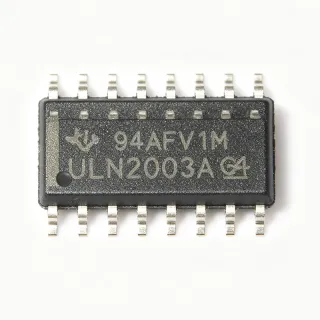
TCAN1051HGVDRQ1 - 5Mbps CAN FD Transceiver AEC-Q100 | TI
MPN: TCAN1051HGVDRQ1 ✓ Active| Qty | Unit Price | Extended |
|---|---|---|
| 1 | $2.45 | $2.45 |
| 10 | $2.2 | $22.00 |
| 100 | $1.72 | $172.00 |
| 500 | $1.45 | $725.00 |
| 1,000 | $1.18 | $1,180.00 |
| 3,000 | $1.02 | $3,060.00 |
TCAN1051HGVDRQ1 Overview
A CAN FD transceiver is a physical-layer interface IC that converts the TTL-level transmit (TXD) and receive (RXD) signals of a CAN controller into the differential CANH/CANL bus signals, and vice versa. Within the signal-chain hierarchy, it sits between the host microcontroller or CAN controller and the twisted-pair bus, defining the robustness, bus-fault tolerance, and data-rate ceiling of the entire network node.
Key features of the TCAN1051HGVDRQ1 include CAN FD support up to 5 Mbps for fast arbitration-free data phases, automotive AEC-Q100 qualification, fault-protected bus pins that survive electrical faults on CANH and CANL, and a standby mode with bus-wake capability for low quiescent power. The VIO pin allows I/O-level adaptation to 3.3 V controllers, and the device provides dominant-timeout protection and thermal shutdown for system-level robustness.
Technically, the transceiver drives a differential bus compliant with high-speed CAN physical-layer requirements while adding fault protection that distinguishes the HGV variant: bus pins tolerate sustained overvoltage and short-circuit events that would destroy a standard transceiver. An internal receiver filters and shapes the bus signal, and the STB pin (pin 8) selects operating modes, enabling standby operation with wake-up via bus activity.
Typical applications include automotive body control modules, gateways, and powertrain nodes; industrial CANopen networks requiring fault tolerance; and battery management systems where bus wiring faults are credible failure modes. High CAN FD data rates make the part suitable for modern zonal architectures.
Design consideration: local bus termination and placement of 100 nF to 470 nF VCC decoupling directly at pin 3 strongly influence signal integrity at 5 Mbps; keep the TXD/RXD traces short and reference them to a clean ground.
This page synthesizes distributor pricing, drop-in alternatives, pinout data, and practical design notes not found in the manufacturer datasheet.
Drop-in alternatives for TCAN1051HGVDRQ1 — same package, pin-to-pin compatible. Different-package parts requiring PCB rework are excluded.
Variants in this series
Same-series models that are drop-in compatible with TCAN1051HGVDRQ1 (same form factor and footprint) — differing in Product Type, Data Rate, Package, Fault Protection, Packaging.
Quick Comparison Tool — Select alternative parts for side-by-side comparison:
TCAN1051VDRQ1
✅ Drop-In✓ In Stock
$0.31 / Unit
View Datasheet →TCAN1051GVDRQ1
✅ Drop-In✓ In Stock
$1.28 / Unit
View Datasheet →TCAN1043GDRQ1
✅ Drop-In📋 Reference alternative (not in catalog)
TCAN1051AVDRQ1
✅ Drop-In ⚠️ Specs Unverified📋 Reference alternative (not in catalog)
TCAN1043AVDRQ1
✅ Drop-In ⚠️ Specs Unverified📋 Reference alternative (not in catalog)
TCAN1051HGVDRQ1 Specifications
| Product Type | Automotive fault-protected CAN FD transceiver |
| Data Rate | 5 Mb/s |
| Supply Voltage - Min | 4.5 V |
| Supply Voltage - Max | 5.5 V |
| Operating Supply Current | 45 mA |
| Number of Transceivers | 1/1 (half-duplex) |
| Protocol | CANbus (CAN FD capable) |
| Operating Mode | Normal / Silent (standby) |
| Operating Temperature Range | -55C to +125C |
| Package | SOIC (D), 8 pins |
| Mounting Type | Surface Mount |
| Qualification | AEC-Q100 automotive |
| I/O Level Adaptation | VIO pin for 3.3 V or 5 V controllers |
| Fault Protection | Fault-protected CANH/CANL bus pins |
| Packaging | Tape & Reel (R suffix) |
| RoHS Status | Compliant |
TCAN1051HGVDRQ1 Pin Configuration
| Pin 1 | TXD — Transmit data input from CAN controller |
| Pin 2 | GND — Ground reference |
| Pin 3 | VCC — 5 V supply (4.5 V to 5.5 V) |
| Pin 4 | RXD — Receive data output to CAN controller |
| Pin 5 | VIO — I/O level supply for TXD/RXD/STB logic adaptation (e.g. 3.3 V) |
| Pin 6 | CANL — CAN low bus line (fault protected) |
| Pin 7 | CANH — CAN high bus line (fault protected) |
| Pin 8 | STB — Standby/mode select control input |
Typical Applications
TCAN1051HGVDRQ1 is suitable for 6 applications: Automotive Body Control Modules, Automotive Gateways and Zonal Controllers, Battery Management Systems (BMS), Industrial CANopen / Fieldbus Nodes, Automotive Lighting and LIDAR Modules, Test and Measurement CAN Interfaces.
Automotive Body Control Modules
Body control modules concentrate switching loads and door/harness wiring where CANH/CANL shorts to battery are credible field faults. The TCAN1051HGVDRQ1's fault-protected bus pins survive these events, while its 5 Mb/s CAN FD rate supports the growing data payload of modern BCM networks, and AEC-Q100 qualification with -55C to +125C rating covers the under-dash thermal environment. The VIO pin interfaces the transceiver directly with 3.3 V MCUs. Placed at the node connector with a split-termination network (typically 60 ohm split by a 4.7 nF capacitor to ground per TI reference designs), it adds robust ESD and fault tolerance without changing the standard 8-pin SOIC footprint.
Recommended
Automotive Gateways and Zonal Controllers
Gateway ECUs bridge high-speed CAN FD backbones with legacy 500 kb/s segments, demanding transceivers that sustain 5 Mbps data phases. The TCAN1051HGVDRQ1 meets this with CAN FD framing up to 5 Mb/s while its fault-protected CANH/CANL pins tolerate the diagnostic miswiring common in service environments. The 45 mA maximum supply current fits a gateway's multi-rail power budget, and the STB-mode standby with bus wake allows the node to sleep per network management requirements. Because gateways often route several bus stubs, the SOIC-8 footprint simplifies replicating an identical, proven transceiver cell across every physical channel of the board.
Recommended
Battery Management Systems (BMS)
In EV and industrial BMS topologies, the CAN bus runs alongside high-voltage cabling, so transceiver bus pins face elevated fault exposure; the HGV variant's fault protection directly addresses this risk. The TCAN1051HGVDRQ1's 5 Mb/s CAN FD capability supports fast pack-telemetry frames, and the -55C to +125C AEC-Q100 rating covers pack-side thermal extremes. Designers typically combine it with TI battery monitors on the same isolated segment, placing 100 nF VCC decoupling at pin 3 and the 120 ohm termination at the pack master. The standby mode keeps quiescent drain low between telemetry bursts, which matters for storage and transport states of the vehicle.
Recommended
Industrial CANopen / Fieldbus Nodes
Industrial automation panels subject bus wiring to installation errors and mechanical wear, so fault-tolerant transceivers reduce field returns. The TCAN1051HGVDRQ1 offers automotive-grade robustness in a commercial-friendly SOIC-8 package, with 5 Mb/s CAN FD headroom for higher-throughput CANopen FD and J1939-style networks. Its VIO pin allows direct connection to both legacy 5 V PLC logic and modern 3.3 V MCUs without level shifters. Layout practice for these nodes keeps the transceiver within 20 mm of the connector, uses a 470 nF VCC capacitor, and routes TXD/RXD as short, ground-referenced traces to preserve signal integrity at FD data phases.
Recommended
Automotive Lighting and LIDAR Modules
Adaptive lighting and LIDAR control modules communicate configuration and diagnostic data over CAN FD and operate in hot, vibration-prone locations where harness faults occur. The TCAN1051HGVDRQ1's fault-protected bus pins and +125C rating make it suitable inside lamp housings and sensor heads, while 5 Mb/s data phases carry high-resolution status frames. Designers use the STB pin to put the transceiver in standby during parked states, achieving low sleep current demanded by telematics disconnect specifications. TI reference designs pair this transceiver class with automotive-qualified MCUs and temperature monitors to form a complete, AEC-Q100-aligned communications cell on a two-layer PCB.
Recommended
Test and Measurement CAN Interfaces
Bench CAN analyzers and ECU flashing fixtures repeatedly connect to unknown devices, where a shorted or miswired target can destroy an unprotected transceiver; the TCAN1051HGVDRQ1's fault-protected bus pins make it an ideal instrument-side interface. Its 5 Mb/s support covers every CAN FD rate in common automotive tools, and the VIO pin adapts to both 3.3 V and 5 V USB-interface logic. The SOIC-8 package allows socketing or simple layout reuse across instrument variants. Typical fixtures add TVS diodes and common-mode chokes ahead of CANH/CANL for extra surge immunity, with the transceiver's own fault protection as the last line of defense.
Recommended
Recommended Products Summary
Engineering reference data for TCAN1051HGVDRQ1 — comparison, design guidance, and compliance information.
Selection Guide
Comparison with Alternatives
| Parameter | This Product | TCAN1051VDRQ1 | TCAN1051GVDRQ1 | TCAN1043GDRQ1 | TCAN1051AVDRQ1 | TCAN1043AVDRQ1 |
|---|---|---|---|---|---|---|
| Package | SOIC-8 (D) | SOIC-8 (D) - same | SOIC-8 (D) - same | SOIC-8 (D) - same | SOIC-8 (D) - same | SOIC-8 (D) - same |
| Brand | Texas Instruments | Texas Instruments | Texas Instruments | Texas Instruments | Texas Instruments | Texas Instruments |
| Data Rate | 5 Mb/s (CAN FD) | 5 Mb/s | 5 Mb/s | 5 Mb/s | 5 Mb/s | 5 Mb/s |
| Supply Voltage | 4.5 V to 5.5 V | 4.5 V to 5.5 V | 4.5 V to 5.5 V | 4.5 V to 5.5 V | 4.5 V to 5.5 V | 4.5 V to 5.5 V |
| VIO / I/O Level | Yes (VIO pin, 3.3 V capable) | Yes (VIO pin) | 5 V I/O (no separate VIO) | Yes (VIO pin) | Yes (VIO pin) | Yes (VIO pin) |
| Operating Temperature | -55C to +125C | -55C to +125C | -55C to +125C | -55C to +125C | -55C to +125C | -55C to +125C |
| AEC-Q100 | Qualified | Qualified | Qualified | Qualified | Qualified | Qualified |
| Secondary Features | Fault protection, standby, dominant timeout, thermal shutdown | Standby, VIO adaptation | Standby, silent mode | Standby, wake pattern options | Standby, wake options | Selectable wake pattern, standby |
Key Differentiators
- Fault-protected CANH/CANL bus pins (vs TCAN1051GVDRQ1)
- 3.3 V I/O adaptation via VIO pin (vs TCAN1051GVDRQ1)
- Feature-set trade-off vs TCAN1043GDRQ1 (vs TCAN1043GDRQ1)
Design Notes
Place a 100 nF ceramic capacitor directly at pin 3 (VCC) to pin 2 (GND), plus a 470 nF bulk capacitor nearby, per TI reference layouts for the TCAN1051 family. Keep the transceiver within about 20 mm of the bus connector and route CANH/CANL as a tightly coupled differential pair. Connect VIO (pin 5) to the host I/O rail with its own 100 nF decoupling capacitor; never leave VIO floating even if unused at 5 V.
At 5 Mbps CAN FD data phases, bit time is only 200 ns, so stub lengths and termination errors dominate ringing. Use split termination (two 60 ohm resistors with 4.7 nF to GND at the node center) to reduce common-mode emissions while preserving the 120 ohm DC termination. Ensure total unterminated stub length at bit rates above 2 Mbps stays below roughly 30 cm, and verify eye diagrams on CANH/CANL with a differential probe during design validation.
Common failure modes: (1) tying VIO to VCC when the controller is 3.3 V, which overstresses the RXD output stage - connect VIO to the controller rail instead; (2) omitting the mode-control connection to STB (pin 8), leaving the transceiver stuck in standby with no bus traffic; (3) assuming the fault-protected bus pins eliminate the need for TVS diodes - they protect the IC, not the rest of the node, so keep external surge protection per your EMC spec. Estimated: 45 mA at 5 V is about 225 mV of IR drop across a 0.1 ohm supply trace, negligible but worth confirming on shared rails.
Compliance Information
AEC-Q100 automotive qualification confirmed via TI product page. RoHS/lead-free status inferred from active TI automotive catalog status; REACH and halogen-free status not stated in provided data.