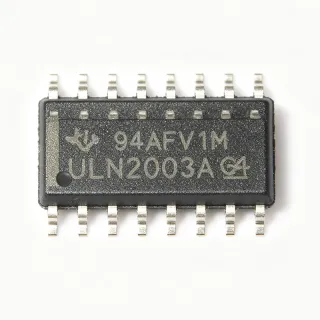
TPS2054ADR - Quad USB Power Switch 0.5A | Texas Instruments
MPN: TPS2054ADR ✓ Active| Qty | Unit Price | Extended |
|---|---|---|
| 1 | $1.28 | $1.28 |
| 10 | $1.15 | $11.50 |
| 100 | $0.98 | $98.00 |
| 500 | $0.84 | $420.00 |
| 1,000 | $0.72 | $720.00 |
TPS2054ADR Overview
A power-distribution switch, also called a load switch or high-side switch, is a power management IC that controls the delivery of a supply rail to a downstream load. In the system hierarchy it sits between a voltage regulator or USB VBUS source and the port or peripheral, providing controlled turn-on, fault isolation, and overcurrent protection. Power-distribution switches are a subclass of load drivers within the broader PMIC (power management IC) category, and USB power switches like the TPS2054ADR are specifically qualified for bus-powered port applications.
Key features include four independently controlled switches in a single package, which reduces board area and BOM count versus four single-channel devices; a precision 0.9 A overcurrent limit per channel that protects upstream supplies during short-circuit events; controlled rise times that limit inrush current when charging heavy capacitive loads; and active-high enable logic with a fault-reporting output for system monitoring.
The TPS2054A family is intended for applications where heavy capacitive loads and short circuits are likely to be encountered, according to the manufacturer product overview. Internal charge-pump驱动 of the N-channel MOSFET gates ensures low, flat on-resistance across the 2.7 V to 5.5 V input range, minimizing voltage drop at full 0.5 A load. Thermal and overcurrent protection circuitry shuts the affected channel down under fault conditions and auto-restarts when the fault clears, enabling robust hot-swap behavior in USB ports.
Typical applications include USB host and hub port power switching (pairing naturally with hub controllers such as the TUSB8041), multi-port peripheral power distribution, hot-plug card-slot power control, and general-purpose 2.7 V to 5.5 V rail load switching in industrial and consumer systems.
When designing with this device, decouple the IN pin with a low-ESR ceramic capacitor close to the package, and size output capacitors so inrush current stays within the 0.9 A current-limit threshold during turn-on.
This page synthesizes distributor pricing, verified drop-in alternatives, comparison data, and practical design notes not found in the manufacturer datasheet, with pricing as of 2026-09-03.
Drop-in alternatives for TPS2054ADR — same package, pin-to-pin compatible. Different-package parts requiring PCB rework are excluded.
Variants in this series
Same-series models that are drop-in compatible with TPS2054ADR (same form factor and footprint) — differing in Switch Type, Package, Category, Fault Reporting, On-Resistance.
Quick Comparison Tool — Select alternative parts for side-by-side comparison:
TPS2054BDR
✅ Drop-In✓ In Stock
$1.12 / Unit
View Datasheet →TPS2054AD
✅ Drop-In✓ In Stock
$1.62 / Unit
View Datasheet →TPS2054DRG4
✅ Drop-In📋 Reference alternative (not in catalog)
TPS2054ADR Maximum Ratings & Electrical Characteristics
| Channels | 4 |
| Function | USB power-distribution switch (high-side) |
| Input Voltage Range | 2.7 V to 5.5 V |
| Continuous Output Current per Channel | 0.5 A |
| Overcurrent Limit | 0.9 A |
| On-Resistance | 80 mOhm (typ) |
| Enable Logic | Active-high |
| Switch Type | N-channel MOSFET, high-side |
| Fault Protection | Overcurrent and thermal shutdown with auto-restart |
| Package | 16-SOIC (0.154 in, 3.90 mm width) |
| Mounting Type | Surface Mount |
| Packaging | Tape & Reel (TR) |
| Category | PMIC - Power Distribution Switches, Load Drivers |
| RoHS Status | Compliant |
TPS2054ADR 16-soic (0.154 in, 3.90 mm width) Pin Configuration Guide
Pin configuration for TPS2054ADR (16-soic (0.154 in, 3.90 mm width) package). Pin numbering, functions, and connection diagrams are defined in the manufacturer datasheet. Refer to it for the exact footprint and soldering guidelines.

No detailed pinout data available for TPS2054ADR.
Refer to the datasheet for full pin configuration.
Typical Applications
TPS2054ADR is suitable for 6 applications: USB Hub Port Power Switching, Hot-Plug Card Slot Power Control, Industrial I/O and Peripheral Rail Distribution, Consumer Electronics Multi-Rail Power Management, Battery-Powered and Portable Device Load Switching, Test and Measurement Instrumentation Power Control.
USB Hub Port Power Switching
The TPS2054ADR's four independent 0.5 A channels align directly with the four downstream ports of a USB 2.0 hub controller, making it a natural power-distribution companion for hubs built around devices such as the TI TUSB8041 or similar quad-port hub ICs. Each channel provides a 0.9 A current limit and fault flag so the hub can detect and report port overcurrent conditions, and the controlled turn-on rise time limits inrush when a device with a large input capacitor is hot-plugged. Placed between the 5 V VBUS supply and each port's VBUS pin with 10 uF of local bulk capacitance per port, the switch isolates faults on one port without disturbing the other three, keeping the hub operational during short-circuit events on any single downstream port.
Recommended
Hot-Plug Card Slot Power Control
Memory-card slots, ExpressCard sockets, and other hot-pluggable interfaces impose heavy capacitive loads and short-circuit risk on their supply rails - exactly the environment the TPS2054A family was designed for, per the TI product overview. The 2.7 V to 5.5 V input range lets one device serve both 3.3 V card slots and 5 V slots, while the 0.9 A current limit prevents connector and trace damage when a damaged card shorts the rail. The 80 mOhm on-resistance keeps voltage drop to about 40 mV at full 0.5 A load, preserving card operating margin. A quad channel device consolidates switching for a multi-slot reader on a single 16-SOIC footprint, and the fault output allows the host to gate off and retry a slot under software control after a fault clears.
Recommended
Industrial I/O and Peripheral Rail Distribution
In industrial control panels and PLC I/O modules, multiple sensor or actuator rails derived from a common 5 V supply benefit from independent switching and fault isolation. The TPS2054ADR provides four such channels per 16-SOIC package, each rated 0.5 A continuous with thermal shutdown and auto-restart, so a shorted sensor cable takes down only its own channel rather than the whole module. The 2.7 V to 5.5 V operating range tolerates supply sag common in factory environments, and the active-high enable inputs interface directly to 3.3 V or 5 V microcontroller GPIO for software-controlled power sequencing of peripherals. Estimated dissipation is modest - at 80 mOhm and 0.5 A, each channel drops about 40 mV, or 20 mW, keeping junction temperature rise negligible without heatsinking.
Recommended
Consumer Electronics Multi-Rail Power Management
Set-top boxes, monitors, docking stations, and multi-port chargers frequently need to switch several subordinate 5 V loads from a common adapter supply. The TPS2054ADR consolidates this switching in one device, cutting board area and assembly cost relative to four discrete single-channel switches. Its N-channel MOSFET architecture with internal charge-pump gate drive delivers 80 mOhm on-resistance without external components, and the 0.9 A per-channel limit protects a shared 5 V rail from individual load faults. Controlled slew rate on turn-on suppresses the voltage dip that would otherwise reset shared-load electronics when a capacitive load engages. The fault flags allow system firmware to log and manage port faults, improving field reliability and user diagnostics in consumer products.
Recommended
Battery-Powered and Portable Device Load Switching
Portable instruments and battery-operated peripherals use load switches to disconnect dormant subsystems and extend battery life. Operating from 2.7 V, the TPS2054ADR switches loads directly from a single Li-ion cell through a buck converter output or from two-cell NiMH stacks. Each of the four channels can be gated independently by the host MCU, allowing unused radios, displays, or sensors to be fully disconnected - eliminating their leakage entirely rather than merely sleeping them. The 0.5 A continuous rating covers most portable subsystem rails, and the low 80 mOhm path loss (roughly 20 mW per channel at full load, estimated) preserves runtime. Tape-and-reel packaging supports high-volume automated assembly typical of portable product manufacturing.
Recommended
Test and Measurement Instrumentation Power Control
Bench instruments, USB-connected data-acquisition modules, and programmable power distributors use high-side switches to apply power to device-under-test loads under software control. The TPS2054ADR's active-high enables give deterministic on/off sequencing from a controller, while the 0.9 A current limit and fault flag provide automatic protection if the DUT presents a short - the channel shuts down and reports rather than damaging the instrument supply. Four channels per 16-SOIC package allow compact multi-channel DUT power matrices. Because on-resistance is 80 mOhm typical, measured voltage at the DUT remains within tens of millivolts of the source at rated load, preserving measurement accuracy. The 2.7 V minimum input also supports low-voltage DUT rails common in modern digital testing.
Recommended
Recommended Products Summary
Engineering reference data for TPS2054ADR — comparison, design guidance, and compliance information.
Selection Guide
Comparison with Alternatives
| Parameter | This Product | TPS2054BDR | TPS2054AD | TPS2054DRG4 |
|---|---|---|---|---|
| Package | 16-SOIC (D, 3.90 mm width) | 16-SOIC - same | 16-SOIC - same | 16-SOIC - same |
| Brand | Texas Instruments | Texas Instruments | Texas Instruments | Texas Instruments |
| Channels | 4 | 4 | 4 | 4 |
| Continuous Current per Channel | 0.5 A | 0.5 A | 0.5 A | 0.5 A |
| Input Voltage Range | 2.7 V to 5.5 V | 2.7 V to 5.5 V | 2.7 V to 5.5 V | 2.7 V to 5.5 V |
| On-Resistance | 80 mOhm (typ) | 80 mOhm (typ) | 80 mOhm (typ) | 80 mOhm (typ) |
| Packaging Format | Tape & Reel (R suffix) | Tape & Reel | Tube/Tray (no R suffix) | Tape & Reel, green (G4) |
Key Differentiators
- Four channels in one 16-SOIC package (vs TPS2051BD (single-channel family member))
- Low 80 mOhm on-resistance across 2.7 V to 5.5 V (vs TPS2054DRG4 (135 mOhm-era figure referenced in some datasheet text))
- A-suffix 0.9 A current limit with fault flag and auto-restart (vs TPS2054BDR)
Design Notes
Place a low-ESR ceramic input capacitor (typically 1 uF to 10 uF, consult the TI TPS2054 datasheet for the recommended value) immediately adjacent to the IN pin of the TPS2054ADR. When all four channels switch large capacitive loads simultaneously, the shared input path can droop; the local capacitor sources the transient and prevents upstream supply disturbance. Route the shared IN trace as a short, wide plane connection rather than a thin serpentine, and star-connect each output trace to minimize cross-channel coupling at 0.5 A per channel.
Verify the current-limit suffix before substitution: the TPS2054A family uses suffixes (A, B, D) that denote different overcurrent-limit ranges on the same die and footprint. Substituting a TPS2054BDR for a TPS2054ADR changes the fault threshold your protection scheme was calibrated to. Also, USB power-distribution compliance requires the port current limit and fault-timing behavior to match the USB specification - re-validate fault timing with the actual suffix used. Do not assume the 80 mOhm figure is a maximum; use the datasheet maximum on-resistance for worst-case voltage-drop analysis.
Estimated: each channel dissipates I^2 x R = 0.5 A squared x 80 mOhm = 20 mW at full load, so a fully loaded TPS2054ADR dissipates roughly 80 mW total - negligible junction rise in a 16-SOIC, and no heatsink or thermal relief is required at rated load. Thermal design attention is only needed during sustained short-circuit conditions, where the current-limit and thermal-shutdown circuits handle stress internally. Ensure the SOIC thermal pad region has at least standard copper connectivity to ground plane to help dissipate fault-period energy before shutdown.
Compliance Information
RoHS compliance indicated by DR suffix (RoHS tape-and-reel) per TI ordering nomenclature and distributor comparison data; TPS2054DRG4 is the explicitly green packaging variant. REACH, halogen-free, and conflict-minerals status should be confirmed via the TI product page environmental data.