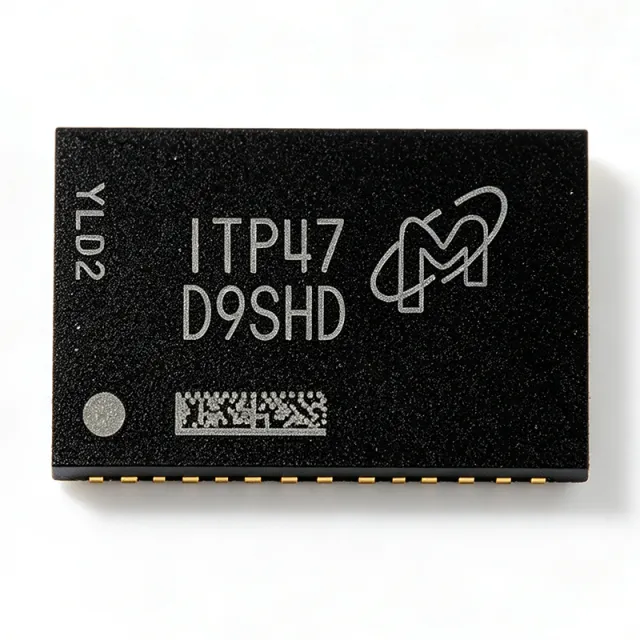
Quick Answers: What Is the MT41K256M16TW-107 and What Does It Cost Today?
The MT41K256M16TW-107 is a Micron 4 Gbit DDR3L SDRAM organized as 256M x 16, clocked at 933 MHz (DDR3L-1866) with a 20 ns access time and powered from a 1.35 V supply in a 96-ball FBGA (8 x 14 mm) surface-mount package. It is in active lifecycle status with 99,999 units in stock at XAIPART as of 2026-10-14, MOQ 1, priced at $18.88 per unit at quantity 1 and $14.10 at quantity 1,000. The commercial :P grade is rated 0 C to +95 C; the industrial IT and AAT grades extend the same die to -40 C and up to +105 C.
Each device carries 512 MB and delivers up to 3.7 GB/s of peak bandwidth, so a 32-bit channel built from two chips yields a 1 GB subsystem at roughly 7.4 GB/s. Those numbers keep the part designed into embedded computing, networking and telecom, industrial control, set-top boxes, automotive infotainment, and test-and-measurement instruments. Use the MT41K256M16TW-107 product page to check live stock and buy; the rest of this guide covers design-in, alternatives, and supply.
| Parameter | Verified value |
|---|---|
| Memory type | DDR3L SDRAM |
| Density | 4 Gbit |
| Organization | 256M x 16 |
| Clock frequency | 933 MHz (DDR3L-1866) |
| Access time | 20 ns |
| Supply voltage | 1.35 V |
| Data bus width | 16 bit |
| Interface | Parallel |
| Package | 96-FBGA (8 x 14 mm), surface mount |
| Operating temperature | 0 C to +95 C (commercial :P grade) |
| Lifecycle status | Active |
| Stock and MOQ | 99,999 units, MOQ 1, as of 2026-10-14 |
Verified feature set. Auto self-refresh, auto precharge, asynchronous reset, data mask (DM), write leveling, dynamic on-die termination (ODT), and ZQ calibration. DDR3L sits in the JEDEC DDR3 memory family hierarchy and runs at 1.35 V instead of the 1.5 V used by standard DDR3, cutting core and I/O power by roughly 15% while remaining backward compatible with 1.5 V operation.
| Quantity | Unit price (XAIPART, as of 2026-10-14) |
|---|---|
| 1+ | $18.88 |
| 10+ | $17.60 |
| 100+ | $16.40 |
| 500+ | $15.20 |
| 1,000+ | $14.10 |
Action for buyers. Specify the :P revision, MT41K256M16TW-107:P, in new BOMs. It is the current RoHS/lead-free packaging revision of the -107 speed grade and the active ordering part number, with the same die, the same 96-FBGA footprint, and the same 4 Gbit x16 DDR3L-1866 specifications.
Technical Guide: How Do You Select and Design In the MT41K256M16TW-107?
Size the memory first, then confirm the speed bin
Four gigabits divided by a 16-bit bus gives 256M addresses, and 256M x 2 bytes equals 512 MB per device. One chip on a 16-bit controller gives 512 MB; two chips on a 32-bit channel give 1 GB; four chips on a 64-bit channel give 2 GB. The verified database rates each x16 device at up to 3.7 GB/s peak, so a two-device 32-bit channel reaches roughly 7.4 GB/s, enough for Linux-based HMIs, gateways, and edge-AI preprocessing. Chip count follows capacity and bandwidth; the 933 MHz DDR3L-1866 bin then only has to satisfy your controller timing requirement, which it does for any DDR3L-1866 memory controller.
Decouple VDD and VDDQ as separate 1.35 V rails
VDD and VDDQ both run at 1.35 V. The verified Micron layout guidance is to keep the rails tightly decoupled near the 96-FBGA balls and to use solid VDD/VDDQ planes under the package. Treat them as separate power domains with their own capacitor banks rather than one shared bulk network. The 1.35 V rail also simplifies power-tree design in battery- and PoE-powered systems.
Route address and command as a length-matched fly-by group
Address and command routing is a length-matched fly-by group per the verified design guidance. Two features exist specifically to make that topology train at DDR3L-1866 on cost-effective board stackups: dynamic ODT, which shifts termination impedance between the write and read phases to reduce reflections, and write leveling, which de-skews DQS against the clock per byte lane. Designs that load two or four DRAMs onto the same fly-by group, such as instrument capture memory and router line cards, depend on both.
Terminate ZQ with a 240-ohm precision resistor per device
Each package needs its own precision 240-ohm resistor from the ZQ ball to GND, per the Micron layout guidance in the verified data. ZQ calibration corrects output driver impedance for process, voltage, and temperature drift. Sharing one resistor between devices, or omitting it, removes that correction and consumes timing margin you will need elsewhere.
Use asynchronous reset, auto precharge, and auto self-refresh deliberately
Asynchronous reset gives deterministic re-initialization after a watchdog or brownout event, which is why this part appears in remotely managed infrastructure. Auto self-refresh holds DRAM contents through suspend states without controller intervention and supports quick resume in set-top boxes and low-power gateways. Auto precharge and data mask cut controller overhead in streaming acquisition pipelines such as logic analyzers and oscilloscopes.
Choose the temperature grade before layout freeze
| Ordering variant | Temperature range | What it is |
|---|---|---|
| MT41K256M16TW-107 | 0 C to +95 C | Base part family identifier, commercial |
| MT41K256M16TW-107:P | 0 C to +95 C | Current lead-free/RoHS packaging revision; active ordering part number |
| MT41K256M16TW-107IT | -40 C to +95 C | Industrial temperature grade, same die and footprint |
| MT41K256M16TW-107 AAT | -40 C to +105 C | Automotive/extended grade, same die and footprint |
All four share the same 4 Gbit x16 DDR3L-1866 die and the 96-FBGA (8 x 14 mm) footprint, so grade selection changes the ordering part number, price, stock, and qualification route, not the layout. The standard commercial grade is not suitable for extended industrial ranges, so specify IT or AAT early: the industrial AAT:P variant listed at $94.4558 with only 18 units in stock at LCSC as of 2026-09-02, versus $18.88 commercial, shows how different the supply picture is.
Budget thermals through the PCB, not the package
The 96-FBGA dissipates heat through the board, so use solid VDD/VDDQ planes and thermal vias under the ball array. The verified database estimates worst-case dissipation for a single 4 Gb x16 DDR3L device at well under 1 W, and that is an estimate rather than a datasheet limit. Compute your own figure from the datasheet IDD specifications against your actual read/write duty cycle, then confirm junction temperature stays inside the 0 C to +95 C commercial window, or select the AAT grade for -40 C to +105 C operation.
Takeaway: Fix chip count from the 512 MB-per-device figure, decouple VDD and VDDQ separately at 1.35 V, keep the fly-by group length-matched, give every package its own 240-ohm ZQ resistor, and lock the temperature grade before layout freeze. For extended-temperature builds, start from the MT41K256M16TW-107IT product page.
What Are the Drop-In Alternatives to the MT41K256M16TW-107?
The XAIPART database lists seven alternatives: four Micron same-family options, one Micron speed-bin upgrade, and two cross-brand second sources. None requires a footprint change; the differences are packaging revision, temperature grade, die revision, power, speed bin, and ball-map verification.
| MPN | Relationship to -107 | Verified differentiator | Product page |
|---|---|---|---|
| MT41K256M16TW-107:P | Same die and specs, current packaging revision | Lead-free/RoHS :P revision; the active ordering part number | View |
| MT41K256M16TW-107IT | Industrial temperature grade | Same die, footprint and speed; -40 C rated | View |
| MT41K256M16MTW-107IT | MTW die revision, industrial grade | Same 4 Gb x16 DDR3L-1866 specifications | View |
| MT41K256M16LY-107 | Lower-power LY die | Reduced IDD, same footprint and speed grade | View |
| MT41K256M16TW-093:P | Faster -093 speed bin, same family | Higher timing margin at higher cost | View |
| K4B4G1646D-BYMA | Cross-brand drop-in (Samsung) | 4 Gb x16 DDR3L-1866 in 96-FBGA with identical ball assignment per cross-reference listings | Not listed in the XAIPART catalog |
| IS43TR16256AL-107MBLI | Second source (ISSI) | DDR3L-1866 256M x 16; verify ball map and controller training before swap | View |
Stay inside the family first. For cost, availability, and zero-qualification swaps, choose :P for current production, -107IT for -40 C to +95 C, AAT where -40 C to +105 C is mandatory, LY where IDD matters, and -093:P only when you need maximum timing margin at the top bin. Because all variants share the 96-FBGA footprint and die, a grade change is a BOM edit rather than a re-spin.
Qualify cross-brand second sources deliberately. The Samsung K4B4G1646D-BYMA is cited in cross-reference listings as sharing an identical pin assignment and electrical specification with the Micron part, which makes it the usual drop-in during Micron shortages. The ISSI IS43TR16256AL-107MBLI is the second-source option, but the verified data explicitly requires ball-map and controller training re-verification before you substitute it. In every case, confirm the speed-bin suffix and temperature grade match your controller DDR3L-1866 timing, then re-run memory training after the swap.
Takeaway: Substitute MT41K256M16TW-107:P for identical commercial builds, step to -107IT or AAT for temperature, and treat any cross-brand swap as a re-qualification: verify ball map, re-run write leveling and ZQ calibration, and re-validate timing at 933 MHz.
Industry Insight: Where Does the MT41K256M16TW-107 Sit in the DDR3L Supply Chain?
The part is in active lifecycle status and is broadly stocked: XAIPART holds 99,999 units as of 2026-10-14 with MOQ 1, and tier pricing runs from $18.88 at quantity 1 down to $14.10 at 1,000 pieces as of the same date. Distribution-level availability matches that picture. LCSC lists 2,919 units of MT41K256M16TW-107:P in stock as of 2026-09-02 with same-day shipping options, and the commercial :P grade is the buy-now part at major distributors.
The industrial picture is the opposite. The extended-temperature MT41K256M16TW-107 AAT:P variant listed at $94.4558 with only 18 units in stock at LCSC as of 2026-09-02, roughly five times the commercial unit price at negligible availability. Industrial and automotive buyers should treat AAT and IT as allocation-limited parts, qualify them early in the design cycle, and consider long-term supply agreements rather than spot buys.
One dated data point to note: the product description carries a price date of 2026-09-02, while XAIPART tier pricing and stock are verified as of 2026-10-14. Quote from the 2026-10-14 tiers and treat the earlier date as the source of the distributor comparisons above.
Structurally, DDR3L depends on mature DRAM capacity rather than leading-edge nodes, while capital spending continues shifting toward advanced logic and packaging lines. Our analysis of SEMI lifting 300 mm fab equipment outlay to $227B by 2029 covers the direction of tool and materials supply. For legacy memory that means supply is stable but not expansively invested, and long-lifecycle designs should carry a second source. The XAIPART component catalog and blog track both.
Takeaway: Buy commercial :P from stock today, but book IT or AAT capacity early. The price and stock gap between the 0 C to +95 C grade and the -40 C to +105 C grade is the single biggest supply risk in this part family.
Trends & Outlook: What Should DDR3L Buyers Watch?
1. Specify the :P revision, not the bare -107. The :P suffix is the current lead-free packaging revision and the active ordering part number. It is electrically the same 4 Gb DDR3L-1866 die in the same 96-FBGA (8 x 14 mm) footprint, so there is no technical reason to keep the base designation on a new BOM.
2. Model the industrial premium before you commit. The verified spread of $94.4558 for AAT:P with 18 units in stock versus $18.88 commercial as of 2026-09-02, and $14.10 at 1,000 pieces at XAIPART as of 2026-10-14, is the number to carry in long-lifecycle programs. If your enclosure only reaches 0 C to +95 C, staying commercial saves thousands per thousand units.
3. Bandwidth growth now comes from bus width, not speed bins. A 4 Gb x16 device at 933 MHz tops out at 3.7 GB/s. Moving to the faster -093 bin buys timing margin at higher cost; adding devices across a 32-bit or 64-bit channel multiplies bandwidth directly. Design the controller interface wide enough and you can stay on the cost-optimized -107 bin.
4. Qualify second sources before you need them. Samsung K4B4G1646D-BYMA is the cross-brand option cited with identical ball assignment, and ISSI IS43TR16256AL-107MBLI is the verified second source that requires ball-map and training checks. Qualify one in parallel with your production BOM while commercial stock is deep, not during a shortage.
5. Re-check power budgets as DDR3L holds its place. The 1.35 V rail and roughly 15% power reduction versus standard DDR3 keep DDR3L attractive for fanless and PoE-powered designs, and backward compatibility with 1.5 V signaling eases controller selection. Validate real dissipation from datasheet IDD figures against your duty cycle instead of relying on the sub-1 W database estimate.
Takeaway: Standardize the :P revision, lock temperature grade against the real enclosure profile, grow bandwidth by widening the channel, and qualify one cross-brand second source while supply is comfortable.
评论
成为第一个评论的人。
🔐 请 登录 即可发表评论。
还没有账户? 注册