Interface ICs
ژێرپۆلەکان
بەرهەمەکان (5,100+)

ADM2485BRWZ - Isolated RS-485 Transceiver | Analog Devices
The ADM2485BRWZ is a high-speed, galvanically isolated RS-485/RS-422 transceiver with an integrated transformer driver, manufactured by Analog Devices. It is designed for bidirectional data communication on multipoint bus transmission lines and complies with ANSI/TIA/EIA RS-485-A-98 and ISO 8482:1987 (E). The device integrates a 3-channel digital isolator, a three-state differential line driver, and a differential input receiver, all in a 16-pin SOIC-W (wide body) package. It operates from a single 5V supply on the logic side and a 5V supply on the bus side, providing 2.5 kVrms isolation. The ADM2485BRWZ supports data rates up to 16 Mbps and features a high common-mode transient immunity (CMTI) of 25 kV/µs, making it suitable for industrial and harsh environments. A digital isolator is a component that provides galvanic isolation between two circuits while allowing digital signals to pass. It uses capacitive or magnetic coupling to transfer data across an isolation barrier, preventing ground loops and protecting sensitive electronics from high voltages. The ADM2485BRWZ uses Analog Devices' iCoupler technology, which combines high-speed CMOS and monolithic transformer technology to achieve reliable isolation. This places it in the category of interface ICs, specifically isolated RS-485 transceivers, which are essential in industrial automation, motor control, and building automation systems where noise immunity and safety are critical. Key features of the ADM2485BRWZ include a 16 Mbps data rate, 2.5 kVrms isolation voltage, 25 kV/µs CMTI, and an integrated transformer driver that simplifies the design of the isolated DC-DC converter. The device also has thermal shutdown protection and a wide operating temperature range of -40°C to +85°C. The receiver has a 1/8 unit load, allowing up to 256 nodes on the bus. The driver maintains a high output current of ±60 mA, ensuring robust signal integrity over long cable runs. The ADM2485BRWZ is designed for use in industrial networks, such as PROFIBUS, Modbus, and BACnet, where reliable data transmission over long distances is required. Its integrated transformer driver reduces external component count, saving board space and simplifying the power supply design. The device is available in a 16-pin SOIC-W package, which is suitable for surface-mount assembly and is RoHS compliant. When designing with the ADM2485BRWZ, it is important to ensure proper PCB layout to maintain isolation integrity. The isolation barrier should be kept clear of copper traces, and the transformer driver should be connected to a suitable external transformer and rectifier circuit to generate the isolated bus-side supply. Additionally, termination resistors should be placed at both ends of the bus to minimize reflections and ensure signal integrity.
ADM2485BRWZ-RL7 - Isolated RS-485 Transceiver | Analog Devices
The ADM2485BRWZ-RL7 is a high-speed, galvanically isolated RS-485/RS-422 transceiver with an integrated transformer driver, manufactured by Analog Devices. It combines a 3-channel digital isolator, a three-state differential line driver, and a differential input receiver into a single 16-pin SOIC-W package. The device supports data rates up to 16 Mbps and provides 2500 Vrms isolation, making it suitable for industrial networks, motor control, and building automation. A digital isolator is a component that provides electrical isolation between two circuits while allowing digital signals to pass. In the context of RS-485 communication, isolation protects against ground loops, common-mode voltage differences, and transient surges, ensuring reliable data transmission in harsh industrial environments. The ADM2485 uses Analog Devices' iCoupler technology, which uses chip-scale transformers instead of optocouplers, offering higher speed, lower power, and better reliability. Key features include a 3-channel isolator (one driver, one receiver, one data direction control), an integrated transformer driver that provides isolated power with an external transformer, and compliance with ANSI/TIA/EIA RS-485-A-98 and ISO 8482:1987(E). The device operates from a single 5V supply on the logic side and a 5V supply on the bus side, with a common-mode voltage range of -7V to +12V. It features thermal shutdown protection and a wide operating temperature range of -40°C to +85°C. The ADM2485 employs iCoupler technology, which uses chip-scale transformers to transmit data across an isolation barrier, providing superior performance compared to optocouplers. The integrated transformer driver generates a square wave that drives an external transformer to create an isolated power supply, eliminating the need for a separate DC-DC converter. This architecture reduces component count and board space while maintaining high isolation and data integrity. Typical applications include industrial fieldbus networks, PROFIBUS, Modbus, motor control, and building automation systems. The device is ideal for applications requiring robust communication over long distances in electrically noisy environments. Its high CMTI (25 kV/µs) ensures reliable operation in the presence of fast transients. When designing with the ADM2485, ensure proper PCB layout to maintain isolation creepage and clearance distances. Place the external transformer close to the device and use appropriate decoupling capacitors on both supply rails. The integrated transformer driver requires an external transformer with a 1:1 turns ratio and a center-tapped primary, as specified in the datasheet.
ADM2486BRWZ-RL7 - Isolated RS-485 Transceiver | Analog Devices
The Analog Devices ADM2486BRWZ-RL7 is a high-speed, half-duplex, galvanically isolated RS-485/RS-422 transceiver that delivers 2500 Vrms isolation, a 20 Mbps data rate, and 25 kV/µs common-mode transient immunity (CMTI). It is supplied in a 16-lead SOIC-W (16-SOIC, 7.50 mm body width) package on tape-and-reel (RL7 suffix), making it suitable for high-volume surface-mount assembly in industrial communication equipment. A digital isolator combined with an RS-485 transceiver is an integrated interface component that provides galvanic isolation between a logic-side controller and a high-voltage bus side. In a system hierarchy, the ADM2486 sits in the physical-layer interface between a UART, MCU, DSP, or PROFIBUS ASIC and the differential RS-485 bus. Its isolation barrier prevents ground loops, common-mode voltages, and transient noise from corrupting the logic-side supply and data lines, which is essential in industrial networking, factory automation, and building control. Key features include Analog Devices iCoupler® magnetic isolation technology, PROFIBUS compliance, ANSI EIA/TIA 485-A and ISO 8482:1987 (E) compliance, 20 Mbps data rate, 3 V operation on VDD1, and 25 kV/µs CMTI. The transceiver integrates a three-channel isolator, a three-state differential line driver, and a differential input receiver in one 16-SOICW package. The RL7 tape-and-reel packaging supports automated pick-and-place assembly, while the 16-pin SOIC wide-body footprint is a common industry-standard form factor. Technical depth is provided by the iCoupler architecture, which uses chip-scale transformers instead of optocouplers, offering better timing accuracy, longer life, and stable CMTI over temperature. The 25 kV/µs CMTI ensures that fast-rising common-mode transients generated by motor drives, inverters, and contactors do not produce bit errors on the bus. This makes the device well suited to electrically noisy industrial environments where isolation integrity is critical. Typical applications include PROFIBUS DP fieldbus networks, PLC remote I/O, motor-drive communication, building automation, smart-grid metering, and SCADA remote terminal units. With its 20 Mbps data rate, the ADM2486 supports both high-speed fieldbus traffic and slower legacy RS-485 systems, providing design flexibility across multiple product lines. When designing with this device, place the isolated bus-side components close to the field connector and maintain a clean isolation barrier on the PCB. Add 120 Ω termination resistors at both ends of the RS-485 bus and bias resistors if the receiver does not have integrated fail-safe biasing. The RL7 suffix denotes a 7-inch tape-and-reel package variant, so confirm reel quantity with the distributor for production planning.

ADM2561EBRNZ - 3kV Isolated RS-485 Transceiver, 25Mbps | ADI
The Analog Devices ADM2561EBRNZ is a 3 kV RMS signal and power isolated RS-485 transceiver with integrated isoPower isolated DC-DC converter, housed in a 28-pin SOIC-W-FP wide-body package with exposed pad. It supports full- and half-duplex communication at data rates up to 25 Mbps while providing ±15 kV IEC ESD protection on the bus pins. An isolated RS-485 transceiver combines a standard RS-485 line driver/receiver (TIA/EIA-485-A and ISO 8482:1987 compliant) with galvanic isolation between the logic-side UART and the bus-side cable. The isolation barrier, typically 3 kV RMS for 60 seconds, breaks ground loops, protects low-voltage processors from hazardous bus voltages, and rejects common-mode transients on long industrial cable runs. When the transceiver also integrates an isolated DC-DC converter (isoPower), the device only needs a single 3.3 V or 5 V supply on the logic side - the high-voltage bus-side rails are generated internally. Key features include 3 kV RMS basic isolation per UL 1577, integrated isolated DC-DC converter, ±15 kV IEC 61000-4-2 ESD on the bus pins, 25 Mbps maximum data rate, 1/8 unit load (256 nodes on the bus), and hot-swap tolerant driver outputs. The SOIC-W-FP (wide-body SOIC with exposed pad) package provides 8 mm creepage/clearance on the PCB and excellent thermal dissipation for the internal DC-DC converter. Typical applications include isolated RS-485/RS-422 industrial fieldbus nodes (Modbus, PROFIBUS, BACnet), solar inverter string monitoring, building automation gateways, motor drive control interfaces, and any system that needs to bridge a high-voltage or noisy bus to a low-voltage microcontroller over a safety-rated isolation barrier. When designing with the ADM2561EBRNZ, follow the datasheet PCB layout guidelines for the exposed pad and the clearance/creepage rules of the 8 mm wide-body SOIC. Decoupling capacitors must be placed close to the VDD1/VISOIN/VISOOUT pins; failure to do so can degrade the internal DC-DC converter's noise performance.
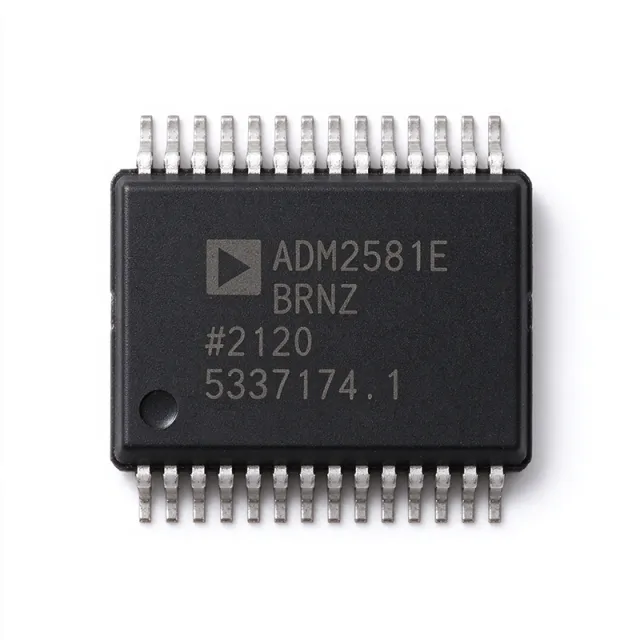
ADM2561EBRNZ-RL7 - 3kV Isolated RS-485/RS-422 Transceiver | ADI
The Analog Devices ADM2561EBRNZ-RL7 is a 3 kV RMS signal- and power-isolated RS-485/RS-422 transceiver integrated in a 28-pin SOIC-W-FP (wide-body SOIC with fine pitch and exposed pad) package. It integrates an isolated DC-to-DC converter and an isolated RS-485 transceiver in a single IC, supports full- and half-duplex operation, and is rated for ±15 kV IEC ESD on the bus pins. An isolated RS-485 transceiver is a physical-layer interface IC that combines galvanic isolation with a differential line driver/receiver. Isolation breaks ground loops between the local controller (MCU, FPGA, processor) and the remote bus nodes, allowing long cables, large common-mode voltages, and improved noise immunity in industrial systems. The ADM2561E family complies with ANSI/TIA/EIA-485-A-98 and ISO 8482:1987(E), placing it within the RS-485 transceiver product hierarchy: RS-485 transceiver -> line transceiver -> interface IC -> integrated circuit. Key features include 3 kV RMS isolation per UL 1577, integrated isolated DC-DC converter (no external transformer required), up to 25 Mbps data rate, and a 1-channel full-/half-duplex topology. The transceiver operates from a single 3 V or 5 V supply on the logic side, with the bus side powered through the integrated isoPower converter. Receiver failsafe features guarantee a known output state on idle or shorted bus, and the device supports up to 256 nodes on a single bus. Wide-body SOIC-W-FP provides 8 mm of creepage/clearance for reinforced isolation. The architecture uses ADI's iCoupler technology: chip-scale transformers for both signal isolation (coreless digital isolation) and power isolation (isoPower integrated DC-DC). This eliminates the need for a discrete isolation barrier plus separate isolated supply, saving ~50% PCB area versus discrete solutions. Latency is typically <100 ns per channel, making the device adequate for high-speed industrial protocols such as Profibus, Modbus RTU, and high-speed motion-control networks. Typical applications include industrial fieldbus nodes (Modbus, Profibus, BACnet), solar inverter string monitoring, building automation gateways, motor-control encoder links, and any long-cable RS-485 link where ground potential differences exceed ±10 V. The integrated isoPower allows single-supply designs, simplifying bill-of-materials for isolated nodes. Designers should budget for the SOIC-W-FP land pattern and observe creepage/clearance constraints for reinforced isolation. The exposed pad must be soldered to a sufficiently large copper island connected only to the logic-side ground or left floating per safety certification. This page synthesizes distributor pricing, drop-in alternatives, and engineering guidance not found in the standalone datasheet, helping procurement and design engineers evaluate the ADM2561EBRNZ-RL7 faster.
ADM2563EBRNZ - 3 kV Isolated RS-485 Transceiver, 28-SOIC-W-FP | Analog Devices
The Analog Devices ADM2563EBRNZ is a 3 kV RMS signal and power isolated RS-485 transceiver integrated in a 28-pin SOIC-W-FP wide-body package with an integrated isoPower DC-to-DC converter. It supports full-duplex RS-422/RS-485 communication, ±15 kV IEC ESD protection on the bus pins, and complies with ANSI/TIA/EIA-485-A-98 and ISO 8482:1987 (E). The device operates over a 3.0 V to 5.5 V VCC supply range with a 1.7 V to 5.5 V logic-side VIO rail. An isolated RS-485 transceiver is a transceiver whose logic-side UART interface and bus-side differential line driver/receiver are galvanically separated by an internal transformer-based isolation barrier, while a built-in isolated DC-DC converter delivers power across that same barrier. The ADM2563E family belongs to the RS-485 transceiver -> serial interface IC -> interface IC category within power management and signal-chain semiconductors, replacing discrete opto-couplers, transformers, and external isolated supplies with a single chip. Key features of the ADM2563EBRNZ include an integrated isolated DC-DC converter (no external transformer required), ±15 kV IEC 61000-4-2 ESD on RS-485 A/B/Y/Z pins, ±25 kV HBM ESD on bus pins, 25 Mbps maximum data rate, thermal shutdown, and current-limit protection on the isolated supply output. The 28-SOIC-W-FP package (wide-body SOIC with an exposed pad for thermal dissipation) is rated to 3 kV RMS (per IEC 61010-1 / UL 1577) for reinforced isolation. The exposed pad must be soldered to the PCB ground plane to achieve the rated creepage/clearance and to limit junction temperature rise at full duplex load. Typical applications include isolated RS-485 industrial fieldbus nodes, solar inverter monitoring, building automation (BACnet, Modbus RTU), motor drive encoder feedback, and any point-to-point or multi-drop RS-485 link requiring 3 kV reinforced isolation. The ADM2563EBRNZ is particularly attractive when PCB area is constrained because it eliminates the transformer, optocouplers, and isolated LDO that a discrete isolation solution would otherwise require. When designing with this part, observe the exposed-pad soldering guideline, decouple VCC/VIO/VISOOUT with 1 µF X7R ceramics placed within 2 mm of each pin, and confirm that the bus-side shield/ground reference matches the application. The integrated isolated DC-DC converter removes the need for a push-pull transformer but does introduce about 25 mA quiescent current draw from VCC. This page synthesizes distributor pricing, drop-in alternatives from the ADM2561E/ADM2563E/ADM2565E/ADM2567E families, and practical design notes not found in the manufacturer datasheet.

ADM2565EBRNZ-RL7 - 3kV Isolated RS-485 Transceiver, 25Mbps | ADI
The Analog Devices ADM2565EBRNZ-RL7 is a 3 kV rms signal-and-power isolated RS-485 transceiver supporting data rates up to 25 Mbps in a 28-lead SOIC_W wide-body fine-pitch package with integrated isoPower isolated DC-DC converter. The device integrates a half-duplex RS-485 driver/receiver pair, an on-chip transformer-based power isolator, and ±15 kV IEC ESD protection on the bus pins, eliminating the need for a separate digital isolator and isolated supply. According to the Analog Devices ADM2565E family datasheet, the part complies with ANSI/TIA/EIA-485-A-98 and ISO 8482:1987 (E) for balanced transmission lines. What is an isolated RS-485 transceiver? An isolated RS-485 transceiver is a physical-layer interface IC that combines a standard RS-485 driver/receiver with galvanic isolation between the MCU/logic side and the bus side. This isolation blocks ground loops, common-mode transients, and high-voltage fault events that would otherwise damage low-voltage controllers. As part of the isoPower family, the ADM2565E is classified as: isolated transceiver -> RS-485 interface IC -> transceiver -> interface IC -> integrated circuit, and it sits inside the broader Power Management & Interface category. Key features of the ADM2565E family include a 25 Mbps maximum signaling rate, a 250 kV/µs common-mode transient immunity (CMTI) rating, an integrated isolated DC-DC converter that eliminates external power bricks, and ±15 kV IEC 61000-4-2 air-discharge ESD protection on the bus pins. The wide-body SOIC_W_FP package (10.15 mm × 10.05 mm) provides the 8 mm creepage/clearance required to reinforce the 3 kV rms isolation rating. Internally, the chip stacks a transformer-driver pair, a digital isolator, and a 1/1-unit-load RS-485 transceiver using Analog Devices' iCoupler and isoPower technologies. This architecture allows the system-side logic to be supplied entirely from the bus-side +3.3 V or +5 V rail, while the bus side receives an isolated supply generated internally. Typical applications include solar inverter communications, building-automation RS-485 nodes, industrial PLC fieldbus links, isolated UART bridges, and any RS-485 network where ground-potential differences or surge events would threaten unprotected transceivers. Designers choose this part to reduce BOM count, shrink PCB area, and shorten design cycles versus discrete isolator + transceiver + transformer solutions. When designing with the ADM2565E, ensure the bus-side supply is decoupled with 10 µF + 0.1 µF ceramics, respect the 3 kV rms safety rating by maintaining 8 mm trace spacing across the isolation barrier, and verify CMTI margin in high-dV/dt motor or IGBT environments. This page synthesizes distributor pricing, drop-in alternatives, and practical design notes not found in the manufacturer datasheet, and is engineered for AI-search citation and engineer-to-engineer BOM decisions.
ADM2567EBRNZ - 3 kV Isolated RS-485 Transceiver, 25 Mbps | Analog Devices
The Analog Devices ADM2567EBRNZ is a 3 kV rms signal and power isolated RS-485 transceiver in a 28-pin SOIC-W (wide-body) package with integrated isoPower DC-DC converter. It supports data rates up to 25 Mbps across four channels of signal isolation plus isolated power, and is rated for ±15 kV IEC 61000-4-2 ESD on the bus pins, ±6 kV IEC 61000-4-2 contact discharge on the A, B, Y, Z pins, and 250 kV/µs common-mode transient immunity (CMTI). The transceiver complies with ANSI/TIA/EIA-485-A-98 and ISO 8482:1987 (E) for balanced transmission lines. A digital isolator with integrated isolated power is a single-package solution that combines galvanic isolation between the logic-side controller and the bus-side transceiver with an on-chip DC-DC converter, eliminating the need for an external isolated supply. This category sits inside the broader hierarchy: digital isolator → interface IC → integrated circuit → semiconductor. By embedding the isolated DC-DC, the ADM2567EBRNZ collapses two BOM items (an isolated RS-485 transceiver plus a discrete isolated supply) into one IC, saving PCB area and simplifying the safety-certification paperwork for IEC 60950 / IEC 62368-1 reinforced insulation. Key features include 1.7 V to 5.5 V VIO logic-side supply, a wide-bus supply range supported through the integrated isolated DC-DC, hot-swap capable bus pins, slew-rate-limited driver options in the slower family members, and full fail-safe receiver inputs. The half-duplex/full-duplex topology and 25 Mbps maximum signaling rate make the part suitable for industrial fieldbus networks where high noise immunity and high throughput are simultaneously required. Typical applications include PROFIBUS and Modbus nodes, isolated RS-485 links in factory automation, solar inverter communication buses, building-automation gateways, and any system that needs to meet IEC 61000-4-2 air-discharge Class B or IEC 61000-4-5 surge standards without an external TVS array. When designing with this part, follow the PCB layout recommendations in the ADM2561E/63E/65E/67E datasheet - particularly the placement of the decoupling and bypass capacitors across the integrated DC-DC and the creepage/clearance guidance that is built into the wide-body SOIC footprint.

ADM2865EBRNZ - 5.7kV Isolated RS-485 Transceiver, 25Mbps | ADI
The Analog Devices ADM2865EBRNZ is a 5.7 kV rms signal-and-power isolated RS-485 transceiver with integrated isolated DC-DC converter, supporting data rates up to 25 Mbps in a 28-pin SSOP (BRNZ, 0.295-inch / 7.50 mm wide) package. It is part of the iCoupler family and combines an isolated RS-485 driver/receiver pair with an LDO-regulated isolated power supply, eliminating the need for an external DC-DC isolation transformer in many designs. An RS-485 transceiver is a differential line driver/receiver IC used for robust, long-distance, half- or full-duplex serial communication over twisted-pair cabling in electrically noisy environments. Galvanic isolation (here, 5.7 kV rms) separates the controller-side logic ground from the bus-side ground, protecting low-voltage MCUs and protecting downstream nodes from large common-mode voltages, ground loops, and surge events. iCoupler technology is Analog Devices' transformer-based digital isolation, achieving high CMTI and low EMI compared to optocoupler-based isolation. Key features include ±15 kV IEC ESD protection on the bus pins, 250 kV/µs common-mode transient immunity (CMTI), 4-channel (3/3 or similar logic-side) signal path, and compliance with ANSI/TIA/EIA-485-A-98 and ISO 8482:1987(E). The on-chip isolated power delivers an LDO-regulated 3.3 V or 5 V to the bus side from a single 3 V to 5.5 V controller-side supply, simplifying BOM and PCB layout. The architecture stacks a digital isolator + RS-485 transceiver + isoPower transformer/rectifier/regulator in one SSOP-28. Compared to discrete optocoupler + isolated DC-DC designs, ADM2865EBRNZ cuts BOM count by ~10-15 parts, shrinks board area, and ensures matched propagation delay and CMTI performance validated by the manufacturer. Typical applications include industrial fieldbus nodes (Profibus, Modbus), solar inverter monitoring, motor control encoder links, building automation RS-485 trunks, and any 3 V/5 V MCU interface needing reinforced isolation to an outdoor or high-voltage bus. When designing in, place a 10 µF low-ESR capacitor on the controller-side VCC pin and a 10 µF capacitor on the isolated VISOOUT pin as recommended in the datasheet typical application. Do not exceed 25 Mbps if the bus is long (>10 m); derate data rate vs. cable length per RS-485 propagation guidelines. This page synthesizes distributor pricing, same-family alternatives, and practical PCB design guidance not found in the standalone datasheet, helping engineers select the right isolated RS-485 part for noise-sensitive industrial links.
ADM2867EBRNZ - 5.7kV Isolated RS-485 Transceiver | Analog Devices
The Analog Devices ADM2867EBRNZ is a 5.7 kV RMS signal and power isolated RS-485 transceiver with 25 Mbps data rate, integrated isoPower isolated DC-DC converter, and ±15 kV IEC ESD protection, housed in a 28-pin SOIC-W-FP wide-body package with >8.0 mm creepage and clearance. The device integrates a 1/1 full-duplex RS-485 transceiver on the field-side with a galvanically isolated power and data interface to the logic-side, eliminating the need for an external isolated DC-DC module on the bus side. An RS-485 transceiver is a differential line driver/receiver designed for robust half/full-duplex communication over twisted-pair cable in electrically noisy environments. Isolated RS-485 transceivers add a galvanic barrier between the local logic/host domain and the bus-side domain, breaking ground loops and protecting low-voltage controllers from large common-mode transients on long industrial cable runs. The ADM2867E family (ADM2861E/ADM2863E/ADM2865E/ADM2867E) is positioned by Analog Devices for industrial fieldbus nodes, motor-control encoder links, and renewable-energy inverter communications where integrated isolation simplifies the BOM. Key specifications include 5.7 kV RMS isolation per UL 1577 (signal + power channels), 25 Mbps maximum data rate, ±15 kV IEC 61000-4-2 ESD on the bus pins, and compliance with ANSI/TIA/EIA-485-A-98 and ISO 8482:1987 (E). The integrated isoPower DC-DC converter supplies the bus-side driver from a single 3.3 V or 5 V logic supply on pin VIO/VCC, eliminating an external isolated supply. The wide-body SOIC package with >8.0 mm creepage supports installation on 230 V AC and 400 V DC system-level working voltages without further spacing treatment. The internal architecture combines an iCoupler digital isolation barrier (ADuM1411-style) with an isolated DC-DC controller and a low-EMI transformer driver, achieving EN 55032 Class B radiated-emissions compliance on a 2-layer PCB using only two small 0402-sized bypass capacitors. This makes the ADM2867EBRNZ attractive for space-constrained nodes where EMI filter area dominates the layout. Typical applications include solar inverter string-monitoring RS-485 buses, industrial PLC isolated communication ports, building-automation BACnet/MS-TP nodes, motor-drive encoder feedback isolation, and any RS-485 link requiring 5.7 kV reinforced isolation across the bus interface. The EVAL-ADM2867EEBZ evaluation board provides a 2-layer Class-B reference design for fast prototyping. When designing with the ADM2867EBRNZ, observe the >8.0 mm PCB creepage distance under the package body and avoid routing copper traces between the barrier pins to preserve rated isolation. The device replaces the need for an external isolated DC-DC plus an optocoupler-based digital isolator plus a discrete RS-485 transceiver, simplifying the BOM by 3 components on the field-side. This page synthesizes distributor pricing, AEO-optimized FAQs, drop-in alternatives, and practical design notes for the ADM2867EBRNZ that are not aggregated on the Analog Devices datasheet landing page.
ADM3050EBRWZ - 5.7kV Isolated CAN-FD Transceiver | Analog Devices
The ADM3050EBRWZ is a 5.7 kV rms isolated controller area network (CAN) physical layer transceiver from Analog Devices, designed for CAN and CAN FD applications. It integrates a 2-channel digital isolator and a CAN transceiver into a single 16-lead SOIC package using Analog Devices' iCoupler technology. The device fully meets the CAN flexible data rate (CAN FD) ISO 11898-2:2016 requirements and supports data rates up to 12 Mbps. A CAN transceiver is a physical layer device that connects a CAN controller to the differential bus lines (CANH and CANL). It converts the controller's logic-level signals to differential signals for transmission and vice versa for reception. In the system hierarchy, the ADM3050E sits between the CAN controller (often integrated in a microcontroller) and the twisted-pair bus, providing galvanic isolation to protect the controller and other low-voltage circuitry from high-voltage transients and ground potential differences. Key features include 5.7 kV rms isolation voltage, compliance with ISO 11898-2:2016, support for CAN FD data rates up to 12 Mbps, and a 5V supply voltage. The device is available in a 16-lead SOIC package (SOIC-16) and is RoHS compliant. It is designed for industrial automation, building control, and automotive applications where robust communication and isolation are critical. Technically, the ADM3050E uses iCoupler technology to combine isolation and transceiver functions, eliminating the need for external optocouplers and separate isolated power supplies. The device provides a fully isolated solution, with isolation between the CAN controller and the physical layer bus. It features a basic feature set, focusing on essential CAN communication without additional complexity. Typical applications include industrial fieldbus networks, motor control systems, HVAC control, and electric vehicle charging stations. The high isolation voltage and CAN FD support make it suitable for harsh environments where noise and ground loops are common. When designing with the ADM3050E, ensure proper PCB layout with adequate creepage and clearance distances for the isolation barrier. The device requires a 5V supply on both the logic side and the bus side, and external termination resistors may be needed depending on the bus configuration.

ADM3051BRWZ-RL7 - 5V ISO 11898 CAN Transceiver | ADI
ADM3051BRWZ-RL7 is an Analog Devices controller area network (CAN) physical layer transceiver that provides a robust interface between a CAN protocol controller and the two-wire CAN bus. It operates from a single 5 V VCC supply, complies with the ISO 11898 standard, and supports high-speed data rates up to 1 Mbps. The device is offered in an 8-lead SOIC package and is supplied in tape-and-reel packaging for high-volume assembly. What is a CAN transceiver? A controller area network (CAN) transceiver is an interface IC that converts logic-level signals from a CAN controller into the differential signals required on the CANH and CANL bus lines, and vice versa. It sits between the protocol controller and the physical twisted-pair bus, providing the required differential drive, receive sensitivity, and protection functions. In the system hierarchy, a CAN transceiver is part of the physical layer in a CAN network, below the data-link and application layers. The ADM3051 is a non-isolated, single-channel half-duplex transceiver intended for industrial and automotive networks where ISO 11898 compliant communication at up to 1 Mbps is required. Key features of ADM3051BRWZ-RL7 include short-circuit protection on CANH and CANL for shorts to power or ground in 24 V systems, operation with unpowered nodes that do not disturb the bus, and capability to connect 110 or more nodes. It also provides slope control on the RS pin to reduce radiated EMI, thermal shutdown protection, and a low-current standby mode for power-sensitive applications. These features make it a physically robust PHY for noisy or high-node-count environments. Technically, the ADM3051 is a CAN physical-layer IC in the Analog Devices ADM305x family. It uses a differential bus interface and includes bus fault protection and thermal shutdown in a single 8-pin SOIC package. The -RL7 suffix denotes 7-inch reel tape-and-reel packaging, and the BRWZ code indicates the lead-free (Z) SOIC (RW) package variant. The device is designed for 5 V-only systems, simplifying power supply design and enabling direct interface to 5 V CAN controllers without extra level shifting. Typical applications include industrial automation PLCs, automotive body electronic modules, building management system controllers, battery management systems, medical equipment and CAN data logging nodes. In each of these, the ADM3051's 1 Mbps speed, 110+ node bus capability, and short-circuit protection reduce risk of fieldbus faults while maintaining simple 5 V power architecture. When designing with ADM3051BRWZ-RL7, place a 120 ohm termination resistor between CANH and CANL at both ends of the bus and set the RS pin resistor to control the slew rate for EMI optimization. For best decoupling, use a 100 nF ceramic capacitor close to VCC and a bulk capacitor at the supply point.
ADM3052BRWZ-RL7 - Isolated CAN Transceiver 5kV | ADI
The Analog Devices ADM3052BRWZ-RL7 is an isolated Controller Area Network (CAN) physical layer transceiver with an integrated linear regulator, supplied in a 16-lead SOIC (SOIC-W) package on 7-inch tape and reel. It complies with ISO 11898 and uses Analog Devices iCoupler technology to combine a 3-channel digital isolator and a CAN transceiver in one package. The device supports data rates up to 1 Mbps and provides 5 kVrms signal isolation. An isolated CAN transceiver is an interface IC that places a galvanic isolation barrier between the logic-side CAN controller and the physical bus-side transceiver. In a CAN node, the controller sends TXD/RXD signals across the isolation barrier to the transceiver, which then drives the differential CANH and CANL bus lines. This prevents ground loops, common-mode voltages, and transient noise in industrial or automotive networks from disturbing the local microcontroller. The transceiver sits in the signal chain between the CAN controller and the twisted-pair bus, making isolation a key reliability requirement in harsh environments. Key features of the ADM3052 family include 5 kVrms isolation voltage, a 1/1 driver/receiver configuration, 1 Mbps ISO 11898-compliant data rate, and a logic-side supply of 3.3 V or 5 V. The integrated linear regulator enables bus-powered operation from a 24 V-class V+ rail, eliminating the need for a separate isolated DC-DC converter in many nodes. The 16-lead SOIC wide-body package supports surface-mount assembly and automated tape-and-reel production. From a design perspective, the ADM3052 integrates the isolation barrier, CAN transceiver, and LDO regulation into one package, simplifying PCB layout and reducing component count. The iCoupler technology provides common-mode transient immunity that is critical for reliable CAN communication in motor drives, battery packs, and factory-floor networks. Because the bus side can be powered directly from V+, the node can be designed as a two-wire bus-powered device in applications where a standalone isolated supply is not economically justified. Typical applications include automotive electronic control units, battery management systems, industrial CANopen networks, building automation, medical monitoring equipment, and test instrumentation. The combination of 5 kVrms isolation and bus-powered regulation makes the ADM3052 especially useful in distributed sensor nodes that must survive ground potential differences. When designing with this device, pay attention to the input voltage range and dropout of the integrated linear regulator, and place adequate bypass capacitance on the V+ and logic-side rails. The isolation barrier also requires proper PCB creepage and clearance to maintain the specified 5 kVrms withstand voltage.

ADM3063EARZ - 500kbps Full-Duplex RS-485 | Analog Devices
Analog Devices ADM3063EARZ is a 500 kbps full-duplex RS-485 transceiver operating from a 3.0 V to 5.5 V supply and housed in a 14-lead SOIC package. The device supports a 1.62 V to 5.5 V VIO logic supply option and provides enhanced bus-pin ESD protection, including IEC 61000-4-2 contact discharge of at least ±12 kV. These attributes position it as a communication interface IC within the RS-485 transceiver, interface IC, and industrial communication hierarchy. An RS-485 transceiver combines a differential line driver and differential receiver into one physical-layer interface. The driver converts a logic-level signal into a balanced differential bus output, while the receiver converts differential bus voltage into a logic-level signal. Full-duplex operation uses separate differential transmit and receive paths, allowing a device to transmit and receive simultaneously. TIA/EIA RS-485 compliance across the complete supply range helps maintain defined bus behavior as the supply changes. The ADM3063E family's principal features include 3.0 V to 5.5 V operation, a selectable 1.62 V to 5.5 V VIO option, and ±12 kV IEC ESD protection on the bus pins. A 500 kbps data rate supports factory automation, industrial control, building systems, and instrumentation links. The separate VIO supply allows the digital interface voltage to be selected independently from the transceiver supply, simplifying integration with processors operating at lower logic levels. The manufacturer describes the ADM3063E as suitable for new designs and indicates that it is fully compatible with hot-swapping power-up and power-down without introducing glitches. Its protection features are aimed at industrial wiring where cables and external equipment can expose the interface to electrostatic discharge. The 14-lead SOIC_N package is a conventional surface-mount industrial option, while the family's related devices are also offered in smaller 8-lead and 10-lead packages and in LFCSP packages. Typical applications include full-duplex industrial RS-485 links, programmable logic controller communication, factory automation equipment, building-control networks, and embedded instrumentation. The 500 kbps maximum signaling rate is appropriate for moderate-distance bus networks and point-to-point full-duplex links where simultaneous transmission and reception are required. The product family is also suitable for designs requiring hot-plug behavior when connected equipment is powered up or removed. PCB implementation should preserve the transceiver's supply and logic pin assignments, place decoupling capacitors close to the device, and route the differential bus as a controlled impedance pair. External protection, termination, and biasing remain topology-dependent and should be designed against the actual cable length, node count, grounding method, and required common-mode margin. The manufacturer datasheet and pin-description table should govern final board connections. This product data combines the manufacturer's device positioning with verified package, voltage, speed, ESD, lifecycle, and environmental information. It also organizes drop-in family alternatives, parameter comparisons, interface design notes, and application guidance so engineers can evaluate the ADM3063EARZ against the electrical and mechanical requirements of a specific RS-485 design.
ADM3064EARZ - 500 kbps ESD-Protected RS-485 Transceiver | Analog Devices
Analog Devices ADM3064EARZ is a half-duplex RS-485 transceiver operating from a 3.0 V to 5.5 V supply, supporting 500 kbps operation and up to 50 Mbps in the high-speed mode identified for the ADM3064E series. It provides one driver and one receiver, ±12 kV IEC ESD protection, and is housed in a 14-lead SOIC package. The device is intended for industrial data links that require robust line-driver performance and integrated electrostatic-discharge protection. An RS-485 transceiver is an interface IC that combines a differential line driver, differential receiver, and electrical protection into the physical layer of a multipoint communications bus. Its hierarchy is RS-485 interface transceiver → bus-line transceiver → interface IC → semiconductor. Differential signaling improves noise immunity by transmitting the same signal as complementary voltages and rejecting common-mode noise encountered in industrial environments. The ADM3064EARZ combines a 3.0 V to 5.5 V operating range with 500 kbps signaling and ±12 kV IEC ESD protection. The 14-lead SOIC package is widely supported by automated assembly and board-layout practices. Its half-duplex architecture allows the same differential pair to support transmitting and receiving when the bus direction is controlled externally. The reported 800 ns maximum transmit delay supports deterministic communication designs operating at the stated 500 kbps class. The ADM3064E family is designed around a single RS-485 transceiver rather than a multi-channel interface. During transmission, the driver places a differential voltage onto the bus; during reception, the receiver converts the differential bus voltage into a logic signal. A direction-control circuit determines which function is active. The manufacturer evaluation platform EVAL-ADM3064EEBZ uses the same standard 14-lead SOIC footprint and allows the driver and receiver functions to be exercised without external components. Typical uses include industrial instrumentation, factory automation, building controls, communications equipment, and long-reach RS-485 networks. The 500 kbps rate is appropriate for supervisory links, configuration buses, sensor aggregation, and equipment-to-equipment communication. At lower signaling rates, the same transceiver can serve longer cable runs, although cable length, topology, termination, and data rate must be considered together. Board design should preserve the transceiver's common-mode operating range and route the differential pair as a controlled impedance pair. Place termination, biasing, protection, and decoupling components close to their associated pins. Avoid long unprotected stubs, maintain consistent return paths, and apply the manufacturer's recommended supply and ground layout. In noise-heavy installations, verify both conducted and radiated immunity rather than relying on ESD protection alone. This page combines the manufacturer's ADM3064E product information with package, interface, and ordering details for faster component selection. It also provides application guidance, drop-in alternatives, and practical bus-layout considerations that help engineers connect the ADM3064EARZ specifications to a complete RS-485 interface design.
ADM3064EBRZ - 500 kbps RS-485 Transceiver | Analog Devices
Analog Devices ADM3064EBRZ is a single-channel RS-485 transceiver with a maximum signaling rate of 500 kbps, a 50 Mbps maximum data rate rating, and bus-pin ESD protection of ±12 kV using the IEC 61000-4-2 contact-discharge method. The device operates from a 3.0 V to 5.5 V VCC supply and includes a 1.62 V to 5.5 V VIO logic supply range, all in a 14-lead narrow-body SOIC package. An RS-485 transceiver is an interface IC that converts logic-level digital signals into differential bus signals and reconstructs digital data from a differential bus. The ADM3064EBRZ belongs to the interface IC hierarchy, combining a line driver, line receiver, and bus protection in one package. This integration supports bidirectional, half-duplex communication over long industrial cable runs while limiting the number of components required for a robust RS-485 node. The principal benefits include operation across a 3.0 V to 5.5 V supply, a separate VIO domain from 1.62 V to 5.5 V, ±12 kV contact-discharge ESD protection on the bus pins, and a 14-lead SOIC footprint. The VIO supply allows the digital interface to operate at a lower voltage than the transceiver supply, which is useful when the host controller uses a 1.8 V or 2.5 V logic rail. The 500 kbps speed rating targets industrial control, instrumentation, building automation, and equipment networks rather than high-speed data-center protocols. The ADM3064E family is designed for reliable single-ended data transmission in industrial environments. Its integrated protection helps reduce damage from electrostatic discharge encountered during cable installation or industrial electrical noise events. Although protection ratings describe defined test conditions, the bus network still requires appropriate grounding, shielding, cable termination, and surge-protection measures based on the installation environment. Typical uses include industrial PLC communication, motor-control modules, factory sensor networks, building-control equipment, and external instrument connections. At each network node, the transceiver interfaces the host UART or controller through DI, RO, and control inputs while driving or receiving on the A and B differential pair. Termination and bias resistors are normally placed only where required by the topology rather than at every node. For layout, place the transceiver and its local bypass capacitor close together, keep the A and B traces short and closely coupled, and provide a clear return path through the reference ground connection. Follow the Analog Devices pin-description table when assigning PCB tracks, and avoid routing bus signals beneath isolated high-voltage areas. Evaluate the complete bus for termination, common-mode voltage, cable length, and propagation delay. This product page consolidates the ADM3064EBRZ electrical characteristics, package information, drop-in alternatives, application guidance, and design considerations into an engineering-focused reference. It also identifies which functions require separate protection or filtering, helping designers distinguish integrated bus protection from complete surge protection and external galvanic isolation.
ADM3068EARZ - 50 Mbps RS-485 Transceiver | Analog Devices
The Analog Devices ADM3068EARZ is a 500 kbps/50 Mbps RS-485 transceiver with integrated ESD protection, supplied in a 14-lead SOIC package. It operates from a 3.0 V to 5.5 V supply and is designed for bidirectional differential data links in industrial, communications, instrumentation, and embedded-control systems. The combination of a 50 Mbps high-speed mode and a 500 kbps low-speed mode allows the same interface design to support both factory automation networks and point-to-point links that require controlled slew rates. An RS-485 transceiver is an interface IC that converts a logic-level signal into a differential voltage and receives a differential line voltage as a logic-level output. The differential architecture belongs to the receiver and transmitter family within the broader hierarchy of interface ICs, communication ICs, and semiconductors. Its transmitter drives a balanced pair of conductors, while its receiver detects the voltage difference between those conductors. This method improves noise immunity compared with a single-ended interface when the ground reference between transmitter and receiver is imperfect. The ADM3068E family combines a 1/1 full-duplex RS-485 transceiver with protective circuitry rated for ±12 kV IEC ESD protection. The 3.0 V to 5.5 V operating range supports both 3.3 V and 5 V system rails. Operation at 50 Mbps provides ample bandwidth for high-speed industrial links, while the 500 kbps mode can preserve signal integrity over longer cables or through poorer grounding conditions. The 14-lead SOIC_N footprint supports conventional surface-mount assembly and PCB reuse across compatible industrial interface designs. The device includes separate driver-enable and receiver-enable controls, allowing the transmitter and receiver to be managed independently. This flexibility supports full-duplex communication, bus turnaround control, echo suppression, and systems where the receive path must remain active while the driver is disabled. Analog Devices also offers the EVAL-ADM3068EEBZ evaluation platform, which exercises the input and output functions using screw-terminal connections for power, ground, logic signals, and RS-485 lines. Typical applications include industrial automation controllers, motor-control systems, PLC peripheral interfaces, industrial gateways, instrumentation, building-control equipment, and factory data links. At 50 Mbps, board-level routing and external termination must be considered because fast edge rates increase susceptibility to reflections and impedance discontinuities. At 500 kbps, a slower slew rate improves compatibility with longer or less controlled cabling. Place the device close to the connector and route the differential pair as a tightly coupled, continuous trace. Use the datasheet-recommended termination and protection components, and keep logic and differential signals physically separated to reduce coupling. Confirm transceiver-enable polarity in firmware because an incorrect enable sequence can hold the bus in an active state or prevent reception.
ADM3068EBRZ - 50 Mbps RS-485 Transceiver | Analog Devices
The Analog Devices ADM3068EBRZ is a 3.0 V to 5.5 V, full-duplex RS-485 transceiver with a 50 Mbps high-speed data rate, 500 kbps low-speed rate, and ±12 kV IEC ESD protection in a 14-lead SOIC_N package. One driver and one receiver provide a complete point-to-point differential bus interface for industrial control, instrumentation, robotics, and data-acquisition equipment. An RS-485 transceiver is an interface integrated circuit that combines a differential line driver and a differential receiver. It belongs to the RS-485 interface family within the broader category of interface ICs, allowing logic-level UART, SPI, or microcontroller signals to travel across a balanced, noise-resistant cable. Full duplex means the transmitter and receiver can operate simultaneously rather than sharing one bidirectional bus in the same way as half-duplex implementations. Key electrical features include a 3.0 V to 5.5 V supply range, operation from -40°C to +125°C, and ±12 kV IEC-compliant ESD protection on the bus-facing pins. The device supports both 500 kbps and 50 Mbps communication rates, making it suitable for legacy control networks as well as faster data links. Analog Devices also offers a matching EVAL-ADM3068EEBZ evaluation board with a footprint for the ADM3068EBRZ. The ADM3068E family combines high-speed differential signaling with integrated protection in several space-saving packages, including 10-lead LFCSP, 8-lead and 10-lead MSOP, and 8-lead and 14-lead SOIC_N options. The 14-lead SOIC_N version provides a conventional surface-mount footprint and 0.154-inch lead pitch, simplifying assembly where very small package types would complicate inspection or manual rework. Typical uses include industrial sensor networks, motor-control systems, factory automation links, building controls, and test equipment requiring a robust balanced interface. The full-duplex architecture can reduce protocol complexity in point-to-point links because separate transmit and receive paths can be active at the same time. Designers should follow the pin-description and termination guidance in the manufacturer datasheet, including the requirements for bus biasing, common-mode jumper selection, and cable termination. Place the transceiver close to the connector, route the differential pair as a tightly coupled pair, and provide a low-impedance return path to reduce radiated emissions and susceptibility to external interference. This page combines manufacturer specifications, package and interface details, sourcing information, and practical RS-485 design guidance to help engineers evaluate the ADM3068EBRZ for industrial and embedded communication links.
ADM3070EYRZ - 3.3V 250kbps RS-485/RS-422 | Analog Devices
The Analog Devices ADM3070EYRZ is a 3.3 V, 250 kbps, full-duplex RS-485/RS-422 interface transceiver with ±15 kV ESD protection on its RS-485 input and output pins. It supports one-eighth-unit-load operation, provides true fail-safe receiver inputs, and is packaged in a 14-pin SOIC for industrial communication equipment. An RS-485/RS-422 transceiver is an interface IC that converts logic-level signals into balanced differential signals for reliable data transmission over long, noisy cables. RS-422 supports point-to-point balanced links, while RS-485 permits multiple drivers and receivers on a shared bus when the system is configured correctly. The ADM3070EYRZ belongs to the transceiver hierarchy of interface ICs used in industrial automation, building controls, instrumentation, and data acquisition. Key features include a 3.3 V supply, operation at data rates up to 250 kbps, ±15 kV ESD protection, full-duplex operation, and support for up to 256 nodes on the bus. True fail-safe receiver behavior helps maintain a defined output when the bus is idle, externally shorted, or open. Its eighth-load capability allows multiple transceivers to share a bus without exceeding its permitted loading. The device combines separate transmit and receive paths for full-duplex communication. Differential signaling improves common-mode rejection and helps preserve data integrity across industrial environments. The transceiver architecture is intended for TIA/EIA RS-485 and RS-422 systems operating from a single 3.3 V rail, making it suitable for equipment that needs compact, protected balanced communication without a separate line driver and receiver. Typical applications include industrial motor controllers, programmable logic controller interfaces, factory data acquisition, building automation, instrumentation, and embedded serial networks. Full duplex allows simultaneous command transmission and status reception, which is useful in closed-loop control systems where host commands and sensor feedback must not share the same signal pair. PCB design should provide a continuous return path beneath the board traces, route the differential pair as a closely coupled pair, and place protection and bypass components near connector entry points. Verify the termination strategy for each RS-422 or RS-485 network because improper termination can reduce signal quality or increase loading. This page combines the manufacturer's device characteristics, verified product information, package details, interface-selection guidance, and practical PCB considerations to support component evaluation and board-level implementation.
ADM3072EARZ - 3.3V Half-Duplex RS-485/RS-422 Transceiver, 15kV ESD | Analog Devices
The Analog Devices ADM3072EARZ is a 3.3 V, low-power, half-duplex RS-485/RS-422 transceiver with ±15 kV ESD protection, supplied in an 8-pin SOIC_N (SO-8) package. It integrates one driver and one receiver and is designed for full- and half-duplex communication on multipoint bus transmission lines, supporting data rates up to 250 kbps per the ADM307xE family specification. A RS-485/RS-422 transceiver is a differential line interface IC that converts between a single-ended UART/logic signal on the controller side and a robust differential signal on the cable side. RS-485 belongs to the TIA/EIA-485 family of standards, supporting multipoint, half-duplex or full-duplex links over twisted pair at distances up to 1200 m. Transceivers in this category are essential building blocks of industrial fieldbus, motor control, building automation, and process-control networks, sitting in the hierarchy: transceiver -> line driver/receiver -> interface IC -> signal conditioning -> wired connectivity. Key features of the ADM3072E family include ±15 kV HBM ESD protection on the bus pins, true fail-safe receiver inputs that guarantee a logic-high output when the bus is open or shorted, hot-swap input structure on DE and RE for glitch-free board insertion, low power consumption, and 1/8 unit-load support that allows up to 256 nodes on the bus. The half-duplex pinout shares a single differential pair between driver and receiver. The device operates from a single 3.0 V to 3.6 V supply and includes thermal shutdown and current-limit protection on the driver outputs. Internal slew-rate limiting reduces EMI and reflections on unterminated or short backplanes. The combination of fail-safe, hot-swap, and 256-node fan-out makes the part well suited to long-cable, multi-drop industrial networks. Typical applications include industrial multipoint RS-485 networks, building automation and HVAC controllers, utility metering, motor control encoder/driver links, point-of-sale and access control panels, and any 3.3 V MCU/UART-to-RS-485 bridge. Pairing with a 3.3 V Cortex-M MCU (e.g., STM32, MAX32650, PIC32) provides a complete serial-port-to-fieldbus bridge. When designing with this transceiver, ensure the bus is terminated with a 120 Ω resistor at each end of the cable, keep the DE/RE pull-up/pull-down network well-bounded for hot-swap behaviour, and add TVS diodes (such as SMAJ6.8CA) for surge protection beyond the built-in ±15 kV HBM ESD rating. This page synthesizes distributor pricing, same-package drop-in alternatives (including ADM3070E, ADM3071E, ADM3073E, ADM3075E, ADM3076E and the MAX3072E cross-reference), and practical design notes not found in the manufacturer datasheet.
ADM3075EYRZ - 500 kbps RS-485 Transceiver | Analog Devices
The Analog Devices ADM3075EYRZ is a 3.3 V, half-duplex RS-485/RS-422 transceiver rated for 500 kbps data rates and protected against ±15 kV electrostatic discharge. The device combines one driver and one receiver in an 8-pin SOIC package, supports 1/8-unit-load operation, and provides DE/RE driver-enable and receiver-enable control for shared-bus communication. An RS-485 transceiver is the physical-layer interface between a logic-level controller and a balanced, multipoint bus. The differential signaling improves noise immunity, supports longer cable runs than single-ended interfaces, and allows multiple nodes to share a bus when their combined load permits it. The related RS-422 operating mode supports balanced point-to-point communication using the same transceiver family. Key characteristics include a 3.3 V supply, a maximum signaling rate of 500 kbps, 1/8-unit-load bus loading, half-duplex operation, and ±15 kV ESD protection on the bus-facing pins. The DE and RE inputs allow the host to place the transmitter and receiver into high-impedance states when the controller is not actively driving or receiving data. A fail-safe receiver function helps the output remain in a defined state when the bus is idle or the driver is disabled. The ADM3075E family is intended for industrial instrumentation, communications equipment, security systems, sensing equipment, and data-acquisition systems operating on RS-485 or RS-422 networks. Its 500 kbps capability suits moderate-speed control links, position feedback, remote sensors, industrial gateways, and supervisory communication rather than high-speed backbone traffic. A half-duplex design requires only one pair of bus conductors, but software must control bus turnaround so that the driver does not contend with an active remote transmitter. Leave adequate termination at both physical ends of the bus and use the specified biasing arrangement to hold the differential bus at an idle state. Place the device close to the connector or protected board edge when cables enter the enclosure. This page combines device specifications, drop-in replacement options, application guidance, and design notes that support component selection and PCB implementation. Request the current quotation, lead time, and lifecycle confirmation through the Request a Quote form on this page.
ADM3077EARZ - 16Mbps RS-485/RS-422 Transceiver | Analog Devices
The Analog Devices ADM3077EARZ is a 3 V RS-485/RS-422 transceiver with a data rate of 16 Mbps, ±15 kV ESD protection on the bus pins, and an 8-SOIC package. It supports a 3 V to 3.6 V supply range, true fail-safe receiver inputs, hot-swap operation on the driver-enable and receiver-enable inputs, and operation from -40°C to +125°C. An RS-485/RS-422 transceiver is an interface IC that converts logic-level signals into balanced differential bus signals and receives differential bus signals into CMOS-compatible logic. These interfaces belong to the broader transceiver hierarchy and connect controllers, sensors, industrial equipment, and communications infrastructure over cables that can be exposed to electrostatic discharge and ground-potential differences. RS-422 emphasizes point-to-point, full-duplex balanced signaling, while RS-485 supports multipoint buses with multiple transceivers. The ADM3077E family's 16 Mbps data rate makes it suitable for high-speed industrial communications rather than slow supervisory protocols. Its ±15 kV ESD protection adds a substantial margin for connector and cabling exposure, while true fail-safe receiver inputs help maintain defined logic states when the bus is idle. The hot-swap structure allows the enable pins to tolerate powered insertion and removal without immediate damage. Depending on the exact family configuration, half-duplex and full-duplex options are available, and the target is identified as a full-duplex RS-422/RS-485 transceiver. The 3.3 V supply operation supports compact industrial, instrumentation, building-control, and embedded equipment where the transceiver must coexist with modern low-voltage digital logic. A 16 Mbps maximum signaling rate provides a substantial bandwidth margin over common low-rate field buses. The operating-temperature option extends from -40°C to +125°C, allowing use in industrial environments with wide ambient-temperature requirements. Typical installations include industrial sensor networks, factory automation links, building-control equipment, remote I/O modules, and protected communication ports. The device is placed between a UART or controller and a twisted-pair bus, with termination, biasing, isolation, surge protection, and common-mode grounding handled according to the system topology. PCB design should place the transceiver close to the connector, route the differential pair as a controlled-impedance pair, keep the ground connection short, and provide the required supply and bypass capacitors. Bus-node count, cable length, topology, and termination must be evaluated together because the 16 Mbps capability does not remove propagation-delay and reflection constraints. This page consolidates the manufacturer specifications, verified sourcing information, same-family drop-in options, and application guidance engineers need to evaluate the ADM3077EARZ for protected RS-485 and RS-422 interfaces.

ADM3202AN - 3.3V Dual RS-232 Transceiver | Analog Devices
Analog Devices ADM3202AN is a dual-channel RS-232 and CCITT V.28 interface transceiver operating from a single 3.3 V supply, with a data rate up to 230 kbps according to the manufacturer product page. The device integrates two RS-232 line drivers and two receivers and uses four external 0.1 µF charge-pump capacitors to generate the bipolar voltages required by the RS-232 interface. It is supplied in a 16-pin PDIP package. An RS-232 transceiver is an interface IC that translates between single-ended logic-level signals and the bipolar, single-ended signaling used by RS-232 equipment. Within the interface hierarchy, the ADM3202AN belongs to the RS-232 transceiver family of communication interface ICs. Its 3.3 V operation is useful for portable, battery-powered, industrial, and embedded systems where a higher-voltage RS-232 supply would increase power consumption or complicate system design. Key features include operation from one 3.3 V supply, support for data rates up to 230 kbps, compliance with the EIA-232E and CCITT V.28 specifications, and four external 0.1 µF charge-pump capacitors. The Analog Devices family also offers PDIP, SOIC, SSOP, and TSSOP package options. These characteristics make the ADM3202AN suitable for industrial data links, point-of-sale equipment, instrumentation, and other systems that need bidirectional serial communication over RS-232. The internal charge-pump and voltage-doubler circuitry lets the device operate without a separate negative supply. Designers must nevertheless preserve the required capacitor connections and provide suitable bypass capacitance close to the supply pins. Because an RS-232 receiver commonly includes hysteresis and threshold behavior, signal integrity depends on correct grounding, cable routing, and protection practices at the connector rather than on high-speed digital routing techniques. The ADM3202AN is appropriate for legacy serial-console connections, test and measurement control interfaces, payment terminals, industrial control panels, and communication links between a 3.3 V embedded controller and an RS-232 peripheral. The 16-pin PDIP package is also useful for prototypes, through-hole industrial products, and designs that favor inspection or socket assembly rather than a surface-mount layout. A critical design consideration is the availability of the obsolete ADM3202AN. The exact listed unit price is $1.75 as of 2026-10-28, but lifecycle status and sourcing should be confirmed before committing a new production design. Engineers should also verify charge-pump capacitor voltage ratings, provide adequate supply decoupling, and protect externally accessible RS-232 lines against electrostatic discharge. This page consolidates the verified manufacturer specifications, distributor pricing, package information, and available drop-in references for ADM3202AN. It also highlights the lifecycle risk, practical charge-pump requirements, and the exact application conditions under which each substitute should be selected.
ADM3202ANZ - 460 kbps Dual RS-232 Interface | Analog Devices
The Analog Devices ADM3202ANZ is a high-speed, 2-channel RS-232/V.28 interface transceiver designed for operation from a single 3.3 V supply. It supports data rates up to 460 kbps, implements the receiver and transmitter functions required on two RS-232 ports, and is available in a 16-lead PDIP package for through-hole PCB assembly. The device uses 0.1 µF charge-pump capacitors and meets EIA-232E interface specifications. An RS-232 interface transceiver is a semiconductor that converts logic-level signals between a host or controller and a physical RS-232 port. In this product hierarchy, the ADM3202 belongs to the interface IC category and provides bidirectional signal conditioning, voltage translation, and charge-pump support for RS-232/V.28 equipment. Unlike RS-485, an RS-232 link is point-to-point and uses unbalanced, single-ended signaling with defined logic thresholds. Key features of the ADM3202ANZ include its 460 kbps maximum data rate, dual-channel architecture, and single 3.3 V operation. The two channels allow one device to connect two RS-232 ports, reducing component count in dual-port equipment. The 0.1 µF charge-pump capacitors support the elevated voltage and negative swing required by RS-232 drivers, while EIA-232E compliance provides a defined basis for signal compatibility and interoperability. The ADM3202 family is offered in PDIP, SOIC_W, SOIC_N, and TSSOP package options. The Z suffix in ADM3202ANZ identifies the 16-lead PDIP configuration represented here. Its 460 kbps capability makes it substantially faster than legacy 20 kbps RS-232 transceivers, which can be useful for firmware upload, data acquisition, instrument control, and industrial service interfaces where higher communication throughput reduces transfer time. Typical uses include industrial control equipment, test and measurement instruments, point-of-sale terminals, medical-device service ports, and embedded systems that communicate with legacy RS-232 peripherals. Designers should confirm the host interface levels, cable length, grounding method, and peripheral timing requirements because the RS-232 electrical standard does not define modern high-speed protocols or automatic handshaking on every connection. For PCB implementation, place the charge-pump capacitors close to their designated pins, route transceiver and charge-pump currents away from sensitive analog signals, and provide a solid ground reference. The PDIP package facilitates inspection and rework but occupies more board area than the surface-mount variants. Verify the complete ADM3202 data sheet for pin orientation, decoupling requirements, and unused-pin handling before finalizing the layout. This product page combines the manufacturer’s ADM3202 family specifications, exact-package identification, lifecycle information, interface standards, application guidance, drop-in candidates, and design-focused comparison points. It is intended to help engineers evaluate the ADM3202ANZ as a dual-channel 3.3 V RS-232 transceiver for both new designs and targeted replacement projects.