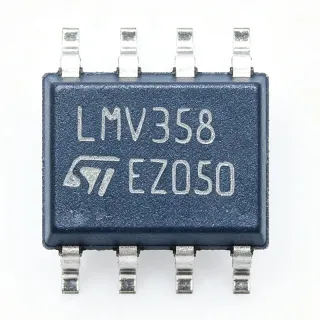
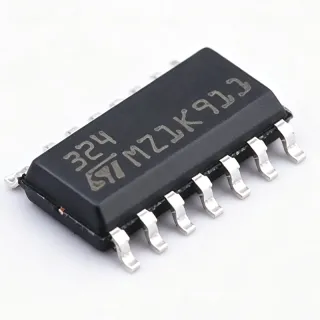
LM324DR2G - Quad Op Amp, 3-32V, 1MHz SOIC-14 | onsemi
MPN: LM324DR2G ✓ Active| Qty | Unit Price | Extended |
|---|---|---|
| 1 | $0.45 | $0.45 |
| 10 | $0.38 | $3.80 |
| 100 | $0.29 | $29.00 |
| 500 | $0.24 | $120.00 |
| 1,000 | $0.21 | $210.00 |
LM324DR2G Overview
An operational amplifier (op-amp) is a high-gain voltage amplifier with differential inputs and a single-ended output, the foundational building block of the analog signal-chain hierarchy: op-amp -> amplifier IC -> analog front end -> mixed-signal system. The LM324 family is the industry-standard general-purpose quad op-amp, designed specifically for single-supply operation where its input common-mode range includes ground and its output swings to within tens of millivolts of the negative rail.
Key features include a wide single-supply range of 3V to 32V, a common-mode input range that extends to the negative rail (ground-sensing capability), a typical input offset voltage of 5 mV (7 mV max per datasheet specifications), a minimum common-mode rejection ratio of 65 dB, and low supply current per amplifier that suits battery-powered designs. Four amplifiers in one SOIC-14 package reduce board area and BOM cost versus four single op-amps.
The bipolar architecture is internally frequency-compensated, so no external compensation capacitors are required for unity-gain stability. Because all four amplifiers share one bias network, supply current is lower than four discrete units; however, channels can exhibit minor crosstalk in high-gain audio paths.
Typical applications include transducer amplifiers, active filters, comparators (with caution regarding slow recovery), DC gain blocks, level shifters, and signal conditioning in industrial controls, consumer appliances, and automotive-adjacent systems.
Designers should note the output stage is not rail-to-rail and can crossover-distort when sourcing current near the negative rail; biasing the output with a pull-down resistor mitigates this. Gain-bandwidth is 1 MHz, so keep closed-loop gains modest for bandwidth-critical circuits.
This page adds value beyond the datasheet with distributor pricing tiers, verified drop-in alternatives, a parameter-by-parameter comparison table, and practical design notes not found on the manufacturer product page.
Drop-in alternatives for LM324DR2G — same package, pin-to-pin compatible. Different-package parts requiring PCB rework are excluded.
Variants in this series
Same-series models that are drop-in compatible with LM324DR2G (same form factor and footprint) — differing in Amplifier Type, Package, Packaging, Slew Rate.
Quick Comparison Tool — Select alternative parts for side-by-side comparison:
LM324ADR2G
✅ Drop-In✓ In Stock
$0.18 / Unit
View Datasheet →LM324DRG
✅ Drop-In📋 Reference alternative (not in catalog)
LM324DRG3
✅ Drop-In📋 Reference alternative (not in catalog)
LM324DR
✅ Drop-In📋 Reference alternative (not in catalog)
TL074CDR
✅ Drop-In📋 Reference alternative (not in catalog)
LM324DR2G Maximum Ratings & Electrical Characteristics
| Number of Channels | 4 |
| Amplifier Type | General Purpose Operational Amplifier |
| Supply Voltage Range (Single) | 3 V to 32 V |
| Supply Voltage Range (Dual) | +/-1.5 V to +/-16 V |
| Gain Bandwidth Product | 1 MHz |
| Slew Rate | 0.6 V/us |
| Input Offset Voltage | 5 mV typ / 7 mV max |
| CMRR (Min) | 65 dB |
| Operating Temperature | 0C to +70C (Commercial) |
| Package | SOIC-14, 14 pins |
| Mounting Type | Surface Mount |
| Architecture | Bipolar, internally compensated |
| Packaging | Tape & Reel, 2500 units |
| MSL Rating | 1 (260C) |
| Compliance | PbAH (Pb-free) |
| Case Outline | 751A-03 |
LM324DR2G Pin Configuration
| Pin 1 | OUT1 — Output of amplifier 1 |
| Pin 2 | IN1- — Inverting input, amplifier 1 |
| Pin 3 | IN1+ — Non-inverting input, amplifier 1 |
| Pin 4 | V+ — Positive supply (up to 32 V single supply) |
| Pin 5 | IN2+ — Non-inverting input, amplifier 2 |
| Pin 6 | IN2- — Inverting input, amplifier 2 |
| Pin 7 | OUT2 — Output of amplifier 2 |
| Pin 8 | OUT3 — Output of amplifier 3 |
| Pin 9 | IN3- — Inverting input, amplifier 3 |
| Pin 10 | IN3+ — Non-inverting input, amplifier 3 |
| Pin 11 | V-/GND — Negative supply or ground in single-supply operation |
| Pin 12 | IN4+ — Non-inverting input, amplifier 4 |
| Pin 13 | IN4- — Inverting input, amplifier 4 |
| Pin 14 | OUT4 — Output of amplifier 4 |
Typical Applications
LM324DR2G is suitable for 6 applications: Transducer Signal Conditioning, Active Filters, DC Gain Blocks and Level Shifters, Industrial Control Systems, Consumer Appliance Boards, Comparator and Threshold Detection Circuits.
Transducer Signal Conditioning
The LM324DR2G excels in transducer amplifier front ends because its input common-mode range extends to ground, allowing direct amplification of sensor outputs referenced to 0V on a single supply. With a 1 MHz gain-bandwidth product, a gain-of-100 stage still delivers 10 kHz bandwidth, sufficient for temperature, pressure, and light sensors with slow dynamics. Four amplifiers per SOIC-14 package let designers implement sensor gain, offset correction, and an anti-alias filter from a single IC, cutting board area and cost. Place a gain-setting network so that the 7 mV maximum offset error produces acceptable output error; for milli volt-level sensors, use the LM324ADR2G A-grade variant instead.
Recommended
Active Filters
Multiple-feedback and Sallen-Key active filters are a classic use for the LM324DR2G: four op-amps per SOIC-14 package can implement a complete 4th-order filter (two biquad stages) in one IC on a single 5V to 32V rail. The internally compensated bipolar input needs no external frequency compensation, and unity-gain-stable operation simplifies low-Q Sallen-Key topologies. Bandwidth considerations are concrete: at a filter corner of 10 kHz with gain-of-10 sections, the 1 MHz GBW leaves adequate margin to keep the Q accurate. Designers should keep resistor impedances in the 10k-100k range to avoid loading the modest output drive, and remember the output cannot swing rail-to-rail.
Recommended
DC Gain Blocks and Level Shifters
As a general-purpose DC gain block, the LM324DR2G provides non-inverting or inverting gain from single-rail 3V to 32V systems, with output swing approaching the negative rail for near-zero-referenced signals. Typical configurations include gain-of-10 and gain-of-11 amplifiers scaling a 0-3.3V ADC input from a 0-0.33V sensor, or summing amplifiers shifting signal levels between analog domains. The 65 dB minimum CMRR and bipolar input keep mid-band errors manageable, while the 5 mV typical offset dominates DC accuracy at low gains. Because quiescent current per amplifier is low, battery-powered instruments can run continuous monitoring from the LM324DR2G without a significant battery-life penalty.
Recommended
Industrial Control Systems
Industrial controllers running from 24V rails benefit directly from the LM324DR2G's 32V maximum single-supply rating, which tolerates unregulated plant power without a pre-regulator. Four amplifiers service multiple control loops - setpoint comparison, error amplification, and actuator drive scaling - from one package. The ground-sensing input range allows direct interface with grounded sensors and potentiometers, and the commercial 0C to +70C rating covers panel-mounted indoor equipment. Designers should add input series resistance and clamp diodes for protection against inductive transients common on factory floors, and reserve the LM324ADR2G for loops where the 7 mV offset maximum would otherwise create unacceptable steady-state error.
Recommended
Consumer Appliance Boards
Cost-driven consumer appliances - coffee makers, air conditioners, chargers, and white goods - use the LM324DR2G for thermistor amplification, comparator-style thresholds, and buzzer drivers. Its commodity pricing (well under USD 0.50 at volume as of 2026-09-13), availability from 13 distributors, and RoHS/Pb-free onsemi 'G' suffix make it a safe long-term BOM choice. The 5V single-supply compatibility aligns with microcontroller-based control boards, and the output can directly drive LED indicators through series resistors. For products exposed to kitchen or outdoor temperatures, verify the commercial 0C to +70C range is adequate or substitute the automotive-rated LM2904 family, which offers similar functionality with extended ratings.
Recommended
Comparator and Threshold Detection Circuits
The LM324DR2G can serve as a low-speed comparator for threshold detection - battery-low warnings, level alarms, and window detectors - exploiting its open-loop gain and ground-sensing inputs. Designers must account for its limitations: the 0.6 V/us slew rate limits switching speed to the tens-of-kilohertz range, and the output stage recovers slowly from saturation, adding microseconds of response lag. Adding a few millivolts of hysteresis via positive feedback prevents output chatter near the threshold, and a pull-down resistor on the output improves the low-level swing. For nanosecond-class comparison, use a dedicated comparator instead; for slow supervisory thresholds, the LM324DR2G is an economical four-channel solution.
Recommended
Recommended Products Summary
Engineering reference data for LM324DR2G — comparison, design guidance, and compliance information.
Selection Guide
Comparison with Alternatives
| Parameter | This Product | LM324ADR2G | LM324DRG | LM324DR | TL074CDR |
|---|---|---|---|---|---|
| Package | SOIC-14 | SOIC-14 - same | SOIC-14 - same | SOIC-14 - same | SOIC-14 - same pinout |
| Brand | onsemi | onsemi | onsemi | Texas Instruments | Texas Instruments |
| Number of Channels | 4 | 4 | 4 | 4 | 4 |
| Supply Voltage (Single) | 3 V to 32 V | 3 V to 32 V | 3 V to 32 V | 3 V to 32 V | ~7 V to 36 V |
| Gain Bandwidth | 1 MHz | 1 MHz | 1 MHz | 1 MHz | 3 MHz |
| Slew Rate | 0.6 V/us | 0.6 V/us | 0.6 V/us | 0.5 V/us | 13 V/us |
| Input Common-Mode Includes Ground | Yes | Yes | Yes | Yes | No |
| Operating Temperature | 0C to +70C | 0C to +70C | 0C to +70C | 0C to +70C | 0C to +70C |
Key Differentiators
- Ground-sensing single-supply input range (vs TL074CDR)
- Precision upgrade path without PCB change (vs LM324ADR2G)
- Dual-source supply resilience (vs LM324DR (TI))
- Honest trade-off: slow output stage (vs TL074CDR)
Design Notes
The LM324 output stage is not rail-to-rail and exhibits crossover distortion when sourcing small currents near the negative rail. If your circuit drives a high-impedance load with output voltages under ~0.5V, add a pull-down resistor (typically 2k to 10k to ground) at the output to bias the output transistor on and linearize the crossover region. Also remember the output cannot approach the positive rail - reserve roughly 1.5V of headroom (the V+ minus a darlington drop) when setting signal swing, especially on 5V supplies.
Decouple the V+ pin (pin 4) with a 100 nF ceramic capacitor placed within a few millimeters of the pin, plus a bulk 10 uF per board. Because all four amplifiers share one bias network, fast output transitions on one channel can couple into the other three through the supply line; good decoupling and a solid ground plane suppress this crosstalk. Estimated: on a 32V rail the worst-case supply voltage is well within the 32V absolute rating, but verify total package dissipation P = (V+ - Vout) * Iout summed over all four channels stays inside the SOIC-14 thermal limits.
Keep input traces short and guard the high-impedance inverting node with ground ring where possible, since the bipolar input bias current, while modest, causes offset errors with large source resistances. Estimated: with 100k source impedance and typical bias current in the tens of nanoamperes, the input-error contribution can approach a millivolt - comparable to the offset spec itself. Route feedback resistors away from output traces of adjacent channels in the shared SOIC-14 body to minimize inter-channel crosstalk in high-gain configurations.
Budget the 1 MHz gain-bandwidth product against your closed-loop gain: a gain-of-100 stage limits bandwidth to roughly 10 kHz, and gain-of-1000 to about 1 kHz. For filter designs, keep the gain-bandwidth at least 20x the corner frequency to preserve Q accuracy. The 0.6 V/us slew rate limits full-power bandwidth; a 10 Vpp sine needs less than 10 kHz before slewing distortion appears. These are datasheet-architecture-level limits that apply to the whole LM324 family including the A-grade variant.
Compliance Information
PbAH (Pb-free) program per onsemi data; the 'G' suffix denotes lead-free/green package. MSL 1, 260C reflow. REACH and conflict-minerals declarations not stated in provided data - consult onsemi compliance portal.