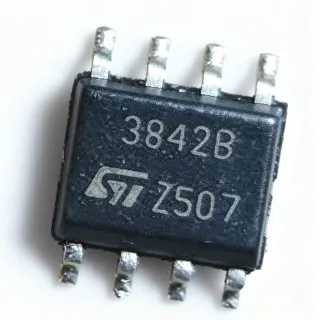
LTC3115-2EFE#TRPBF - 40V, 2A Sync Buck-Boost | Analog Devices
MPN: LTC3115-2EFE#TRPBF ✓ Active| Qty | Unit Price | Extended |
|---|---|---|
| 1 | $6.5 | $6.50 |
| 10 | $5.85 | $58.50 |
| 100 | $4.95 | $495.00 |
| 500 | $4.2 | $2,100.00 |
| 1,000 | $3.75 | $3,750.00 |
LTC3115-2EFE#TRPBF Overview
A buck-boost converter is a type of DC-DC switching regulator that can step up or step down an input voltage to produce a regulated output, regardless of whether the input is higher or lower than the output. This makes it ideal for battery-powered systems where the battery voltage may drop below the required rail. The LTC3115-2 belongs to the family of switching regulators, which are more efficient than linear regulators but generate switching noise that must be managed with proper filtering.
Key features include a wide 2.7V to 40V input and output range, 800mA/2A output current capability, and a proprietary switching algorithm that ensures seamless transitions between buck and boost modes. The device offers internal soft-start, short-circuit protection, and output disconnect in shutdown, with a low 3µA shutdown current. Its high efficiency, up to 95%, reduces thermal dissipation and extends battery life in portable applications.
Technically, the LTC3115-2 uses a current-mode control architecture with a fixed frequency of 1.2MHz, allowing the use of small, low-profile inductors and capacitors. The device is designed to handle fast input transients without output voltage deviation, making it suitable for automotive and industrial environments where supply lines can fluctuate rapidly. The exposed pad enhances thermal performance, enabling higher power dissipation in compact designs.
Typical applications include automotive power supplies, industrial control systems, battery-powered equipment, and portable instrumentation. Its ability to maintain a regulated output during input voltage dips makes it ideal for systems powered by multi-cell batteries or unregulated sources. The LTC3115-2 is also used in power-over-Ethernet (PoE) and USB power delivery applications.
When designing with this device, ensure proper input and output capacitor selection to minimize ripple and maintain stability. The exposed pad should be soldered to a large copper area for effective heat sinking. For applications not requiring fast transient response, the LTC3115-1 is recommended as a lower-cost alternative.
Drop-in alternatives for LTC3115-2EFE#TRPBF — same package, pin-to-pin compatible. Different-package parts requiring PCB rework are excluded.
Variants in this series
Same-series models that are drop-in compatible with LTC3115-2EFE#TRPBF (same form factor and footprint) — differing in Input Voltage Range, Operating Temperature, Output Type, Output Voltage Range, Package.
Quick Comparison Tool — Select alternative parts for side-by-side comparison:
LTC3115EFE-1#TRPBF
✅ Drop-In📋 Reference alternative (not in catalog)
LTC3115IFE-2#TRPBF
✅ Drop-In📋 Reference alternative (not in catalog)
LTC3115EFE-1#PBF
✅ Drop-In📋 Reference alternative (not in catalog)
TPS63070RNMT
✅ Drop-In ⚠️ Specs Unverified✓ In Stock
$1.4 / Unit
View Datasheet →LTC3115-2EFE#TRPBF Maximum Ratings & Electrical Characteristics
| Function | Buck-Boost |
| Output Type | Adjustable |
| Output Voltage Range | 2.7V to 40V |
| Input Voltage Range | 2.7V to 40V |
| Output Current (Buck) | 800mA |
| Output Current (Boost) | 2A |
| Switching Frequency | 1.2MHz |
| Shutdown Current | 3µA |
| Efficiency | Up to 95% |
| Package | 20-TSSOP Exposed Pad |
| Mounting Type | Surface Mount |
| Operating Temperature | -40°C to +125°C |
| Number of Outputs | 1 |
| Synchronous Rectifier | Yes |
| RoHS Status | Compliant |
LTC3115-2EFE#TRPBF Pin Configuration
| Pin 1 | SW1 — Switch node for buck converter |
| Pin 2 | PVIN1 — Power input for buck stage |
| Pin 3 | PVIN2 — Power input for boost stage |
| Pin 4 | SW2 — Switch node for boost converter |
| Pin 5 | GND — Ground |
| Pin 6 | GND — Ground |
| Pin 7 | FB — Feedback input for output voltage regulation |
| Pin 8 | VOUT — Output voltage sense |
| Pin 9 | SHDN — Shutdown control (active low) |
| Pin 10 | SYNC — External clock synchronization input |
| Pin 11 | MODE — Mode selection (PWM or Burst Mode) |
| Pin 12 | SS — Soft-start programming |
| Pin 13 | ITH — Error amplifier output for loop compensation |
| Pin 14 | VCC — Internal supply voltage (bypass with capacitor) |
| Pin 15 | GND — Ground |
| Pin 16 | GND — Ground |
| Pin 17 | SW2 — Switch node for boost converter |
| Pin 18 | PVIN2 — Power input for boost stage |
| Pin 19 | PVIN1 — Power input for buck stage |
| Pin 20 | SW1 — Switch node for buck converter |
Typical Applications
LTC3115-2EFE#TRPBF is suitable for 6 applications: Automotive Power Supplies, Industrial Control Systems, Battery-Powered Equipment, Portable Instrumentation, Power-over-Ethernet (PoE), USB Power Delivery.
Automotive Power Supplies
The LTC3115-2EFE#TRPBF is ideal for automotive power supplies due to its wide 2.7V to 40V input range and fast transient response. It can handle load dumps and cold-crank conditions, maintaining a regulated output for ECUs, sensors, and infotainment systems. Its synchronous architecture delivers up to 95% efficiency, reducing heat in the engine bay. The 1.2MHz switching frequency allows small external components, saving PCB space. With output current up to 2A in boost mode, it can power multiple loads from a 12V battery during cranking dips.
Recommended
Industrial Control Systems
In industrial control systems, the LTC3115-2EFE#TRPBF provides a stable output from fluctuating 24V rails. Its fast transient response ensures minimal voltage deviation during motor start-ups or relay switching. The wide input range accommodates brownout conditions, and the 3µA shutdown current helps meet standby power regulations. The exposed pad package aids thermal management in sealed enclosures. With 800mA buck and 2A boost capability, it can power microcontrollers, sensors, and communication interfaces from a single converter.
Recommended
Battery-Powered Equipment
The LTC3115-2EFE#TRPBF is well-suited for battery-powered equipment, such as portable instruments and wireless sensors. Its wide input range allows operation from a single Li-ion cell (2.7V to 4.2V) down to 2.7V, maximizing battery utilization. The low 3µA shutdown current extends shelf life, and the high efficiency (up to 95%) reduces power loss, prolonging runtime. The 1.2MHz switching frequency enables the use of small inductors, making the design compact. The output can be regulated at 3.3V or 5V, powering microcontrollers, RF modules, and sensors.
Recommended
Portable Instrumentation
For portable instrumentation, the LTC3115-2EFE#TRPBF provides a clean, regulated supply from batteries or USB power. Its fast transient response ensures accurate measurements even when the input voltage dips. The adjustable output allows tailoring to specific ADC or sensor requirements. The small TSSOP package and integrated switches reduce component count, saving board space. With 800mA buck and 2A boost, it can power a variety of analog front-ends, displays, and wireless interfaces. The device's low shutdown current is ideal for battery-operated field instruments.
Recommended
Power-over-Ethernet (PoE)
The LTC3115-2EFE#TRPBF is used in PoE powered devices (PDs) to convert the 48V PoE input down to a regulated 5V or 3.3V rail. Its wide input range (2.7V to 40V) covers the PoE voltage range, and its buck-boost topology ensures operation even when the input voltage is close to the output. The fast transient response handles load steps from communication circuits. The high efficiency reduces heat in compact PoE modules. The 1.2MHz switching frequency allows small transformers and capacitors, enabling a compact form factor.
Recommended
USB Power Delivery
In USB Power Delivery (PD) applications, the LTC3115-2EFE#TRPBF can regulate the output voltage from a variable input, such as a battery or solar panel. Its wide input range (2.7V to 40V) supports various power sources, and the buck-boost topology allows the output to be set above or below the input. The fast transient response ensures stable voltage during load changes, critical for USB PD. The high efficiency reduces heat in compact adapters. The device can be used in USB PD sources or sinks, providing a regulated 5V, 9V, 15V, or 20V output.
Recommended
Recommended Products Summary
Engineering reference data for LTC3115-2EFE#TRPBF — comparison, design guidance, and compliance information.
Selection Guide
Comparison with Alternatives
| Parameter | This Product | LTC3115EFE-1#TRPBF | LTC3115IFE-2#TRPBF | TPS63070RNMT |
|---|---|---|---|---|
| Package | 20-TSSOP Exposed Pad | 20-TSSOP Exposed Pad | 20-TSSOP Exposed Pad | VQFN-20 (RNM) |
| Brand | Analog Devices | Analog Devices | Analog Devices | Texas Instruments |
| Input Voltage Range | 2.7V to 40V | 2.7V to 40V | 2.7V to 40V | 2V to 16V |
| Output Current (Buck) | 800mA | 1A | 800mA | 2A |
| Output Current (Boost) | 2A | 2A | 2A | 2A |
| Switching Frequency | 1.2MHz | 1.2MHz | 1.2MHz | 2.4MHz |
| Shutdown Current | 3µA | 3µA | 3µA | 15µA |
| Fast Transient Optimization | Yes | No | Yes | No |
Key Differentiators
- Optimized for fast input transients (vs LTC3115EFE-1#TRPBF)
- Wide input voltage range up to 40V (vs TPS63070RNMT)
- Low shutdown current of 3µA (vs TPS63070RNMT)
Design Notes
Place input and output capacitors as close to the IC pins as possible to minimize parasitic inductance. Use a 10µF ceramic capacitor on the input and a 10µF ceramic capacitor on the output. Add a 0.1µF ceramic capacitor for high-frequency bypass. The exposed pad should be soldered to a large copper area for thermal dissipation.
The LTC3115-2EFE#TRPBF can dissipate significant power at high output currents. For example, at 12V input, 5V output, and 2A load, power dissipation is approximately 14W. The 20-TSSOP package has a thermal resistance of about 40°C/W (theta_JA). Ensure adequate copper area or a heatsink to keep the junction temperature below 125°C.
Do not exceed the absolute maximum input voltage of 40V. Ensure the feedback resistor divider uses 1% tolerance resistors to maintain output voltage accuracy. The SS pin controls soft-start time; a 0.1µF capacitor is typical. The SYNC pin can be left floating or tied to ground for internal 1.2MHz operation.
Compliance Information
RoHS compliant per Analog Devices product page. Not AEC-Q100 qualified; for automotive, consider the LTC3115IFE-2#TRPBF which is not explicitly qualified either. REACH compliance is assumed based on ADI's policy.