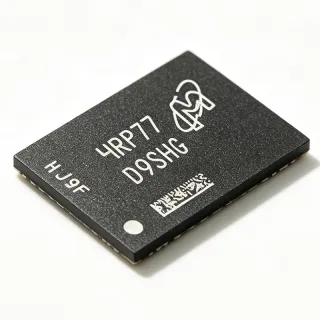
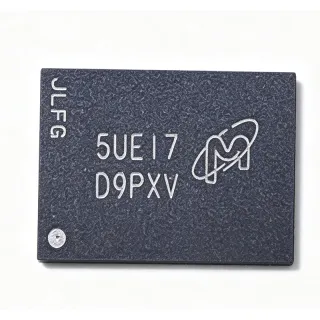
M29W128GH70ZS3E - 128Mb 70ns Parallel NOR Flash | Micron
MPN: M29W128GH70ZS3E ✓ Active| Qty | Unit Price | Extended |
|---|---|---|
| 1 | $8.9 | $8.90 |
| 10 | $8.01 | $80.10 |
| 100 | $7.12 | $712.00 |
| 500 | $6.41 | $3,205.00 |
| 1,000 | $5.78 | $5,780.00 |
M29W128GH70ZS3E Overview
Parallel NOR flash is a nonvolatile memory technology that supports random word-addressed reads, making it well suited to storing boot code and firmware that a microprocessor executes or copies directly from memory (XIP). In the memory hierarchy, NOR flash sits alongside DRAM and SRAM as a directly addressable memory IC, distinguished from NAND flash by its fast random access and byte-level erasure granularity at the cost of lower density per bit.
Key features of the M29W128GH70ZS3E include its 70 ns access time, which supports zero-wait-state execution from fast processors, and a wide 2.7 V to 3.6 V operating supply that suits 3.3 V and battery-backed systems. The device offers hardware and software block protection, a Common Flash Interface (CFI) for software tool discovery of parameters, and extended automotive-grade temperature support to +125C.
Architecturally, the memory is divided into erase blocks that can be independently erased and programmed using standard command-set operations. The top boot block organization places the boot code blocks at the top of the address map, keeping critical firmware close to the reset vector of common CPU architectures. Status polling and data polling streamline programming algorithms without additional handshake pins.
Typical applications include automotive body and powertrain modules, industrial control systems, networking equipment boot storage, and set-top boxes. The extended -40C to +125C temperature rating and 3 V rail compatibility make it a natural fit for under-hood and industrial environments where consumer-grade flash cannot survive.
Designers should note that asynchronous parallel NOR consumes more address and data lines than serial NOR, so PCB routing and bus loading must be considered; supply decoupling of at least 0.1 uF per supply pin is recommended per Micron layout guidance.
This page synthesizes distributor availability, same-family drop-in options, and practical design notes not found in the manufacturer datasheet, with pricing references as of 2026-09-02.
Drop-in alternatives for M29W128GH70ZS3E — same package, pin-to-pin compatible. Different-package parts requiring PCB rework are excluded.
Variants in this series
Same-series models that are drop-in compatible with M29W128GH70ZS3E (same form factor and footprint) — differing in Package, Organization, Supply Voltage, Interface, Memory Type.
Quick Comparison Tool — Select alternative parts for side-by-side comparison:
M29W128GH70ZA3E
✅ Drop-In ⚠️ Specs Unverified✓ In Stock
$2.7 / Unit
View Datasheet →M29W128GL70ZS3E
✅ Drop-In ⚠️ Specs Unverified✓ In Stock
$2.39 / Unit
View Datasheet →M29W128GH70ZS6T
✅ Drop-In ⚠️ Specs Unverified📋 Reference alternative (not in catalog)
M29W128GH70ZS3E Maximum Ratings & Electrical Characteristics
| Memory Type | Parallel NOR Flash (SLC) |
| Density | 128 Mbit (16 MB) |
| Organization | 8M x16 (x8/x16 capable family) |
| Access Time | 70 ns |
| Supply Voltage | 2.7 V to 3.6 V |
| Interface | Parallel, Asynchronous |
| Boot Block | Top Boot Block |
| Operating Temperature | -40C to +125C |
| Package | 64-FBGA (11 x 13 mm), LBGA |
| Mounting Type | Surface Mount |
| Technology | NOR Flash, SLC |
| Common Flash Interface | Yes |
| Block Protection | Hardware/Software block protection |
| Automotive Temperature Grade | Yes (-40C to +125C) |
M29W128GH70ZS3E 64-fbga (11 x 13 mm), lbga Pin Configuration Guide
Pin configuration for M29W128GH70ZS3E (64-fbga (11 x 13 mm), lbga package). This digital IC includes GPIO, communication interfaces (UART, SPI, I2C), and power pins. Refer to the manufacturer datasheet for alternate pin functions and configuration options. Essential for embedded system design and PCB layout.

No detailed pinout data available for M29W128GH70ZS3E.
Refer to the datasheet for full pin configuration.
Typical Applications
M29W128GH70ZS3E is suitable for 6 applications: Automotive Body and Powertrain Modules, Industrial Control and PLC Boot Storage, Networking Equipment Boot Code, Set-Top Boxes and Consumer Multimedia, Test and Measurement Instrumentation, Aerospace and Rugged Embedded Systems.
Automotive Body and Powertrain Modules
The M29W128GH70ZS3E is well suited to automotive body control, gateway, and powertrain modules because its -40C to +125C operating range meets under-hood and near-engine temperature requirements where consumer flash would fail. Partstack explicitly lists this MPN with automotive temperature grade. Its 70 ns asynchronous access supports fast boot-code fetch by automotive MCUs, while the top boot block keeps calibration data and reset vectors in a protected region. Placed on the MCU's external bus with 0.1 uF decoupling per supply ball, the device provides 16 MB of reliable SLC NOR firmware storage; the trade-off versus modern serial NOR is higher pin count and board area, acceptable when reusing an existing parallel-bus PCB.
Recommended
Industrial Control and PLC Boot Storage
Industrial programmable logic controllers and motor-drive controllers require nonvolatile firmware that survives wide temperature swings and electrical noise, making the M29W128GH70ZS3E's SLC NOR with -40C to +125C rating a strong fit. The 70 ns access time allows the main processor to execute configuration code directly from flash without a RAM shadow copy, shortening cold-start time. Its hardware/software block protection prevents accidental corruption of the bootloader during field firmware updates. Designed into the parallel address/data bus with proper series termination, the device offers deterministic read timing; designers should budget for the 2.7 V to 3.6 V rail with clean LDO supply to avoid program/erase errors at the 3.6 V upper margin.
Recommended
Networking Equipment Boot Code
Routers, switches, and line cards historically boot from parallel NOR because the CPU reset vector executes straight from flash with random access. The M29W128GH70ZS3E provides 16 MB of boot/firmware storage with 70 ns access, sufficient for bootloaders plus compressed OS images in telecom hardware. The top boot block organization aligns with common network processor boot maps, and the Common Flash Interface lets the bootloader software discover erase-block geometry automatically. Compared with SPI NOR such as Micron MT25QL128, this parallel device reduces boot latency but consumes roughly 40 address/data/control pins; it is the correct choice for legacy network backplanes already routed for parallel NOR FBGA footprints.
Recommended
Set-Top Boxes and Consumer Multimedia
Set-top box and digital TV platforms use parallel NOR for the primary bootloader that initializes the SoC before loading the main OS from eMMC or NAND. The M29W128GH70ZS3E's 70 ns read and 8M x16 organization match the boot-ROM interfaces of many media processors, and its 16 MB density holds splash-screen assets and recovery kernels alongside the bootloader. The 2.7 V to 3.6 V single supply integrates directly with 3.3 V board rails. Its SLC architecture delivers higher endurance and data retention than MLC alternatives, an advantage for devices that perform frequent OTA firmware updates; block protection safeguards the immutable boot region during those updates.
Recommended
Test and Measurement Instrumentation
Oscilloscopes, data loggers, and bench instruments benefit from the M29W128GH70ZS3E's combination of fast random access and long-term data retention for storing calibration constants, boot firmware, and instrument settings. The -40C to +125C rating tolerates harsh lab-adjacent and field environments, and SLC NOR ensures calibration data remains intact over years of power cycles. Its asynchronous parallel interface provides deterministic timing without serial protocol overhead, which helps meet tight instrument power-on-to-ready specifications. When layout allows, designers place the device close to the processor with short bus traces and 0.1 uF per supply ball decoupling; the FBGA 11 x 13 mm body keeps the memory footprint compact on dense main boards.
Recommended
Aerospace and Rugged Embedded Systems
Ruggedized industrial-aerospace compute modules - drones, avionics ground support, and satellite test equipment - demand memory that retains firmware through vibration, thermal cycling, and radiation-adjacent environments. While the M29W128GH70ZS3E is not a radiation-hardened part, its extended -40C to +125C automotive temperature grade and SLC NOR reliability make it appropriate for ground-based rugged systems. The 70 ns asynchronous access removes controller latency from boot-critical code, and the 64-ball FBGA's short ball interconnects improve signal integrity versus TSOP leaded packages at bus speeds. Follow Micron's recommended reflow profile for BGA assembly and consider conformal coating since FBGA solder joints cannot be visually inspected after assembly.
Recommended
Recommended Products Summary
Engineering reference data for M29W128GH70ZS3E — comparison, design guidance, and compliance information.
Selection Guide
Comparison with Alternatives
| Parameter | This Product | M29W128GH70ZA3E | M29W128GL70ZS3E | M29W128GH70ZS6T |
|---|---|---|---|---|
| Package | 64-FBGA (11 x 13 mm) | 64-FBGA (variant ball map) | 64-FBGA (11 x 13 mm) - same | 64-FBGA (11 x 13 mm) - same |
| Brand | Micron Technology | Micron Technology | Micron Technology | Micron Technology |
| Density | 128 Mbit | 128 Mbit | 128 Mbit | 128 Mbit |
| Access Time | 70 ns | 70 ns | 70 ns | 80 ns |
| Supply Voltage | 2.7 V to 3.6 V | 2.7 V to 3.6 V | 2.7 V to 3.6 V | 2.7 V to 3.6 V |
| Operating Temperature | -40C to +125C | -40C to +125C | -40C to +125C | -40C to +125C |
| Boot Block Position | Top Boot | Top Boot | Bottom Boot | Top Boot |
| Interface | Parallel, Asynchronous | Parallel, Asynchronous | Parallel, Asynchronous | Parallel, Asynchronous |
Key Differentiators
- 70 ns asynchronous random access for XIP boot (vs MT25QL128ABB8E12-0AUT)
- Automotive-grade temperature range in a compact FBGA (vs M29F800FT55N3E2)
- Trade-off: higher pin count than serial NOR (vs MT25QL128ABB8E12-0AUT)
Design Notes
The 64-ball FBGA package requires careful footprint generation from the official Micron M29W128GH/GL datasheet ball map - do not copy footprints from other FBGA NOR parts, as ball assignments for address/data/control differ between families. FBGA solder joints cannot be visually inspected, so plan AOI or X-ray inspection for production. Route parallel address/data bus traces with matched lengths where the processor bus exceeds roughly 50 MHz equivalent timing, and add 22-33 ohm series resistors on bus lines to control reflections and reduce EMI.
Operate from a clean 3.3 V rail within the 2.7 V to 3.6 V specification. During program and erase operations, supply current spikes occur; provide at least 0.1 uF ceramic decoupling directly at each VCC ball plus 10 uF bulk capacitance near the device. Estimated: a brown-out during erase can corrupt a block, so pair the flash with a supply supervisor that holds the system in reset until VCC is stable, protecting boot-block integrity in automotive and industrial power profiles.
Do not assume pin compatibility across FBGA NOR families or suffix variants: the ZA3E ball-map suffix differs from ZS3E, and Spansion/Cypress S29AL128J uses a different ball-out despite similar specs. Always verify with the datasheet ball-out table before qualifying a substitution. Also use the Common Flash Interface (CFI) in your programmer software rather than hardcoded block geometry, since erase-block layouts differ between top-boot (GH) and bottom-boot (GL) versions of the same 128 Mb die.
Compliance Information
Compliance flags were not captured in the retrieved web data. Verify RoHS/REACH/lead-free status on Micron's official product page or the DigiKey compliance documents for this MPN. Partstack lists the part with automotive temperature grade, but formal AEC-Q100 qualification was not stated in the data.