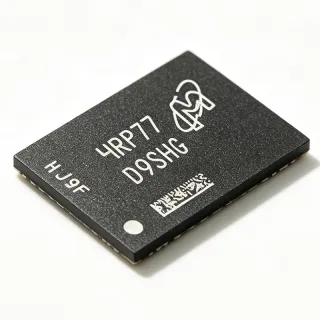
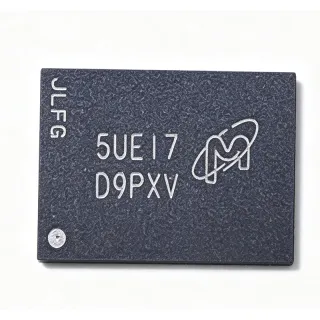
MT41K128M16JT-125 AUT:K - 2Gbit DDR3L SDRAM 96-FBGA | Micron
MPN: MT41K128M16JT-125 AUT:K ✓ Active| Qty | Unit Price | Extended |
|---|---|---|
| 1 | $15.21 | $15.21 |
| 10 | $14.45 | $144.50 |
| 100 | $13.69 | $1,369.00 |
| 500 | $12.93 | $6,465.00 |
| 1,000 | $12.17 | $12,170.00 |
MT41K128M16JT-125 AUT:K Overview
DDR3L SDRAM (Double Data Rate 3 Low Voltage synchronous dynamic random access memory) is a JEDEC-standard DRAM family that stores data in capacitor-based cells refreshed at regular intervals. Within the memory hierarchy, it sits between embedded SRAM and high-density storage, serving as the primary working memory for processors, SoCs, and FPGAs. The 'L' designation denotes low-voltage operation at 1.35V, fully backward compatible with 1.5V DDR3 systems per JEDEC specifications.
Key features include 2 Gbit density in a single 128M x 16 organization, a -125 speed grade supporting 1600 MT/s data transfers, an automotive operating temperature range of -40C to +125C, and 1.35V nominal supply for reduced power consumption versus 1.5V DDR3. The AUT:K suffix identifies Micron's automotive product line with extended quality screening.
Technically, the device uses an 8n-prefetch architecture internal to the core, with programmable CAS latency, on-die termination (ODT), and asynchronous reset support per DDR3L standards. The 16-bit wide data interface simplifies layout versus x32 parts and allows stacking multiple devices for 32-bit or 64-bit buses in embedded compute modules.
Typical applications include automotive infotainment and telematics systems, ADAS sensor fusion platforms requiring validated memory, industrial control and human-machine interfaces, and network equipment operating over extended temperature ranges.
Design consideration: DDR3L signal integrity demands length-matched fly-by routing of address/command lines, per-byte-tree data routing, and careful VTT termination; the 96-FBGA (8x14) footprint requires controlled-impedance PCB stackup for 1600 MT/s operation.
This page synthesizes distributor pricing, drop-in alternatives, application guidance, and FAQ content not consolidated in the manufacturer datasheet.
Drop-in alternatives for MT41K128M16JT-125 AUT:K — same package, pin-to-pin compatible. Different-package parts requiring PCB rework are excluded.
Variants in this series
Same-series models that are drop-in compatible with MT41K128M16JT-125 AUT:K (same form factor and footprint) — differing in Package, Clock Frequency, Organization, Access Time, Memory Size.
Quick Comparison Tool — Select alternative parts for side-by-side comparison:
MT41K128M16JT-125:K
✅ Drop-In✓ In Stock
$9.75 / Unit
View Datasheet →MT41K128M16JT-125 AUT:K TR
✅ Drop-In📋 Reference alternative (not in catalog)
MT41K64M16TW-107 AUT:J
✅ Drop-In✓ In Stock
$2.85 / Unit
View Datasheet →MT41K64M16TW-107
✅ Drop-In✓ In Stock
$2.95 / Unit
View Datasheet →K4B4G1646E-BYK000
✅ Drop-In✓ In Stock
$0.5619 / Unit
View Datasheet →MT41K128M16JT-125 AUT:K Maximum Ratings & Electrical Characteristics
| Memory Type | DDR3L SDRAM |
| Memory Size | 2 Gbit |
| Organization | 128M x 16 |
| Clock Frequency | 800 MHz |
| Access Time | 13.75 ns |
| Supply Voltage | 1.35 V |
| Interface | Parallel |
| Speed Grade | -125 (1600 MT/s) |
| Package | 96-FBGA (8x14) |
| Operating Temperature | -40C to +125C |
| Automotive Qualification | Yes (AUT part number suffix) |
| Mounting Type | Surface Mount |
| Marking Code | D9VKD |
| Data Rate | 1600 MT/s |
| Packaging Option | Tape & Reel (TR suffix variant available) |
MT41K128M16JT-125 AUT:K 96-fbga (8x14) Pin Configuration Guide
Pin configuration for MT41K128M16JT-125 AUT:K (96-fbga (8x14) package). This digital IC includes GPIO, communication interfaces (UART, SPI, I2C), and power pins. Refer to the manufacturer datasheet for alternate pin functions and configuration options. Essential for embedded system design and PCB layout.

No detailed pinout data available for MT41K128M16JT-125 AUT:K.
Refer to the datasheet for full pin configuration.
Typical Applications
MT41K128M16JT-125 AUT:K is suitable for 6 applications: Automotive Infotainment and Telematics, ADAS Sensor Fusion Platforms, Industrial Control and HMI, Embedded Compute Modules, Network Equipment and Routers, Medical and Diagnostic Instrumentation.
Automotive Infotainment and Telematics
Automotive head units, cluster displays, and telematics control units demand memory that survives cabin extremes while feeding high-resolution graphics. The MT41K128M16JT-125 AUT:K fits because its -40C to +125C automotive rating covers cold cranks and desert soaks, and its 1600 MT/s bandwidth over a 16-bit bus supplies roughly 3.2 GB/s of peak throughput for map rendering and video decode pipelines. Placed as the SoC's main memory in the standard 96-FBGA footprint, it supports fly-by C/A routing with on-die termination, reducing stub reflections at speed. The 1.35V operation lowers dynamic power versus 1.5V DDR3, easing thermal budgets in sealed enclosures.
Recommended
ADAS Sensor Fusion Platforms
ADAS domains aggregate camera, radar, and lidar streams into fusion processors that need validated, high-bandwidth working memory. The MT41K128M16JT-125 AUT:K aligns with these requirements through its 2 Gbit capacity buffering multi-sensor frame data, 800 MHz operation feeding fusion SoCs, and Micron automotive screening consistent with AEC-oriented platform flows. In a typical design, the DDR3L sits on a 16-bit bus with per-byte ODT and reset support, enabling low-power self-refresh during standby perception modes. Its -40C to +125C range suits modules mounted near headlamp units or sensor housings where ambient excursions exceed consumer ratings.
Recommended
Industrial Control and HMI
Industrial PLCs, motion controllers, and human-machine interface panels run Linux or RTOS images whose working sets need hundreds of megabytes of reliable RAM. The MT41K128M16JT-125 AUT:K serves these designs with 2 Gbit in one chip, simplifying BOM versus two 1 Gbit parts, and the extended -40C to +125C window covers unconditioned factory floors and outdoor cabinets. Its 1.35V rail simplifies power tree design alongside 1.8V and 3.3V logic, while the 96-FBGA (8x14) package keeps routing dense on HMI PCBs. At 1600 MT/s the bus sustains GUI compositing and protocol stacks without becoming the throughput bottleneck.
Recommended
Embedded Compute Modules
SoM and COM form factors stack x16 DDR3L devices to build 32-bit or 64-bit memory buses on small modules. The MT41K128M16JT-125 AUT:K is a natural choice because the 128M x 16 organization pairs two or four chips symmetrically, its 1600 MT/s grade matches mainstream ARM SoC memory controllers, and the uniform 96-FBGA (8x14) footprint enables mirror-placement routing. The AUT:K automotive variant lets one module design serve both industrial and automotive customers with a single layout. Designers should verify controller drive strength and ZQ calibration scheduling when populating multiple loads on the fly-by bus.
Recommended
Network Equipment and Routers
Edge routers, industrial gateways, and network appliances buffer packets in DRAM while CPUs run routing stacks. The MT41K128M16JT-125 AUT:K provides 2 Gbit of packet-buffer and table memory with 1600 MT/s transfers, adequate for multi-gigabit forwarding when combined with efficient buffer management. Its 1.35V operation trims power in always-on network hardware where energy budgets are contractual, and the wide -40C to +125C range permits sealed, fanless outdoor installations. The 16-bit interface lets designers double bandwidth easily with a second device rather than migrating to wider, harder-to-route packages.
Recommended
Medical and Diagnostic Instrumentation
Benchtop analyzers, portable ultrasound, and patient-monitoring hardware capture and process imaging or signal datasets in volatile memory. The MT41K128M16JT-125 AUT:K contributes 2 Gbit capacity for frame buffers, an 800 MHz DDR3L interface matching common medical SoCs, and conservative automotive-grade quality screening that medical teams often reuse as a supply-quality proxy. Operation at 1.35V reduces heat inside fanless enclosed instruments, supporting quiet bedside operation. Because data integrity matters, enable controller-level scrubbing and ECC where the CPU supports it; the x16 organization supports some SoC ECC-by-16 schemes without a dedicated device.
Recommended
Recommended Products Summary
Engineering reference data for MT41K128M16JT-125 AUT:K — comparison, design guidance, and compliance information.
Selection Guide
Comparison with Alternatives
| Parameter | This Product | MT41K128M16JT-125:K | MT41K64M16TW-107 AUT:J | K4B4G1646E-BYK000 |
|---|---|---|---|---|
| Package | 96-FBGA (8x14) | 96-FBGA (8x14) - same | 96-FBGA (8x14) - same | 96-FBGA (8x14) - same |
| Brand | Micron Technology | Micron Technology | Micron Technology | Samsung Electronics |
| Organization | 128M x 16 | 128M x 16 | 64M x 16 | x16 |
| Supply Voltage | 1.35 V (DDR3L) | 1.35 V (DDR3L) | 1.35 V (DDR3L) | 1.5 V (DDR3) |
| Automotive Grade | Yes (AUT:K) | No (standard grade) | Yes (AUT:J) | No (standard grade) |
Key Differentiators
- Automotive screening with -40C to +125C range (vs MT41K128M16JT-125:K)
- Double the density of the smaller family member (vs MT41K64M16TW-107 AUT:J)
- Low-voltage DDR3L operation (vs K4B4G1646E-BYK000)
Design Notes
At 1600 MT/s, route address/command lines in a fly-by topology terminated with VTT (0.675V, half of 1.35V) at the end of the chain, and route the DQ/DM/DQS byte groups as length-matched trees per byte lane. Keep all DDR3L traces on inner layers referenced to solid ground, control single-ended impedance near 40 ohms for address/command and 50 ohms for DQ, and match within-group skew tightly. Follow the Micron datasheet layout guidelines section for the 96-FBGA breakout pattern.
Provision three rails per JEDEC DDR3L practice: VDD/VDDQ at 1.35V, and VTT/VREF tracking at 0.675V capable of sourcing and sinking significant current during bus turnaround. Estimate VTT current as roughly half the peak per-pin current across terminated nets; use a dedicated sink-source VTT regulator rather than a resistor divider. Decouple VDDQ with a bulk capacitor per bank plus 0.1uF ceramics at ball pairs, placed inside the FBGA fanout area.
Do not substitute the standard-grade MT41K128M16JT-125:K into an automotive BOM without updating your qualification file - the AUT:K suffix carries the -40C to +125C screening and traceability. Verify the marking code D9VKD on incoming units to detect re-marked parts. Also confirm your memory controller supports 1.35V DDR3L initialization; DDR3 controllers without VDDQ-detect may mis-train when VTT/VREF is generated from the wrong reference.
For the 96-FBGA (8x14) footprint, use non-solder-mask-defined (NSMD) pads per Micron recommendation and fan out DQ balls to the nearest layer transitions within two via spans to limit stubs. Allow keep-out zones under the package for the center GND/ZQ balls, and place the VTT bulk capacitor within 5 mm of the termination net end. Reserve space for series termination resistors on clock and strobe nets for tuning after SI simulation.
Compliance Information
RoHS/REACH/lead-free status for this automotive DDR3L part was not explicitly stated in the retrieved distributor snippets; verify against Micron's official product environmental page. AEC-Q100 applicability not explicitly stated in retrieved data - the AUT:K suffix denotes Micron's automotive line, but the retrieved data does not confirm a specific AEC-Q100 grade.