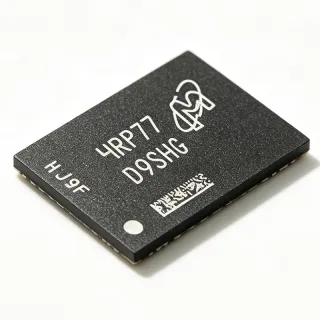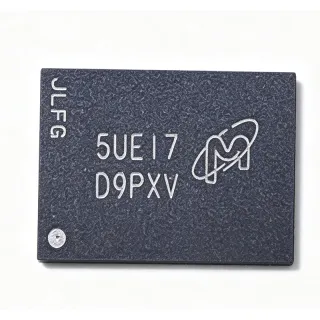
MT42L16M32D1HE-18 - 512Mb LPDDR2 SDRAM 134-VFBGA | Micron
MPN: MT42L16M32D1HE-18 ✓ Active| Qty | Unit Price | Extended |
|---|---|---|
| 1 | $4.2 | $4.20 |
| 10 | $3.95 | $39.50 |
| 100 | $3.55 | $355.00 |
| 500 | $3.2 | $1,600.00 |
| 1,000 | $2.9 | $2,900.00 |
MT42L16M32D1HE-18 Overview
LPDDR2 (Low Power Double Data Rate 2) is a JEDEC-defined memory standard derived from the DDR SDRAM family, optimized for battery-powered and thermally constrained systems. As a class of DRAM (itself a subclass of volatile memory within the broader power-management-aware memory hierarchy), LPDDR2 reduces core and I/O voltage, adds low-power states such as self-refresh and deep power-down, and integrates initialization and calibration features on-die.
Key features of the MT42L16M32D1HE include its x32 bus width for high peak bandwidth per package, 1.2V VDD and VDDQ operation that minimizes dynamic power, and support for clock-stop, power-down, and self-refresh modes that cut standby consumption. The -18 speed grade corresponds to a 533 MHz clock / 1066 MT/s data rate, and the die-level LPDDR2 command interface (CA bus) reduces pin count versus conventional DDR interfaces.
Architecturally, the device uses an internal bank organization with on-chip DLL-off operation support and voltage-temperature derating logic, allowing reliable operation across automotive-grade temperature ranges. Micron implements the LPDDR2 S2 die (1.2V core) with AC timing tuned for the -18 bin; signal integrity is supported by on-die termination strategies defined in the JEDEC LPDDR2 specification.
Typical applications include smartphone and tablet application-processor memory, automotive infotainment and ADAS buffering (with the AUT:E AEC-Q100 variant), industrial HMI buffers, and networking line-card frame buffers. The 16M x 32 organization suits systems needing wide bursts per row activation.
Design consideration: LPDDR2 fly-by-free point-to-point routing still requires length-matched CA/DQ traces and careful VDDQ decoupling; always confirm the speed-grade derating tables at your maximum junction temperature.
This page synthesizes distributor availability, same-package family alternatives, and practical design notes not found in the manufacturer datasheet. Pricing references are as of 2026-09-02.
Drop-in alternatives for MT42L16M32D1HE-18 — same package, pin-to-pin compatible. Different-package parts requiring PCB rework are excluded.
Variants in this series
Same-series models that are drop-in compatible with MT42L16M32D1HE-18 (same form factor and footprint) — differing in Interface, Organization, RoHS Status.
Quick Comparison Tool — Select alternative parts for side-by-side comparison:
MT42L16M32D1HE-18 IT:E
✅ Drop-In📋 Reference alternative (not in catalog)
MT42L16M32D1HE-18 AAT:E
✅ Drop-In📋 Reference alternative (not in catalog)
MT42L16M32D1HE-18 AUT:E
✅ Drop-In📋 Reference alternative (not in catalog)
MT42L32M32D1HE-18 IT:E
✅ Drop-In ⚠️ Specs Unverified📋 Reference alternative (not in catalog)
MT42L16M32D1HE-18 Specifications
| Memory Type | Mobile LPDDR2 SDRAM |
| Density | 512 Mbit |
| Organization | 16M x 32 |
| Clock Frequency | 533 MHz |
| Data Rate | 1066 MT/s (DDR) |
| Supply Voltage VDD | 1.2 V |
| Supply Voltage VDDQ | 1.2 V |
| Interface | Parallel, LPDDR2 CA bus |
| Package | 134-VFBGA (10 x 11.5 mm) |
| Mounting Type | Surface Mount |
| Operating Temperature (IT:E) | -40C to +85C |
| Operating Temperature (AAT:E) | -40C to +105C |
| Speed Grade | -18 |
| Low-Power Modes | Self-refresh, power-down, deep power-down, clock stop |
| Automotive Qualification (AAT:E variant) | AEC-Q100 |
| RoHS Status | Compliant |
| Technology | LPDRAM |
MT42L16M32D1HE-18 134-vfbga (10 x 11.5 mm) Pin Configuration Guide
Pin configuration for MT42L16M32D1HE-18 (134-vfbga (10 x 11.5 mm) package). Pin numbering, functions, and connection diagrams are defined in the manufacturer datasheet. Refer to it for the exact footprint and soldering guidelines.

No detailed pinout data available for MT42L16M32D1HE-18.
Refer to the datasheet for full pin configuration.
Typical Applications
MT42L16M32D1HE-18 is suitable for 6 applications: Automotive Infotainment and ADAS Buffering, Smartphone and Tablet Main Memory, Industrial HMI and Embedded Vision Buffers, Networking Line-Card Frame Buffering, Portable Medical and Test Instruments, Consumer IoT Gateways and Smart Displays.
Automotive Infotainment and ADAS Buffering
The MT42L16M32D1HE-18 AUT:E variant, qualified to AEC-Q100 and rated -40C to +105C, targets automotive infotainment head units and ADAS sensor-fusion modules. Its 1066 MT/s data rate on a 32-bit bus delivers roughly 4.2 GB/s of peak bandwidth, sufficient for camera frame buffering and navigation map caching at 512Mb density. At 1.2V VDD/VDDQ with self-refresh during idle periods, it limits DRAM power draw - a key factor in systems with strict thermal budgets behind windshields. Place it close to the SoC with length-matched CA/DQ routing and validate the Micron derating tables at maximum junction temperature for guaranteed AC timing across the full automotive range.
Recommended
Smartphone and Tablet Main Memory
In mobile handsets and tablets, the MT42L16M32D1HE-18 IT:E provides application-processor working memory at minimal energy cost. The 1.2V LPDDR2 interface directly matches LPDDR2-capable SoC memory controllers, while self-refresh and deep power-down modes preserve SRAM-like standby behavior during screen-off states - critical for battery life. The x32 organization in one 10 x 11.5 mm VFBGA saves board area versus stacked narrower parts. Designers should budget for CA-bus timing (point-to-point), use on-die-termination-free LPDDR2 termination per JEDEC practice, and pair the DRAM with an eMMC or UFS storage device managed by the same PMIC rails for power-sequenced bring-up.
Recommended
Industrial HMI and Embedded Vision Buffers
Industrial human-machine interfaces and embedded-vision nodes benefit from the IT:E grade (-40C to +85C) of the MT42L16M32D1HE-18. Frame buffers for touch-panel graphics controllers demand sustained bandwidth; the 1066 MT/s x32 bus provides it with lower dynamic power than DDR3L, easing passive cooling in sealed enclosures. Deep power-down supports fast-resume standby in always-on panels. Design guidance: keep VDDQ decoupling (multiple 0.1 uF plus bulk capacitance) within 2 mm of supply balls, follow controller-recommended trace-length matching, and confirm refresh rate requirements (x1/x2 temperature-compensated refresh) at the low end of the industrial range where retention characteristics shift.
Recommended
Networking Line-Card Frame Buffering
Access-layer switches and routers use packet frame buffers sized in the hundreds of megabits; the MT42L16M32D1HE-18's 512Mbit 16M x 32 organization fits this range with high burst efficiency per row activation. Its 1.2V operation reduces DRAM power - a meaningful saving in equipment with dozens of memory devices per chassis. LPDDR2's clock-stop feature allows zero-frequency idle between bursts, useful in bursty traffic profiles. Thermal design is straightforward: DRAM power scales with utilization, so model worst-case 100% read/write toggle current from the Micron datasheet IDD tables and provide airflow or copper pour accordingly across the -18 speed grade's operating envelope.
Recommended
Portable Medical and Test Instruments
Battery-powered medical monitors and handheld test instruments select the MT42L16M32D1HE-18 IT:E where waveform capture buffers require DRAM density with strict energy budgets. At 1.2V, dynamic read/write current is markedly lower than DDR3L equivalents, extending battery runtime during continuous acquisition. Self-refresh preserves buffer contents during processor sleep between samples. Designers must consider LPDDR2's ZQ calibration and initialization sequence timing when implementing custom memory controllers in FPGAs, and should verify the -18 speed grade timing at both temperature extremes. For sterilizable or patient-coupled equipment, confirm the full Micron reliability qualification report, since medical qualification regimes typically reference industrial-grade data.
Recommended
Consumer IoT Gateways and Smart Displays
IoT gateways with voice assistants and smart displays need local frame and audio buffers without the cost of gigabyte-class memory. The 512Mb MT42L16M32D1HE-18 (commercial or IT:E grade) supplies this at the LPDDR2 power point, and its deep power-down mode supports milliwatt-class standby mandated by energy regulations. One 134-ball VFBGA minimizes PCB layers in cost-sensitive gateway hardware. Integration notes: pair with LPDDR2-capable SoCs (many ARM Cortex-A application processors), implement the JEDEC initialization sequence including MRW register writes, and provision a power-rail reset that guarantees VDD ramps monotonically to 1.2V to avoid undefined states during brown-out events common in mains-powered IoT hardware.
Recommended
Recommended Products Summary
Engineering reference data for MT42L16M32D1HE-18 — comparison, design guidance, and compliance information.
Selection Guide
Comparison with Alternatives
| Parameter | This Product | MT42L16M32D1HE-18 IT:E | MT42L16M32D1HE-18 AAT:E | MT42L16M32D1HE-18 AUT:E | MT42L32M32D1HE-18 IT:E |
|---|---|---|---|---|---|
| Package | 134-VFBGA (10 x 11.5 mm) | 134-VFBGA (10 x 11.5 mm) - same | 134-VFBGA (10 x 11.5 mm) - same | 134-VFBGA (10 x 11.5 mm) - same | 134-VFBGA (10 x 11.5 mm) - same |
| Brand | Micron Technology | Micron Technology | Micron Technology | Micron Technology | Micron Technology |
| Density | 512 Mbit | 512 Mbit | 512 Mbit | 512 Mbit | 1 Gbit |
| Organization | 16M x 32 | 16M x 32 | 16M x 32 | 16M x 32 | 32M x 32 |
| Data Rate | 1066 MT/s (533 MHz) | 1066 MT/s (533 MHz) | 1066 MT/s (533 MHz) | 1066 MT/s (533 MHz) | 1066 MT/s (533 MHz) |
| Supply Voltage | 1.2 V | 1.2 V | 1.2 V | 1.2 V | 1.2 V |
| Operating Temperature | Per grade suffix (IT: -40 to +85C) | -40C to +85C | -40C to +105C | -40C to +105C | -40C to +85C |
| AEC-Q100 Automotive Qualification | No (grade-dependent) | No | Yes | Yes | No |
Key Differentiators
- Automotive AEC-Q100 option up to +105C (vs MT42L16M32D1HE-18 IT:E)
- LPDDR2 1.2V power point vs DDR3L alternatives (vs MT41K128M16JT-125 AUT:K)
- Same-footprint density upgrade path (vs MT42L32M32D1HE-18 IT:E)
Design Notes
LPDDR2 uses a command/address (CA) bus shared across dies with no on-die termination, so signal integrity depends on board-level design. Keep CA trace lengths matched within the tolerance your memory controller specifies (typically a few hundred mils skew budget), route DQ/DQS/DM as tightly matched length groups per byte lane, and reference all high-speed traces to a continuous VDDQ plane. Simulate the CA bus at 533 MHz with IBIS models from the Micron support portal before tape-out; reflections on unterminated CA lines are the most common cause of init failures.
Provide separate, low-impedance 1.2V rails for VDD and VDDQ, each decoupled with a network of 0.1 uF ceramics within 2 mm of the VFBGA supply balls plus at least one 10 uF bulk capacitor per rail. Sequence power so VDD ramps monotonically to 1.2V before or with VDDQ to avoid latch-up or undefined register states; most PMICs for LPDDR2 SoCs include dedicated DRAM rails with controlled slew. Estimated: at full 1066 MT/s utilization, IDD currents from the Micron datasheet tables should be summed to size the rail - do not rely on idle current alone.
The VFBGA package dissipates heat primarily through the ball field into the PCB. Use solid VDD/VSS planes on adjacent layers under the package with an array of thermal vias to spread heat into inner planes. Estimated: DRAM power at moderate utilization is well under 0.5 W, but in the AUT:E / AAT:E automotive grade (-40C to +105C ambient) verify that junction temperature stays within the Micron rating by combining worst-case IDD currents from the datasheet with your PCB theta_JA estimate, and apply the speed-derating tables at high temperature when scheduling 533 MHz operation.
Compliance Information
RoHS compliance and lead-free status indicated by the E suffix and distributor listings (DigiKey, Mouser) for the IT:E / AAT:E / AUT:E grades. AEC-Q100 applies only to the AAT:A/E automotive grades, not the base part. REACH, halogen-free, and conflict-minerals declarations should be obtained from Micron's official product environmental documents.