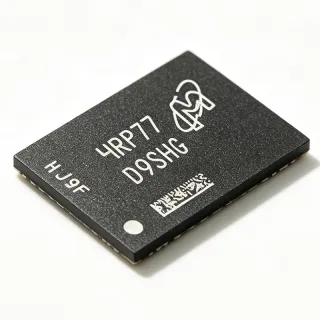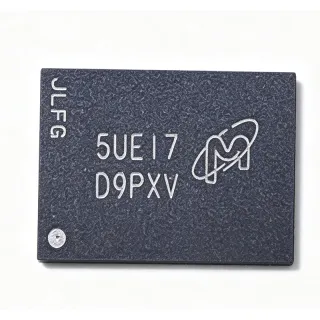
MT29F4G01ABBFD12-AUT:F - 4Gbit SLC SPI NAND Flash | Micron
MPN: MT29F4G01ABBFD12-AUT:F ✓ Active| Qty | Unit Price | Extended |
|---|---|---|
| 1 | $1.96 | $1.96 |
| 10 | $1.86 | $18.60 |
| 100 | $1.76 | $176.00 |
| 500 | $1.67 | $835.00 |
| 1,000 | $1.58 | $1,580.00 |
MT29F4G01ABBFD12-AUT:F Overview
Serial NAND flash is a category of non-volatile memory that stores data in floating-gate cells arranged in NAND strings but exposes a reduced-pin-count SPI (Serial Peripheral Interface) bus instead of the wide parallel asynchronous bus of conventional NAND. In the memory hierarchy, it sits between raw parallel NAND (highest throughput, complex controller requirement) and NOR flash (fast random read, lower density), offering designers a simple, low-pin-count path to high-density code and data storage.
Key features of this device include 4 Gbit SLC density organized for reliable page-level operation, an SPI-compatible serial interface that drastically reduces pin count and PCB routing complexity compared to parallel NAND, and integrated ECC handling on-die that offloads error correction from the host, reducing firmware complexity. The :F suffix denotes Micron's automotive-qualified lead-free finishing option.
Architecturally, the device organizes the 4 Gbit array into pages and blocks with on-die ECC and standard SPI command protocols (including quad-capable read operations on the BFD variant family), supporting fast sequential reads for code shadowing and data logging. SLC technology delivers substantially higher endurance and data retention than MLC or TLC NAND, which is why SLC serial NAND dominates automotive and industrial storage designs.
Typical applications include automotive infotainment and telematics data storage, ADAS event data recorders, industrial programmable logic controllers, network equipment boot storage, and IoT gateways requiring high-endurance flash with minimal host pin usage.
When designing this part in, reserve adequate VCC decoupling and honor the SPI mode timing requirements; because the :F suffix parts are automotive-qualified, follow Micron's automotive reliability guidelines for wear-leveling to exploit the full SLC endurance budget.
This page synthesizes distributor pricing, drop-in same-family alternatives, and practical design notes not found in the manufacturer datasheet.
Drop-in alternatives for MT29F4G01ABBFD12-AUT:F — same package, pin-to-pin compatible. Different-package parts requiring PCB rework are excluded.
Variants in this series
Same-series models that are drop-in compatible with MT29F4G01ABBFD12-AUT:F (same form factor and footprint) — differing in Interface, Memory Type, Mounting Type, Package, Density.
Quick Comparison Tool — Select alternative parts for side-by-side comparison:
MT29F4G01ABAFD12-AUT:F
✅ Drop-In📋 Reference alternative (not in catalog)
MT29F2G01ABAFD12-AUT:F
✅ Drop-In ⚠️ Specs Unverified📋 Reference alternative (not in catalog)
MT29F1G01ABAFD12-AUT:F
✅ Drop-In ⚠️ Specs Unverified📋 Reference alternative (not in catalog)
MT25QL01GBBB8E12-0AUT
✅ Drop-In✓ In Stock
$4.65 / Unit
View Datasheet →MT25QU01GBBB8E12-0AUT
✅ Drop-In✓ In Stock
$7.1 / Unit
View Datasheet →MT29F4G01ABBFD12-AUT:F Specifications
| Memory Type | FLASH - NAND (SLC) Memory IC |
| Interface | SPI |
| Memory Size | 4 Gbit (512 MB) |
| Cell Type | SLC (Single-Level Cell) |
| Package | TBGA (63-ball, per Micron serial NAND family) |
| Mounting Type | Surface Mount |
| Automotive Qualification | AUT grade, :F automotive suffix |
| On-Die ECC | Yes (ECD feature of serial NAND family) |
| RoHS Status | Compliant (lead-free :F suffix) |
MT29F4G01ABBFD12-AUT:F tbga (63-ball, per micron serial nand family) Pin Configuration Guide
Pin configuration for MT29F4G01ABBFD12-AUT:F (tbga (63-ball, per micron serial nand family) package). Pin numbering, functions, and connection diagrams are defined in the manufacturer datasheet. Refer to it for the exact footprint and soldering guidelines.

No detailed pinout data available for MT29F4G01ABBFD12-AUT:F.
Refer to the datasheet for full pin configuration.
Typical Applications
MT29F4G01ABBFD12-AUT:F is suitable for 6 applications: Automotive Telematics Data Storage, ADAS Event Data Recorders, Industrial PLC Code Storage, Network Equipment Boot Storage, IoT Gateway Data Logging, Test and Measurement Instrumentation.
Automotive Telematics Data Storage
The MT29F4G01ABBFD12-AUT:F fits automotive telematics units because its SLC architecture provides high program/erase endurance and stable retention under the extended temperature range demanded by the :F automotive qualification, unlike MLC consumer NAND that degrades under cabin-temperature cycling. The SPI interface needs only a handful of host pins (SCK, SI, SO, CS), leaving controller resources free for modem and GNSS handling, while on-die ECC removes software correction overhead. Typical usage places the device on a quad-capable SPI bus logging CAN/GNSS event streams at several MB/s; sequential write performance is sufficient for trip-data recording. The trade-off versus parallel NAND is lower peak bandwidth, acceptable because telematics data rates rarely exceed a few MB/s and power-off integrity matters more than throughput.
Recommended
ADAS Event Data Recorders
ADAS event recorders demand non-volatile storage that survives crash power loss and years of cyclic overwriting; the MT29F4G01ABBFD12-AUT:F addresses this with 4 Gbit of SLC NAND whose per-cell single-bit storage yields endurance far exceeding MLC alternatives, backed by the automotive :F qualification for AEC-grade deployment. Its on-die ECC guarantees data integrity without burdening the ADAS SoC, and the TBGA package withstands vibration better than leaded packages. In practice the recorder firmware wear-levels across all blocks, buffering camera-frame metadata through DDR4 SDRAM before burst writes to the SPI NAND. The 512 MB capacity suits event clips and sensor logs; for continuous HD video, pair multiple devices or offload to larger media.
Recommended
Industrial PLC Code Storage
Programmable logic controllers store ladder-logic programs, retentive data, and firmware images that must persist through power cycles; the MT29F4G01ABBFD12-AUT:F serves this role with 4 Gbit SLC density and an SPI interface that simplifies routing on crowded PLC mainboards. SLC endurance tolerates the frequent parameter writes typical of industrial automation, and the wide temperature support of the AUT-qualified part suits unconditioned cabinets. The controller typically shadows the program image from SPI NAND into DRAM at boot, then logs alarms and counters back periodically. On-die ECC protects configuration integrity against industrial electrical noise, and the TBGA footprint enables compact, serviceable designs with standard reflow assembly.
Recommended
Network Equipment Boot Storage
Routers, switches, and gateways boot firmware from SPI flash; the MT29F4G01ABBFD12-AUT:F provides 4 Gbit - enough for dual firmware images plus configuration - at lower cost per bit than NOR flash, while on-die ECC keeps boot images reliable. Its SPI interface allows sharing the bus between the CPU boot ROM and a CPLD for management access, and the SLC cells guarantee fast, deterministic random reads at power-up. Typical topology stores the active and golden firmware images in separate blocks with the bootloader in NOR, keeping a 24/7-updatable path. Design consideration: SPI NAND page-based reads add address-management overhead versus byte-random NOR, so boot code is usually duplicated to NOR while bulk storage uses this NAND.
Recommended
IoT Gateway Data Logging
IoT gateways aggregate sensor data from field nodes and buffer it before cloud upload; the MT29F4G01ABBFD12-AUT:F provides 512 MB of local SLC storage whose endurance absorbs years of continuous logging cycles, while the four-wire SPI bus fits the pin-limited gateway SoC. On-die ECC secures data across the intermittent power typical of solar or PoE edge deployments, and the AUT-qualified temperature range covers both outdoor cabinets and industrial plant floors. Firmware typically pages log records into NAND via a journaling layer, uploading batches over LTE or Ethernet, with the SPI NAND serving as the store-and-forward buffer. Cost per bit of SLC serial NAND makes it the economical choice over FRAM or MRAM for megabyte-scale buffers.
Recommended
Test and Measurement Instrumentation
Bench instruments, data acquisition units, and spectrum analyzers store calibration constants, waveform captures, and user settings in non-volatile memory; the MT29F4G01ABBFD12-AUT:F suits this with SLC reliability, an SPI bus that coexists with front-panel controllers, and 4 Gbit capacity for thousands of stored captures. Calibration data written rarely benefits from SLC retention measured in decades at typical lab temperatures, while frequent waveform snapshots exploit SLC endurance. On-die ECC prevents bit corruption of stored calibration tables - a critical reliability point because a corrupted calibration invalidates measurement accuracy. The TBGA surface-mount package supports the compact, thermally dense boards typical of modern instrument mainboards, and the automotive-grade suffix provides margin over commercial-grade flash in rack environments.
Recommended
Recommended Products Summary
Engineering reference data for MT29F4G01ABBFD12-AUT:F — comparison, design guidance, and compliance information.
Selection Guide
Comparison with Alternatives
| Parameter | This Product | MT29F4G01ABAFD12-AUT:F | MT29F2G01ABAFD12-AUT:F | MT25QL01GBBB8E12-0AUT |
|---|---|---|---|---|
| Package | TBGA | TBGA - same | TBGA - same | TBGA - same |
| Brand | Micron Technology | Micron Technology | Micron Technology | Micron Technology |
| Density | 4 Gbit SLC | 4 Gbit SLC | 2 Gbit SLC | 1 Gbit NOR |
| Interface | SPI | SPI | SPI | Quad SPI |
| Speed Grade | BB grade | AA grade (slower SPI clock) | AA grade | NOR random read faster |
| Automotive Qualification | Yes (:F suffix) | Yes (:F suffix) | Yes (:F suffix) | Yes (AUT suffix) |
| On-Die ECC | Yes | Yes | Yes | N/A (NOR) |
Key Differentiators
- Faster SPI grade within the same family (vs MT29F4G01ABAFD12-AUT:F)
- Highest density in the small-serial-NAND SLC family (vs MT29F2G01ABAFD12-AUT:F)
- Higher capacity per unit cost than NOR (vs MT25QL01GBBB8E12-0AUT)
Design Notes
Place 100 nF ceramic decoupling capacitors within 2-3 mm of each VCC ball of the TBGA package, plus one 10 uF bulk capacitor per device. Keep the SPI clock trace short (under 10 cm for clock rates near the device maximum) and route CS as a dedicated, non-shared line when possible. BGA escape routing should use via-in-pad or dog-bone fanout consistent with the ball pitch; follow the mechanical drawing in the manufacturer datasheet for exact ball pitch and keep-out dimensions.
Do not assume byte-level random access: SPI NAND is page-based, so host firmware must implement page reads, block erases, and bad-block management - unlike NOR flash. Although on-die ECC corrects bit errors, software must still handle block remapping for factory and runtime bad blocks. When substituting the AA-grade MT29F4G01ABAFD12-AUT:F for this BB-grade part, re-verify SPI timing margins at your maximum clock frequency since the AA grade runs a slower maximum clock.
Estimated: ensure the host 3.3 V rail can supply program-operation peak current in addition to steady-state read current; program and erase operations draw more current than reads, so budget the supply for worst-case program current from the datasheet electrical table rather than the read figure. During power-down, hold CS high and gate the clock to prevent spurious command writes that could corrupt the array; implement proper brown-out handling in firmware to protect in-flight program operations.
Compliance Information
:F suffix denotes lead-free automotive-grade finish per Micron part-numbering; RoHS compliance per DigiKey/Mouser listings. REACH, halogen-free, and conflict-minerals statuses not stated in provided data.