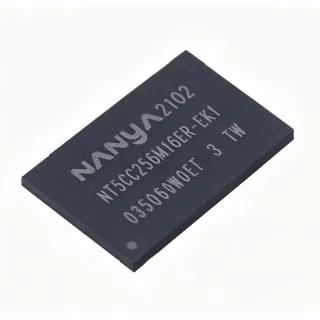
NT5CC256M16ER-EKT - 4Gb DDR3L SDRAM 256Mx16 | Nanya
MPN: NT5CC256M16ER-EKT ✓ Active| Qty | Unit Price | Extended |
|---|---|---|
| 1 | $30.12 | $30.12 |
| 10 | $28.5 | $285.00 |
| 100 | $26 | $2,600.00 |
| 500 | $24 | $12,000.00 |
| 1,000 | $22 | $22,000.00 |
NT5CC256M16ER-EKT Overview
DDR3L (Double Data Rate 3 Low Voltage) SDRAM is a type of synchronous dynamic random-access memory that operates at a lower voltage (1.35V) compared to standard DDR3 (1.5V), reducing power consumption by up to 20% while maintaining similar performance. It is part of the DDR3 memory family, which uses double data rate signaling to transfer data on both edges of the clock, and is widely used in computing, networking, and embedded systems.
Key features include a 4Gb density organized as 256Mx16, a 96-ball TFBGA package, and support for DDR3L-1866 speed grade. The device operates from a 1.35V supply (with 1.5V compatibility) and features programmable CAS latency, burst lengths of 8 and 4 (with burst chop), and on-die termination (ODT) for improved signal integrity. The industrial temperature range option (EKI suffix) is available for harsh environments.
Technically, the NT5CC256M16ER-EKT uses an 8n-prefetch architecture with a 16-bit I/O interface, achieving data rates up to 1866 Mbps. It includes a mode register set (MRS) for configuration, DLL for timing alignment, and ZQ calibration for output driver and ODT impedance tuning. The device supports various power-saving modes including power-down and self-refresh, making it suitable for battery-powered applications.
Typical applications include DDR3L memory modules for laptops and embedded systems, networking equipment such as routers and switches, industrial automation controllers, and automotive infotainment systems. Its low voltage and high density make it ideal for space-constrained designs requiring high memory bandwidth.
When designing with this device, ensure proper decoupling capacitors near the VDD and VDDQ pins, and follow the PCB layout guidelines for DDR3 routing to maintain signal integrity. The ZQ pin requires a 240-ohm resistor to ground for calibration.
Drop-in alternatives for NT5CC256M16ER-EKT — same package, pin-to-pin compatible. Different-package parts requiring PCB rework are excluded.
Variants in this series
Same-series models that are drop-in compatible with NT5CC256M16ER-EKT (same form factor and footprint) — differing in Package, Supply Voltage, Operating Temperature, Data Rate, Clock Frequency.
Quick Comparison Tool — Select alternative parts for side-by-side comparison:
NT5CC256M16ER-EK
✅ Drop-In✓ In Stock
$24 / Unit
View Datasheet →NT5CC256M16ER-EKI
✅ Drop-In✓ In Stock
$16.7045 / Unit
View Datasheet →MT41K256M16TW-107
✅ Drop-In✓ In Stock
$14.1 / Unit
View Datasheet →AS4C256M16D3LC-10BCN
✅ Drop-In📋 Reference alternative (not in catalog)
IS43TR16256AL-125KBL
✅ Drop-In✓ In Stock
$5.6 / Unit
View Datasheet →K4B4G1646E-BYMA
✅ Drop-In ⚠️ Specs Unverified✓ In Stock
$14.3182 / Unit
View Datasheet →NT5CC256M16ER-EKT Maximum Ratings & Electrical Characteristics
| Memory Type | DDR3L SDRAM |
| Density | 4 Gb |
| Organization | 256M x 16 |
| Supply Voltage | 1.35 V (1.5 V compatible) |
| Speed Grade | DDR3L-1866 (1866 Mbps) |
| CAS Latency | 13 |
| Timing | 13-13-13 |
| Package | 96-ball TFBGA |
| Operating Temperature Range | 0°C to +95°C |
| Interface | 16-bit |
| Burst Length | 8 and 4 (with burst chop) |
| On-Die Termination | Yes (dynamic) |
| ZQ Calibration | Yes |
| Auto Self-Refresh | Yes |
| RoHS | Compliant |
NT5CC256M16ER-EKT Pin Configuration
| Pin A1 | VDD — Power supply for core logic |
| Pin A2 | VSS — Ground |
| Pin B1 | DQ0 — Data input/output bit 0 |
| Pin B2 | DQ1 — Data input/output bit 1 |
| Pin C1 | DQ2 — Data input/output bit 2 |
| Pin C2 | DQ3 — Data input/output bit 3 |
| Pin D1 | VDDQ — Power supply for I/O |
| Pin D2 | VSSQ — Ground for I/O |
| Pin E1 | A0 — Address input bit 0 |
| Pin E2 | A1 — Address input bit 1 |
| Pin F1 | A2 — Address input bit 2 |
| Pin F2 | A3 — Address input bit 3 |
| Pin G1 | BA0 — Bank address bit 0 |
| Pin G2 | BA1 — Bank address bit 1 |
| Pin H1 | RAS# — Row address strobe |
| Pin H2 | CAS# — Column address strobe |
| Pin J1 | WE# — Write enable |
| Pin J2 | CS# — Chip select |
| Pin K1 | CK — Clock input |
| Pin K2 | CK# — Complementary clock input |
| Pin L1 | CKE — Clock enable |
| Pin L2 | ODT — On-die termination control |
| Pin M1 | ZQ — Calibration reference |
| Pin M2 | RESET# — Reset input |
Typical Applications
NT5CC256M16ER-EKT is suitable for 6 applications: Laptop and Notebook Memory, Networking Equipment, Industrial Automation, Automotive Infotainment, Embedded Systems, Server and Data Center.
Laptop and Notebook Memory
The NT5CC256M16ER-EKT is ideal for laptop and notebook memory modules due to its low 1.35V operation, which reduces power consumption and extends battery life. Its 4Gb density and 256Mx16 organization provide sufficient capacity for mainstream computing tasks. The DDR3L-1866 speed ensures fast data transfer for multitasking and multimedia applications. The TFBGA package allows for compact module designs, fitting into slim laptop form factors. Its compatibility with 1.5V DDR3 systems ensures flexibility in mixed-voltage environments.
Recommended
Networking Equipment
In networking equipment such as routers and switches, the NT5CC256M16ER-EKT provides high-bandwidth memory for packet buffering and routing tables. Its 1866 Mbps data rate supports high-throughput processing, while the 1.35V operation reduces heat generation in dense networking hardware. The industrial temperature range option (EKI) is available for outdoor or harsh environments. The device's on-die termination and ZQ calibration ensure signal integrity in high-speed PCB designs, critical for reliable data transmission.
Recommended
Industrial Automation
The NT5CC256M16ER-EKT is suitable for industrial automation controllers that require reliable memory in temperature-extreme environments. With an operating temperature range of 0°C to +95°C (or -40°C to +95°C for EKI variant), it can withstand factory floor conditions. The low voltage operation reduces power consumption in 24/7 operation, and the high density supports complex control algorithms and data logging. Its robust design and long lifecycle make it a dependable choice for industrial applications.
Recommended
Automotive Infotainment
In automotive infotainment systems, the NT5CC256M16ER-EKT provides high-speed memory for navigation, multimedia playback, and connectivity features. Its 1.35V operation reduces power draw from the vehicle's electrical system, and the 1866 Mbps speed ensures smooth performance for graphics and audio processing. The device's wide temperature range supports under-hood and cabin environments. Its compatibility with 1.5V DDR3 systems allows integration with existing automotive electronics.
Recommended
Embedded Systems
The NT5CC256M16ER-EKT is well-suited for embedded systems such as single-board computers, IoT gateways, and medical devices. Its low power consumption is critical for battery-powered or energy-efficient designs. The 4Gb density provides ample memory for operating systems and applications, while the TFBGA package allows for compact PCB layouts. The device's support for auto self-refresh and power-down modes helps optimize energy usage in idle states.
Recommended
Server and Data Center
Although DDR3L is older than DDR4/DDR5, the NT5CC256M16ER-EKT can be used in legacy servers and data center equipment that still rely on DDR3L memory. Its 4Gb density and 1866 Mbps speed provide adequate performance for entry-level servers and storage systems. The low voltage operation reduces power consumption in large-scale deployments, contributing to lower operational costs. Its reliability and long availability make it a viable option for maintaining existing infrastructure.
Recommended
Recommended Products Summary
Engineering reference data for NT5CC256M16ER-EKT — comparison, design guidance, and compliance information.
Selection Guide
Comparison with Alternatives
| Parameter | This Product | NT5CC256M16ER-EK | MT41K256M16TW-107 | AS4C256M16D3LC-10BCN | IS43TR16256AL-125KBL | K4B4G1646E-BYMA |
|---|---|---|---|---|---|---|
| Package | 96-ball TFBGA | 96-ball TFBGA | 96-ball TFBGA | 96-ball TFBGA | 96-ball TFBGA | 96-ball FBGA |
| Brand | Nanya Technology | Nanya Technology | Micron Technology | Alliance Memory | ISSI | Samsung Electronics |
| Density | 4 Gb | 4 Gb | 4 Gb | 4 Gb | 4 Gb | 4 Gb |
| Organization | 256M x 16 | 256M x 16 | 256M x 16 | 256M x 16 | 256M x 16 | 256M x 16 |
| Supply Voltage | 1.35 V (1.5 V compatible) | 1.35 V (1.5 V compatible) | 1.35 V (1.5 V compatible) | 1.35 V (1.5 V compatible) | 1.35 V (1.5 V compatible) | 1.35 V (1.5 V compatible) |
| Speed Grade | DDR3L-1866 | DDR3L-1866 | DDR3L-1866 | DDR3L-1600 | DDR3L-1866 | DDR3L-1866 |
| Operating Temperature | 0°C to +95°C | 0°C to +95°C | 0°C to +95°C | 0°C to +95°C | 0°C to +95°C | 0°C to +95°C |
| RoHS | Compliant | Compliant | Compliant | Compliant | Compliant | Compliant |
Key Differentiators
- Low voltage operation (1.35V) with 1.5V compatibility (vs Standard DDR3 parts (1.5V))
- High speed grade DDR3L-1866 (vs AS4C256M16D3LC-10BCN (DDR3L-1600))
- Industrial temperature grade option (EKI) (vs Standard temperature grade (0°C to +95°C))
Design Notes
For DDR3L routing, maintain 50-ohm single-ended and 100-ohm differential impedance for data and address/control lines. Keep trace lengths matched within 100 mils for data groups and 500 mils for address/control. Use a solid ground plane beneath the memory device and minimize vias to reduce signal integrity issues. Place decoupling capacitors (0.1uF and 1uF) close to each VDD and VDDQ pin.
The NT5CC256M16ER-EKT operates up to +95°C, but ensure adequate airflow or heatsinking in high-temperature environments. The TFBGA package has a thermal resistance of approximately [DATA_NEEDED: theta_JA] °C/W. For industrial applications, consider the EKI variant with extended temperature range. Monitor junction temperature to avoid exceeding the maximum rating.
Ensure the ZQ pin is connected to a 240-ohm resistor to ground for calibration. Do not leave the RESET# pin floating; tie it high during normal operation. Follow the DDR3L power-up sequence: apply VDD and VDDQ simultaneously, then CKE, and wait for reset and clock stabilization. Incorrect sequencing can cause initialization failures.
Compliance Information
RoHS compliant per Nanya green product policy. Lead-free. AEC-Q100 not applicable for DRAM.