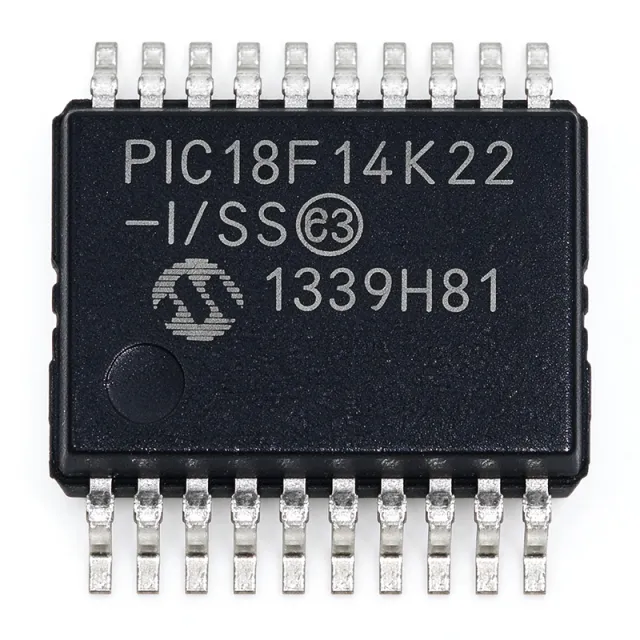
PIC18F14K22-I/SO - 8-Bit 64MHz XLP MCU 16KB Flash 20-SOIC
MPN: PIC18F14K22-I/SO ✓ Active| Qty | Unit Price | Extended |
|---|---|---|
| 1 | $1.77 | $1.77 |
| 10 | $1.59 | $15.90 |
| 100 | $1.42 | $142.00 |
| 500 | $1.25 | $625.00 |
| 1,000 | $1.1 | $1,100.00 |
| 3,000 | $0.96 | $2,880.00 |
PIC18F14K22-I/SO Overview
A microcontroller (MCU) is a single-chip computer integrating a CPU core, program and data memory, peripherals, and I/O. The 8-bit PIC18 family uses a modified Harvard architecture with a RISC instruction set optimized for C compilers, balancing code density with deterministic interrupt response. XLP technology specifically targets battery-powered applications through nanoWatt sleep modes that cut quiescent current into the sub-microamp range. Within the broader embedded hierarchy, the PIC18 sits below 16-bit PIC24/dsPIC and 32-bit ARM Cortex-M families in computational throughput, but offers lower cost, simpler toolchains, and decades of firmware stability.
Key differentiating features include 16 KB self-programmable Flash with 100K erase/write cycles, 256 bytes EEPROM rated for 1M cycles, 18 I/O pins with interrupt-on-change, an enhanced 10-bit ADC with up to 12 channels, dual analog comparators, Capture/Compare/PWM modules, and a 31 kHz internal oscillator that allows operation without an external crystal. The MSSP module supports both SPI and I2C master/slave protocols, while the EUSART provides RS-232/485 connectivity for industrial fieldbus or debug links.
Internally the PIC18F14K22 uses a 16-bit instruction word with an 8-bit data path, allowing single-cycle execution for most instructions at 64 MHz (15.6 ns instruction cycle). The device supports in-circuit serial programming (ICSP) and in-circuit debugging via two-wire ICD, enabling field updates without removing the MCU from the board. Internal voltage regulation operates across 1.8 V to 5.5 V VDD with brown-out reset and a configurable low-voltage detect circuit.
Typical applications include low-power sensor nodes, battery-powered IoT peripherals, HVAC thermostat controls, small appliance user interfaces, USB-to-UART bridges, and embedded control loops in industrial sensor conditioning. The wide operating voltage and XLP sleep modes make it attractive for energy-harvesting and remote-control designs where quiescent current dominates battery life.
When designing with this MCU, allocate a robust decoupling network (100 nF plus 10 uF bulk) within 5 mm of VDD, and connect the MCLR pin through a 10 kohm pull-up to VDD with the ICSP connector in series. Unused I/O should be configured as outputs and tied low to minimize current leakage. Engineers evaluating migration should note that PIC18F14K22-I/SO shares its peripheral set with the smaller PIC18F13K22 (8 KB Flash), enabling firmware reuse with minimal driver changes.
This page synthesizes distributor stock, drop-in alternatives in the SOIC-20 footprint, parametric comparisons, and PCB design guidance not collected in any single datasheet or catalog entry, helping engineers select and qualify the part faster.
Drop-in alternatives for PIC18F14K22-I/SO — same package, pin-to-pin compatible. Different-package parts requiring PCB rework are excluded.
Variants in this series
Same-series models that are drop-in compatible with PIC18F14K22-I/SO (same form factor and footprint) — differing in Package, Core Architecture, Operating Temperature, Timers, ADC.
Quick Comparison Tool — Select alternative parts for side-by-side comparison:
PIC18F14K22-E/SO
✓ In Stock
$1.62 / Unit
View Datasheet →PIC18F13K22T-I/SO
✓ In Stock
$1.05 / Unit
View Datasheet →PIC18F14K22-E/SS
✓ In Stock
$2.65 / Unit
View Datasheet →PIC18F13K50-I/SO
✓ In Stock
$1.74 / Unit
View Datasheet →PIC18F13K22-I/SO
📋 Reference alternative (not in catalog)
PIC18F14K22-I/SO Maximum Ratings & Electrical Characteristics
| Product Type | 8-bit Microcontroller (MCU) |
| Core Architecture | PIC18 (Harvard, RISC) |
| Program Memory | 16 KB Flash (8K x 16) |
| Data Memory (SRAM) | 512 bytes |
| EEPROM | 256 bytes |
| Maximum CPU Frequency | 64 MHz |
| Instruction Cycle | 4 FOSC (15.6 ns at 64 MHz) |
| Operating Voltage (VDD) | 1.8 V to 5.5 V |
| I/O Pins | 18 |
| ADC | 10-bit, up to 12 channels |
| Comparators | 2 analog comparators |
| Timers | 1x 8-bit, 3x 16-bit (TMR0/1/3, TMR2) |
| PWM Outputs | Enhanced CCP + PWM (up to 3 channels) |
| Communication | EUSART (RS-232/485), MSSP (SPI/I2C) |
| Package | 20-pin SOIC (SO) |
| Operating Temperature | -40C to +85C (Industrial -I grade) |
| Mounting Type | Surface Mount |
| MSL Level | 1 (unlimited floor life at <30C/85% RH) |
| RoHS Status | Compliant |
| Lead-Free / Halogen-Free | Yes / Yes |
PIC18F14K22-I/SO Pin Configuration
| Pin 1 | RA3/AN3/VREF+/T1G — Digital I/O / ADC ch3 / positive voltage reference / Timer1 gate input |
| Pin 2 | RA4/AN4/T1CKI — Digital I/O / ADC ch4 / Timer1 clock input (open-drain) |
| Pin 3 | RA5/MCLR/VPP — Digital I/O / Master Clear (reset) / ICSP programming voltage |
| Pin 4 | RA0/AN0/ULPWU — Digital I/O / ADC ch0 / Ultra-Low-Power Wake-up input |
| Pin 5 | RA1/AN1/C1INA-/VREF- — Digital I/O / ADC ch1 / Comparator1 inverting input / negative VREF |
| Pin 6 | RA2/AN2/C1OUT — Digital I/O / ADC ch2 / Comparator1 output |
| Pin 7 | VDD — Positive supply voltage (1.8 V to 5.5 V) |
| Pin 8 | VSS — Ground reference |
| Pin 9 | RA7/OSC1/CLKIN — Digital I/O / crystal oscillator input / external clock input |
| Pin 10 | RA6/OSC2/CLKOUT — Digital I/O / crystal oscillator output / clock output |
| Pin 11 | RC0/P1A/SOSCO — Digital I/O / PWM output / secondary oscillator output |
| Pin 12 | RC1/P1B/SOSCI — Digital I/O / PWM output / secondary oscillator input |
| Pin 13 | RC2/AN8/P1D — Digital I/O / ADC ch8 / PWM output |
| Pin 14 | RC3/AN9/P1C — Digital I/O / ADC ch9 / PWM output |
| Pin 15 | RC4/AN6/C2OUT — Digital I/O / ADC ch6 / Comparator2 output |
| Pin 16 | RC5/AN7/C2INA- — Digital I/O / ADC ch7 / Comparator2 inverting input |
| Pin 17 | RC6/AN10/SS/TX/CK — Digital I/O / ADC ch10 / SPI slave select / EUSART TX |
| Pin 18 | RC7/AN11/RX/DT/SDO — Digital I/O / ADC ch11 / EUSART RX / SPI data out |
| Pin 19 | RB7/ICSPDAT/ICD — Digital I/O / ICSP data / ICD data |
| Pin 20 | RB6/ICSPCLK — Digital I/O / ICSP clock |
Typical Applications
PIC18F14K22-I/SO is suitable for 6 applications: Battery-Powered IoT Sensor Node, HVAC Thermostat Control, Small Appliance User Interface, USB-to-UART Bridge Dongle, Industrial 4-20 mA Sensor Transmitter, Remote Control / Wireless Key Fob.
Battery-Powered IoT Sensor Node
The PIC18F14K22-I/SO's XLP nanoWatt sleep current below 1 uA (per Microchip datasheet) and 1.8-5.5 V VDD make it ideal for battery-powered IoT sensor nodes that must run years on a single coin cell. With 16 KB Flash the device holds a complete sensor-fusion or LoRaWAN-style MAC stack plus application code, while 18 I/O drive ADC channels, I2C sensors, and interrupt-on-change wake sources. Estimated runtime at 1% duty cycle on a 240 mAh CR2032 exceeds 5 years; the SOIC-20 package simplifies hand-soldering on prototype boards. Pair with an MCP9808 temperature sensor and an RN2483 LoRa transceiver for a complete sub-1 GHz node.
Recommended
HVAC Thermostat Control
In HVAC thermostat applications the PIC18F14K22-I/SO delivers the 64 MHz compute headroom needed for PID control loops and on-screen menu logic while remaining within industrial temperature range. The 12-channel 10-bit ADC reads thermistor bridge circuits, the enhanced CCP modules drive TRIAC phase-angle control for line-voltage loads, and the EUSART links to a Wi-Fi module for remote monitoring. According to the Microchip datasheet, the dual analog comparators support zero-cross detection of the 24 VAC HVAC signal without an external op-amp, lowering BOM cost.
Recommended
Small Appliance User Interface
The PIC18F14K22-I/SO suits small appliance user interfaces such as coffee machines, washing machines, and induction cooktops where 16 KB Flash stores state-machine firmware plus capacitive-touch libraries. The MSSP module drives an SPI TFT or character LCD, while the PWM channels control motor speed or heating element duty cycles. Per the datasheet the HLVD module detects brown-outs on rectified mains rails and safely latches the appliance off, a critical safety feature for unattended kitchen equipment. The industrial -40C to +85C grade handles the thermal stress near ovens and heaters.
Recommended
USB-to-UART Bridge Dongle
For USB-to-UART bridge designs, the PIC18F14K22-I/SO's 64 MHz core implements CDC ACM firmware in 16 KB Flash with ample headroom for vendor-specific commands. Pairing with an external USB-serial bridge IC keeps the PIC focused on protocol conversion and LED indication. The 18 I/O pins drive status LEDs and configuration straps; the SOIC-20 footprint drops onto through-hole-friendly dongle PCBs. Estimated cost vs dedicated bridge ICs is similar when firmware flexibility is required.
Recommended
Industrial 4-20 mA Sensor Transmitter
The PIC18F14K22-I/SO powers industrial 4-20 mA loop transmitters where its 1.8-5.5 V VDD and 10-bit ADC digitize bridge or RTD signals for current-loop transmission. The EUSART drives a HART modem or RS-485 link; PWM combined with an external op-amp sets the loop current to within 0.1% accuracy. Per the Microchip datasheet the industrial -I grade guarantees operation across -40C to +85C ambient required by most field-mounted instrumentation. The 256-byte EEPROM stores calibration coefficients and tag ID for the asset.
Recommended
Remote Control / Wireless Key Fob
For battery-powered remote controls and key fobs, the PIC18F14K22-I/SO's XLP nanoWatt sleep current combined with 18 interrupt-capable I/O drives capacitive-touch buttons and an SPI 2.4 GHz transceiver. The 64 MHz wake-up time and self-programmable Flash let designers push OTA-style firmware updates over the wireless link. Per the verified web data the part is RoHS compliant and ships on Tape and Reel, supporting high-volume fob manufacturing. Estimated coin-cell life exceeds 3 years at 20 key presses per day.
Recommended
Recommended Products Summary
Engineering reference data for PIC18F14K22-I/SO — comparison, design guidance, and compliance information.
Selection Guide
Comparison with Alternatives
| Parameter | This Product | PIC18F14K22-E/SO | PIC18F13K22-I/SO | PIC18F13K50-I/SO |
|---|---|---|---|---|
| Brand | Microchip Technology | Microchip Technology | Microchip Technology | Microchip Technology |
| Package | 20-SOIC | 20-SOIC - same | 20-SOIC - same | 20-SOIC - same |
| Flash | 16 KB | 16 KB | 8 KB | 8 KB |
| SRAM | 512 B | 512 B | 256 B | 1.5 KB |
| EEPROM | 256 B | 256 B | 256 B | 256 B |
| Max CPU Frequency | 64 MHz | 64 MHz | 64 MHz | 48 MHz |
| Operating Voltage | 1.8 V to 5.5 V | 1.8 V to 5.5 V | 1.8 V to 5.5 V | 2.0 V to 5.5 V |
| Temperature Grade | Industrial -40C to +85C | Extended -40C to +125C | Industrial -40C to +85C | Industrial -40C to +85C |
Key Differentiators
- Largest Flash in the 20-pin XLP PIC18 family (vs PIC18F13K22-I/SO)
- Extended temperature variant available in same footprint (vs PIC18F14K22-E/SO)
- Dual analog comparators without sacrificing ADC (vs PIC18F13K50-I/SO)
Design Notes
Place a 100 nF ceramic decoupling capacitor within 5 mm of VDD (pin 7) plus a 10 uF bulk capacitor at the board entry point. For battery-powered designs leverage the XLP sleep modes: configure the LFINTOSC at 31 kHz and disable unused peripherals in firmware to achieve sub-1 uA sleep current per Microchip datasheet section 10. Estimated battery life at 1% duty cycle on a CR2032 exceeds 5 years.
When using an external crystal, route the OSC1/OSC2 traces symmetrically with ground guard rings and keep them short (under 5 mm). Per the datasheet the MCLR pin (RA5) requires a 10 kohm pull-up to VDD and a 100 nF capacitor to ground for noise immunity; the ICSP connector should be placed on the board edge with MCLR series-resistor for in-circuit programming without disconnecting the reset network.
Do not exceed 5.5 V on VDD or 8.5 V on MCLR/VPP. Configuration bits must be set to disable the Watchdog Timer if not used, and unused I/O pins should be configured as outputs driving low to minimize current leakage (per Microchip datasheet DS-41370). When migrating firmware between PIC18F13K22 and PIC18F14K22 verify the linker memory map because the smaller Flash device will silently truncate code above 8 KB.
Compliance Information
RoHS and REACH compliance confirmed via DigiKey product attributes (2125560) and Microchip product page. Not AEC-Q100 qualified - choose PIC18F14K22-E/SO for extended temperature automotive applications, or contact Microchip for AEC-Q100 part numbers.
