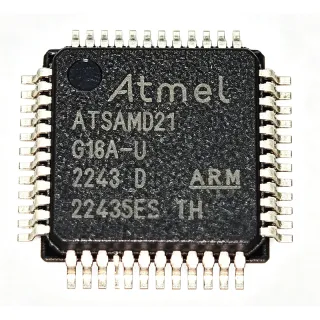
RTAX2000SL-1CG1152V - 2M-Gate Rad-Tolerant FPGA | Microchip
MPN: RTAX2000SL-1CG1152V ✓ Active| Qty | Unit Price | Extended |
|---|---|---|
| 1 | $0 | $0.00 |
| 10 | $0 | $0.00 |
| 100 | $0 | $0.00 |
| 500 | $0 | $0.00 |
| 1,000 | $0 | $0.00 |
RTAX2000SL-1CG1152V Overview
A radiation-tolerant FPGA is a field-programmable gate array engineered to survive the heavy-ion and proton environments encountered in Earth-orbiting and deep-space missions. Unlike commercial FPGAs, RTAX-S/SL devices combine an anti-fuse, one-time-programmable (OTP) fabric with design-level mitigation (triple-module redundancy implemented via Microchip tools), delivering single-chip solutions that are live at power-up without external configuration memory, which is a decisive advantage for spacecraft avionics, payload controllers, and instrument electronics.
Key features of the RTAX2000SL include embedded SRAM blocks with built-in FIFO control logic, segmentable clock resources, chip-wide highway routing, and dedicated carry logic for arithmetic-intensive datapaths. The SL variant offers reduced power consumption relative to the earlier RTAX2000S, preserving heritage and radiation data continuity recognized by Microchip, ESA documentation, and industry practice.
Architecturally, the device is a digital CMOS fabric based on the commercial Axcelerator accelerator family, re-manufactured on a radiation-tolerant flow. Design entry, synthesis, and timing sign-off are performed with Microchip Libero SoC and Actel/Microsemi legacy toolchains, enabling netlist migration from RTAX-S prototypes and Aldec flash-based adaptor-board prototyping.
Typical applications include satellite payload data processing, spacecraft bus control, telemetry and telecommand interfaces, and radiation-exposed instrument controllers where a true single-chip, live-at-power-up FPGA is mandated.
A critical design consideration is the OTP nature of the fabric: programming is irreversible, so full functional and timing sign-off in Libero plus flight-unit programming procedures are essential; prototype using the Aldec RTAX adaptor or Axcelerator equivalents.
This page synthesizes verified distributor data, family cross-references, and space-program design guidance not consolidated in the manufacturer datasheet. Pricing is quote-based as of 2026-09-02.
Drop-in alternatives for RTAX2000SL-1CG1152V — same package, pin-to-pin compatible. Different-package parts requiring PCB rework are excluded.
Variants in this series
Same-series models that are drop-in compatible with RTAX2000SL-1CG1152V (same form factor and footprint) — differing in Configuration, Package, Family, Technology, Logic Cells.
Quick Comparison Tool — Select alternative parts for side-by-side comparison:
RTAX2000SL-1LG1152V
✅ Drop-In✓ In Stock
$1 / Unit
View Datasheet →RTAX2000S-1CG1152
✅ Drop-In ⚠️ Specs Unverified📋 Reference alternative (not in catalog)
RTAX2000SL-CG1152
✅ Drop-In ⚠️ Specs Unverified📋 Reference alternative (not in catalog)
RTAX2000SL-1CG1152
✅ Drop-In ⚠️ Specs Unverified📋 Reference alternative (not in catalog)
RTAX2000SL-1CG1152V Maximum Ratings & Electrical Characteristics
| Family | RTAX-S/SL Radiation-Tolerant FPGAs |
| Equivalent System Gates | 2000000 |
| Logic Cells | 32256 |
| Configurable Logic Blocks (CLBs) | 21504 |
| Technology | Digital CMOS, anti-fuse OTP |
| Speed Grade | -1 |
| Package | CG1152 (1152-pin ceramic column grid array) |
| Qualification Flow | V (space/flight, suffix V) |
| Embedded Memory | Embedded SRAM with built-in FIFO control logic |
| Clocking | Segmentable clocks, chip-wide highway routing |
| Arithmetic Support | Dedicated carry logic |
| Configuration | Single-chip, live at power-up (no external boot device) |
| Programmability | One-Time Programmable (OTP) anti-fuse |
| Application Domain | Space-flight systems (radiation-tolerant) |
| Total Equivalent Gate Density Range (Family) | Up to 4,000,000 equivalent system gates |
| Mounting Type | Surface Mount |
RTAX2000SL-1CG1152V cg1152 (1152-pin ceramic column grid array) Pin Configuration Guide
Pin configuration for RTAX2000SL-1CG1152V (cg1152 (1152-pin ceramic column grid array) package). This digital IC includes GPIO, communication interfaces (UART, SPI, I2C), and power pins. Refer to the manufacturer datasheet for alternate pin functions and configuration options. Essential for embedded system design and PCB layout.

No detailed pinout data available for RTAX2000SL-1CG1152V.
Refer to the datasheet for full pin configuration.
Typical Applications
RTAX2000SL-1CG1152V is suitable for 6 applications: Satellite Payload Data Processing, Spacecraft Bus Control and Avionics, Telemetry and Telecommand Interfaces, Instrumentation and Sensor Electronics for Space Missions, Launch Vehicle and Reentry Systems Electronics, Deep-Space Probe and CubeSat Flight Computers.
Satellite Payload Data Processing
The RTAX2000SL-1CG1152V fits payload data processing because its 2,000,000 equivalent gates, 32,256 logic cells, and 21,504 CLBs provide enough fabric for on-board compression, formatting, and channelization pipelines, while dedicated carry logic accelerates arithmetic datapaths. Embedded SRAM with built-in FIFO control allows buffering between high-rate sensor interfaces and downlink chains without consuming general-purpose logic. In this role the FPGA typically sits between payload sensor front-ends and the telemetry formatter, clocked from segmentable clock resources for multi-domain designs. Because the anti-fuse fabric is live at power-up, the payload initializes deterministically after separation events with no external configuration device to fail in orbit - a quantified reliability benefit over SRAM-based FPGAs in this class.
Recommended
Spacecraft Bus Control and Avionics
For spacecraft bus control, the RTAX2000SL-1CG1152V provides deterministic, single-chip live-at-power-up logic for power switching sequencing, mode control, and telecommand/telemetry glue logic. The 2,000,000-gate capacity absorbs legacy MIL-STD or custom bus interfaces that would otherwise require multiple discrete devices, while the chip-wide highway routing and segmentable clocks support the mixed slow/fast domains typical of bus electronics. Anti-fuse configuration cannot be corrupted by single-event upsets at the configuration layer, simplifying the mitigation budget relative to SRAM FPGAs that require configuration scrubbing. Program heritage matters here: the RTAX2000S-to-RTAX2000SL equivalence recognized by Microchip and ESA documentation lets programs carry an existing qualification basis forward without requalification.
Recommended
Telemetry and Telecommand Interfaces
Telemetry and telecommand (TM/TC) chains benefit directly from the RTAX2000SL-1CG1152V's embedded SRAM with FIFO control logic, which implements frame buffering and rate adaptation between the spacecraft clock domain and the RF/ground segment clock domain. The 32,256 logic cells implement encoders, scramblers, and framing state machines with headroom, and carry logic supports CRC and accumulator functions efficiently. Because these interfaces must be available from the instant of power-up during launch and early orbit phase, the anti-fuse live-at-power-up property eliminates boot-time gaps. Designers typically prototype the TM/TC netlist on the Aldec flash-based RTAX adaptor using the EDIF netlist and pinout conversion flow before committing to OTP flight units, preserving full design verification.
Recommended
Instrumentation and Sensor Electronics for Space Missions
Scientific instruments on orbit require control logic that survives total ionizing dose and single-event effects while delivering deterministic timing to detectors. The RTAX2000SL-1CG1152V provides the -1 speed grade timing margin for detector sequencers and ADC interface controllers, and its 2,000,000 gates absorb calibration logic, histogramming, and event filtering. Segmentable clocks allow precise multi-phase sampling schemes, and embedded SRAM FIFOs decouple detector output rates from processing rates. The hermetic ceramic column grid array package suits the thermal and vacuum environment of space instruments. Using an SL (reduced power) device in these applications lowers dissipation in thermally constrained payloads compared to the RTAX2000S, a measurable system-level advantage cited in Microchip family positioning.
Recommended
Launch Vehicle and Reentry Systems Electronics
Launch and reentry avionics demand logic that is operational from battery application and immune to configuration memory corruption under heavy vibration and radiation exposure. The RTAX2000SL-1CG1152V meets these needs: anti-fuse OTP programming is permanent and cannot be flipped by single-event upsets, and live-at-power-up operation means sequencing, safe-and-arm interface logic, and health monitoring begin instantly without a configuration load cycle. The 32,256 logic cells and 21,504 CLBs implement redundant voter structures and two-out-of-three schemes, while carry logic supports navigation accumulator computations. The ceramic column grid array provides a hermetic, mechanically robust interconnect for the high-shock environment of launch vehicles and reentry platforms.
Recommended
Deep-Space Probe and CubeSat Flight Computers
Deep-space probes and higher-class CubeSats use the RTAX2000SL-1CG1152V as the core of flight computers where every milliwatt and every reliability mechanism counts. The SL process variant reduces static power relative to the RTAX2000S, directly benefiting solar- and RTG-power budgets on missions far from the sun. The 2,000,000-gate fabric implements EDAC, watchdog, and recovery state machines alongside the main computation, and the absence of external configuration flash removes a common deep-space failure point. Prototyping with the Aldec RTAX adaptor board on ProASIC3E flash technology lets small teams validate flight software interfaces early. Heritage equivalence with RTAX2000S documented by Microchip and ESA supports mission assurance reviews for these programs.
Recommended
Recommended Products Summary
Engineering reference data for RTAX2000SL-1CG1152V — comparison, design guidance, and compliance information.
Selection Guide
Comparison with Alternatives
| Parameter | This Product | RTAX2000SL-1LG1152V | RTAX2000S-1CG1152 | RTAX2000SL-CG1152 |
|---|---|---|---|---|
| Package | CG1152 (1152-pin ceramic column grid array) | LG1152 (1152-pin ceramic lidded grid array) | CG1152 (1152-pin ceramic column grid array) - same | CG1152 (1152-pin ceramic column grid array) - same |
| Brand | Microchip Technology (Actel/Microsemi) | Microchip Technology | Microchip Technology | Microchip Technology |
| Equivalent System Gates | 2000000 | 2000000 | 2000000 | 2000000 |
| Logic Cells | 32256 | 32256 | 32256 | 32256 |
| CLBs | 21504 | 21504 | 21504 | 21504 |
| Speed Grade | -1 | -1 | -1 | Standard (non -1) |
| Qualification Suffix / Flow | V (space/flight) | V (space/flight) | Standard per device suffix | Standard per device suffix |
| Relative Static Power | Low (SL variant) | Low (SL variant) | Higher than SL | Low (SL variant) |
| Heritage / Qualification Basis | RTAX2000SL heritage, equivalent to RTAX2000S per Microchip/ESA | Same RTAX2000SL heritage | Explicitly listed in ESCC REP 010 | Same RTAX2000SL heritage |
Key Differentiators
- SL process variant for reduced power (vs RTAX2000S-1CG1152)
- Flight (V) qualification suffix (vs RTAX2000SL-1CG1152)
- -1 speed grade timing margin (vs RTAX2000SL-CG1152)
Design Notes
The RTAX2000SL-1CG1152V is one-time programmable (OTP): anti-fuse programming is irreversible, so programming flight units before full Libero timing sign-off and design review destroys the device. Complete static and dynamic timing closure, verify the EDIF netlist, and prototype on the Aldec flash-based RTAX adaptor (ProASIC3E based) using Microchip's netlist/pinout conversion methodology before committing flight hardware. Budget for engineering-model units in the program plan, since a programming error on a flight part cannot be recovered.
The CG1152 ceramic column grid array requires a land pattern and column pitch verified against the mechanical drawing in the Microchip RTAX-S/SL datasheet (ds2169). If second-sourcing to the lidded LG1152 variant, re-check the land pattern because column and lidded constructions may specify different pad geometry. Use the footprint-compatible adaptor board approach for density migration between CG624 and CG1152 packages, and maintain controlled-impedance stackup documentation for flight qualification reviews.
Estimated: prefer the SL (RTAX2000SL) die over the RTAX2000S when power budget is tight, as Microchip positions the SL variant for reduced static power consumption - a system-level benefit for solar- and RTG-powered spacecraft. Exact static and dynamic current figures for the -1 speed grade at mission temperature must be taken from the power tables in the official RTAX-S/SL datasheet, and worst-case power analysis should use Microchip power tools with flight temperature and radiation conditions.
Compliance Information
RoHS/REACH status not stated in reviewed distributor listings for this hermetic ceramic flight package; hermetic space parts are often RoHS-exempt. Space screening flows referenced via Microchip DLA Cross Reference Guide (Mil Prf 38535, QML class Q/V) - confirm program-specific screening with Microchip.