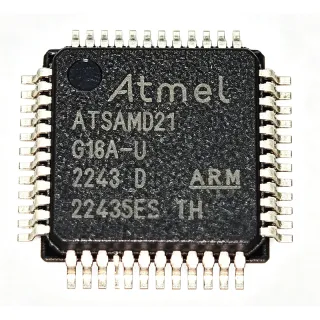
RTAX2000SL-CG1152V - 2M-Gate Rad-Tolerant FPGA | Microchip
MPN: RTAX2000SL-CG1152V ✓ Active| Qty | Unit Price | Extended |
|---|---|---|
| 1 | $0 | $0.00 |
| 10 | $0 | $0.00 |
| 100 | $0 | $0.00 |
| 500 | $0 | $0.00 |
| 1,000 | $0 | $0.00 |
RTAX2000SL-CG1152V Overview
A radiation-tolerant FPGA is a field-programmable gate array qualified to survive the total ionizing dose (TID) and single-event effects encountered in orbital and deep-space missions. Within the power-management hierarchy of spacecraft avionics, the RTAX-S/SL family sits alongside rad-hard microcontrollers and memories as the reprogrammable logic element, based on the commercial Microsemi (Actel) Axcelerator architecture and manufactured on a digital CMOS process.
Key features include live-at-power-up operation thanks to its antifuse-based, one-time-programmable (OTP) fabric, a true single-chip form factor that eliminates external configuration devices, low-power consumption relative to SRAM FPGAs, embedded SRAM blocks with built-in FIFO control logic, segmentable clock resources, and chip-wide highway routing for high-fanout signals. The SL suffix denotes a lower-power variant of the standard RTAX2000S die.
Technically, the device leverages the Axcelerator cluster-based logic structure with D-shaped flip-flops in each logic element, delivering high register-rich performance for pipeline-intensive space applications such as on-board data processing, telemetry encoding, and sensor interfacing. Design migration from the commercial Axcelerator family is supported through a footprint-compatible adaptor board and EDIF netlist conversion methodology for prototyping.
Typical applications include satellite payload data handling, spacecraft bus avionics, instrument control in Earth-observation platforms, and fault-tolerant logic in launch vehicles - environments where TID endurance and single-event-upset immunity outweigh in-field reprogrammability.
A key design consideration is that the antifuse fabric is OTP: a programming error produces an unusable device, so flight designs should be validated using the Aldec/Microchip flash-based ProASIC3E prototyping adaptor or the RTAX2000SL-1LG1152PROTO engineering part before flight-unit programming.
This page synthesizes distributor cross-references, drop-in same-footprint alternatives, pricing-inquiry tiers, and practical space-design notes not consolidated in the manufacturer datasheet.
Drop-in alternatives for RTAX2000SL-CG1152V — same package, pin-to-pin compatible. Different-package parts requiring PCB rework are excluded.
Variants in this series
Same-series models that are drop-in compatible with RTAX2000SL-CG1152V (same form factor and footprint) — differing in Package, Configuration, Technology, Family, Equivalent System Gates.
Quick Comparison Tool — Select alternative parts for side-by-side comparison:
RTAX2000SL-1CG1152V
✅ Drop-In✓ In Stock
Contact for price
View Datasheet →RTAX2000SL-1LG1152V
✅ Drop-In✓ In Stock
$1 / Unit
View Datasheet →RTAX2000S-1CG1152V
✅ Drop-In✓ In Stock
Contact for price
View Datasheet →RTAX2000SL-1LG1152PROTO
✅ Drop-In📋 Reference alternative (not in catalog)
RTAX2000SL-CG1152V Maximum Ratings & Electrical Characteristics
| Family | RTAX-S/SL Radiation-Tolerant FPGAs |
| Equivalent System Gates | 2000000 |
| Logic Cells | 32256 |
| Configurable Logic Blocks (CLBs) | 21504 |
| Technology | Digital CMOS, antifuse OTP |
| Application Domain | Space-flight systems, radiation tolerant |
| Configuration | Live at power-up, single chip |
| Embedded Memory | Embedded SRAM with built-in FIFO control logic |
| Clocking | Segmentable clocks, chip-wide highway routing |
| Package | CG1152 ceramic column grid array |
| Mounting Type | Surface Mount |
| Speed Grade | Standard (no speed-grade suffix) |
RTAX2000SL-CG1152V cg1152 ceramic column grid array Pin Configuration Guide
Pin configuration for RTAX2000SL-CG1152V (cg1152 ceramic column grid array package). This digital IC includes GPIO, communication interfaces (UART, SPI, I2C), and power pins. Refer to the manufacturer datasheet for alternate pin functions and configuration options. Essential for embedded system design and PCB layout.

No detailed pinout data available for RTAX2000SL-CG1152V.
Refer to the datasheet for full pin configuration.
Typical Applications
RTAX2000SL-CG1152V is suitable for 6 applications: Satellite Payload Data Processing, Spacecraft Bus Avionics, Earth-Observation Instrument Control, Launch Vehicle Flight Logic, On-Board Data Compression and Formatting, Fault-Tolerant System Prototyping and Migration.
Satellite Payload Data Processing
The RTAX2000SL-CG1152V fits satellite payload processing because its 2,000,000 equivalent gates and 32,256 logic cells absorb high-throughput framing, compression, and channel-encoding pipelines, while the antifuse OTP fabric is immune to configuration memory upsets in orbit - no scrubber or external configuration flash is needed. Designers typically implement CCSDS framing, Reed-Solomon or LDPC front-end stages, and sensor-data glue logic within the 21,504 CLB fabric, exploiting embedded SRAM blocks with built-in FIFO control logic for stream buffering between high-rate instrument interfaces and downchain encoders. Chip-wide highway routing distributes segmentable clocks with low skew across the processing pipeline, preserving timing closure at mission clock rates. Because the device is live at power-up in a true single-chip form factor, payload logic comes up instantly after a reset without a boot sequence - a decisive advantage for payload availability windows. The trade-off is one-time programmability: flight designs must be timing-verified on engineering parts before programming flight units.
Recommended
Spacecraft Bus Avionics
For spacecraft bus avionics - attitude control, command and data handling, power-switch sequencing logic - the RTAX2000SL-CG1152V offers low static power via the SL low-power die, which directly reduces solar-array and battery sizing margins on power-constrained platforms. The antifuse architecture provides deterministic, live-at-power-up behavior demanded by critical bus functions that must respond to safe-mode entry immediately after separation events. Its 2,000,000-gate capacity consolidates discrete 1553/UART/BC glue logic, watchdog functions, and mode-sequencing state machines that previously required multiple rad-tolerant ASICs or SSI/MSI devices, improving board-level parts-count reliability. The 1152-pin ceramic column grid array delivers hermetic packaging consistent with the thermal-vacuum and outgassing requirements of bus electronics. Engineers should reserve segmentable clock resources for the bus master clock domain and validate all state machines against single-event-effect requirements using the manufacturer's SEE reporting before flight review.
Recommended
Earth-Observation Instrument Control
Imaging instruments on Earth-observation satellites require deterministic, low-jitter control of detector readout, timing generation, and high-speed data capture - workloads matched to the RTAX2000SL-CG1152V's register-rich Axcelerator-based logic elements with D-shaped flip-flops, which pipeline high-rate detector data without external FIFOs. Embedded SRAM with FIFO control logic stages image lines between the detector interface and the mass-memory formatter, while chip-wide highway routing fans out the instrument master timing with controlled skew across the 21,504-CLB array. Radiation tolerance ensures the timing generator continues operating through TID accumulation over multi-year LEO missions, and the single-chip, live-at-power-up design eliminates configuration-boot latency between imaging windows. Because instrument-control logic is finalized before launch and rarely changed in orbit, the OTP antifuse programming model imposes little practical limitation, making this device a strong fit versus reprogrammable SRAM alternatives that would require SEU-mitigation overhead.
Recommended
Launch Vehicle Flight Logic
Launch-vehicle avionics experience severe vibration, thermal excursions, and radiation belts during ascent, making the hermetic 1152-pin ceramic column grid array of the RTAX2000SL-CG1152V appropriate for flight-control and telemetry logic. The antifuse fabric holds configuration through shock and vibration with no solder-down configuration memory to fail, and live-at-power-up behavior means flight logic is active from the instant of power application - critical for abort-detection and range-safety interfaces that cannot tolerate boot delay. The 2,000,000-gate density integrates vehicle-mode sequencing, telemetry encoders, and redundancy-voting logic in a single qualified device, replacing multiple rad-hard standard-logic parts and improving mean-time-between-failure at the box level. Engineering teams should perform vibration-qualified solder profiles per their program requirements and validate functional behavior on the RTAX2000SL-1LG1152PROTO engineering part, since flight units are one-time programmable and cannot be reworked after programming.
Recommended
On-Board Data Compression and Formatting
Data-compression and CCSDS-formatting engines are classic RTAX2000SL-CG1152V workloads: the 32,256 logic cells and 21,504 CLBs accommodate parallel LZ-class or transform-based compressor datapaths, while embedded SRAM blocks with built-in FIFO control logic hold reference windows and stream buffers without external memory. Chip-wide highway routing carries the formatter's segmentable clocks to all processing lanes with low skew, supporting sustained throughput to the downlink chain. Because compression logic is deterministic flight software-free RTL, the single-chip antifuse device delivers low power - the SL die variant reduces static current versus the standard RTAX2000S, easing thermal design in enclosed avionics bays. The 1152-pin package supplies the wide parallel buses needed between compression, formatting, and cipher stages. Designers migrating from the commercial Axcelerator family can reuse RTL and reuse the EDIF netlist conversion methodology documented for RTAX-S prototyping, shortening the qualification loop substantially compared with custom ASIC development.
Recommended
Fault-Tolerant System Prototyping and Migration
Microchip's documented migration methodology supports prototyping RTAX-S designs on reprogrammable hardware before committing to one-time-programmable flight silicon. The RTAX2000SL-CG1152V design flow uses a footprint-compatible adaptor board and an EDIF netlist and pinout converter - commercially embodied in the Aldec/Microchip prototyping solution that maps RTAX-S designs onto flash-based ProASIC3E FPGAs. This lets teams verify timing, I/O assignments, and functional coverage on the RTAX2000SL-1LG1152PROTO engineering part or an A3PE3000-family ProASIC3E device, iterating rapidly at a fraction of flight-part cost. Once verified, the identical netlist is place-and-routed for the RTAX2000SL-CG1152V flight device, preserving the validated pinout. For programs prototyping against commercial equivalents, the A3PE3000 Axcelerator-derived family provides an architecture-compatible stepping stone. This application is essential because the antifuse fabric permits exactly one programming cycle - errors found after programming are unrecoverable, so disciplined prototyping is a schedule-critical program phase.
Recommended
Recommended Products Summary
Engineering reference data for RTAX2000SL-CG1152V — comparison, design guidance, and compliance information.
Selection Guide
Comparison with Alternatives
| Parameter | This Product | RTAX2000SL-1CG1152V | RTAX2000SL-1LG1152V | RTAX2000S-1CG1152V | RTAX2000SL-1LG1152PROTO |
|---|---|---|---|---|---|
| Brand | Microchip Technology | Microchip Technology | Microchip Technology | Microchip Technology | Microchip Technology |
| Package | CG1152 (1152-pin ceramic column grid array) | CG1152 - same | LG1152 lidded CGA variant | CG1152 - same | LG1152 lidded CGA variant |
| Equivalent System Gates | 2000000 | 2000000 | 2000000 | 2000000 | 2000000 |
| Logic Cells / CLBs | 32256 / 21504 | 32256 / 21504 | 32256 / 21504 | 32256 / 21504 | 32256 / 21504 |
| Speed Grade | Standard | -1 (faster) | -1 (faster) | -1 (faster) | -1 (faster) |
| Power Variant | SL (low power) | SL (low power) | SL (low power) | S (standard power) | SL (low power) |
| Intended Use | Flight (space-qualified) | Flight (space-qualified) | Flight (space-qualified) | Flight (space-qualified) | Engineering prototype only |
| Configuration | Antifuse OTP, live at power-up | Antifuse OTP, live at power-up | Antifuse OTP, live at power-up | Antifuse OTP, live at power-up | Antifuse OTP, live at power-up |
Key Differentiators
- Low-power SL die in the full 2M-gate density (vs RTAX2000S-1CG1152V)
- Lower unit cost than the speed-grade-1 variant (vs RTAX2000SL-1CG1152V)
- Flight-grade qualification versus prototype part (vs RTAX2000SL-1LG1152PROTO)
Design Notes
The RTAX2000SL-CG1152V uses antifuse one-time-programmable technology: a failed programming cycle permanently destroys the device. Never program flight units with an unverified bitstream. Follow the datasheet migration methodology - footprint-compatible adaptor board plus EDIF netlist and pinout converter - and validate on the RTAX2000SL-1LG1152PROTO engineering part or the Aldec flash-based ProASIC3E prototyping adaptor first. Budget at least one flight spare per programming session, since programmer handling and lot acceptance introduce scrap risk even with verified netlists.
Choose the SL (low-power) die deliberately: the SL variant of the 2,000,000-gate fabric reduces static power versus the RTAX2000S standard-power die, which matters in thermally enclosed avionics bays where radiative cooling is the only path. Estimated: at multi-hundred-mW static levels typical of this density class, an S-to-SL die swap can meaningfully reduce radiator area on small satellites. Confirm exact static current figures in the manufacturer datasheet electrical tables for your voltage and temperature corner before finalizing power budgets - do not rely on family-typical values.
The 1152-pin ceramic column grid array requires a controlled-expansion substrate; on conventional FR-4, ceramic-to-organic CTE mismatch through thermal cycling drives solder-column fatigue. Use thick copper thermal planes under the package and consider redundant column attach per program reliability requirements. During capture, respect the datasheet pre-assigned power/ground/configuration pins and bank constraints for user I/O, and verify your pinout against the Libero SoC I/O report - hand-edited constraint files are a leading cause of unusable OTP flight devices.
Exploit chip-wide highway routing for the master clock distribution instead of general fabric routing; the segmentable clock structure of the RTAX-S/SL architecture gives controlled skew across the 32,256-logic-cell array, which is essential for source-synchronous detector and telemetry interfaces operating at high data rates. Keep the fastest I/O in banks closest to the clock conditioning resources and simulate the ceramic package flight lidded variant in IBIS if your receiver timing budgets are tight.
Compliance Information
Microchip space FPGA product lines on DLA drawings are qualified per Mil-Prf-38535 and listed on the QML class Q and class V lists per the Microchip DLA Cross Reference Guide; qualification status of this specific commercial-orderable MPN must be confirmed with the manufacturer at order time.