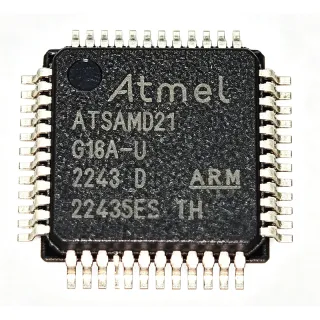
RTAX250S-LG624E - 250K Gate Rad-Tolerant FPGA | Microchip
MPN: RTAX250S-LG624E ✓ Active| Qty | Unit Price | Extended |
|---|---|---|
| 1 | $0 | $0.00 |
| 10 | $0 | $0.00 |
| 100 | $0 | $0.00 |
| 500 | $0 | $0.00 |
| 1,000 | $0 | $0.00 |
RTAX250S-LG624E Overview
A radiation-tolerant FPGA is a field programmable gate array designed to survive the radiation environment of space without the full cost and schedule burden of a radiation-hardened ASIC. Within the power-management hierarchy of spacecraft avionics, an FPGA such as the RTAX-S sits between radiation-hardened microcontrollers and full custom ASICs, providing configurable glue logic, data path processing, and bus interfacing for satellites, planetary probes, and launch vehicles.
Key features of the RTAX250S include SEU-hardened registers that eliminate the need for Triple Module Redundancy (TMR), immunity to Single-Event Upsets (SEU) at specified LET thresholds, and an SEU error rate of less than 10-10 errors per bit-day, which is critical for long-duration missions. True single-chip form factor and live-at-power-up operation remove the need for external configuration devices, while low static power consumption suits energy-constrained spacecraft power budgets.
Technically, the RTAX-S family uses an antifuse-based architecture that is inherently tolerant to configuration upsets: once programmed, the routing cannot be disturbed by radiation-induced charge. The 0.15 um metal-to-metal antifuse process combines ASIC-like security and low power with post-manufacturing programmability. Registered logic elements are rad-hardened at the design level, and the CGA-624 ceramic column grid array package provides hermetic sealing and mechanical robustness for launch vibration and thermal cycling.
Typical applications include satellite on-board data handling, payload telemetry and command processing, spacewire and CAN bus interface bridges, attitude control electronics, and instrument front-end sequencing on Earth-observation and deep-space missions.
A key design consideration is that antifuse FPGAs are one-time programmable, so engineering prototypes must be validated on footprint-compatible development tools, such as the Microchip/Aldec RTAX adaptor boards, before flight-unit programming. Use the Prototyping for RTAX-S and RTAX-SL Devices application note methodology with an EDIF netlist and pinout converter.
This page synthesizes distributor listings, drop-in same-family alternatives, and practical design guidance not consolidated in the manufacturer datasheet, helping space engineers select the correct RTAX-S orderable part quickly.
Drop-in alternatives for RTAX250S-LG624E — same package, pin-to-pin compatible. Different-package parts requiring PCB rework are excluded.
Variants in this series
Same-series models that are drop-in compatible with RTAX250S-LG624E (same form factor and footprint) — differing in Radiation Tolerance, Package, Family, Configuration, Core Supply Voltage.
Quick Comparison Tool — Select alternative parts for side-by-side comparison:
RTAX250S-LG624EV
✅ Drop-In✓ In Stock
Contact for price
View Datasheet →RTAX250S-LG624B
✅ Drop-In✓ In Stock
$2350 / Unit
View Datasheet →RTAX250S-LG624V
✅ Drop-In✓ In Stock
Contact for price
View Datasheet →RTAX250S-1LG624V
✅ Drop-In✓ In Stock
Contact for price
View Datasheet →RTAX250SL-LG624E
✅ Drop-In✓ In Stock
$1000 / Unit
View Datasheet →RTAX250SL-1CG624E
✅ Drop-In✓ In Stock
$1 / Unit
View Datasheet →RTAX250S-CG624E
✅ Drop-In✓ In Stock
Contact for price
View Datasheet →RTAX250SL-CG624B
✅ Drop-In✓ In Stock
$3950 / Unit
View Datasheet →RTAX250S-LG624E Maximum Ratings & Electrical Characteristics
| System Gates | 250,000 |
| Logic Cells / Logic Blocks | 2,816 |
| Maximum Toggle Frequency | 649 MHz |
| Process Technology | 0.15 um CMOS |
| Core Supply Voltage | 1.5 V |
| Logic Family | CMOS |
| Package Type | Ceramic LGA / CGA-624 |
| Pin Count | 624 |
| Operating Temperature | -55C to +125C |
| Radiation Tolerance | SEU rate < 10-10 errors per bit-day (per digchip datasheet excerpt) |
| SEU Immunity | Immune to Single-Event Upsets at specified LET threshold |
| SEU-Hardened Registers | Yes (eliminates need for TMR) |
| Configuration | One-time programmable antifuse, live at power-up |
| Product Family | RTAX-S / RTAX-SL Radiation-Tolerant FPGAs |
| Mounting Type | Surface Mount |
| Typical Application Domain | Space-flight systems |
RTAX250S-LG624E ceramic lga / cga-624 Pin Configuration Guide
Pin configuration for RTAX250S-LG624E (ceramic lga / cga-624 package). This digital IC includes GPIO, communication interfaces (UART, SPI, I2C), and power pins. Refer to the manufacturer datasheet for alternate pin functions and configuration options. Essential for embedded system design and PCB layout.

No detailed pinout data available for RTAX250S-LG624E.
Refer to the datasheet for full pin configuration.
Typical Applications
RTAX250S-LG624E is suitable for 6 applications: Satellite On-Board Data Handling, Payload Telemetry and Command Processing, SpaceWire and CAN Bus Interface Bridging, Attitude Determination and Control Electronics, Instrument Front-End Sequencing and Acquisition, Launch Vehicle Avionics Glue Logic.
Satellite On-Board Data Handling
The RTAX250S-LG624E fits spacecraft on-board computer (OBC) data-handling logic because its SEU-hardened registers are immune to Single-Event Upsets at the specified LET threshold with an SEU rate below 10-10 errors per bit-day, removing the need for Triple Module Redundancy and freeing 250K gates of fabric for application logic. The antifuse configuration cannot be corrupted in orbit, and live-at-power-up operation means the FPGA is functional immediately when the spacecraft bus powers the OBC - no boot device loading time. In a typical implementation the part bridges the processor to telemetry encoders, memory controllers, and redundant Mil-Std-1553 or SpaceWire interfaces on the 624-pin CGA ceramic package, whose hermetic construction withstands vacuum outgassing and launch vibration. Design consideration: one-time programmability requires full netlist freeze before flight-lot programming.
Recommended
Payload Telemetry and Command Processing
For payload telemetry formatting and command decoding, the RTAX250S-LG624E offers deterministic, live-at-power-up logic that begins frame generation the instant power is applied, which matters during launch and early operations where no configuration controller exists. Its 649 MHz-class internal toggle performance supports high-rate CCSDS framing, scramblers, and CRC engines within the 2,816 logic cells, while the low static power of the 0.15 um antifuse CMOS process respects tight payload power budgets. The CGA-624 ceramic LGA supplies 624 interconnects, ample for wide parallel data buses between the payload sensor chain and the downlink modulator. The -55C to +125C rating covers orbital thermal cycling without active control. Engineers should budget power at worst-case toggle rates using Microchip's Libreporte timing/power tools before flight-lot commitment.
Recommended
SpaceWire and CAN Bus Interface Bridging
The RTAX250S-LG624E is well suited to implementing SpaceWire links (LVDS transceivers at 100-200 Mbit/s per the RTAX-S family I/O capability) and fault-tolerant CAN controllers as bridging logic between spacecraft subsystems. Its SEU-hardened registers keep link state machines correct through the radiation environment without designer-implemented TMR, which would otherwise consume roughly three times the register resources in these protocol engines. The single-chip antifuse form factor removes external configuration PROMs that would be additional failure points on each bus node. The 624-pin CGA-624 package provides enough I/O for multiple redundant bus interfaces plus discrete subsystem control lines. According to the Microchip RTAX-S/SL datasheet, the family is positioned as the FPGA of choice for space-flight bus electronics due to low power and live-at-power-up operation.
Recommended
Attitude Determination and Control Electronics
Attitude control units benefit from the RTAX250S-LG624E's combination of deterministic timing, radiation-tolerant registers, and modest power draw. The device typically implements sun-sensor pulse counting, reaction-wheel PWM generation, and magnetorquer drive interfaces, all of which must remain operational through single-event transients - the SEU rate below 10-10 errors per bit-day and hardened registers directly address this. The 649 MHz-class fabric timing supports fine-resolution PWM and encoder interpolation, while 2,816 logic cells accommodate a PID control loop alongside interface logic with margin. The CGA-624 ceramic package's hermetic seal and column grid array attachment withstand launch vibration and repeated thermal swings across the -55C to +125C range. Because control loops are latency-sensitive, use the -1 speed grade variant (RTAX250S-1LG624V) when timing closure at high control rates is marginal.
Recommended
Instrument Front-End Sequencing and Acquisition
Science instruments on observation and deep-space missions use the RTAX250S-LG624E as the sequencing and acquisition controller that clocks detector readout, sequences exposure timing, and buffers pixel data into downlink memory. The antifuse architecture guarantees that the sequence program defined before launch runs unchanged for mission life, an important provenance argument for scientific data integrity, while SEU-hardened registers protect exposure counters from bit flips that would corrupt timing. Its 0.15 um CMOS process yields low static power, critical for instruments with strict thermal budgets near detectors, and the wide 624-pin CGA-624 I/O count supports parallel ADC and CCD interface buses. Live-at-power-up behavior ensures acquisition starts autonomously after instrument power events. Validate the full acquisition netlist with Microchip's prototyping adaptor methodology before flight-lot antifuse programming.
Recommended
Launch Vehicle Avionics Glue Logic
Launch vehicle flight computers and telemetry units operate for only minutes but must tolerate extreme vibration and radiation belts; the RTAX250S-LG624E addresses both with its mechanically robust hermetic CGA-624 ceramic package and its intrinsic SEU immunity (rate below 10-10 errors per bit-day). The part typically provides bus interfacing, majority-voted command decoding, safe-and-arm logic support circuits, and redundancy management glue between the flight processor and pyrotechnic and telemetry channels. Live-at-power-up operation eliminates configuration boot time during the launch sequence window, and the one-time-programmable antifuse provides configuration assurance that no bitstream can be disturbed by shock or radiation. The -55C to +125C range covers unconditioned avionics bays. Qualification engineers should lock the netlist and screening suffix early given typical flight-hardware lead times.
Recommended
Recommended Products Summary
Engineering reference data for RTAX250S-LG624E — comparison, design guidance, and compliance information.
Selection Guide
Comparison with Alternatives
| Parameter | This Product | RTAX250S-LG624EV | RTAX250SL-LG624E | RTAX250S-1LG624V | RTAX250SL-1CG624E |
|---|---|---|---|---|---|
| Package | CGA-624 (624-pin ceramic LGA) | CGA-624 - same | CGA-624 - same | CGA-624 - same | CGA-624 - same |
| Brand | Microchip Technology (Actel/Microsemi) | Microchip Technology | Microchip Technology | Microchip Technology | Microchip Technology |
| System Gates | 250,000 | 250,000 | 250,000 | 250,000 | 250,000 |
| Logic Cells | 2,816 | 2,816 | 2,816 | 2,816 | 2,816 |
| Speed Grade | Standard | Standard | Standard | -1 (faster) | -1 (faster) |
| Core Supply Voltage | 1.5 V | 1.5 V | 1.5 V | 1.5 V | 1.5 V |
| Operating Temperature | -55C to +125C | -55C to +125C | -55C to +125C | -55C to +125C | -55C to +125C |
| SEU Hardening | SEU-hardened registers, no TMR needed | Same | Same (SL family) | Same | Same (SL family) |
| Screening / Flow Suffix | L flow, E suffix | L flow, EV suffix | SL family, L flow, E suffix | L flow, V suffix | C flow, E suffix |
Key Differentiators
- Standard speed grade with widest procurement availability (vs RTAX250S-1LG624V)
- Original RTAX-S family heritage (vs RTAX250SL-LG624E)
- Single-chip live-at-power-up antifuse configuration (vs RTAX250S-1LG624V)
Design Notes
The RTAX250S is one-time programmable antifuse silicon: a programming error on a flight unit is unrecoverable. Never program flight devices with an unverified netlist. Follow the Microchip application note 'Prototyping for RTAX-S and RTAX-SL Devices', which uses a footprint-compatible adaptor board and an EDIF netlist and pinout converter to validate the exact design on hardware before committing flight-lot programming. Freeze timing constraints, pin assignments, and design checksums before programming, and retain programming files under configuration control for mission traceability.
The core supply is 1.5V with a 0.15 um CMOS antifuse process; static power is low because there is no configuration bitstream to refresh, unlike SRAM FPGAs. Estimate dynamic power with Microchip's power tools using worst-case toggle rates for your design, and provide sequencing so I/O banks are powered before or with the core per the RTAX-S/SL datasheet power-up requirements. Because live-at-power-up is a family feature, do not add reset logic that assumes a configuration delay window - the device is functional immediately at power application.
The CGA-624 ceramic column grid array requires a land pattern matched to the ceramic column geometry and a rigid, low-warpage PCB to survive launch vibration and thermal cycling from -55C to +125C. Use underfilled or symmetric stackup construction as per your qualification approach, and route the 624 pads with controlled impedance for high-speed bus I/O. Verify column coplanarity on receipt and follow the Microchip mounting and rework guidance for ceramic CGA packages; do not hand-solder flight units.
With 649 MHz-class internal timing and large parallel buses on the CGA-624 package, manage I/O switching noise by grouping banks by voltage standard and distributing ground returns. For SpaceWire LVDS implementations, follow the RTAX-S datasheet I/O bank rules for differential pairs and use series termination per the Microchip high-speed interface guidance. Simultaneous switching output limits on ceramic-packaged RTAX devices must be checked for wide buses; the manufacturer's packaging and I/O tables in the RTAX-S/SL datasheet provide per-bank drive allowances.
Compliance Information
Compliance data not stated in verified web data. Ceramic hermetic space-flight packages frequently carry RoHS exemptions for aerospace/high-reliability use; request material declarations and certificates of conformance from Microchip or the distributor for flight paperwork.