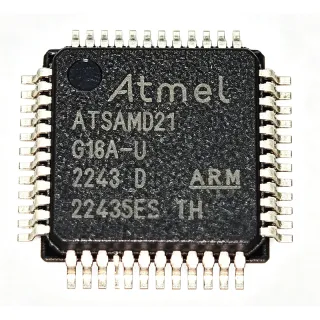
RTAX250S-1LG624E - 250K-Gate Rad-Tolerant FPGA | Microchip
MPN: RTAX250S-1LG624E ✓ Active| Qty | Unit Price | Extended |
|---|---|---|
| 1 | $1 | $1.00 |
| 10 | $1 | $10.00 |
| 100 | $1 | $100.00 |
| 500 | $1 | $500.00 |
| 1,000 | $1 | $1,000.00 |
RTAX250S-1LG624E Overview
A radiation-tolerant FPGA is a programmable logic device qualified for the space-flight radiation environment, sitting in the device hierarchy above commercial FPGAs: programmable logic -> FPGA -> radiation-tolerant FPGA -> space-flight electronics. Unlike one-time-programmable anti-fuse devices that require external configuration, RTAX-S devices combine anti-fuse fabric with live-at-power-up operation, giving designers a true single-chip form factor without a configuration PROM in many system architectures.
Key features include low static power consumption, live-at-power-up operation immediately after the supply rails settle, and the high logic density needed for spacecraft payload processing, telemetry formatting, and bus-interface logic. The -1 speed grade balances timing performance against power, while the 624-pin land-grid array provides a high I/O count for memory interfaces, redundant buses, and instrument front ends.
Architecturally, the RTAX250S uses Microchip (Actel) axcelerator-derived logic modules arranged in a cluster-based fabric, supported by embedded SRAM blocks and clock-conditioning resources, implemented on a 0.15 um CMOS process optimized for total ionizing dose (TID) and single-event effect robustness. Design flows use Libero SoC with timing-verified libraries and radiation reports for SET/SEU mitigation planning.
Typical applications include satellite on-board data handling, payload data processing and compression, spacecraft attitude-control and telemetry systems, and launch-vehicle avionics where radiation tolerance and single-chip reliability are mandatory.
A key design consideration is prototyping: because the anti-fuse fabric is one-time programmable, Microchip recommends prototyping on footprint-compatible ProASIC3-based adaptor boards (for example the Aldec RTAX prototyping solution) before committing hardware, per the RTAX-S/SL datasheet application methodology.
This page synthesizes verified distributor data, drop-in same-package alternatives, and practical design guidance not found in the manufacturer datasheet, with pricing referencing as of 2026-09-02.
Drop-in alternatives for RTAX250S-1LG624E — same package, pin-to-pin compatible. Different-package parts requiring PCB rework are excluded.
Variants in this series
Same-series models that are drop-in compatible with RTAX250S-1LG624E (same form factor and footprint) — differing in Package, Radiation Tolerance, Family, Configuration, Speed Grade.
Quick Comparison Tool — Select alternative parts for side-by-side comparison:
RTAX250SL-1LG624E
✅ Drop-In ⚠️ Specs Unverified✓ In Stock
$2350 / Unit
View Datasheet →RTAX250S-LG624E
✅ Drop-In✓ In Stock
Contact for price
View Datasheet →RTAX250S-1LG624V
✅ Drop-In✓ In Stock
Contact for price
View Datasheet →RTAX250S-1LG624B
✅ Drop-In ⚠️ Specs Unverified✓ In Stock
$2020 / Unit
View Datasheet →RTAX250SL-LG624E
✅ Drop-In ⚠️ Specs Unverified✓ In Stock
$1000 / Unit
View Datasheet →RTAX250S-1LG624E Maximum Ratings & Electrical Characteristics
| Family | RTAX-S |
| Equivalent Gate Count | 250,000 gates |
| Configurable Logic Blocks (CLBs) | 2816 |
| Logic Cells | 4224 |
| Maximum System Frequency | 649 MHz |
| Process Technology | 0.15 um CMOS |
| Core Supply Voltage | 1.5 V |
| Speed Grade | -1 |
| Package | 624-pin LGA |
| Package Option Code | LG624 |
| Radiation Tolerance | Radiation-tolerant (space-flight qualified family) |
| Configuration | Anti-fuse, live at power-up |
| Mounting Type | Surface Mount |
| Application Domain | Space-flight systems |
RTAX250S-1LG624E lg624 Pin Configuration Guide
Pin configuration for RTAX250S-1LG624E (lg624 package). This digital IC includes GPIO, communication interfaces (UART, SPI, I2C), and power pins. Refer to the manufacturer datasheet for alternate pin functions and configuration options. Essential for embedded system design and PCB layout.

No detailed pinout data available for RTAX250S-1LG624E.
Refer to the datasheet for full pin configuration.
Typical Applications
RTAX250S-1LG624E is suitable for 6 applications: Satellite On-Board Data Handling, Payload Data Processing, Spacecraft Attitude Control and Telemetry, Launch Vehicle Avionics, Deep-Space Instrumentation and Science Probes, Space-Grade Glue Logic Consolidation.
Satellite On-Board Data Handling
The RTAX250S-1LG624E fits spacecraft on-board computer and data-handling units because it combines 250,000 equivalent gates and 4,224 logic cells with live-at-power-up operation, so flight logic is active the moment the 1.5V and I/O rails settle - no configuration device boot sequence delays telemetry acquisition after eclipse exit or reset. In this role the FPGA implements CCSDS-style telemetry formatting, MIL-STD-1553 or SpaceWire interface glue logic, memory controllers for MRAM/SDRAM, and watchdog functions in one radiation-tolerant chip, eliminating the reliability risk of separate configuration PROMs. The 624-pin LG package provides enough I/O for redundant cross-strapped interfaces, and the -1 speed grade at up to 649 MHz comfortably covers typical bus clock rates. Design teams should budget timing margins in Libero SoC and validate SET/SEU mitigation such as triple-module redundancy during the prototyping flow.
Recommended
Payload Data Processing
Imaging and scientific instrument payloads use the RTAX250S-1LG624E for front-end data acquisition, compression, and formatting, where its 2,816 CLBs provide the fabric for FIFO staging, convolution or FFT pre-processing, and packetization, while the 649 MHz capability of the 0.15 um process supports parallel datapaths clocked at instrument rates. Because payloads often power-cycle, live-at-power-up anti-fuse configuration ensures the processing chain is available immediately without a boot controller. The LG624 package's high pin count interfaces directly with ADCs, CCD/CIMS readout chains, and solid-state mass-memory banks. A practical performance consideration: route the highest-speed datapaths on the shortest PCB runs and use the datasheet-recommended prototyping adaptor to validate timing before anti-fuse programming, since one-time-programmable fabric cannot be reworked in flight hardware.
Recommended
Spacecraft Attitude Control and Telemetry
Attitude-control units and telemetry encoders benefit from the RTAX250S-1LG624E's deterministic, single-chip implementation of PWM generators, encoder interfaces, star-tracker/gyro readouts, and redundant bus bridges. The radiation-tolerant RTAX-S fabric is qualified for the space radiation environment, and the 1.5V core keeps static power low - important for power-limited smallsats during eclipse operations. With 4,224 logic cells there is headroom for triple-module-redundant registers and voting logic, a standard SEU mitigation technique that fits comfortably at this density. The live-at-power-up characteristic guarantees control logic is never in an unconfigured state during transfer orbits or safe-mode resets. Engineers should place the FPGA close to the actuator driver circuitry to keep PWM edges clean and reference Microchip's radiation reports when preparing mission assurance documentation.
Recommended
Launch Vehicle Avionics
Launch-vehicle flight computers and stage-separation controllers adopt the RTAX250S-1LG624E because mission durations are short but vibration, shock, and radiation environments are severe, and the anti-fuse RTAX-S fabric is inherently immune to configuration upsets that affect SRAM-based FPGAs - there is no configuration memory to corrupt, only sensitive sequential logic that can be protected with TMR at this 250K-gate density. Live-at-power-up ensures countdown sequencing logic is ready from battery insert. The 624-pin LGA offers the redundant I/O needed for cross-strapped harnesses between stages, and the -1 speed grade covers hard real-time deadlines with margin. Teams should replicate the flight design on the footprint-compatible ProASIC3E prototyping adaptor for full functional verification before committing one-time-programmable flight units, per the RTAX-S/SL datasheet methodology.
Recommended
Deep-Space Instrumentation and Science Probes
Deep-space science instruments face extreme total ionizing dose and single-event environments over multi-year missions, which is exactly the qualification envelope of the RTAX-S family. The RTAX250S-1LG624E implements instrument sequencers, science-data packetizers, and sensor front-end interfaces with 2,816 CLBs while drawing low static power from a 1.5V core - critical where RTGs or limited solar arrays set a tight power budget. True single-chip operation removes the external configuration device, reducing parts count and associated failure modes on missions with no repair possibility. The 624-pin LG package supports multi-channel sensor interfaces including redundant串行 links. Mission planners should apply SEU-hardened coding styles (TMR, EDAC) in Libero SoC and review Microchip radiation test reports for the RTAX250S when generating mission radiation design margins.
Recommended
Space-Grade Glue Logic Consolidation
Many spacecraft boards retain legacy ASIC/SLT glue logic (address decoders, bus bridges, interrupt controllers) that must be replaced when parts go end-of-life; the RTAX250S-1LG624E consolidates these functions into one radiation-tolerant device with 250,000 gates of capacity, dramatically reducing board complexity, solder joints, and screening cost versus multiple SSI/MSI space parts. Because the fabric is live at power-up, replaced glue logic behaves identically to the original TTL-era functions from the first clock edge, easing system-level requalification. The LG624 footprint leaves I/O budget for future design growth on the same PCB. When migrating designs, engineers can use the EDIF netlist and pinout conversion flow documented in the RTAX-S/SL datasheet to move verified logic between prototyping and flight devices with minimal translation risk.
Recommended
Recommended Products Summary
Engineering reference data for RTAX250S-1LG624E — comparison, design guidance, and compliance information.
Selection Guide
Comparison with Alternatives
| Parameter | This Product | RTAX250SL-1LG624E | RTAX250S-LG624E | RTAX250S-1LG624V | RTAX250S-1LG624B | RTAX250SL-LG624E |
|---|---|---|---|---|---|---|
| Package | 624-pin LGA (LG624) | 624-pin LGA (LG624) - same | 624-pin LGA (LG624) - same | 624-pin LGA (LG624) - same | 624-pin LGA (LG624) - same | 624-pin LGA (LG624) - same |
| Brand | Microchip Technology | Microchip Technology | Microchip Technology | Microchip Technology | Microchip Technology | Microchip Technology |
| Equivalent Gates | 250,000 | 250,000 | 250,000 | 250,000 | 250,000 | 250,000 |
| Speed Grade | -1 | -1 | Standard | -1 | -1 | Standard |
| Core Supply Voltage | 1.5 V | 1.5 V (SL low-power core) | 1.5 V | 1.5 V | 1.5 V | 1.5 V (SL low-power core) |
| Radiation Tolerance | RTAX-S space-flight family | RTAX-SL (enhanced) | RTAX-S | RTAX-S | RTAX-S | RTAX-SL (enhanced) |
| Screening Flow Suffix | E | E | E | V | B | E |
| Configuration Technology | Anti-fuse, live at power-up | Anti-fuse, live at power-up | Anti-fuse, live at power-up | Anti-fuse, live at power-up | Anti-fuse, live at power-up | Anti-fuse, live at power-up |
Key Differentiators
- Fastest -1 speed grade in the 250K RTAX-S class (vs RTAX250S-LG624E)
- Lower-power SL generation available as drop-in (vs RTAX250SL-1LG624E)
- No configuration device required (vs SRAM-based commercial FPGAs)
Design Notes
The RTAX250S uses one-time-programmable anti-fuse fabric - a design error cannot be reprogrammed in flight hardware. Per the RTAX-S/SL datasheet, use the footprint-compatible prototyping methodology (Aldec adaptor board with flash-based ProASIC3E, EDIF netlist and pinout converter) to verify the design fully in the lab before committing RTAX-S silicon. Budget schedule time for this prototyping step; skipping it is the single most costly mistake on RTAX programs.
The RTAX250S-1LG624E runs a 1.5V nominal core supply. Decouple each supply pin per the RTAX-S/SL datasheet power-supply recommendations, and verify I/O bank voltages (VCCI) match the signaling standards assigned in Libero SoC. If board power is tightly budgeted, the RTAX250SL-1LG624E in the same LG624 footprint offers the SL generation's lower static power - a drop-in option worth evaluating at schematic capture rather than after layout.
With 624 pins, define consistent I/O bank assignments early and group high-speed interfaces (memory buses, SpaceWire, ADC links) to banks with matched VCCI to avoid level-shifter complexity. Simulate flight-card stackup for impedance control on the fastest nets, and use the -1 speed grade timing models in Libero SoC for static timing closure before releasing the netlist to prototyping; anti-fuse route delays are fixed once programmed.
Compliance Information
No compliance certificates found in verified web data for this space-grade MPN. Space-grade packages are often exempt from RoHS/REACH for high-reliability applications; request formal certificates from Microchip Technology.