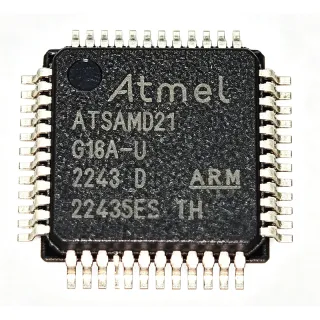
RTAX4000DL-1CGD1272EV - 4M Gate Rad-Tolerant FPGA | Microchip
MPN: RTAX4000DL-1CGD1272EV ✓ Active| Qty | Unit Price | Extended |
|---|---|---|
| 1 | $4980 | $4,980.00 |
| 10 | $4731 | $47,310.00 |
| 100 | $4482 | $448,200.00 |
| 500 | $4233 | $2,116,500.00 |
| 1,000 | $3984 | $3,984,000.00 |
RTAX4000DL-1CGD1272EV Overview
A radiation-tolerant FPGA is a field-programmable gate array engineered to survive the ionizing radiation environments of spaceflight, including total ionizing dose (TID), single-event latchup (SEL), and single-event upset (SEU) conditions. Within the power-management hierarchy of spacecraft avionics, these devices sit between fully rad-hard ASICs (expensive, inflexible) and commercial FPGAs (not space-qualified), offering flight-programmable logic with high reliability.
Key features include the 4M-gate capacity suitable for complex on-board data processing, embedded DSP-friendly multiply-accumulate structures in the DL (DSP-Logic) variant, flash-based Live-at-Power-Up configuration via an external boot PROM, and low-power CMOS operation at 1.5V core voltage. The -1 speed grade and extended ceramic package target stringent flight programs.
The RTAX-DSP architecture combines the proven RTAX-S logic fabric with dedicated DSP blocks, using antifuse-based one-time programmable interconnect that is inherently immune to configuration upsets, unlike SRAM-based FPGAs. Only user flip-flops are SEU-sensitive and can be protected by triple-module redundancy in the design flow using Libero IDE and SoftConsole tooling.
Typical applications include satellite payload data processing, spacecraft command and data handling (C&DH), software-defined radio front ends on orbiters, and instrument control for deep-space probes.
Designers should plan the boot PROM interface early: the device loads its design from an external anti-fuse or flash PROM at power-up, and the 1272-pad CCGA demands careful PCB footprint and column-solder process control.
This page synthesizes distributor availability data, drop-in family alternatives, and practical spaceflight design notes not found in a single manufacturer datasheet.
Drop-in alternatives for RTAX4000DL-1CGD1272EV — same package, pin-to-pin compatible. Different-package parts requiring PCB rework are excluded.
Variants in this series
Same-series models that are drop-in compatible with RTAX4000DL-1CGD1272EV (same form factor and footprint) — differing in Configuration, Family, Logic Cells, Package, Core Supply Voltage.
Quick Comparison Tool — Select alternative parts for side-by-side comparison:
RTAX4000DL-1CGD1272V
✅ Drop-In📋 Reference alternative (not in catalog)
RTAX4000DL-CGD1272V
✅ Drop-In📋 Reference alternative (not in catalog)
RTAX4000SL-1LG1272B
✅ Drop-In✓ In Stock
$9200 / Unit
View Datasheet →RTAX4000SL-CG1272V
✅ Drop-In✓ In Stock
Contact for price
View Datasheet →RTAX4000SL-1LG1272B
✅ Drop-In ⚠️ Specs Unverified✓ In Stock
$9200 / Unit
View Datasheet →RTAX4000DL-1CGD1272EV Maximum Ratings & Electrical Characteristics
| Family | RTAX-DSP |
| Equivalent Gates | 4,000,000 |
| Logic Cells | 55,440 |
| CLBs | 36,960 |
| Process Technology | 0.15 um CMOS |
| Core Supply Voltage | 1.5 V |
| Speed Grade | -1 |
| Package | 1272-Pin CCGA (ceramic column grid array) |
| Mounting Type | Surface Mount |
| Radiation Tolerance | Radiation-tolerant (space-flight grade) |
| Configuration | Live-at-Power-Up (external boot PROM) |
| Program Technology | Antifuse (one-time programmable) |
RTAX4000DL-1CGD1272EV 1272-pin ccga (ceramic column grid array) Pin Configuration Guide
Pin configuration for RTAX4000DL-1CGD1272EV (1272-pin ccga (ceramic column grid array) package). This digital IC includes GPIO, communication interfaces (UART, SPI, I2C), and power pins. Refer to the manufacturer datasheet for alternate pin functions and configuration options. Essential for embedded system design and PCB layout.

No detailed pinout data available for RTAX4000DL-1CGD1272EV.
Refer to the datasheet for full pin configuration.
Typical Applications
RTAX4000DL-1CGD1272EV is suitable for 6 applications: Satellite Payload Data Processing, Spacecraft Command and Data Handling (C&DH), Space Software-Defined Radio (SDR), Deep-Space Instrument Control, On-Board Image Compression and Fusion, Launch Vehicle Avionics.
Satellite Payload Data Processing
The RTAX4000DL-1CGD1272EV fits satellite payload processing because it combines 4,000,000 equivalent gates, 55,440 logic cells, and dedicated DSP multiply-accumulate blocks, enabling on-board implementation of FIR filters, FFTs, and image-compression pipelines that would otherwise require downlinking raw sensor data. Its antifuse fabric is immune to configuration upsets, so only user flip-flops need triple-module redundancy, preserving the majority of the 36,960 CLBs for useful computation. In a typical payload chain the device sits between the sensor front end and the downlink formatter, clocked from a radiation-hardened oscillator, with the 1.5V core keeping power within spacecraft bus budgets. The 1272-pin CCGA provides the I/O count and hermetic reliability required for multi-year orbital missions.
Recommended
Spacecraft Command and Data Handling (C&DH)
For C&DH modules, the RTAX4000DL-1CGD1272EV implements telemetry encoding, command decoding, memory controllers, and 1553/SpaceWire-style interface glue logic within a single rad-tolerant device. Live-at-Power-Up configuration means the FPGA is operational immediately when the spacecraft bus energizes, without waiting for a processor to load configuration - a critical property for autonomous safe-mode recovery. The 4M-gate capacity absorbs multiple legacy ASIC or discrete functions, consolidating board real estate and reducing solder-joint count, while the 0.15 um antifuse process at 1.5V core draws low static power during eclipse operations. Designers typically pair it with an external boot PROM and a rad-hard microcontroller that supervises housekeeping, reserving the DL's fabric for time-critical protocol handling.
Recommended
Space Software-Defined Radio (SDR)
Space SDR front ends benefit directly from the RTAX4000DL's dedicated DSP multiply-accumulate blocks, which implement digital down-conversion mixers, decimating filters, and matched filters at the sample rates of typical spacecraft receivers without consuming general-purpose CLB resources. According to Microchip, the RTAX-DSP family was created precisely for these signal-chain workloads in space-flight systems. The 55,440 logic cells handle framing, FEC (Reed-Solomon or convolutional coding), and MAC-layer state machines alongside the DSP datapath, and the 1272-pin CCGA supplies the wide parallel I/O needed for multi-channel ADC/DAC interfaces. The antifuse configuration is immune to SEU-driven loss of fabric function - a key differentiator versus SRAM FPGAs that must scrub configuration continuously in orbit.
Recommended
Deep-Space Instrument Control
Deep-space instruments - spectrometers, imagers, and plasma sensors - require deterministic sequencing and long-mission reliability that the RTAX4000DL-1CGD1272EV provides through its one-time-programmable antifuse fabric and hermetic ceramic CCGA package. Instrument control logic such as exposure timing, detector clocking, and high-voltage supply sequencing fits comfortably within the 36,960 CLBs, while the DSP blocks perform on-board co-adding and baseline subtraction to reduce downlink volume. The 0.15 um process tolerates the total ionizing dose profiles of multi-year cruises, and the 1.5V core minimizes power when the instrument operates from limited radioisotope or solar margins. Live-at-Power-Up behavior guarantees the instrument is controllable from the first turn-on after launch-separation anomaly recovery.
Recommended
On-Board Image Compression and Fusion
Earth-observation and reconnaissance payloads use the RTAX4000DL-1CGD1272EV to run JPEG-like discrete-cosine and wavelet compression engines on raw image streams before downlink, multiplying effective mission data return within fixed transponder bandwidth. The dedicated DSP MACs execute the transform inner loops while the 55,440 logic cells manage DMA-style streaming from the image sensor interface, entropy coding, and packetization. Compared with a software solution on a rad-hard CPU, the FPGA datapath sustains line rates that software cannot reach at acceptable power; compared with an ASIC, it remains reprogrammable between missions via the boot PROM image. The wide 1272-column CCGA interface supports high-parallelism sensor adapters in a single hermetic package suitable for flight qualification.
Recommended
Launch Vehicle Avionics
Launch-vehicle flight computers and stage-separation controllers adopt the RTAX4000DL-1CGD1272EV for voting logic, redundancy management, and high-speed bus bridging where single-chip operation reduces the failure surface of multi-FPGA architectures. Microchip highlights the family's true single-chip form factor and live-at-power-up operation as decisive advantages for launch timelines, since no configuration-load failure mode exists at the fabric level. The 4M-gate capacity implements triple-module-redundant comparators, 1553 and discrete I/O, and telemetry packing simultaneously, while the -1 speed grade timing supports the deterministic latencies demanded by separation-event sequencing. The ceramic CCGA withstands the vibration and thermal shock profile of boost phases better than plastic-packaged commercial FPGAs.
Recommended
Recommended Products Summary
Engineering reference data for RTAX4000DL-1CGD1272EV — comparison, design guidance, and compliance information.
Selection Guide
Comparison with Alternatives
| Parameter | This Product | RTAX4000DL-1CGD1272V | RTAX4000DL-CGD1272V | RTAX4000SL-1LG1272B | RTAX4000SL-CG1272V |
|---|---|---|---|---|---|
| Package | 1272-Pin CCGA | 1272-Pin CCGA - same | 1272-Pin CCGA - same | 1272-Pin CCGA - same | 1272-Pin CCGA - same |
| Brand | Microchip Technology (Actel) | Microchip Technology | Microchip Technology | Microchip Technology | Microchip Technology |
| Equivalent Gates | 4,000,000 | 4,000,000 | 4,000,000 | 4,000,000 | 4,000,000 |
| Logic Cells | 55,440 | 55,440 | 55,440 | 55,440 | 55,440 |
| DSP Blocks | Yes (DL variant) | Yes | Yes | No (SL family) | No (SL family) |
| Speed Grade | -1 | -1 | Standard | -1 | Standard |
| Core Supply Voltage | 1.5 V | 1.5 V | 1.5 V | 1.5 V | 1.5 V |
| Process Technology | 0.15 um CMOS | 0.15 um CMOS | 0.15 um CMOS | 0.15 um CMOS | 0.15 um CMOS |
Key Differentiators
- Dedicated DSP multiply-accumulate blocks (vs RTAX4000SL-1LG1272B)
- SEU-immune configuration fabric (vs RTAX4000DL-1CGD1272V)
- Faster -1 speed grade timing (vs RTAX4000DL-CGD1272V)
Design Notes
The 1272-pin CCGA uses solder columns rather than solder balls, which accommodates CTE mismatch between the ceramic package and typical flight PCB laminates. Follow the column-solder reflow profile from the Microchip RTAX-S/SL and RTAX-DSP datasheet and inspect joints via X-ray, since columns hide cold-joint defects that ball-grid arrays would reveal optically. Use a stiffener or symmetric stack-up around the FPGA to limit board warp during thermal cycling.
The RTAX4000DL is one-time programmable: once antifuses are burned, the die cannot be reprogrammed. Never program flight units with unverified designs - use Microchip's PROTO prototype units, which share the same timing attributes as flight units in non-hermetic ceramic packages, to burn and validate your bitstream first. Plan a spare die per board for program-risk mitigation, and verify boot PROM compatibility before committing flight hardware.
The 1.5V core supply must meet the sequencing and ripple requirements in the Microchip RTAX-S/SL and RTAX-DSP datasheet. Estimated: for mid-density utilization, core current is commonly in the hundreds-of-milliamp range; size the core regulator for peak configuration current, which exceeds steady-state operation during boot-PROM load. Add bulk plus high-frequency ceramic decoupling at the CCGA power columns, and verify I/O bank voltages against your interface standards before layout freeze.
Compliance Information
No compliance data for this exact MPN in verified web data. Hermetic ceramic CCGA space parts may use leaded solder columns under high-reliability RoHS exemptions - obtain Microchip material declarations per lot.