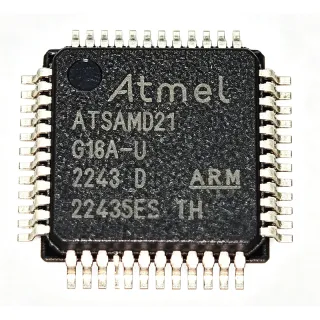
RTAX4000SL-CG1272EV - 4M-Gate Rad-Tolerant FPGA CCGA-1272 | Microchip
MPN: RTAX4000SL-CG1272EV ✓ Active| Qty | Unit Price | Extended |
|---|---|---|
| 1 | $0 | $0.00 |
| 10 | $0 | $0.00 |
| 100 | $0 | $0.00 |
| 500 | $0 | $0.00 |
| 1,000 | $0 | $0.00 |
RTAX4000SL-CG1272EV Overview
A radiation-tolerant FPGA is a field-programmable gate array engineered to survive the ionizing radiation environment of space: galactic cosmic rays, solar particle events, and trapped protons in Earth orbit. Within the semiconductor hierarchy, the RTAX4000SL-CG1272EV sits at the top of the programmable logic taxonomy - FPGA -> radiation-tolerant FPGA -> space-flight FPGA - and is a direct descendant of the commercial Axcelerator architecture from Actel, later Microsemi and now Microchip Technology.
Key differentiating features include SEU-hardened flip-flops that eliminate the need for triple-module redundancy (TMR) in much of the design, immunity to single-event upsets to a specified LET threshold with SEU rates below 10-10 errors per bit-day in typical orbits, embedded SRAM blocks with built-in FIFO control logic, segmentable clock resources, chip-wide highway routing, and dedicated carry logic for arithmetic chains.
Technically, the device uses antifuse-based one-time programmable interconnect, which gives it live-at-power-up (LAPU) operation - configuration data cannot be upsets in flight because no external configuration flash or SRAM configuration image must be reloaded. This true single-chip form factor removes the radiation-hardened configuration memory that competing SRAM FPGAs require, reducing board area, weight, and boot risk. The 0.15 um process keeps static power low, an important budget item on solar- or battery-limited spacecraft.
Typical applications include satellite payload data processing, spacecraft on-board computers and telemetry formatting, instrument control in deep-space probes, and fault-tolerant glue logic bridging rad-hard processors to sensors and downlink subsystems. The -55C to +125C ceramic package operating range supports launch and eclipse thermal environments.
Design consideration: because the part is one-time programmable, radiography and prototype validation on the footprint-compatible Axcelerator adapter-board flow is essential before committing flight units; order engineering-variant (E) devices for this purpose.
This page consolidates verified distributor data, drop-in family alternates, pricing-tier guidance, and practical space-design notes not found in the manufacturer datasheet.
Drop-in alternatives for RTAX4000SL-CG1272EV — same package, pin-to-pin compatible. Different-package parts requiring PCB rework are excluded.
Variants in this series
Same-series models that are drop-in compatible with RTAX4000SL-CG1272EV (same form factor and footprint) — differing in Configuration, Family, Package, Logic Cells, Core Supply Voltage.
Quick Comparison Tool — Select alternative parts for side-by-side comparison:
RTAX4000SL-CG1272V
✅ Drop-In✓ In Stock
Contact for price
View Datasheet →RTAX4000SL-1LG1272B
✅ Drop-In✓ In Stock
$9200 / Unit
View Datasheet →RTAX4000SL-LG1272B
✅ Drop-In✓ In Stock
$9600 / Unit
View Datasheet →RTAX4000SL-1CG1272V
✅ Drop-In✓ In Stock
Contact for price
View Datasheet →RTAX4000SL-1CG1272B
✅ Drop-In✓ In Stock
$6980 / Unit
View Datasheet →RTAX4000DL-1CGD1272EV
✅ Drop-In✓ In Stock
$3984 / Unit
View Datasheet →RTAX4000SL-CG1272EV Maximum Ratings & Electrical Characteristics
| Family | RTAX-SL (Radiation-Tolerant FPGA) |
| System Gates | 4,000,000 |
| Logic Cells | 40320 |
| Process Technology | 0.15 um |
| Core Supply Voltage | 1.5 V |
| Package | 1272-Pin CCGA (Ceramic Column Grid Array) |
| Operating Temperature | -55C to +125C |
| Logic Family | CMOS |
| SEU Immunity | SEU-hardened registers; SEU rate < 10-10 errors/bit-day |
| Configuration | One-time programmable (antifuse), live-at-power-up |
| Embedded Memory | Embedded SRAM with built-in FIFO control logic |
| Clocking | Segmentable clocks, chip-wide highway routing |
| Arithmetic Support | Dedicated carry logic |
| Mounting Type | Surface Mount |
| Radiation Environment | Space-flight (TID/SEE rated per RTAX-S datasheet) |
RTAX4000SL-CG1272EV 1272-pin ccga (ceramic column grid array) Pin Configuration Guide
Pin configuration for RTAX4000SL-CG1272EV (1272-pin ccga (ceramic column grid array) package). This digital IC includes GPIO, communication interfaces (UART, SPI, I2C), and power pins. Refer to the manufacturer datasheet for alternate pin functions and configuration options. Essential for embedded system design and PCB layout.

No detailed pinout data available for RTAX4000SL-CG1272EV.
Refer to the datasheet for full pin configuration.
Typical Applications
RTAX4000SL-CG1272EV is suitable for 6 applications: Satellite Payload Data Processing, Spacecraft On-Board Computer and Avionics, Deep-Space Instrument Control, Fault-Tolerant Bus Bridging and Glue Logic, Launch Vehicle Electronics, Design Prototyping and Migration Flow.
Satellite Payload Data Processing
The RTAX4000SL-CG1272EV fits satellite payload processing because its 4 million equivalent system gates and 40,320 logic cells absorb framing, compression, and packetization pipelines, while SEU-hardened flip-flops remove most triple-module redundancy overhead and cut design area by a large factor versus conventional SRAM FPGAs. Microchip specifies SEU rates below 10-10 errors per bit-day for typical orbits, which keeps payload error budgets achievable without scrubbers. In the signal chain, the FPGA sits between sensor front-ends and the downlink formatter, implemented once via antifuse programming so no configuration memory can be upset in flight. The 1.5V core on 0.15 um process limits static power on solar-constrained smallsats. Trade-off: one-time programming means any logic fix requires a new device, so prototype on the engineering variant first.
Recommended
Spacecraft On-Board Computer and Avionics
For on-board computers, the RTAX4000SL-CG1272EV provides fault-tolerant glue logic, memory controllers, and bus interfaces around rad-hard processors. Live-at-power-up antifuse configuration guarantees logic is functional the instant power arrives - a critical property for launch vehicles and safe-mode paths where no configuration load time or boot failure is acceptable. Embedded SRAM blocks with built-in FIFO control implement telemetry buffers and message queues without external memory parts, reducing board count. The -55C to +125C ceramic CCGA package tolerates eclipse cycling and launch transients. Chip-wide highway routing and segmentable clocks let designers partition control, timing, and data domains with isolation. Design consideration: lock down the EDIF netlist and pinout early since the antifuse fabric is one-time programmable.
Recommended
Deep-Space Instrument Control
Science instruments on deep-space probes benefit from the RTAX4000SL-CG1272EV's combination of SEU immunity to the datasheet LET threshold and deterministic live-at-power-up behavior, both essential where a single reboot command takes tens of minutes to hours of light-time. The 40,320 logic cells implement detector sequencers, high-speed serial framing, and CCD/IR readout chains, while dedicated carry logic accelerates correlator and filter arithmetic. The 0.15 um process keeps quiescent power low during cruise phases when solar flux is weak. Radiation-tolerant (not fully rad-hard) screening keeps cost below fully qualified rad-hard parts while meeting many Jupiter-range mission requirements with proper TID analysis. Engineers should validate total ionizing dose and displacement damage against mission trajectory using Microchip's radiation reports.
Recommended
Fault-Tolerant Bus Bridging and Glue Logic
Spacecraft backplanes mix legacy interfaces (MIL-STD-1553, SpaceWire, CAN) with modern payload buses; the RTAX4000SL-CG1272EV bridges them in a single 4M-gate device, replacing dozens of ASSPs that would each need separate radiation qualification. SEU-hardened registers in the interface state machines eliminate most triple-module redundancy, shrinking area versus an SRAM FPGA solution that requires TMR plus a scrubbing controller and rad-hard configuration flash. Embedded FIFO logic absorbs rate mismatch between bus domains, and chip-wide routing isolates noisy interfaces from the deterministic core. Because configuration is antifuse, bridge logic cannot lose its bitstream - a key argument against SRAM FPGAs in single-string avionics. Verify interface IP timing closure in Libero SoC on the engineering variant before flight-programmable release.
Recommended
Launch Vehicle Electronics
Launch environments impose extreme vibration plus radiation from the Van Allen belts during ascent; the RTAX4000SL-CG1272EV's ceramic CCGA-1272 column-grid package mechanically survives vibration better than brittle-ball BGA equivalents, and its antifuse fabric needs no configuration read that vibration-induced glitches could corrupt. Sequencing, safe-and-arm interface logic, and flight-termination receivers demand live-at-power-up determinism, which the single-chip one-time-programmed device delivers with zero boot latency. The -55C to +125C operating range covers pad dwell and ascent aerothermal gradients. Designers should place the FPGA on the same power domain as critical pyrotechnic interfaces with independent enable control, and X-ray inspect CCGA column joints after mounting, since rework of 1272 columns is impractical.
Recommended
Design Prototyping and Migration Flow
The 'EV' engineering variant exists precisely for the prototyping methodology Microchip documents in the RTAX-S/SL datasheet: a footprint-compatible adapter board plus an EDIF netlist and pinout converter let teams validate RTAX4000SL designs on commercial Axcelerator devices first, then migrate the identical pinout to the radiation-tolerant die. This flow catches I/O mapping, timing, and functional errors at commercial-IC cost and lead time before any flight silicon is committed - crucial since antifuse devices cannot be reprogrammed. XAIPART recommends ordering the CG1272EV engineering units in parallel with Libero SoC timing sign-off, holding flight-grade CG1272V or 1CG1272B purchase orders until the prototype passes environmental test. Typical savings exceed the cost of the prototype lot many times over on 4M-gate designs.
Recommended
Recommended Products Summary
Engineering reference data for RTAX4000SL-CG1272EV — comparison, design guidance, and compliance information.
Selection Guide
Comparison with Alternatives
| Parameter | This Product | RTAX4000SL-CG1272V | RTAX4000SL-1LG1272B | RTAX4000SL-1CG1272V | RTAX4000DL-1CGD1272EV |
|---|---|---|---|---|---|
| Package | CCGA-1272 | CCGA-1272 - same | CCGA-1272 - same | CCGA-1272 - same | CCGA-1272 - same |
| Brand | Microchip Technology (Actel) | Microchip Technology (Actel) | Microchip Technology (Actel) | Microchip Technology (Actel) | Microchip Technology (Actel) |
| System Gates | 4,000,000 | 4,000,000 | 4,000,000 | 4,000,000 | 4,000,000 (RTAX-DSP with MAC blocks) |
| Speed Grade | Standard (EV engineering) | Standard (flight) | -1 | -1 | -1 |
| Variant Type | Engineering/Evaluation | Flight | Flight (B screening) | Flight | Engineering/Evaluation (DSP) |
| Core Voltage | 1.5 V | 1.5 V | 1.5 V | 1.5 V | 1.5 V |
| SEU-Hardened Registers | Yes | Yes | Yes | Yes | Yes |
Key Differentiators
- SEU-hardened registers eliminate most triple-module redundancy (vs RTAX4000SL-CG1272V (same die) and SRAM-based space FPGAs generally)
- Live-at-power-up single-chip antifuse configuration (vs RTAX4000DL-1CGD1272EV and all SRAM-based rad-tolerant FPGAs)
- Engineering (EV) variant enables low-risk flight development (vs RTAX4000SL-1CG1272B)
Design Notes
The RTAX4000SL-CG1272EV is one-time programmable: a single netlist error in a flight unit is unrecoverable. Follow Microchip's documented prototyping methodology from the RTAX-S/SL datasheet - validate on a footprint-compatible adapter board using the EDIF netlist and pinout converter, and exhaustively verify the design on the CG1272EV engineering variant before programming flight-grade CG1272V or B-screened units. Budget at least one full prototype iteration; skipping it on a 40,320-cell design historically costs far more in rework than the prototype devices themselves.
CCGA-1272 uses ceramic columns, not solder balls, precisely to tolerate the CTE mismatch between the alumina package and standard PCB laminates across -55C to +125C excursions. Design the land pattern per the mechanical drawing in the Microchip RTAX-S/SL datasheet, use uniform thermal relief on all 1272 pads to prevent warping during reflow, and specify X-ray inspection of column joints after assembly - column voids are the dominant CCGA assembly defect and cannot be found optically under the package body.
Supply the 1.5V core and the I/O banks with independently monitored rails; the SEU-hardened fabric tolerates upsets but not brownouts, and the live-at-power-up guarantee assumes clean monotonic ramp per the datasheet power-up specifications. Estimate core current from the datasheet power calculator for your utilization and toggle rates rather than worst-case numbers - on the 0.15 um process, static power dominates at low toggle rates, which usually favors this device over SRAM FPGAs needing continuous configuration scrubbing power.
Compliance Information
Radiation-tolerant space-grade ceramic CCGA package; environmental compliance declarations must be obtained from Microchip for the specific screening lot.