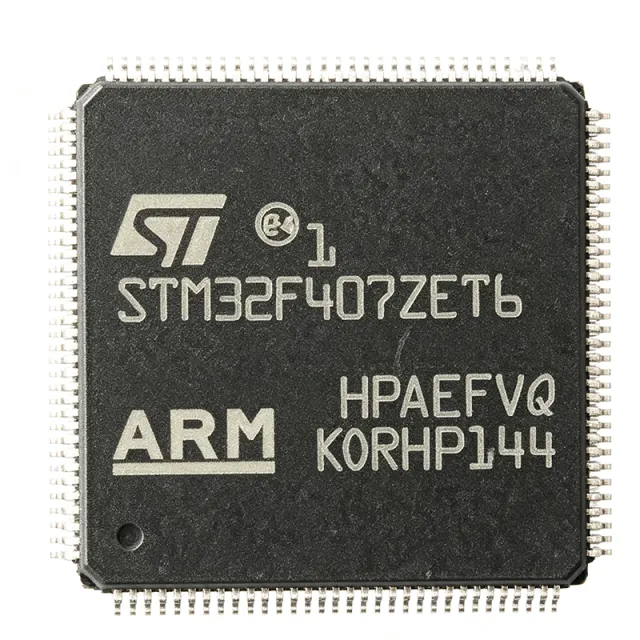
STM32F407ZET6 - 32-bit ARM Cortex-M4F MCU, 512KB Flash | STMicroelectronics
MPN: STM32F407ZET6 ✓ Active| Qty | Unit Price | Extended |
|---|---|---|
| 1 | $11.3182 | $11.32 |
| 10 | $8.1742 | $81.74 |
| 100 | $7.2311 | $723.11 |
| 500 | $6.9167 | $3,458.35 |
| 1,000 | $6.6023 | $6,602.30 |
STM32F407ZET6 Overview
What is a microcontroller? A microcontroller (MCU) is a compact integrated circuit designed to govern a specific operation in an embedded system. It contains a processor core, memory (flash and SRAM), and programmable input/output peripherals on a single chip. Microcontrollers are the brains of countless electronic products, from automotive engine control units to industrial automation systems, consumer electronics, and IoT devices. The STM32F407ZET6 belongs to the STM32F4 family, which is part of the broader STM32 32-bit ARM Cortex-M microcontroller portfolio from STMicroelectronics, a leading semiconductor manufacturer.
Key features of the STM32F407ZET6 include a 168 MHz ARM Cortex-M4F core with FPU and DSP instructions, 512 KB flash, 192 KB SRAM, and a comprehensive set of peripherals: 3x 12-bit ADCs, 2x DACs, 12x general-purpose 16-bit timers, 2x 32-bit timers, and a true random number generator (RNG). It also offers advanced connectivity with 2x CAN, 6x USART, 3x SPI, 3x I2C, 1x SDIO, 1x USB 2.0 OTG FS/HS, 1x Ethernet MAC, and a camera interface (DCMI). The device supports a wide supply voltage range of 1.8V to 3.6V and operates over a temperature range of -40°C to +85°C (or +105°C for the suffix 'I' variant).
Technically, the STM32F407ZET6 leverages the ARM Cortex-M4F core with a single-precision FPU, enabling efficient handling of floating-point arithmetic for signal processing and control algorithms. The memory architecture includes a 64 KB CCM (Core Coupled Memory) RAM for time-critical data, and the flash supports read-while-write for firmware updates. The device features a sophisticated clock tree with a PLL capable of generating up to 168 MHz from an external 8 MHz crystal, and includes multiple low-power modes (Sleep, Stop, Standby) for energy-sensitive applications.
Typical applications include industrial motor control, medical equipment, consumer electronics, IoT gateways, and audio processing. The combination of high clock speed, rich peripherals, and connectivity options makes it suitable for complex real-time control and data acquisition systems. For example, in a drone flight controller, the STM32F407ZET6 can handle sensor fusion, PID control loops, and communication with ground stations simultaneously.
When designing with this device, ensure proper decoupling of the power supply pins with 100 nF capacitors placed close to each VDD pin, and a 4.7 uF bulk capacitor. The VDDA analog supply should be filtered with a ferrite bead and a 1 uF capacitor to minimize noise for ADC accuracy. Also, consider the thermal dissipation: the LQFP144 package has a thermal resistance of 40°C/W (theta_JA), so for high clock speeds and heavy peripheral usage, adequate PCB copper area is recommended.
Drop-in alternatives for STM32F407ZET6 — same package, pin-to-pin compatible. Different-package parts requiring PCB rework are excluded.
Variants in this series
Same-series models that are drop-in compatible with STM32F407ZET6 (same form factor and footprint) — differing in SRAM, Package, ADC, CAN, Core.
Quick Comparison Tool — Select alternative parts for side-by-side comparison:
STM32F407ZGT6
✓ In Stock
$5.25 / Unit
View Datasheet →STM32F407ZET7
✓ In Stock
Contact for price
View Datasheet →STM32F417ZET6
📋 Reference alternative (not in catalog)
STM32F407ZGT7
✓ In Stock
Contact for price
View Datasheet →STM32F407IGH6
✓ In Stock
Contact for price
View Datasheet →LPC4357FET256
✓ In Stock
$9.5 / Unit
View Datasheet →R7S721020VCBG
📋 Reference alternative (not in catalog)
STM32F407ZET6 Maximum Ratings & Electrical Characteristics
| Core | ARM Cortex-M4F with FPU |
| Maximum Clock Speed | 168 MHz |
| Flash Memory | 512 KB |
| SRAM | 192 KB (including 64 KB CCM) |
| Supply Voltage Range | 1.8 V to 3.6 V |
| Operating Temperature Range | -40°C to +85°C |
| Package | LQFP144 (20x20 mm) |
| Number of I/O Pins | 114 |
| ADC | 3x 12-bit, up to 2.4 MSPS |
| DAC | 2x 12-bit |
| Timers | 12x 16-bit, 2x 32-bit |
| Communication Interfaces | 6x USART, 3x SPI, 3x I2C, 2x CAN, 1x USB 2.0 OTG FS/HS, 1x Ethernet MAC, 1x SDIO |
| DMA | 16-stream DMA controller |
| RNG | True random number generator |
| RoHS Status | Compliant |
STM32F407ZET6 Pin Configuration
| Pin 1 | PE2 — General-purpose I/O or alternate function |
| Pin 10 | VDD |
| Pin 20 | VSS |
| Pin 30 | PA0 |
| Pin 40 | PB2 |
| Pin 50 | PC4 |
| Pin 60 | PD0 |
| Pin 70 | PE0 |
| Pin 80 | VDD |
| Pin 90 | PF0 |
| Pin 100 | PG0 |
| Pin 110 | VSS |
| Pin 120 | PH0 |
| Pin 130 | PH1 |
| Pin 144 | VDD |
Typical Applications
STM32F407ZET6 is suitable for 6 applications: Industrial Motor Control, IoT Gateway, Medical Monitoring Device, Audio Processing, Drone Flight Controller, Smart Home Hub.
Industrial Motor Control
The STM32F407ZET6 is ideal for industrial motor control due to its advanced timers with complementary PWM outputs, dead-time generation, and high-speed ADCs. The 168 MHz Cortex-M4F core with FPU can execute field-oriented control (FOC) algorithms for brushless DC (BLDC) and permanent magnet synchronous motors (PMSM). In a typical application, the MCU reads phase currents via the 12-bit ADCs, computes the rotor position using Hall sensors or encoders, and generates PWM signals to drive the inverter. The FPU accelerates the trigonometric calculations required for Clarke and Park transforms, reducing CPU load. The device also supports safety features like brake control and overcurrent protection. Compared to lower-end MCUs, the STM32F407ZET6 provides the computational headroom for advanced control techniques such as sensorless FOC and predictive control, improving efficiency and dynamic response.
Recommended
IoT Gateway
The STM32F407ZET6 is well-suited for IoT gateways that require multiple connectivity options. With Ethernet MAC, USB OTG, CAN, and several UART/SPI/I2C interfaces, it can aggregate data from various sensors and devices, process it locally, and transmit to the cloud via Ethernet or Wi-Fi (using an external module). The 512 KB flash and 192 KB SRAM provide ample space for communication stacks (e.g., lwIP, MQTT) and application logic. The Cortex-M4F core with FPU can handle protocol conversion, data encryption (with external crypto chip), and edge computing tasks. In a smart building scenario, the gateway can collect data from temperature, humidity, and occupancy sensors over Modbus (via UART), process it, and send alerts over Ethernet. The low-power modes allow the gateway to sleep when idle, reducing energy consumption. The rich peripheral set eliminates the need for external MCUs, simplifying the design and reducing BOM cost.
Recommended
Medical Monitoring Device
The STM32F407ZET6 is used in medical monitoring devices such as patient vital signs monitors and portable ECG devices. Its high-speed ADC (up to 2.4 MSPS) can sample multiple biosignals simultaneously, while the FPU enables real-time digital filtering and analysis. The device's low power consumption and multiple low-power modes extend battery life in portable monitors. In an ECG monitor, the MCU acquires the ECG signal through an analog front-end, applies a band-pass filter to remove noise, and computes heart rate. The 512 KB flash stores patient data and firmware, and the USB interface allows data transfer to a PC or cloud. The device's reliability and industrial temperature range make it suitable for continuous operation. The rich timer and DMA resources ensure precise sampling timing without CPU intervention, freeing the core for signal processing algorithms.
Recommended
Audio Processing
The STM32F407ZET6 is capable of real-time audio processing for applications like audio effects processors, voice recognition, and active noise cancellation. The Cortex-M4F core with FPU and DSP instructions accelerates FFT and filtering algorithms. The device includes I2S interfaces for connecting audio codecs, and the DMA controller can stream audio data without CPU overhead. In a guitar effects pedal, the MCU samples the analog audio signal via the ADC, applies effects such as reverb or distortion, and outputs the processed signal via DAC or I2S. The 168 MHz clock speed allows complex effects with low latency. The device's large SRAM (192 KB) can buffer audio samples for delay effects. The USB OTG interface enables connection to a PC for firmware updates or audio streaming. The high performance and rich peripherals make it a cost-effective solution for professional audio equipment.
Recommended
Drone Flight Controller
The STM32F407ZET6 is a popular choice for drone flight controllers due to its high processing power and rich peripheral set. It can handle sensor fusion from IMU (accelerometer, gyroscope, magnetometer), GPS, and barometer, and execute complex control algorithms for stable flight. The 168 MHz Cortex-M4F core with FPU accelerates the Kalman filter and PID control loops. The device's multiple timers generate PWM signals for the ESCs (electronic speed controllers), and the UART interfaces connect to GPS and telemetry modules. The camera interface (DCMI) can capture video for FPV (first-person view) or obstacle avoidance. In a typical quadcopter, the MCU reads IMU data at 1 kHz, fuses it to estimate attitude, and adjusts motor speeds accordingly. The device's low latency and deterministic timing ensure responsive flight control. The 512 KB flash stores the flight controller firmware, and the USB interface allows configuration and firmware updates.
Recommended
Smart Home Hub
The STM32F407ZET6 can serve as the central hub in a smart home system, coordinating various sensors and actuators. With multiple UART, SPI, I2C, and CAN interfaces, it can communicate with Zigbee, Z-Wave, or proprietary RF modules. The Ethernet MAC allows wired connection to the home network, while USB OTG can connect to external storage or a Wi-Fi dongle. The device's processing power enables local automation rules, such as turning on lights when motion is detected or adjusting the thermostat based on occupancy. The low-power modes allow the hub to run on battery backup during power outages. In a typical setup, the hub collects data from door/window sensors, motion detectors, and smart plugs, and sends commands to actuators. The 512 KB flash stores the hub firmware and configuration, and the RNG provides secure key generation for encrypted communication. The rich peripheral set and connectivity options make it a versatile platform for home automation.
Recommended
Recommended Products Summary
Engineering reference data for STM32F407ZET6 — comparison, design guidance, and compliance information.
Selection Guide
Comparison with Alternatives
| Parameter | This Product | STM32F407ZGT6 | STM32F407ZET7 | STM32F417ZET6 |
|---|---|---|---|---|
| Package | LQFP144 | LQFP144 - same | LQFP144 - same | LQFP144 - same |
| Brand | STMicroelectronics | STMicroelectronics | STMicroelectronics | STMicroelectronics |
| Flash Memory | 512 KB | 1 MB | 512 KB | 512 KB |
| SRAM | 192 KB | 192 KB | 192 KB | 192 KB |
| Maximum Clock Speed | 168 MHz | 168 MHz | 168 MHz | 168 MHz |
| Operating Temperature Range | -40°C to +85°C | -40°C to +85°C | -40°C to +105°C | -40°C to +85°C |
| Crypto/Hash Processor | No | No | No | Yes |
| Ethernet MAC | Yes | Yes | Yes | Yes |
Key Differentiators
- Higher flash memory option available in same package (vs STM32F407ZGT6)
- Extended temperature range variant (vs STM32F407ZET7)
- Integrated crypto/hash processor (vs STM32F417ZET6)
Design Notes
Decouple each VDD pin with a 100 nF ceramic capacitor placed as close as possible to the pin, and add a 4.7 uF bulk capacitor for the entire supply. For the VDDA analog supply, use a ferrite bead and a 1 uF capacitor to filter high-frequency noise, ensuring ADC accuracy. The VREF+ pin should be connected to a clean reference voltage, typically 3.3V, with a 1 uF capacitor to ground.
For the LQFP144 package, ensure adequate copper area for thermal dissipation. The theta_JA is approximately 40°C/W, so for high clock speeds and heavy peripheral usage, provide a solid ground plane and thermal vias under the exposed pad (if present). Keep high-speed signals (Ethernet, USB) away from analog pins to minimize noise coupling.
Do not exceed the absolute maximum supply voltage of 4.0V. Ensure the BOOT0 pin is properly configured to select the correct boot mode (flash, system memory, or SRAM). When using the internal HSI oscillator, note that it has lower accuracy than an external crystal; for applications requiring precise timing, use an external 8 MHz crystal with appropriate load capacitors. Also, configure the PLL correctly to avoid exceeding the maximum clock speed of 168 MHz.
Compliance Information
RoHS and REACH compliant per STMicroelectronics product page. Not AEC-Q100 qualified; for automotive, consider STM32F407ZET7 with extended temperature range.
