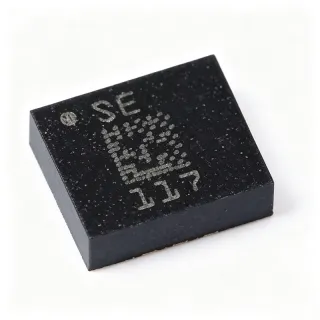
STM8L001J3M3TR - Ultra-Low-Power 8-bit MCU, 8KB Flash | STMicroelectronics
MPN: STM8L001J3M3TR ✓ Active| Qty | Unit Price | Extended |
|---|---|---|
| 1 | $0.77 | $0.77 |
| 10 | $0.69 | $6.90 |
| 100 | $0.61 | $61.00 |
| 500 | $0.55 | $275.00 |
| 1,000 | $0.49 | $490.00 |
STM8L001J3M3TR Overview
An 8-bit microcontroller is a compact computing device that processes data in 8-bit chunks, balancing performance and power efficiency for embedded control tasks. The STM8L EnergyLite family is designed specifically for ultra-low-power operation, with multiple low-power modes including Halt, Active-Halt, and Wait, enabling extended battery life in portable and IoT devices. This MCU sits within the broader hierarchy of embedded systems, from simple 8-bit controllers to complex 32-bit processors, and is optimized for applications where energy efficiency is paramount.
Key features include a 16 MHz CPU with 16 MIPS throughput, 8 KB Flash, 1.5 KB RAM, and 2 KB EEPROM with error correction. The device operates from 1.8V to 3.6V, with a low-power oscillator and multiple clock sources. It also integrates a 12-bit ADC, comparators, and a variety of communication interfaces including SPI, I2C, and UART, all in a compact 8-SOIC package.
The STM8L001J3M3TR is built on ST's low-power process technology, achieving ultra-low current consumption in Halt mode (typically 0.4 µA) and fast wake-up times. The architecture includes a flexible clock system, power management with multiple low-power modes, and a rich set of peripherals, enabling efficient handling of sensor data and control tasks.
Typical applications include portable medical devices, smart sensors, wearable electronics, and industrial monitoring systems. Its low power consumption and small footprint make it particularly suitable for battery-operated devices where long operational life is critical.
When designing with this MCU, careful attention to the power supply decoupling and clock configuration is essential to achieve the specified low-power performance. The device supports in-application programming (IAP) and in-circuit programming (ICP), facilitating firmware updates in the field.
Drop-in alternatives for STM8L001J3M3TR — same package, pin-to-pin compatible. Different-package parts requiring PCB rework are excluded.
Variants in this series
Same-series models that are drop-in compatible with STM8L001J3M3TR (same form factor and footprint) — differing in Package, Maximum Clock Frequency, Supply Voltage Range, RAM Size, ADC.
Quick Comparison Tool — Select alternative parts for side-by-side comparison:
STM8L001J3M3
✅ Drop-In✓ In Stock
$0.49 / Unit
View Datasheet →STM8L051F3P6
✅ Drop-In ⚠️ Specs Unverified✓ In Stock
Contact for price
View Datasheet →STM8L101F3P6
✅ Drop-In ⚠️ Specs Unverified✓ In Stock
$1.15 / Unit
View Datasheet →STM8L151K4T6
✅ Drop-In ⚠️ Specs Unverified📋 Reference alternative (not in catalog)
PIC16F18313-I/SN
✅ Drop-In ⚠️ Specs Unverified✓ In Stock
$0.71 / Unit
View Datasheet →ATTINY13A-SSU
✅ Drop-In ⚠️ Specs Unverified✓ In Stock
$0.65 / Unit
View Datasheet →STM8L001J3M3TR Maximum Ratings & Electrical Characteristics
| Core | STM8 |
| Architecture | 8-bit CISC |
| Maximum Clock Frequency | 16 MHz |
| Program Memory Size | 8 KB (8K x 8) |
| Program Memory Type | Flash |
| RAM Size | 1.5 KB |
| EEPROM Size | 2 KB |
| Supply Voltage Range | 1.8 V to 3.6 V |
| Operating Temperature Range | -40°C to +85°C |
| Package / Case | 8-SOIC (0.154", 3.90mm Width) |
| Mounting Type | Surface Mount |
| Number of I/O Pins | 6 |
| ADC Resolution | 12-bit |
| Communication Interfaces | SPI, I2C, UART |
| Low Power Modes | Halt, Active-Halt, Wait |
| RoHS Status | Compliant |
STM8L001J3M3TR Pin Configuration
| Pin 1 | VDD — Power supply |
| Pin 2 | PA1 — General purpose I/O |
| Pin 3 | PA2 — General purpose I/O |
| Pin 4 | VSS — Ground |
| Pin 5 | PA3 — General purpose I/O |
| Pin 6 | PA4 — General purpose I/O |
| Pin 7 | PA5 — General purpose I/O |
| Pin 8 | NRST — Reset |
Typical Applications
STM8L001J3M3TR is suitable for 6 applications: Portable Medical Devices, Smart Sensors, Wearable Electronics, IoT Devices, Industrial Monitoring, Battery Management Systems.
Portable Medical Devices
The STM8L001J3M3TR is ideal for portable medical devices such as glucose meters, pulse oximeters, and wearable health monitors. Its ultra-low-power consumption (0.4 µA in Halt mode) extends battery life, while the 12-bit ADC enables precise sensor readings. The 8-SOIC package allows for compact designs, and the 1.8V to 3.6V supply range is compatible with coin-cell batteries. In a typical glucose meter, the MCU reads the sensor, processes the data, and drives an LCD display, all while maintaining minimal power draw. The integrated EEPROM stores calibration data and patient history, and the UART interface can communicate with external devices for data logging. The low-power modes allow the device to sleep between measurements, significantly extending battery life compared to higher-power MCUs.
Recommended
Smart Sensors
The STM8L001J3M3TR is well-suited for smart sensors in industrial and building automation. Its low power consumption and multiple communication interfaces (SPI, I2C, UART) allow it to interface with various sensor elements and transmit data to a central controller. The 12-bit ADC provides accurate analog-to-digital conversion for temperature, humidity, and pressure sensors. In a typical smart thermostat, the MCU reads temperature and humidity sensors, processes the data, and controls the HVAC system via a relay. The device can operate in Wait mode between readings, reducing average power consumption. The 8 KB Flash is sufficient for sensor calibration algorithms and communication protocols. The wide operating temperature range (-40°C to +85°C) ensures reliable operation in harsh industrial environments.
Recommended
Wearable Electronics
The STM8L001J3M3TR is perfect for wearable electronics like fitness trackers and smartwatches. Its ultra-low-power modes and small 8-SOIC package make it ideal for space-constrained, battery-powered designs. The MCU can handle sensor fusion from accelerometers and heart rate monitors, process the data, and communicate via Bluetooth (using an external module). The 1.8V to 3.6V supply range is compatible with lithium-polymer batteries. In a typical fitness tracker, the MCU reads the accelerometer, counts steps, and displays the data on an OLED screen. The device spends most of its time in Halt mode, waking up periodically to process sensor data, which extends battery life to several months. The integrated EEPROM can store user profiles and activity logs.
Recommended
IoT Devices
The STM8L001J3M3TR is an excellent choice for IoT edge devices that require low power consumption and reliable operation. Its low-power modes and communication interfaces enable efficient data collection and transmission. The MCU can interface with various sensors, process data locally, and send it to a gateway via UART or SPI. In a typical IoT sensor node, the MCU reads environmental data, applies simple algorithms, and transmits the results via a LoRa or Zigbee module. The device can operate for years on a single battery due to its ultra-low-power consumption. The 8 KB Flash is sufficient for the firmware, and the EEPROM can store configuration parameters. The wide operating temperature range makes it suitable for outdoor deployments.
Recommended
Industrial Monitoring
The STM8L001J3M3TR is suitable for industrial monitoring applications such as vibration analysis, motor control, and process automation. Its robust design, wide temperature range, and low power consumption make it ideal for remote monitoring systems. The 12-bit ADC can sample analog signals from sensors, and the UART interface can communicate with a central PLC or SCADA system. In a typical vibration monitoring system, the MCU reads an accelerometer, performs FFT analysis, and sends alerts if abnormal vibrations are detected. The device can operate in a low-power mode between readings, reducing energy consumption. The 8 KB Flash is sufficient for the analysis algorithms, and the EEPROM can store calibration data. The 8-SOIC package is easy to integrate into existing industrial PCBs.
Recommended
Battery Management Systems
The STM8L001J3M3TR can be used in battery management systems (BMS) for monitoring and protecting lithium-ion batteries. Its low power consumption and ADC are ideal for measuring cell voltages and temperatures. The MCU can implement charge balancing algorithms and communicate with a host controller via I2C or UART. In a typical BMS, the MCU monitors each cell's voltage, calculates the state of charge, and controls the charging/discharging process. The device can operate in a low-power mode when the battery is idle, minimizing drain. The 8 KB Flash is sufficient for the BMS firmware, and the EEPROM can store battery parameters. The wide operating temperature range ensures reliable operation in various environments.
Recommended
Recommended Products Summary
Engineering reference data for STM8L001J3M3TR — comparison, design guidance, and compliance information.
Selection Guide
Comparison with Alternatives
| Parameter | This Product | STM8L001J3M3 | STM8L051F3P6 | STM8L101F3P6 | PIC16F18313-I/SN |
|---|---|---|---|---|---|
| Package | 8-SOIC | 8-SOIC | 8-SOIC | 8-SOIC | 8-SOIC |
| Brand | STMicroelectronics | STMicroelectronics | STMicroelectronics | STMicroelectronics | Microchip Technology |
| Core | STM8 | STM8 | STM8 | STM8 | PIC |
| Max Clock Frequency | 16 MHz | 16 MHz | 16 MHz | 16 MHz | 32 MHz |
| Flash Memory | 8 KB | 8 KB | 8 KB | 8 KB | 3.5 KB |
| RAM Size | 1.5 KB | 1.5 KB | 1 KB | 1.5 KB | 256 B |
| Supply Voltage | 1.8V to 3.6V | 1.8V to 3.6V | 1.8V to 3.6V | 1.8V to 3.6V | 2.3V to 5.5V |
| ADC Resolution | 12-bit | 12-bit | 12-bit | 12-bit | 10-bit |
Key Differentiators
- Ultra-low-power consumption (vs PIC16F18313-I/SN)
- Higher RAM capacity (vs STM8L051F3P6)
- 12-bit ADC (vs PIC16F18313-I/SN)
Design Notes
For ultra-low-power operation, use the Halt mode with an external interrupt to wake the MCU. Ensure the supply voltage is within 1.8V to 3.6V and place a 100nF decoupling capacitor close to the VDD pin. In Halt mode, the current consumption is typically 0.4 µA, but this can increase if the watchdog or LSI is enabled. Use the low-power oscillator (LSI) for timing in low-power modes to minimize current draw.
For the 8-SOIC package, ensure proper PCB layout with a solid ground plane. Place the decoupling capacitor (100nF) as close as possible to the VDD and VSS pins. For best EMC performance, use a 4-layer PCB with dedicated power and ground planes. The thermal pad (if present) should be connected to ground for heat dissipation, although the STM8L001J3M3TR has low power dissipation.
Avoid using the STM8L001J3M3TR for applications requiring more than 6 I/O pins, as it has limited I/O. Also, ensure that the firmware does not exceed the 8 KB Flash memory. When using the ADC, ensure the reference voltage is stable and use a low-pass filter on the input to reduce noise. The NRST pin should be pulled up with a 10kΩ resistor to prevent accidental resets.
Compliance Information
RoHS compliant per STMicroelectronics product page. Not AEC-Q100 qualified - this is a general-purpose MCU, not automotive grade.