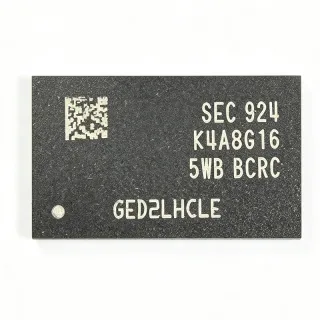
K9LUGY8J7D-BCK0 - Samsung V-NAND Flash Memory | Samsung
MPN: K9LUGY8J7D-BCK0 ✓ AktifK9LUGY8J7D-BCK0 Genel Bakış
NAND flash memory is a non-volatile storage technology that retains data without power and forms the storage layer in solid-state drives (SSDs), eMMC/UFS modules, memory cards, and embedded systems. Within the memory hierarchy, NAND flash sits below DRAM as persistent bulk storage; 3D V-NAND stacks memory cells vertically to increase bit density while reducing cell-to-cell interference compared with planar NAND.
The K9LUGY8J7D family is designed for mass-storage applications requiring high capacity per package. Samsung's V-NAND technology improves endurance and write performance through charge-trap flash cells arranged in vertical stacks. Devices in this class interface via a standard ONFI-compliant asynchronous/DDR toggle-mode NAND interface, supporting page-program and block-erase commands managed by a host-side controller with ECC (error correcting code) such as BCH or LDPC.
Typical applications include solid-state drives, eMMC and UFS embedded storage, industrial storage modules, set-top boxes, and networking equipment requiring reliable non-volatile storage.
When designing with high-density V-NAND, the host controller must implement wear leveling, bad-block management, and refresh algorithms, and layout should follow Samsung's signal-integrity guidance for high-speed data lines.
This page synthesizes drop-in family alternatives, application guidance, and sourcing information in one place, adding value beyond the raw manufacturer datasheet. Note that many parametric values below are pending verification against the official Samsung datasheet and are marked .
Drop-in alternatifler için K9LUGY8J7D-BCK0 — aynı paket, pin-başına uyumlu. PCB yeniden montajı gerektiren farklı paket bileşenleri dışlanmıştır.
Bu Serideki Variantlar
Yedek parça uyumlu olan aynı serideki modeller K9LUGY8J7D-BCK0 (aynı form faktörü ve ayağa oturma) — farklı olan Memory Type, Cell Type, Technology, RoHS Status, Density.
K9KUGY8J7C-BCK0
✅ Yerleştirme ⚠️ Onaylanmamış ÖzelliklerFiyat için iletişime geçin
Veri Şablonunu Görüntüle →K9KUGY8J7C-CCK0
✅ Yerleştirme ⚠️ Onaylanmamış ÖzelliklerFiyat için iletişime geçin
Veri Şablonunu Görüntüle →K9JUGY8J5C-BCK0
✅ Yerleştirme ⚠️ Onaylanmamış ÖzelliklerFiyat için iletişime geçin
Veri Şablonunu Görüntüle →K9JUGY8J5C-CCK0
✅ Yerleştirme ⚠️ Onaylanmamış ÖzelliklerFiyat için iletişime geçin
Veri Şablonunu Görüntüle →K9IUGY8J7B-BCK0
✅ Yerleştirme ⚠️ Onaylanmamış ÖzelliklerFiyat için iletişime geçin
Veri Şablonunu Görüntüle →K9IUGY8J7B-CCK0
✅ Yerleştirme ⚠️ Onaylanmamış ÖzelliklerFiyat için iletişime geçin
Veri Şablonunu Görüntüle →K9LUGY8J7D-BCK0 Maksimum Değerlendirmeler & Elektriksel Özellikler
| Manufacturer | Samsung Electronics |
| Product Type | 3D V-NAND Flash Memory |
| Memory Technology | V-NAND (3D NAND flash) |
| Montaj Türü | Surface Mount |
| RoHS Durumu | unknown |
K9LUGY8J7D-BCK0 standard Pin Yapısı Kılavuzu
K9LUGY8J7D-BCK0 (standard paket) için pin yapısı. Bu dijital IC, GPIO, iletişim arayüzleri (UART, SPI, I2C) ve güç pinleri içerir. Alternatif pin işlevleri ve yapılandırma seçenekleri için üretici veri kitapçığını referans alın. Tünel sistem tasarımı ve PCB yerleşimi için temel bir bileşendir.

Ayrıntılı pin çıkış verisi mevcut değil: K9LUGY8J7D-BCK0.
Aşağıdaki veri sayfası tam pin konfigürasyonu için.
Tipik Uygulamalar
K9LUGY8J7D-BCK0 için uygundur 6 uygulamas: Solid-State Drives, Embedded eMMC / UFS Storage, Industrial Storage Modules, Set-Top Boxes and Smart TVs, Networking and Telecom Equipment, Automotive Infotainment and Telematics.
Solid-State Drives
Samsung V-NAND devices of the K9LUGY8J7D class are core storage media in client and consumer SSDs. The vertical 3D cell stacking delivers high bits per package, allowing SSD controllers to aggregate multiple dies on shared channels for parallelism. In this role the NAND connects to an SSD controller over toggle-mode/ONFI interfaces; the controller implements wear leveling, LDPC ECC, and garbage collection to manage TLC cell endurance characteristics. The design benefit is high capacity per BGA footprint with Samsung's mature V-NAND reliability record, while the trade-off is strict dependence on controller firmware quality for endurance and retention.
Önerilen
Embedded eMMC / UFS Storage
Raw V-NAND of this family is packaged by Samsung into eMMC and UFS embedded storage modules used in smartphones, tablets, and IoT devices. The K9LUGY8J7D-class NAND provides the non-volatile layer behind the eMMC/UFS controller, which abstracts NAND management from the host. Benefits include proven V-NAND endurance, high sequential throughput over the UFS interface, and industrial temperature options. Designers of custom embedded boards who choose raw NAND instead of finished eMMC gain cost control but must implement full flash translation layers, bad-block management, and refresh algorithms in their host controller firmware.
Önerilen
Industrial Storage Modules
Industrial PCs, data loggers, and factory automation systems use V-NAND like the K9LUGY8J7D-BCK0 in CFast, mSATA, and board-level storage modules. V-NAND's charge-trap cells tolerate program-disturb stress better than planar NAND, supporting the high write duty cycles of logging applications. Industrial builds benefit from fixed-BOM supply agreements on Samsung NAND and predictable endurance data for maintenance scheduling. The design consideration is that industrial controllers must implement power-fail protection circuits (bulk capacitors plus firmware checkpointing) because unexpected power loss during a program operation can corrupt the affected page.
Önerilen
Set-Top Boxes and Smart TVs
Broadcast and streaming set-top boxes use K9LUGY8J7D-class V-NAND for firmware storage and DVR content buffering. The BGA NAND provides gigabit-class capacity in a compact footprint, and toggle-mode interfaces keep controller pin counts low. Low standby power of V-NAND suits always-on consumer electronics, and the TLC density point keeps bill-of-material cost competitive for high-volume CE manufacturing. Designers should verify the NAND's timing modes against the SoC's NAND controller, as many CE SoCs support only a subset of toggle-mode speeds, requiring conservative timing configuration at boot.
Önerilen
Networking and Telecom Equipment
Routers, switches, and 5G small-cell equipment store firmware, configuration, and log data on V-NAND devices of this class. The K9LUGY8J7D-BCK0's high density enables redundant firmware banks and extended log retention on a single package. Samsung V-NAND's stable read-disturb behavior suits equipment with 24/7 read-mostly duty cycles, and the BGA package withstands vibration better than card-based storage. Telecom designers typically pair the NAND with industrial-temperature controllers and must derate endurance estimates for continuous ambient temperatures above the consumer baseline specified in the Samsung datasheet.
Önerilen
Automotive Infotainment and Telematics
Automotive head units, digital clusters, and telematics control units require multi-gigabyte non-volatile storage for navigation maps and media, using V-NAND like the K9LUGY8J7D-BCK0 within automotive-qualified eMMC/UFS or raw-NAND subsystems. V-NAND tolerance of wide temperature swings and high vibration environments makes it well matched to vehicle electronics, and its density supports OTA update partitioning with A/B fallback banks. Automotive designers must verify the specific ordering code's qualification level (AEC-Q100 grade or Samsung automotive qualification), since suffix variants differ, and should implement power-interruption-safe FTL firmware for cranking and load-dump scenarios.
Önerilen
Önerilen Ürünler Özeti
Mühendislik referans verileri: K9LUGY8J7D-BCK0 — karşılaştırma, tasarım rehberi ve uyumluluk bilgileri.
Seçim Kılavuzu
Alternatiflerle Karşılaştırma
| Parametre | Bu Ürün | K9KUGY8J7C-BCK0 | K9JUGY8J5C-BCK0 | K9IUGY8J7B-BCK0 |
|---|---|---|---|---|
| Brand | Samsung Electronics | Samsung Electronics | Samsung Electronics | Samsung Electronics |
| Generation / Revision | D revision (newest in family) | C revision (prior) | C revision, J5 family | B revision, I generation |
Ana Farklılayıcılar
- Newest D-revision V-NAND process generation (karşılaştırma:K9KUGY8J7C-BCK0)
- Longer supply longevity than older generations (karşılaştırma:K9IUGY8J7B-BCK0)
- Higher capacity option within the same family (karşılaştırma:K9JUGY8J5C-BCK0)
Tasarım Notları
Samsung V-NAND devices use separate VCC (core) and VCCQ (I/O) supply rails. Decouple each rail with low-ESR ceramic capacitors (typically 0.1uF per ball group plus bulk capacitance) placed as close to the BGA as possible. Verify power sequencing between VCC and VCCQ in the device datasheet before power-tree design; incorrect sequencing can stress I/O structures. Estimated rail currents depend on operating mode (read, program, erase) and should be taken from the official Samsung datasheet ICC tables, which were not available in the current verified data.
In toggle-mode/DDR operation, DQ, RE#, and WE# lines toggle at high rates. Length-match the DQ bus within the tolerance specified by Samsung's layout guide, maintain a continuous ground reference plane beneath the bus, and avoid routing data lines across plane splits. Add series termination resistors near the driver as recommended for the applicable speed grade. Simulation of the full channel (controller, PCB trace, NAND input) is recommended for first-pass success on new boards using this V-NAND generation.
The most frequent raw-NAND design errors are under-provisioned ECC (modern TLC V-NAND needs LDPC, not simple BCH), missing bad-block management in the flash translation layer, and ignoring power-fail integrity - a lost power event during program/erase can corrupt the operating page or block. Budget firmware effort accordingly, and reserve spare blocks for wear leveling. Also confirm the exact -BCK0 suffix meaning (speed grade/packing) from Samsung before ordering, since suffix variants are not interchangeable on the same PCB in all cases.
Uyumluluk Bilgisi
No explicit compliance declarations for this exact ordering code were present in the retrieved web data. Samsung current-generation V-NAND is generally RoHS/lead-free compliant as standard; obtain the official declaration from Samsung Semiconductor product compliance documentation.