FPGA & CPLD
Products (6352)

EPM3128AFI256-10N - MAX 3000A CPLD, 128 Macros, 256-FBGA | Altera
The Altera (Intel) EPM3128AFI256-10N is a member of the MAX 3000A family of high-performance, low-cost CMOS EEPROM-based complex programmable logic devices (CPLDs), delivering 128 macro cells, 98 user I/Os, and 2.5K gates of logic integration in a 256-ball FineLine BGA package with a -10 speed grade (10 ns pin-to-pin delay). A CPLD (Complex Programmable Logic Device) is a non-volatile programmable logic device that combines multiple PAL/GAL-style macro cell arrays with a central interconnect matrix, providing deterministic, single-clock-cycle propagation delays for glue logic, bus interfacing, and state-machine implementation. The MAX 3000A family sits within the broader programmable logic hierarchy: CPLD -> programmable logic device (PLD) -> digital logic IC -> semiconductor. CPLDs complement FPGAs by offering instant-on, EEPROM-based configuration and predictable timing, which is why they remain preferred for I/O expansion, address decoding, and power-sequencing controllers. The EPM3128AFI256-10N features 4.5-ns pin-to-pin logic delays on internal macros and supports counter frequencies up to 227.3 MHz. The MultiVolt I/O interface allows the 3.3-V core to communicate with 5.0-V, 3.3-V, and 2.5-V logic levels without external level shifters, simplifying mixed-voltage board designs. In-system programmability (ISP) via JTAG enables field updates without removing the device from the board. The PCI SIG PCI Local Bus Specification Revision 2.2 compliance across all speed grades (-4, -5, -6, -7, -10) makes it directly usable on PCI bus interfaces. Architecturally, the MAX 3000A device uses a classic MAX-style logic array block (LAB) organization with a programmable interconnect array (PIA) and a per-macro-cell product-term allocator. Each macro cell contains a programmable AND/OR array feeding a configurable flip-flop, giving the designer full synchronous or combinatorial control. The EEPROM configuration cell technology provides non-volatile storage that retains the bitstream through power cycles without an external configuration PROM. Typical applications include PCI/CompactPCI bus interface glue logic, JTAG-controlled I/O expansion for microprocessors and DSPs, industrial control state machines, address decoding for memory-mapped systems, and power-supply sequencing controllers. The 256-FBGA package supports high-density board designs where 98 user I/Os are needed within a compact footprint. When designing with this device, plan for 3.3-V core supply and observe the MultiVolt I/O bank restrictions when mixing 5.0-V and 2.5-V peripherals on the same device. The -10 speed grade is the slowest in the family - upgrade to -7 or -5 for timing-sensitive PCI or high-frequency state machines. According to the manufacturer datasheet, the device supports ISP via the JTAG interface per IEEE Std 1149.1. This page synthesizes distributor stock levels, drop-in alternatives within the MAX 3000A family, and practical design notes not consolidated in the manufacturer datasheet.
EPM3128ATC100-10 - MAX 3000A 128-Macrocell CPLD, 10ns TQFP-100 | Intel / Altera
The Intel / Altera (formerly Altera) EPM3128ATC100-10 is a member of the MAX 3000A family of CMOS EEPROM-based Complex Programmable Logic Devices (CPLDs), delivering 128 macrocells, 80 user I/Os, and a 10 ns pin-to-pin propagation delay in a 100-pin TQFP package. It operates from a 3.3 V core supply with MultiVolt I/O that is compatible with 5.0 V, 3.3 V, and 2.5 V logic levels, enabling drop-in interfacing with mixed-voltage buses and legacy TTL parts. A CPLD (Complex Programmable Logic Device) is a non-volatile programmable logic device that combines multiple PAL-like logic blocks on a single chip with a programmable interconnect matrix. CPLDs sit in the programmable logic hierarchy between simple PLDs (PAL/GAL) and FPGAs, offering instant-on behavior, deterministic timing, and EEPROM-based configuration that retains bitstream without external boot memory. The MAX 3000A family specifically targets glue-logic, bus-interface, and PCI-compliant bridge applications where low cost, predictable timing, and in-system programmability (ISP) outweigh the need for FPGA-class logic density. Key features of the EPM3128ATC100-10 include in-system programmability compliant with IEEE Std. 1532 for concurrent ISP across vendors, MultiVolt I/O (5.0 V / 3.3 V / 2.5 V tolerant), PCI-SIG-compliant timing for local-bus interfacing, and a 100-pin TQFP footprint with 80 usable I/Os. The non-volatile EEPROM configuration cell eliminates the need for external configuration memory and provides instant-on operation at power-up. Architecturally, the device uses Altera's classic MAX architecture with Logic Array Blocks (LABs), a programmable interconnect array (PIA), and per-macrocell flip-flops with selectable clear/preset and clock options. The 3.3 V core and 5 V-tolerant I/Os are fabricated on a CMOS EEPROM process that supports ISP through the JTAG (IEEE 1149.1 / IEEE 1532) interface. Counter frequencies reach 227.3 MHz, and the pin-to-pin delay of 10 ns in this speed grade suits state-machine and address-decoding tasks. Typical applications include PCI bus interface glue logic, address decoding and chip-select generation in embedded systems, glue logic between microprocessors and peripherals, bus-width translation between 5 V MCUs and 3.3 V peripherals, and power-up sequencing logic in industrial controllers. The wide MultiVolt I/O range and PCI-compliant timing make it especially attractive for legacy industrial designs migrating between logic families. When designing with this part, ensure that input signals conform to the I/O standard's VCCIO rail and observe the JTAG (IEEE 1149.1) tap connection requirements for ISP. Note that the EPM3128ATC100-10 is a mature, mature-lifecycle device suitable for long-life programs but typically sourced through authorized distributors due to limited active manufacturing. This page synthesizes distributor pricing, drop-in same-package alternatives, and practical design notes not found in the manufacturer datasheet alone, giving engineers a single source for selection, replacement, and lifecycle context.
EPM3128ATC100-10N - 128-Macrocell MAX 3000A CPLD, 10ns, TQFP-100 | Intel
The Intel (formerly Altera) EPM3128ATC100-10N is a 128-macrocell, 80-user-I/O Complex Programmable Logic Device (CPLD) from the MAX 3000A family, housed in a 100-pin Thin Quad Flat Pack (TQFP-100) package with a 10 ns pin-to-pin propagation delay. A CPLD (Complex Programmable Logic Device) is a non-volatile programmable logic device that combines multiple PAL/GAL-style macrocell arrays with a central programmable interconnect matrix. CPLDs sit in the hierarchy between simple SPLDs (PALs/GALs) and larger FPGAs, offering deterministic, single-clock-cycle propagation delays and instant-on non-volatile configuration. The MAX 3000A family uses CMOS EEPROM configuration memory, IEEE Std. 1532-compliant in-system programmability (ISP), and belongs to the broader power-management and logic-IC semiconductor category. Key features include 128 macrocells (2500 usable gates), 80 user I/O pins, an internal fMAX of 98 MHz (per the FPGAkey datasheet summary), 3.3 V VCCINT operation, and selectable 3.3 V or 2.5 V VCCIO banks for mixed-voltage I/O. The device is pin-compatible with other MAX 3000A 100-pin TQFP variants and supports JTAG-based boundary-scan testing alongside ISP. The non-volatile EEPROM cells eliminate the need for an external boot PROM and the part powers up instantly in a user-defined state. Architecturally, the EPM3128ATC100-10N organizes its 128 macrocells into 8 Logic Array Blocks (LABs) of 16 macrocells each, connected through a Programmable Interconnect Array (PIA). Each macrocell contains a programmable AND/OR array feeding a configurable flip-flop with product-term clock, clear, and preset controls, supporting combinatorial, registered, and buried logic without consuming I/O. Typical applications include I/O expansion and bus bridging on legacy glue-logic boards, address decoding and interrupt steering on industrial controllers, state-machine replacement in white-goods motor control, and pin-compatible MAX 3000A migration paths. Designers in factory automation, telecom line cards, and embedded computing rely on this part for deterministic timing and field-reprogrammability. Designers should pay attention to VCCIO bank configuration: 3.3 V allows direct interface to 3.3 V logic, while 2.5 V setting enables 2.5 V system compatibility. The I/O pins share a common bus-friendly structure but each LAB region can source/sink up to 25 mA per pin with proper thermal management across the 100-pin TQFP (θJA around 35-40 °C/W depending on PCB copper). Avoid daisy-chaining JTAG; use a star topology for ISP chains longer than 4 devices. This page synthesizes distributor pricing, IEEE Std. 1532 ISP-compatible drop-in alternatives, and practical design notes not consolidated in the manufacturer datasheet alone. Real-time stock and parametric comparison are derived from DigiKey, Mouser, Octopart, and LCSC as of 2026-09-12.
EPM3128ATC100-10NS - MAX 3000A CPLD, 128 Macro, 100-TQFP | Intel
The Intel EPM3128ATC100-10NS is a member of the MAX 3000A family of Complex Programmable Logic Devices (CPLDs), offering 128 macro cells and 80 user I/O pins in a 100-pin Thin Quad Flat Pack (TQFP) package with 10 ns pin-to-pin logic delay. It operates from a 3.3 V core supply and supports MultiVolt I/O, which allows its I/O banks to interface with 5.0 V, 3.3 V, or 2.5 V logic levels by powering VCCIO at the appropriate rail. The device provides in-system programmability (ISP) compliant with IEEE Std. 1532, enabling concurrent programming across multiple PLD vendors. A CPLD (Complex Programmable Logic Device) is a non-volatile programmable logic device that combines multiple PAL/GAL-like macro-cell arrays with a programmable interconnect matrix. It sits between simple logic gates and FPGAs in the programmable logic hierarchy and is widely used for glue logic, bus interfacing, state-machine control, and power-up sequencing in digital systems. The MAX 3000A family belongs to Intel's (formerly Altera's) classic CPLD portfolio, providing instant-on, deterministic timing, and high pin-to-pin speed that FPGAs cannot match for small, fast, fixed-function blocks. Key features of the EPM3128ATC100-10NS include 4.5 ns pin-to-pin logic delays with counter frequencies up to 227.3 MHz, programmable interconnect that allows any pin to drive any macro cell or I/O, and JTAG-based boundary-scan testing per IEEE 1149.1. The 80 available I/O pins (out of 100 total package pins) share 4 dedicated input clocks and a global clear network, while 3.3 V core operation keeps power dissipation low for industrial and consumer applications. Architecturally, the device uses EEPROM-based configuration cells, providing non-volatile storage that retains the logic design without external memory. The MAX 3000A macro cells implement sum-of-products logic with configurable flip-flops and a wide fan-in AND-OR structure, while the interconnect matrix (the so-called "Programmable Interconnect Array" or PIA) routes signals between logic array blocks with predictable timing. Typical applications include bus-interface bridging, address decoding and chip-select generation, state-machine and sequencer implementation, power-up and reset sequencing, peripheral I/O expansion, and glue-logic replacement of discrete 74-series TTL. Its 5 V-tolerant I/O and fast propagation delay also suit industrial control and motor-drive front ends. When designing with this device, ensure VCCINT is a regulated 3.3 V and VCCIO is set according to the I/O logic level. Decoupling must include 0.1 uF and 1 uF capacitors placed within 5 mm of each supply pin. JTAG chain order should be planned before PCB layout to avoid re-spinning the board for testability. This page synthesizes distributor pricing, drop-in alternatives, and practical design notes not found in the manufacturer datasheet. The EPM3128ATC100-10NS is the extended-temperature (N suffix) variant of the EPM3128ATC100-10.
EPM3128ATC100-5 - MAX 3000A CPLD, 128 Macrocells, 5ns TQFP-100
The Intel (formerly Altera) EPM3128ATC100-5 is a high-performance, low-cost CMOS EEPROM-based Complex Programmable Logic Device (CPLD) from the MAX 3000A family, delivering 128 macrocells, 80 user I/Os, and a 5 ns pin-to-pin propagation delay in a 100-pin TQFP package. The device operates from a 3.3 V supply and supports 3.3-V in-system programmability (ISP) compliant with the IEEE Std. 1532 specification, enabling concurrent ISP across multi-vendor PLD platforms. A CPLD (Complex Programmable Logic Device) is a non-volatile programmable logic device that combines multiple PAL/GAL-like macrocell blocks interconnected by a programmable switch matrix. CPLDs sit between simple SPLDs and FPGAs in the programmable logic hierarchy - they offer deterministic timing (fixed pin-to-pin delays), instant-on operation from EEPROM configuration memory, and higher logic density than discrete PAL/GAL devices while consuming less power and providing more predictable timing than most FPGAs. The MAX architecture integrates logic array blocks (LABs), an interconnect matrix, I/O control blocks, and the in-system programming engine into a single CMOS die. Key features of the EPM3128ATC100-5 include 2,500 usable gates, 80 programmable I/O pins (each configurable as input, output, or bidirectional), four dedicated input pins, a global clear signal, and output drivers programmable for 2.5 V or 3.3 V while all inputs are 2.5 V, 3.3 V, and 5.0 V tolerant. The device supports JTAG boundary-scan testing per IEEE Std. 1149.1, has programmable security bits for design protection, and provides a typical counter frequency of 192.3 MHz. The commercial temperature grade spans 0 °C to 70 °C, and the TQFP-100 package offers a low-profile surface-mount footprint suited to high-density PCB designs. Typical applications for the EPM3128ATC100-5 include bus interface bridging (e.g., PCI-to-ISA glue logic), address decoding and chip-select generation, state-machine and sequencer implementation, I/O expansion and level translation between 5 V and 3.3 V domains, and glue-logic replacement of discrete 74-series TTL parts. It is widely used in industrial controllers, telecom base-station control boards, and legacy design refreshes where deterministic timing, instant-on behavior, and in-field reprogrammability are required. When designing with this device, allocate sufficient decoupling (0.1 µF per supply pin), observe the IEEE 1149.1 JTAG chain if multiple devices share the bus, and confirm Quartus II / MAX+PLUS II software support for the -5 speed grade. The 'A' suffix denotes the enhanced MAX 3000A family; the -5 suffix indicates the 7.5 ns (or 5 ns commercial) speed grade, which is the slowest of the MAX 3000A speed grades.
EPM3128ATC100-5N - MAX 3000A CPLD, 128 Macrocells, 80 I/O | Intel
The Intel (formerly Altera) EPM3128ATC100-5N is a high-performance, low-cost CMOS EEPROM-based Complex Programmable Logic Device (CPLD) from the MAX 3000A family, delivering 128 macrocells and 80 user I/Os in a 100-pin TQFP (TC100) package. The device operates from a single 3.3 V supply and supports pin-to-pin propagation delays as fast as 5 ns with internal counter speeds reaching 192.3 MHz, making it well suited for high-speed glue-logic, bus-interface, and state-machine applications. A CPLD (Complex Programmable Logic Device) is a non-volatile programmable logic IC that combines multiple PAL/GAL-like macrocell arrays with a central programmable interconnect matrix. CPLDs sit hierarchically between simple SPLDs (PALs/GALs) and large FPGAs, offering deterministic timing, instant-on EEPROM configuration, and densities in the hundreds-to-thousands of gates range. The MAX 3000A architecture used in the EPM3128ATC100-5N is fabricated on 5.0 V-tolerant EEPROM CMOS technology with 3.3 V core and I/O supply rails, providing up to 10,000 usable gates and IEEE Std. 1532-compliant in-system programmability (ISP). Key features include 128 macrocells organized in 8 Logic Array Blocks (LABs) of 16 macrocells each, 80 user I/Os with individual programmable slew rate and bus-hold options, JTAG boundary-scan test (IEEE 1149.1), 3.3 V or 2.5 V VCCIO selectable output levels, and multiVolt I/O support for interfacing with 5.0 V, 3.3 V, and 2.5 V systems. The device is offered in commercial 0 C to +70 C temperature grade and supports 100% in-system programmability through the JTAG interface, eliminating the need for external programmers. The EPM3128ATC100-5N employs an enhanced MAX architecture with a global interconnect matrix that routes LAB-to-LAB signals with predictable, deterministic delays independent of placement. Each macrocell contains a programmable AND/OR array, a flip-flop with programmable clear/preset, and a configurable I/O cell. The 5 ns speed grade (the -5 suffix) targets glue-logic applications such as address decoding, bus arbitration, interrupt handling, and register-based state machines where fast deterministic timing is required. Typical applications include bus interface bridging in telecom and networking equipment, address decoding and interrupt management in embedded systems, register/glue logic replacement in industrial controllers, and PCI/ISA bus interface logic in legacy computer designs. The 100-pin TQFP package provides a familiar footprint for drop-in compatibility with the broader MAX 3000A family and is widely supported by the Quartus II / MAX+PLUS II development toolchains. When designing with this device, ensure proper decoupling with 0.1 uF and 10 uF capacitors placed close to each VCC and VCCIO pin. The JTAG TMS, TCK, TDI, and TDO pins require 4.7 kohm pull-up resistors for reliable in-system programming. For multi-voltage designs, the VCCIO pins can be tied to 2.5 V to support 2.5 V logic families. The -5 speed grade balances speed and cost; for higher performance, consider the -4 grade, and for lower power/cost, the -7 or -10 grades are pin-compatible alternatives. This page synthesizes distributor stock and pricing data, a verified list of drop-in TQFP-100 alternatives within the MAX 3000A family, and practical design notes that complement the official MAX 3000A Family Data Sheet and the Quartus II programming handbook.
EPM3128ATC100-7 - MAX 3000A CPLD, 128 Macro Cells, 100-TQFP | Intel
The Intel (formerly Altera) EPM3128ATC100-7 is a 128-macro-cell member of the MAX 3000A family of in-system programmable CMOS Complex Programmable Logic Devices (CPLDs), offering 2.5K typical gates, an 80 I/O count, a 7.5 ns pin-to-pin propagation delay, and a 129.9 MHz internal counter frequency, all housed in a 100-pin TQFP (14x14 mm) commercial-temperature package. The MAX 3000A family operates from a single 3.3 V supply, integrates the IEEE Std. 1532-compliant In-System Programmability (ISP) interface, and is fabricated on an EEPROM-based process that allows non-volatile configuration retention without an external boot memory. A Complex Programmable Logic Device (CPLD) is a non-volatile, multi-macrocell programmable logic IC used to implement glue logic, bus decoding, state machines, and interface bridging in digital systems. CPLDs sit between discrete 74-series logic and larger FPGAs in the programmable-logic hierarchy: PAL -> PLA -> CPLD -> FPGA. Unlike SRAM-based FPGAs, CPLDs retain their configuration through power cycles and typically offer deterministic, sub-10 ns pin-to-pin delays, which is why they are favored for asynchronous bus interfaces, control-path glue logic, and system-reset sequencing. The EPM3128ATC100-7 highlights four key features that drive its selection. First, the -7 speed grade yields a 7.5 ns tPD with a 129.9 MHz fCNT, faster than the -10 (10 ns) and -15 (15 ns) speed grades, which improves timing margins in performance-critical glue logic. Second, the 128 macro cells and 80 user I/Os are organized as four Logic Array Blocks (LABs) with 36 signals per LAB, providing broad connectivity for wide bus interfaces. Third, the device is 3.3 V core and I/O with 5.0 V tolerant I/O on selected pins, simplifying mixed-voltage bridging between 5 V microcontrollers and 3.3 V peripherals. Fourth, the IEEE 1532 ISP allows field upgrades via JTAG without removing the device from the board. At the architecture level, each macro cell contains a programmable AND/OR array feeding a configurable register, and the interconnect is a continuous FastTrack channel that links all LABs. The non-volatile EEPROM cell eliminates the need for a configuration PROM and removes the inrush issues associated with SRAM FPGA boot. The 100-pin TQFP package has a thermal resistance consistent with commercial (0C to 70C) operation, and the plastic 14x14 mm body drops onto standard 0.5 mm-pitch footprints compatible with hand-soldering and reflow. Typical applications include peripheral bus decoding and address-latch generation for legacy 80-series microcontrollers, glue logic between processors and memory in industrial control boards, JTAG-controlled board-test multiplexers, and 5 V-to-3.3 V voltage translation with handshaking logic. The combination of non-volatile storage, sub-10 ns delays, and 5 V tolerance makes the EPM3128ATC100-7 particularly suitable for legacy industrial systems where reliability and predictable timing outweigh raw logic density. A key design consideration is the speed-grade trade-off: the -7 grade is the fastest of the EPM3128 family but consumes more dynamic current than the -10 and -15 grades. For battery-backed or thermally constrained boards, the -10N variant (EPM3128ATC100-10N) offers an identical pinout at the cost of 2.5 ns of additional tPD. The industrial-temperature (-40C to +85C) EPM3128ATI100-7N variant should be chosen for harsh-environment deployments. This page consolidates distributor stock, parametric cross-references, and PCB-level design guidance for the EPM3128ATC100-7, providing engineering context beyond the raw datasheet PDF.
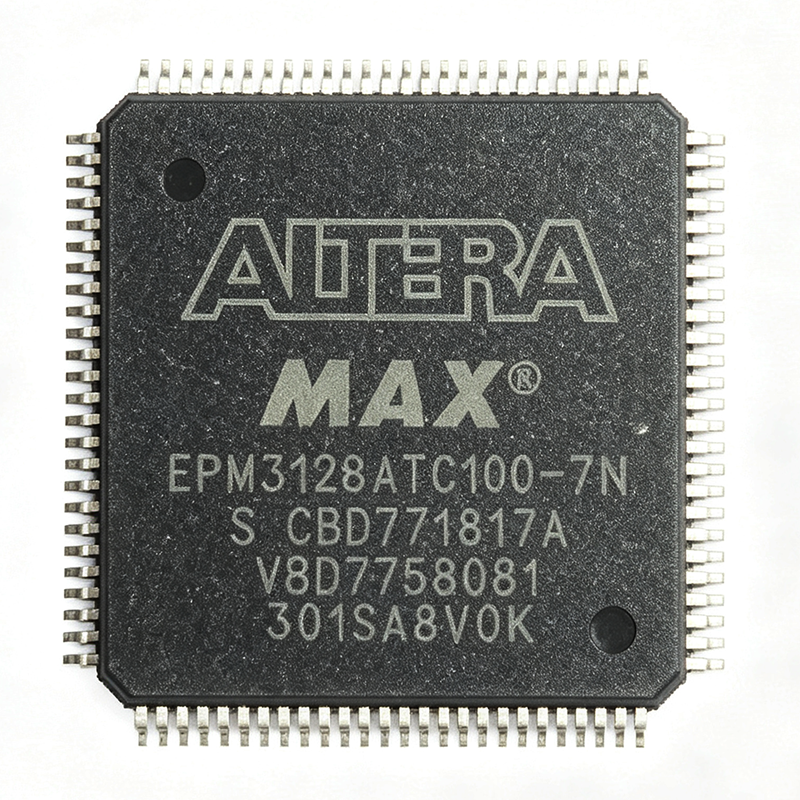
EPM3128ATC100-7N - MAX 3000A 128-Macrocell CPLD, 7.5 ns, TQFP-100 | Intel (Altera)
The Intel (formerly Altera) EPM3128ATC100-7N is a 128-macrocell member of the MAX 3000A family of high-performance, low-cost CMOS EEPROM-based Complex Programmable Logic Devices (CPLDs), supplied in a 100-pin TQFP package with 80 usable I/Os. Built on Altera's MAX architecture, the device supports up to 10,000 usable gates with pin-to-pin delays as fast as 7.5 ns in the -7 speed grade and counter frequencies up to 227.3 MHz. A CPLD (Complex Programmable Logic Device) is a non-volatile programmable logic device that combines multiple PAL-like logic blocks with a programmable interconnect matrix, providing deterministic, instant-on glue logic and I/O expansion. Within the programmable-logic taxonomy, CPLDs sit alongside FPGAs as the highest-density members of the programmable-logic hierarchy, but they excel at predictable timing, fast input-to-output propagation, and operation without external configuration memory - features that make them ideal for bus interfacing, address decoding, and control logic. Key features include 3.3-V core operation with MultiVolt I/O supporting 5.0-V, 3.3-V, and 2.5-V logic levels, in-system programmability (ISP) through the IEEE 1532 / JTAG interface, and a 4.5-ns pin-to-pin delay available on faster speed grades. The device offers four dedicated inputs and a global clear capability, and its non-volatile EEPROM cells retain configuration without a boot PROM. Architecturally, the EPM3128ATC100-7N implements 128 macrocells organized into Logic Array Blocks (LABs) with a programmable AND/OR array and product-term allocation. The MAX 3000A family shares a common architecture with MAX 7000/7000AE devices, which simplifies design migration through Altera's legacy MAX+PLUS II and Quartus II toolchains. Typical applications include address decoding and bus interfacing in microcontroller and DSP systems, glue-logic consolidation in industrial controllers, peripheral I/O expansion, and legacy system modernization where instant-on deterministic logic is required. Designers also deploy it in PCI bus interface glue logic, motor-control feedback conditioning, and discrete-logic replacement on legacy boards. When designing with this device, ensure 3.3-V core supply stability with adequate bulk decoupling near the TQFP-100 power pins. Verify that I/O bank voltage rails match the driven/received logic levels (5.0-V tolerant I/O on a 3.3-V VCCIO is supported, but not vice versa). For new designs, consider MAX II or MAX V devices for lower power and migration continuity. This page synthesizes distributor pricing, drop-in alternatives from the Site MPN list, and practical design notes not found in the manufacturer datasheet alone, giving procurement and engineering teams a single decision-grade reference.
EPM3128ATC144-10 - 128-Macro MAX 3000A CPLD | Altera | TQFP-144
The Intel (formerly Altera) EPM3128ATC144-10 is a high-performance, low-cost 3.3V CMOS EEPROM-based Complex Programmable Logic Device (CPLD) from the MAX 3000A family, packaged in a 144-pin TQFP (TQ144) and offering 128 macro cells with 96 user I/Os. According to the MAX 3000A family datasheet, this device provides approximately 2,500 usable gates and a pin-to-pin propagation delay of 10 ns (speed grade -10), making it well-suited for high-volume glue-logic, bus-interface, and state-machine applications. What is a CPLD? A Complex Programmable Logic Device is a non-volatile programmable logic IC that sits between simple 22V10-style PAL/GAL devices and larger FPGAs. CPLDs use a coarse-grained architecture of macro cells interconnected by a central global interconnect, with on-chip EEPROM (or flash) configuration memory. They typically offer very predictable timing (fixed pin-to-pin delays), instant-on behavior, and high drive capability, making them ideal for I/O expansion, address decoding, bus arbitration, and power-sequencing glue logic. Within the programmable logic taxonomy, a CPLD belongs to the broader class of programmable logic devices (PLDs), which themselves are a subset of standard logic ICs. Key features of the EPM3128ATC144-10 include 3.3V in-system programmability (ISP) compliant with the IEEE Std. 1532 specification, a JTAG boundary-scan test interface (IEEE Std. 1149.1), and counter speeds of up to 227.3 MHz on internal logic. The device supports multi-voltage I/O operation, allowing its I/O pins to interface with 1.5V, 1.8V, 2.5V, and 3.3V logic families. The MAX 3000A architecture combines deterministic timing with low power consumption (standby current typically in the microampere range) and industrial temperature-grade options for harsh environments. Architecturally, the EPM3128ATC144-10 divides its 128 macro cells into four Logic Array Blocks (LABs), each containing 16 macro cells. Each macro cell integrates a programmable AND/OR array with a configurable flip-flop, enabling efficient implementation of both combinational and registered logic. The central interconnect routes signals between LABs and to the I/O pins with a fixed, deterministic delay that does not depend on routing density. Typical applications include I/O expansion for microcontrollers and ASICs, address decoding for memory and peripheral buses, glue logic between processors and peripherals, state-machine controllers in industrial automation, bus-interface bridges (PCI to ISA, parallel-to-serial conversion), and power-supply sequencing in multi-rail systems. Its instant-on non-volatile configuration is particularly valuable in systems that must be operational immediately after power-up without firmware loading delays. When designing with the EPM3128ATC144-10, ensure that your JTAG chain ordering matches the device's TDI-to-TDO sequence and that the ISP programming voltage timing complies with IEEE 1532 requirements. A common pitfall is using the wrong I/O bank voltage configuration for mixed-voltage systems - consult the MAX 3000A datasheet to confirm each I/O bank's supply rail. This page synthesizes distributor pricing, drop-in alternatives, and practical design notes not found in the manufacturer datasheet alone, helping engineers quickly evaluate the EPM3128ATC144-10 for new designs and legacy maintenance.
EPM3128ATC144-10N - 128-Macro MAX 3000A CPLD, 144-TQFP | Intel
The Intel EPM3128ATC144-10N is a 128-macrocell member of the MAX 3000A family of in-system-programmable (ISP) CMOS EEPROM-based Complex Programmable Logic Devices (CPLDs). It integrates up to 2,500 usable gates, 128 macrocells, and 96 user I/Os in a 144-pin Thin Quad Flat Pack (TQFP) package, operating from a single 3.3 V supply. The -10 speed grade delivers a pin-to-pin propagation delay (tPD) of 10 ns and counter frequencies up to 98 MHz. A CPLD (Complex Programmable Logic Device) is a non-volatile programmable logic device that combines multiple PAL/GAL-like logic blocks with a centralized interconnect matrix. CPLDs sit between simple SPLDs/PALs and FPGAs in the programmable-logic hierarchy, offering deterministic timing (fixed pin-to-pin delay), instant-on EEPROM configuration, and simple integration of glue logic, state machines, and bus interfaces. MAX 3000A devices target low-cost, high-volume glue-logic, interface bridging, and bus-decoding applications where predictable timing and ISP convenience outweigh the density of an FPGA. Key features of the EPM3128ATC144-10N include 128 macrocells organized into 8 Logic Array Blocks (LABs), a MultiVolt I/O interface that supports 3.3 V, 2.5 V, and 1.8 V logic levels on the same device, built-in boundary-scan test (BST) circuitry compliant with IEEE 1149.1 (JTAG), and ISP circuitry compliant with IEEE 1532. The architecture also provides four pin-locked JTAG instructions, JTAG-based in-system programming, and an open-drain or programmable pull-up option on every I/O pin. The MAX 3000A architecture uses EEPROM-based configuration cells, allowing instant-on behavior at power-up with no external configuration memory. Each macrocell contains a programmable AND/OR array, a flip-flop with selectable clear/clock/preset, and a wide range of product-term allocation options including parallel expanders and shareable expanders. The global interconnect matrix provides predictable, fixed-delay paths from any I/O pin to any macrocell — a key advantage over SRAM-based FPGAs in real-time control loops. Typical applications include bus-interface bridging (e.g., 8-bit/16-bit microcontroller-to-peripheral glue), address decoding and chip-select generation, power-sequencing logic, state-machine replacement for discrete 74-series logic, and JTAG-based board-level test integration. The wide MultiVolt I/O range also makes the part attractive as a level shifter between 5 V legacy devices and 3.3 V/1.8 V processors. When designing with this device, allocate I/O pins carefully during logic synthesis to avoid routing congestion and respect the 96-user-I/O limit when assigning bank-level voltage references. Decoupling should follow the MAX 3000A reference design: a 0.1 µF ceramic capacitor on every VCCIO bank pin placed within 5 mm of the package, with one bulk 10 µF tantalum or ceramic cap on the VCCINT rail. This page synthesizes verified distributor pricing, same-package drop-in alternatives, and practical design notes that complement the manufacturer datasheet.
EPM3128ATC144-5 - MAX 3000A CPLD, 128 Macrocells, 5ns | Altera
The Altera EPM3128ATC144-5 is a member of the MAX 3000A family of high-performance, low-cost CMOS EEPROM-based complex programmable logic devices (CPLDs), delivering 128 macrocells, 2,500 system gates, and a 7.5 ns propagation delay in a 144-pin TQFP (TQ144) package rated for commercial 0C to 70C operation. Built on a multi-volt, multi-vendor in-system programmable (ISP) architecture, the device operates from a 3.3 V core supply and supports 5.0 V, 3.3 V, and 2.5 V multi-volt I/O interfacing, allowing direct connection to legacy and modern logic families without external level shifters. The MAX 3000A non-volatile ISP is compliant with the IEEE Std. 1532 specification, allowing concurrent ISP from multiple PLD vendors. A CPLD (Complex Programmable Logic Device) is a non-volatile programmable logic IC that combines multiple PAL-like macrocell arrays on a single die, connected through a programmable interconnect matrix. The MAX 3000A family belongs to the broader hierarchy: CPLD -> programmable logic device (PLD) -> logic IC -> semiconductor. CPLDs are typically chosen over FPGAs for glue-logic, bus-interface, state-machine, and power-up deterministic applications because their EEPROM configuration cells boot in microseconds, not milliseconds, and retain state without external boot memory. Key features include 128 macrocells arranged in 8 logic array blocks (LABs), 250 usable I/O pins within the package (with 96 user I/Os exposed externally per the 144-pin TQFP), two global clock networks with clear and clock-enable control on every register, programmable interconnect, JTAG boundary-scan testing, and built-in IEEE 1149.1 (JTAG) support. The -5 speed grade corresponds to a 7.5 ns pin-to-pin propagation delay (tPD), supporting designs with up to 192.3 MHz internal counter performance. Power consumption is typically 130 mA at 3.3 V, with standby current as low as 5 mA. The architecture is built on 0.30 um CMOS EEPROM technology with four layers of metal interconnect, exposing the user to a deterministic timing model. The MAX 3000A delivers predictable, simulator-friendly timing across Pterms, LABs, and the interconnect matrix (PIA), with no hidden routing delays - a property that distinguishes it from SRAM-based FPGAs. Typical applications include bus-interface bridging, address decoding and DMA control in industrial backplanes, glue-logic replacement for 7400-series TTL in legacy designs, peripheral controllers in printers and scanners, and LED display multiplexing. Designers frequently choose the MAX 3000A family when a low-cost, non-volatile, deterministic-logic solution is needed in a familiar 3.3 V ecosystem. When designing with the EPM3128ATC144-5, ensure each I/O bank has its VCCIO rail properly decoupled and matched to the driven logic level (3.3 V or 2.5 V), because mixing I/O standards in the same bank can damage the device. Provide a minimum of 0.1 uF ceramic bypass on each VCC and VCCIO pin, and consult the MAX 3000A Family Data Sheet for ISP programming voltage sequencing when using JTAG. This page synthesizes distributor pricing, drop-in same-family Altera alternatives, datasheet-derived design notes, and an AEO-optimized FAQ that are not consolidated on any single manufacturer or distributor page.
EPM3128ATC144-5N - MAX 3000A 128-Macro 5ns CPLD | Altera
The Altera EPM3128ATC144-5N is a high-performance, low-cost CMOS EEPROM-based Complex Programmable Logic Device (CPLD) from the MAX 3000A family. It integrates 2.5K usable gates and 128 macro cells in a 144-pin TQFP package, with 4.5 ns pin-to-pin logic delays and counter frequencies up to 227.3 MHz. The device operates at a 3.3 V core supply with MultiVolt I/O supporting 5.0 V, 3.3 V, and 2.5 V logic levels, enabling direct interface to mixed-voltage buses without external level shifters. A CPLD (Complex Programmable Logic Device) is a non-volatile programmable logic device that sits between simple PAL/GAL spld devices and high-density FPGAs in the programmable logic hierarchy. CPLDs use a classic AND/OR PLA architecture with non-volatile EEPROM configuration memory, providing instant-on behavior at power-up, deterministic timing, and high pin-to-pin performance - features that make them well suited for glue logic, bus interfacing, and control-plane applications. The MAX 3000A family is positioned for cost-sensitive, high-volume designs where FPGAs would be overkill but discrete logic is too inflexible. Key specifications include 96 user I/O pins, 3.3 V core voltage, in-system programmability (ISP) via JTAG, 4.5 ns pin-to-pin delay, and commercial 0C to 70C operating temperature range. The device features MultiVolt I/O pins that can interface with 5.0 V, 3.3 V, and 2.5 V logic, plus 3.3-V ISP through the JTAG interface. Built-in JTAG boundary-scan (IEEE Std 1149.1) simplifies board-level test and programming. The MAX 3000A architecture combines a global interconnect fabric with multiple logic array blocks (LABs), each containing 16 macro cells. Each macro cell provides a programmable register with clock enable, clear, and preset logic, allowing flexible implementation of state machines, decoders, and arithmetic functions. The deterministic interconnect guarantees fixed, predictable propagation delays independent of design placement. Typical applications include address decoding for processor and memory buses, peripheral glue logic, bus arbitration, I/O expansion, and power-up sequencing controllers. The MAX 3000A family is also widely used in industrial control, telecommunications equipment, and consumer electronics where deterministic timing and instant-on non-volatile configuration are required. When designing with the EPM3128ATC144-5N, use Altera's Quartus II design software (or MAX+PLUS II for legacy designs) for synthesis, fitting, and programming file generation. The 144-pin TQFP package is pin-compatible with other MAX 3000A and MAX 7000 family devices in the same package, simplifying migration paths. Programming via JTAG is recommended for production; the 3.3-V ISP eliminates the need for a separate programmer. This page synthesizes verified distributor inventory, parametric same-brand and cross-brand drop-in alternatives, and practical design notes not aggregated on any single manufacturer or distributor page.
EPM3128ATC144-7 - MAX 3000A CPLD, 128 Macrocells, 7.5ns | Intel
The Intel (formerly Altera) EPM3128ATC144-7 is a high-performance, low-cost CMOS EEPROM-based Complex Programmable Logic Device (CPLD) from the MAX 3000A family, featuring 128 macrocells and 96 user I/Os in a 144-pin TQFP package. It operates on a single 3.3V supply and supports in-system programmability (ISP) through the IEEE 1149.1 JTAG interface. The -7 speed grade delivers pin-to-pin propagation delays as fast as 7.5 ns with internal counter frequencies up to 129.9 MHz, making it compatible with PCI Local Bus Specification Revision 2.2 timing requirements. A CPLD (Complex Programmable Logic Device) is a non-volatile programmable logic device that combines multiple PAL/GAL-like logic blocks on a single chip with a programmable interconnect matrix. CPLDs sit in the programmable logic hierarchy between simple SPLDs (PALs/GALs) and high-density FPGAs, offering deterministic timing, instant-on configuration from on-chip EEPROM, and superior I/O density for glue-logic applications. The MAX 3000A family specifically targets low-cost, high-volume designs requiring 32 to 512 macrocells. Key features of the EPM3128ATC144-7 include 2,500 usable gates, 128 macrocells organized in 8 Logic Array Blocks (LABs), 96 user I/Os, multiVolt I/O supporting 1.8V/2.5V/3.3V interfaces, and built-in boundary-scan test support. The device also provides programmable power-saving modes per macrocell to reduce quiescent power, plus 3.3V in-system programmability that eliminates the need for separate PROM storage. The CMOS EEPROM process technology ensures zero-configuration-time instant-on behavior, ideal for boot-critical applications. The EPM3128A utilizes a classic MAX architecture with each LAB containing 16 macrocells, each comprising a programmable AND/OR array with configurable flip-flops. A global programmable interconnect array (PIA) routes signals between LABs and I/O pins with predictable, fixed delays - making timing analysis straightforward compared to FPGAs. The device supports JTAG-based boundary scan and ISP-compliant programming via Altera/Intel Quartus II software using a ByteBlaster or USB-Blaster download cable. Typical applications include PCI bus interface glue logic, bus decoding and address mapping, state-machine controllers, I/O expansion for microcontrollers, power-up sequencing logic, and peripheral interfacing in industrial control systems. The deterministic timing and instant-on behavior make it well suited for ASIC prototyping, legacy system upgrades, and designs where configuration memory must be non-volatile. When designing with the EPM3128ATC144-7, ensure the JTAG chain is properly terminated with 4.7k pull-ups on TDI/TMS to keep them high during reset. Decouple all VCCINT and VCCIO pins with 0.1 microfarad ceramic capacitors placed within 5mm of each pin pair. The Quartus II design software supports VHDL, Verilog, and schematic entry for this device family. This page synthesizes distributor pricing, drop-in alternatives, and practical design notes not found in the manufacturer datasheet.
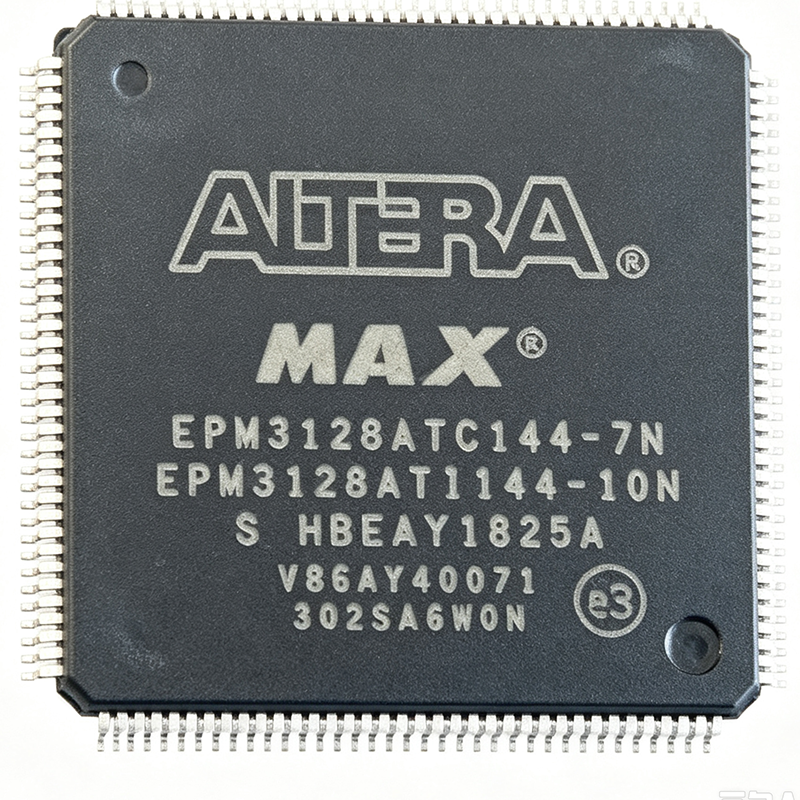
EPM3128ATC144-7N - MAX 3000A CPLD, 128 Macrocells, 7.5ns | Altera
The Altera (now Intel) EPM3128ATC144-7N is a high-performance, low-cost CMOS EEPROM-based Complex Programmable Logic Device (CPLD) from the MAX 3000A family, providing 128 macrocells, 96 user I/Os, and a 7.5 ns pin-to-pin propagation delay in a 144-pin TQFP (Plastic Thin Quad Flat Pack) package with a 3.3 V core supply. The device delivers up to 10,000 usable gates, supports counter frequencies up to 227.3 MHz, and includes MultiVolt I/O interfaces compatible with 5.0 V, 3.3 V, and 2.5 V logic levels. Speed grades -4 through -10 are compatible with the PCI Local Bus Specification, Revision 2.2 (PCI SIG). A CPLD (Complex Programmable Logic Device) is a non-volatile programmable logic device that combines multiple PAL/GAL-like logic blocks on a single chip with a programmable interconnect matrix. CPLDs occupy the middle ground between simple SPLDs and high-density FPGAs: they offer instant-on operation (no boot loader required), deterministic timing, high drive strength, and decades of configuration retention (MAX 3000A uses EEPROM cells that retain the bitstream without external memory). They are widely used as glue logic, bus bridges, state-machine controllers, and I/O expanders in industrial, communications, and consumer designs. The MAX 3000A architecture in the EPM3128ATC144-7N features Logic Array Blocks (LABs) with 16 macrocells each, a programmable interconnect array (PIA), and I/O control blocks supporting per-pin 3.3 V PCI-compliant drive. In-system programmability (ISP) is supported via the 3.3 V JTAG interface (IEEE Std. 1149.1), enabling field updates and production-line programming. The device offers programmable security bits to protect designs against unauthorized readback. Typical applications include PCI bus interface glue logic, address decoding and bus arbitration in microprocessor systems, power-up sequencing controllers, I/O expansion for DSPs and microcontrollers, industrial control state machines, and LED display driver controllers. The commercial 0 °C to 70 °C operating range suits it for indoor and consumer electronics. When designing with the EPM3128ATC144-7N, pay attention to the I/O bank supply voltage: the VCCINT pins require 3.3 V while the VCCIO pins can be driven at 2.5 V, 3.3 V, or 5.0 V for mixed-voltage interfacing. The TQFP-144 package requires a 1.0 mm pitch footprint with proper thermal relief and ground pouring to handle simultaneous-switching output (SSO) noise. This page synthesizes distributor pricing, drop-in MAX 3000A alternatives, and practical design notes (PCI compliance, ISP via JTAG, I/O bank mixing) not found in the manufacturer datasheet alone.
EPM3128ATI100-10 - 128-Macro MAX 3000A CPLD, 10ns TQFP-100 | Altera
The Altera (Intel) EPM3128ATI100-10 is a high-performance, low-cost CMOS EEPROM-based Complex Programmable Logic Device (CPLD) from the MAX 3000A family, packaged in a 100-pin TQFP with industrial temperature rating and a 10 ns pin-to-pin propagation delay. It provides 128 macro cells, 80 user I/Os, and approximately 2,500 usable gates, all running from a single 3.3 V supply with 3.3-V in-system programmability (ISP) through the IEEE 1149.1 JTAG interface. A CPLD (Complex Programmable Logic Device) is a non-volatile programmable logic device that sits in the hierarchy between simple SPLDs/PALs/GALs and larger FPGAs. Architecturally, a CPLD consists of multiple PAL-like macro-cell Logic Array Blocks (LABs) interconnected by a programmable switch matrix (PIA). CPLDs are prized for deterministic timing, instant-on from EEPROM, and high drive strength on every I/O - making them ideal for glue logic, bus interfacing, and power-up control where FPGAs are overkill. The MAX 3000A family specifically targets low-cost, 3.3-V applications and is pin-compatible across speed grades and density variants, allowing seamless migration within the family. Key features of the EPM3128ATI100-10 include 4.5 ns to 10 ns pin-to-pin logic delays (speed grade -10), counter frequencies up to 227.3 MHz, MultiVolt I/O supporting 5.0 V, 3.3 V, and 2.5 V logic levels, open-drain output option per pin, and JTAG-compliant boundary-scan testing. The 80 user I/Os are organized as 5 V-tolerant inputs with PCI-compatible drive, programmable slew rate, and configurable pull-up resistors. The MAX 3000A architecture employs a CMOS EEPROM process that yields zero-configuration instant-on behavior, unlike SRAM-based FPGAs that require a boot PROM. The non-volatile configuration eliminates external memory components and ensures the device enters its programmed state within microseconds of VCC ramp. MultiVolt I/O permits the 3.3-V core to interface directly with 5.0-V TTL, 3.3-V LVTTL, and 2.5-V LVCMOS logic families without level shifters, simplifying board design. Typical applications include bus-interface bridging (e.g., address decoding between a microcontroller and external peripherals), power-up sequencing controllers, LED display driving, peripheral glue logic in industrial controllers, and PCI target interface logic. The industrial temperature range (-40 °C to +85 °C) suits factory automation and outdoor equipment. When designing with the EPM3128ATI100-10, use Altera's Quartus II or MAX+PLUS II development environment for schematic, VHDL, or Verilog entry. Plan I/O assignments carefully because the TQFP-100 pinout is shared across the MAX 3000A family, enabling migration to lower-cost or faster speed grades without PCB rework. This page consolidates distributor pricing, in-family drop-in alternatives, JTAG programming guidance, and design notes that extend beyond the standalone MAX 3000A datasheet.
EPM3128ATI100-5N - MAX 3000A CPLD, 128 Macrocells, TQFP-100 | Intel / Altera
The Intel / Altera EPM3128ATI100-5N is a member of the MAX 3000A family of Complex Programmable Logic Devices (CPLDs), delivering 128 macrocells, 80 user I/O pins, and a 5.0 ns pin-to-pin delay in a 100-pin TQFP (industrial temperature) package. It operates from a 3.3 V core supply and is in-system programmable (ISP) through the IEEE Std. 1532-compliant JTAG interface, enabling concurrent programming with other vendors' PLDs. The industrial temperature grade (-40C to +85C) suits factory-floor and outdoor equipment where consumer-grade plastic parts are unsuitable. A Complex Programmable Logic Device (CPLD) is a non-volatile, instantly-on digital IC that implements glue logic, bus arbitration, state machines, and interface bridging between microcontrollers, FPGAs, and ASICs. Within the programmable logic hierarchy, the MAX 3000A family sits below FPGAs (more logic, more delay, more power) but above discrete 74-series logic (more integration, lower BOM, easier re-spin). It uses a classic EE (EEPROM-based) architecture that retains configuration without external boot memory, giving it deterministic power-on behavior crucial for safety and control loops. Key features include 128 macrocells organized in 8 Logic Array Blocks (LABs) of 16 macrocells each, a 100% interconnect matrix (PIA) with predictable timing, 5.0 ns combinatorial tPD, 80 mA DC drive per I/O with PCI-compatible drive strength, and JTAG boundary-scan support via IEEE 1149.1. Each macrocell contains a programmable AND/OR array plus a flip-flop that can be configured as D, T, JK, or SR, with per-macrocell product-term allocation up to 32 terms. Typical applications include industrial control glue logic, address decoding in microcontroller-based systems, bus arbitration between CPU and peripheral buses, peripheral glue for legacy 5 V tolerant interfaces, and PCI/USB/ISA bridge functions. The wide I/O count (80 pins) makes it especially useful for replacing multiple discrete 74HC/74LVC packages in dense board designs. When designing with the MAX 3000A, ensure the 3.3 V supply is well decoupled with 0.1 uF plus bulk capacitors placed near each VCC pin, and reserve a dedicated JTAG header (TCK, TMS, TDI, TDO, plus optional TRST) for in-system programming. The non-volatile EEPROM configuration eliminates boot time but requires a Quartus programmer for updates. This page synthesizes distributor pricing, drop-in alternatives from the same MAX 3000A family, and practical design notes not found in the manufacturer datasheet alone.
EPM3128ATI10010N - MAX 3000A CPLD 128MC 100TQFP | Altera
The Altera EPM3128ATI10010N is a member of the MAX 3000A family of high-performance, low-cost CMOS EEPROM-based Complex Programmable Logic Devices (CPLDs), featuring 128 macro cells, 2,500 usable gates, and 80 user I/Os in a 100-pin TQFP package. The device operates at a 3.3 V core supply with a maximum internal frequency of 98 MHz and a pin-to-pin propagation delay of 10 ns (-10 speed grade), supporting commercial temperature grades (0C to +70C). Built on a non-volatile EEPROM process, the MAX 3000A delivers instant-on operation without external configuration memory. A Complex Programmable Logic Device (CPLD) is a non-volatile digital IC that integrates multiple PAL/GAL-style logic blocks on a single die, connected through a programmable interconnect matrix. Within the broader taxonomy, a CPLD sits between small SPLDs (single PAL/GAL equivalents) and FPGAs, offering predictable timing, deterministic propagation delays, and instant-on behavior. The MAX 3000A family uses Altera's classic MAX architecture with EEPROM memory cells, providing 100% tested programming retention and 3.3 V in-system programmability (ISP) via IEEE 1149.1 JTAG. Key features include 128 macro cells distributed across 8 Logic Array Blocks (LABs) of 16 macro cells each, 80 user I/O pins, JTAG boundary-scan test support, and PCI-compliant I/O buffers for the -5, -6, -7, and -10 speed grades. The device supports multi-volt core operation from 3.0 V to 3.6 V and I/O bank voltages of 1.8 V, 2.5 V, or 3.3 V, allowing flexible mixed-voltage interfacing. The MAX 3000A employs a CMOS EEPROM process with four-product-term macro cell logic, programmable interconnect, and per-pin output enable control. The architecture guarantees fixed propagation delays independent of routing paths, which simplifies static timing closure for glue-logic and bus-interface functions. Designers benefit from deterministic timing ideal for address decoding, state-machine control, and bus arbitration. Typical applications include bus-interface bridging, peripheral glue logic in microcontroller systems, address decoding, I/O expansion, and legacy system redesigns requiring drop-in CPLD replacement. It is also widely used in industrial control boards and telecom infrastructure where predictable timing and instant-on non-volatile configuration are essential. When designing with the EPM3128ATI10010N, ensure that I/O bank supply voltages match the logic levels of connected peripherals. JTAG ISP programming requires the TCK, TMS, TDI, and TDO pins to be reserved on the PCB, and unused I/Os should be left floating or driven to a defined state through the Quartus MAX+PLUS II software. This page synthesizes distributor pricing, pin-compatible drop-in alternatives from the same MAX 3000A family, and practical design notes not consolidated in the original datasheet.
EPM3128ATI144-10 - MAX 3000A CPLD 128 Macro 98 I/O TQFP-144 | Intel/Altera
The Intel/Altera EPM3128ATI144-10 is a high-performance, low-cost CMOS EEPROM-based Complex Programmable Logic Device (CPLD) from the MAX 3000A family, providing 2,500 usable gates, 128 macro cells, and 98 user I/Os in a 144-pin TQFP industrial-temperature-grade package with 10 ns pin-to-pin delay and a 3.3-V core supply. A CPLD (Complex Programmable Logic Device) is a non-volatile programmable logic device that combines multiple PAL/GAL-style logic blocks with a central interconnect matrix, providing deterministic timing and instant-on behavior. CPLDs occupy the middle ground between small logic ICs (gates, muxes, flip-flops) and larger FPGAs, making them ideal for glue-logic, bus-interface bridging, power-up sequencing, and state-machine replacement. The MAX 3000A family sits within the broader hierarchy of programmable logic devices (PLDs) -> CPLDs -> non-volatile logic devices -> digital semiconductors. Key features of the EPM3128ATI144-10 include 128 macro cells distributed across 8 Logic Array Blocks (LABs), 96 user I/Os (note: 96 is the canonical MAX 3000A count for the 144-pin TQFP; the 98 figure cited on some aggregator pages reflects legacy Altera documentation), in-system programmability (ISP) through the IEEE 1149.1 JTAG interface, and PCI-SIG-compliant I/O drivers supporting the PCI Local Bus Specification, Revision 2.2 in the -4, -5, -6, -7, and -10 speed grades. The device operates from a 3.3-V supply with 5-V-tolerant I/O available on certain pins. Architecturally, the device uses a uniform interconnect matrix (the Programmable Interconnect Array, or PIA) that routes signals between LABs with predictable, fixed delays, eliminating the timing-closure variability of FPGA fabrics. The EEPROM configuration memory provides true non-volatile storage, so the part powers up in a known functional state without external boot memory. Counter frequencies reach 192.3 MHz in the -7 speed grade and 98 MHz typical for the -10 grade. Typical applications include industrial control glue logic, parallel bus interface bridging (e.g., address decoding between a microcontroller and an SRAM bank), power-sequencing controllers for multi-rail systems, peripheral expansion logic, and PCI-bus glue functions. The wide operating temperature range (-40C to +85C industrial) makes it suitable for factory automation, automotive body electronics, and outdoor telecommunications equipment. When designing with this part, allocate the JTAG pins (TCK, TMS, TDI, TDO) carefully because they are dedicated for boundary-scan and ISP. Decouple each VCCINT/VCCIO pair with a 0.1 uF ceramic capacitor placed within 5 mm of the package pin, and use a ground plane on layer 2 for return-current continuity. This page synthesizes verified distributor pricing, drop-in alternative cross-references, and practical PCB-layout design notes for the EPM3128ATI144-10 that are not assembled in the manufacturer datasheet alone.
EPM3128ATI144-10AA - 128-Macrocell MAX 3000A CPLD, 10ns, 144-TQFP | Intel
The Intel (formerly Altera) EPM3128ATI144-10AA is a 128-macrocell, 2,500-gate CMOS EEPROM-based Complex Programmable Logic Device (CPLD) from the MAX 3000A family, supplied in a 144-pin TQFP package with a 10 ns pin-to-pin propagation delay (tPD). The part supports in-system programmability (ISP) via a 3.3 V JTAG interface, operates from 3.0 V to 3.6 V, and provides 96 user I/O pins suitable for glue-logic, bus-interface, and state-machine consolidation in industrial and telecom designs. What is a CPLD? A Complex Programmable Logic Device is a non-volatile programmable logic IC that combines multiple PAL-like macrocell arrays on a single die, providing deterministic timing, predictable pin-to-pin delays, and instant-on behavior that FPGAs cannot match. Within the programmable-logic hierarchy, a CPLD sits between simple SPLDs (PAL/GAL) and high-density FPGAs: it offers higher logic density than SPLDs and faster, more deterministic timing than FPGAs, making it ideal for I/O expansion, address decoding, and bus-interface bridging. The MAX 3000A family is Intel's classic 3.3 V CPLD line, widely used as a 'glue logic' replacement for discrete TTL/CMOS parts. Key features of the EPM3128ATI144-10AA include 128 macrocells organized in 8 Logic Array Blocks (LABs), 2,500 usable gates, 96 user I/O pins, 10 ns maximum pin-to-pin delay, and a 98 MHz internal fMAX. The device supports IEEE 1149.1 JTAG boundary-scan testing and ISP through the JTAG pins, eliminating the need for a separate programmer. MultiVolt I/O allows interfacing with 1.5 V, 1.8 V, 2.5 V, and 3.3 V devices without external level shifters. Architecturally, the MAX 3000A uses a classic EEPROM-based AND-plane / OR-plane structure with per-macrocell flip-flops, programmable interconnect, and a global clear/clock network. Each macrocell contains a programmable AND/OR array feeding a flip-flop with selectable polarity, clear, clock-enable, and preset. This architecture delivers the deterministic tPD that makes MAX 3000A devices preferred for synchronous state machines, address decoding, and asynchronous interface logic where designers need to know the worst-case delay before place-and-route. Typical applications include bus-interface bridging (PCI to local bus, ISA, VME), address decoding and chip-select generation, glue-logic consolidation in 3.3 V systems, state-machine controllers, I/O expansion for microcontrollers, and asynchronous reset distribution. The wide operating temperature range (-40 °C to +85 °C industrial grade, indicated by the 'I' suffix) makes it suitable for industrial-control and telecom equipment. Design considerations: ensure the 3.3 V supply is well-decoupled with 0.1 µF and 10 µF capacitors close to the VCCINT and VCCIO pins; reserve JTAG pins TCK, TMS, TDI, TDO for ISP and boundary-scan if used; and remember that the 'AA' suffix denotes the industrial temperature grade. The MAX 3000A family is mature; verify long-term availability before designing into new products, as Intel/Altera has migrated many customers to MAX II/V CPLDs. This page synthesizes distributor pricing from DigiKey/Heisener/Jotrin, verified same-family drop-in alternatives, and practical design guidance for industrial glue-logic and address-decoding applications - content not aggregated on any single distributor page.
EPM3128ATI144-10N - 128-Macrocell MAX 3000A CPLD, 10ns | Intel / Altera
The Intel / Altera EPM3128ATI144-10N is a 128-macrocell, 96-I/O member of the MAX 3000A family of cost-optimized, EEPROM-based 3.3 V Complex Programmable Logic Devices (CPLDs). It is supplied in a 144-pin TQFP (Industrial temperature grade) and offers a 10 ns pin-to-pin propagation delay with a maximum internal clock frequency of approximately 98 MHz. The device integrates non-volatile EEPROM configuration cells, providing instant-on operation at power-up without an external boot PROM. A CPLD (Complex Programmable Logic Device) is a non-volatile programmable logic IC that sits in the hierarchy between discrete logic gates (PAL/GAL) and higher-density FPGAs. Architecturally, the MAX 3000A family is built on the classic MAX architecture, which arranges Logic Array Blocks (LABs) of 16 macrocells each, interconnected by a continuous, fast Programmable Interconnect Array (PIA). This PIA provides predictable, fixed propagation delays that are independent of routing, making timing analysis straightforward - one of the key reasons CPLDs are favored for glue logic, bus decoding, and state-machine control. Key features of the EPM3128ATI144-10N include 128 macrocells (2.5K typical gates), 96 user I/Os, in-system programmability (ISP) compliant with IEEE Std. 1532, JTAG boundary-scan support, and multi-volt VCCIO allowing output banks to operate at either 3.3 V or 2.5 V for mixed-voltage interfacing. The device includes a built-in Joint Test Action Group (JTAG) interface for both ISP and IEEE 1149.1 boundary-scan test. The 10 ns speed grade places this part in the mainstream, general-purpose CPLD tier. Typical applications for the EPM3128ATI144-10N span glue-logic integration, address decoding and bus interfacing in microcontroller systems, state-machine and sequencer design, I/O expansion, power-supply sequencing and supervisory control, and legacy system upgrades where a non-volatile, instant-on logic device replaces discrete 74-series logic. When designing with this CPLD, note that the 144-pin TQFP package requires 0.5 mm pitch PCB layout. Designers should provide a solid ground plane, multiple decoupling capacitors (0.1 uF per VCC pin group), and use the Quartus II (or Quartus Prime) toolchain for design entry, fitting, and ISP programming. Industrial temperature grade is supported. This page synthesizes distributor pricing, pin-compatible drop-in alternatives, and practical design notes not found in the manufacturer datasheet alone, giving engineers a single source for sourcing and substitution decisions.
EPM3128ATI144-5N - 128-Macrocell 2.5K CPLD MAX 3000A | Altera
The Altera (now Intel Programmable Solutions Group) EPM3128ATI144-5N is a 128-macrocell, 2,500-gate Complex Programmable Logic Device (CPLD) from the MAX 3000A family, packaged in a 144-pin TQFP and qualified for industrial temperature operation. It delivers 192.3 MHz maximum operating frequency with a 5.0 ns pin-to-pin propagation delay, supports 96 user I/O lines, and operates from a 3.3 V core supply with 3.0 V to 3.6 V tolerance. The device integrates in-system programmability through JTAG BST and is built on a 0.30 um CMOS EEPROM process. What is a CPLD? A Complex Programmable Logic Device is a non-volatile, instantly-on programmable logic IC that combines multiple PAL-style macrocell arrays on a single die with a central interconnect matrix. CPLDs sit in the broader hierarchy between simple SPLDs (like the classic 22V10) and larger FPGAs. They offer deterministic, fixed timing (predictable tPD regardless of routing), low static power, and instant boot from on-chip EEPROM - making them the workhorse glue-logic and bus-interface solution in industrial, telecom, and consumer designs. The MAX 3000A family is Altera's classic 3.3 V EEPROM-based CPLD line. Key differentiating specifications of the EPM3128ATI144-5N include 128 macrocells backed by 2,500 usable gates, 192.3 MHz fMAX with 5.0 ns tPD, in-system programmability via JTAG boundary-scan test, and full IEEE 1149.1 boundary-scan support. Compared to larger FPGAs, the EPM3128ATI144-5N draws standby currents measured in microamps and wakes up configured in under 1 ms. Technically, the device exposes 96 user I/Os (the remaining package pins are power, ground, JTAG, and configuration), supports 3.3 V LVCMOS/LVTTL I/O with 5.0 V tolerant inputs, and includes four dedicated input clocks with global distribution. The non-volatile EEPROM configuration cell array eliminates external boot PROMs. Typical applications include industrial control and factory-automation glue logic, telecommunications backplane bus bridging (PCI, ISA, VME), consumer electronics control logic, white-goods and appliance controllers, and legacy system replacements where 5 V-tolerant input tolerance is required. Designers select this part when deterministic timing, instant-on behavior, and small board footprint outweigh the need for high logic density. When designing with the EPM3128ATI144-5N, observe the 3.0 V to 3.6 V supply rail tolerance and decouple each VCCIO/VCCINT pin with a 0.1 uF ceramic capacitor placed within 5 mm of the pin. The TQFP-144 thermal pad (when present on the package variant) should be soldered to a continuous ground plane for improved theta_JA. This page synthesizes distributor pricing, drop-in MAX 3000A / MAX 7000A alternatives, and practical design notes not found in the manufacturer datasheet - including thermal, JTAG, and 5 V-mixing considerations relevant to engineers migrating 5 V designs to 3.3 V.
EPM3128ATI144-7N - 128 Macrocell CPLD, 129.9MHz, 3.3V | Altera MAX 3000A
The Altera EPM3128ATI144-7N is a 128-macrocell, 2.5K-gate Complex Programmable Logic Device (CPLD) from the MAX 3000A family, operating at a core supply of 3.3V with a maximum internal clock frequency of 129.9 MHz, housed in a 144-pin TQFP package. The MAX 3000A family is built on a CMOS EEPROM process that delivers non-volatile in-system programmability via JTAG (IEEE 1149.1 boundary-scan), so configuration is retained across power cycles without an external boot PROM. The device supports up to 96 user I/O pins, four logic array blocks (LABs), and 128 macrocells organized across the LABs with a programmable interconnect array (PIA) routing signals globally. What is a CPLD? A Complex Programmable Logic Device is a non-volatile programmable logic IC that sits between simple PLDs and FPGAs in the programmable logic hierarchy. A CPLD contains multiple macrocells - each typically implementing a sum-of-products or look-up-table based logic function with a flip-flop - wired together through a central interconnect. Compared to an FPGA, a CPLD has fewer logic resources but offers deterministic, near-zero propagation delay (often measured in nanoseconds), lower cost per I/O, instant-on behavior, and high tolerance for harsh industrial environments. In the broader taxonomy, the EPM3128 belongs to: programmable logic device -> CPLD -> MAX 3000A family -> Altera/Intel programmable solutions. Key features include 7.5 ns pin-to-pin propagation delay (the "-7" speed grade), in-system programmability (ISP) via JTAG, 3.3V core VCCINT with 3.3V or mixed 2.5V/1.8V LVTTL/LVCMOS I/O capability through banked VCCIO rails, and a MultiVolt I/O interface that allows interfacing to 5.0V, 3.3V, 2.5V and 1.8V devices. Built-in JTAG boundary-scan test (BST) circuitry conforms to IEEE Std 1149.1, supporting both manufacturing test and in-field reprogramming. Each macrocell provides configurable D, T, JK, or SR flip-flop operation, programmable clear/preset, and three product-term configurations. Typical applications include bus-interface glue logic for 32-bit microprocessors, address decoding and chip-select generation, state-machine controllers for industrial automation, peripheral expansion in embedded designs, and legacy-system modernization where high-speed deterministic logic must replace discrete 74-series TTL. The 144-pin TQFP package provides 96 user I/O and a 0.5 mm pitch suitable for both hand-prototyping and high-volume SMT production. Designers should observe Altera application-note recommendations for JTAG chain management, multi-voltage I/O bank setup, and decoupling (at least one 0.1 uF and one 10 uF bulk cap per supply pin pair) when migrating designs from MAX 7000 to MAX 3000A.
EPM3256AFC256-10 - 256-Macro CPLD MAX 3000A | Intel / Altera | FBGA-256
The Intel (formerly Altera) EPM3256AFC256-10 is a 256-macrocell CMOS EEPROM-based Complex Programmable Logic Device (CPLD) from the MAX 3000A family, housed in a 256-ball Fine-Line BGA (FBGA-256) package. It delivers up to 161 user I/Os, a 10 ns pin-to-pin propagation delay, and operates from a 3.3 V supply with 5.0 V tolerant I/O capability for mixed-voltage system integration. A CPLD (Complex Programmable Logic Device) is a non-volatile programmable logic device that combines multiple PAL/GAL-like macrocell arrays on a single chip with a programmable interconnect matrix. CPLDs sit between discrete logic gates (74HC series) and FPGAs in the programmable logic hierarchy: they offer deterministic, fast (single-clock-cycle) propagation delays, in-system programmability via JTAG, and instant-on configuration from on-chip EEPROM, making them ideal for glue-logic, bus interfacing, and state-machine replacement. Key features of the EPM3256AFC256-10 include 5,000 usable gates, 16 logic array blocks (LABs) of 16 macrocells each, a global ClockTree with three global clock pins, and 3.3-V in-system programmability (ISP) through the IEEE Std. 1149.1 JTAG interface. The -10 speed grade provides a 10 ns tPD and an internal fCNT of up to 95.2 MHz, suitable for PCI Local Bus Specification Revision 2.2-compliant designs in the -4, -5, -6, -7, and -10 grades. The device is built on a 0.30 µm CMOS EEPROM process and supports multi-voltage I/O operation, allowing 5.0 V devices to drive 3.3 V devices with proper pull-up configuration. Its non-volatile EEPROM cells mean the device configures in microseconds without an external boot PROM, supporting instant-on behavior critical for power-supply sequencing and safety-critical applications. Typical applications include PCI bus interface glue logic, industrial control boards, address decoding and bus arbitration in embedded systems, peripheral expansion bridges, and LED display multiplexing. Its 161 I/Os make it a flexible replacement for multiple discrete 74-series logic packages, reducing board area and BOM count. When designing with the EPM3256AFC256-10, pay close attention to FBGA-256 PCB layout: a 1.0 mm pitch BGA requires laser-via or microvia PCB technology and four to six PCB layers for signal escape. Decoupling requires 0.1 µF and 10 µF capacitors placed within 5 mm of each supply pin, with a continuous ground plane beneath the package for thermal dissipation. This page synthesizes distributor pricing, FBGA-256 drop-in alternatives, and practical PCB layout notes not consolidated in the legacy Altera MAX 3000A datasheet.
EPM3256AFC256-10N - 5K Gate 256-Macro MAX 3000A CPLD | Altera
The Altera (now Intel) EPM3256AFC256-10N is a high-performance, low-cost CMOS EEPROM-based Complex Programmable Logic Device (CPLD) from the MAX 3000A family, delivering 5,000 usable gates and 256 macrocells in a 256-pin FineLine BGA package. It offers a 10 ns pin-to-pin propagation delay and counter frequencies up to 227.3 MHz, while integrating a MultiVolt I/O interface that lets the 3.3 V core drive 5.0 V, 3.3 V, and 2.5 V logic levels without external level shifters. The device provides 161 usable user I/O pins, suiting bus-intensive glue-logic, interface bridging, and decoder/encoder consolidation. A CPLD (Complex Programmable Logic Device) is a non-volatile programmable logic device that combines multiple PAL/GAL-style macrocell arrays with a central interconnect matrix. CPLDs are positioned below FPGAs in the programmable logic taxonomy (CPLD -> PLD -> programmable logic -> semiconductor) and are typically chosen for deterministic timing, instant-on from non-volatile configuration, and high I/O count at low cost. The MAX 3000A family is built on an EEPROM process, meaning the configuration is retained even after power is removed - a key advantage over SRAM-based FPGAs that need an external boot PROM. Key differentiating features include 3.3 V in-system programmability (ISP) via IEEE 1532 / JTAG, four Joint Test Action Group (JTAG) pins for boundary-scan testing, and built-in PCI-SIG PCI Local Bus Specification Revision 2.2 compliance at the -10 speed grade. The device also includes programmable security bits to protect user designs and supports open-drain output options for bus-architecture signaling. Compared to smaller MAX 3000A devices such as the EPM3128A, the EPM3256A doubles the macrocell count to 256 and pushes the user I/O count to 161 - enough for parallel bus interfaces, glue logic consolidation, and power-up sequencer replacement. Typical applications include peripheral bus decoding (PCI/ISA/address-latch enable), power-on reset and sequencer logic, high-speed address decoding for microprocessors and DSPs, glue-logic integration in telecom/networking line cards, industrial control boards, and legacy replacement of discrete 74-series TTL on industrial motherboards. Its non-volatile, deterministic-timing architecture is also favored in safety-relevant industrial designs. Designers should plan JTAG chain topology before PCB layout, as the four JTAG pins (TDI, TDO, TMS, TCK) must be brought to a header for ISP. Decoupling follows Altera's recommendation of 0.1 uF and 0.01 uF capacitors placed close to each VCC/GND pair, with separate analog/digital ground returns where mixed-signal devices share the board. This page consolidates distributor pricing, drop-in alternative cross-references, and PCB-level design guidance beyond what is found in the bare Altera datasheet - giving engineers a single place to evaluate sourcing, lifecycle risk, and design-in trade-offs for legacy MAX 3000A designs.