Audio Codecs
بەرهەمەکان (190+)

MC145557P - 13-Bit A-Law PCM Codec-Filter | Motorola
Motorola, Inc. MC145557P is a single-function A-law PCM codec-filter integrated circuit with 13-bit PCM resolution, offered in a 16-lead PDIP package. It belongs to the MC145554, MC145557, MC145564, and MC145567 family of per-channel devices that combine voice digitization and reconstruction with band-limiting and smoothing functions for PCM communication systems. The component is designed for use in synchronous and asynchronous PCM signal paths. A PCM codec-filter is an interface integrated circuit that processes pulse-code-modulated audio or voice signals between an analog system and a digital PCM channel. Within the broader semiconductor hierarchy, it is a codec and signal-conditioning device within interface ICs, with a more specialized function than a general-purpose audio codec. The MC145557P specifically combines 13-bit PCM processing with A-law encoding in a single 16-lead PDIP package. The principal identified specifications are 13-bit PCM resolution, A-law operation, one codec-filter function, and a 16-pin PDIP package. Its single-function organization makes it suitable for designs that require dedicated per-channel voice conversion rather than a multi-channel codec with additional control and routing functions. The through-hole PDIP format also supports conventional PCB assembly, prototyping, repair, and communication equipment with larger component packages. In a PCM system, the codec-filter provides the conversion and filtering functions needed to digitize voice information, reconstruct received PCM information, and limit the signal band before transmission or processing. Devices in the MC145554, MC145557, MC145564, and MC145567 family perform these per-channel functions and can operate in synchronous or asynchronous systems. The MC145557P is differentiated within that family by its A-law configuration and 13-bit PCM resolution. Typical implementation areas include telephony and voice communication equipment, PCM interface modules, digital voice processing systems, telecommunications line interfaces, and legacy PCM test equipment. Its 16-lead PDIP package may be especially useful where a through-hole footprint is preferred over a surface-mount package, or where the original circuit design already uses this package style. Circuit implementation should follow the Motorola manufacturer datasheet for pin assignment, external component selection, clocking, and signal-path layout. Verify the required A-law system configuration, 13-bit PCM word format, synchronous or asynchronous timing mode, and grounding arrangement before finalizing the PCB. The PDIP footprint also requires adequate lead spacing and clearance from adjacent components. This product overview consolidates the confirmed codec type, PCM resolution, A-law configuration, package format, sourcing context, and functional relationships into an engineering-focused reference. It also provides application guidance, design cautions, package information, and links to the manufacturer documentation needed for an informed design decision.
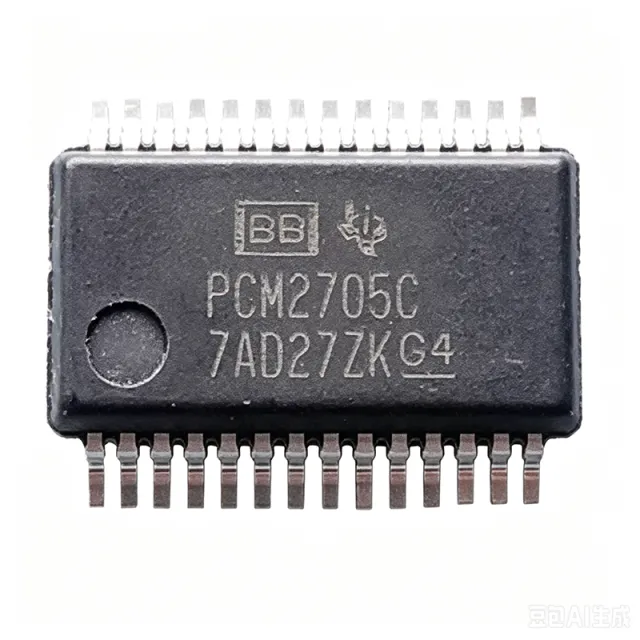
PCM2705C - 98dB SNR Stereo USB DAC with S/PDIF | Texas Instruments
The Texas Instruments PCM2705C is a single-chip stereo audio digital-to-analog converter (DAC) with an integrated USB 2.0 full-speed protocol controller and S/PDIF output. It delivers 98dB SNR and supports both bus-powered and self-powered operation with software control. The device is fully compliant with USB 2.0 specifications and USB Audio Class, requiring no dedicated device driver. It comes in a 28-pin SSOP package, making it ideal for compact audio applications. A USB audio DAC is a digital-to-analog converter that receives digital audio data from a USB host and converts it to analog audio signals. It integrates the USB interface, protocol controller, and DAC core into a single chip, simplifying system design. The PCM2705C sits in the hierarchy of audio converters, specifically as a USB audio interface IC, which is a subset of audio data converters within the broader category of mixed-signal ICs. Key features include a 98dB SNR stereo DAC, S/PDIF output, and support for both bus-powered and self-powered modes. The device also features partially programmable USB descriptors, allowing customization of vendor ID and product ID via an external SPI host. The integrated USB transceiver eliminates the need for external PHY, reducing BOM cost and board space. Technically, the PCM2705C uses adaptive isochronous transfer for audio data, ensuring synchronized playback. The S/PDIF output supports digital audio transmission to external decoders or amplifiers. The device operates from a 3.3V supply and includes an internal PLL for clock generation, minimizing external components. The SSOP-28 package provides a compact footprint suitable for portable and space-constrained designs. Typical applications include USB sound cards, docking stations, gaming headsets, and portable audio interfaces. The device's plug-and-play capability makes it ideal for consumer audio products where driver installation is undesirable. Its low power consumption and small size also suit battery-powered devices. When designing with the PCM2705C, ensure proper decoupling of the 3.3V supply and careful layout of the USB differential pair to maintain signal integrity. The SPI interface for descriptor programming should be configured during initial setup, and the PSEL and HOST pins must be set correctly for the desired operating mode.

PCM3000E - 18-Bit Stereo Audio Codec | Texas Instruments
The Texas Instruments PCM3000E is an 18-bit stereo audio codec with integrated analog-to-digital and digital-to-analog converters, 64-times oversampling, and a 28-pin SSOP package. It accepts single-ended analog voltage inputs and produces single-ended analog voltage outputs, combining stereo recording and playback functions in one low-cost CMOS device. An audio codec is a mixed-signal interface IC that converts between digital audio data and analog voltage signals. In the signal-chain hierarchy, the PCM3000E sits between an audio signal source or microphone front end and a digital audio processor, microphone preamplifier, and analog output amplifier. Its ADC path digitizes stereo analog inputs, while its DAC path reconstructs stereo audio from serial digital data. The integrated converters make it useful in cost-sensitive consumer equipment requiring more functionality than a basic interface controller. Key features include 18-bit ADC and DAC resolution, stereo operation, single-ended analog inputs and outputs, and 64-times ADC oversampling. The DAC section uses an 8-times oversampling digital interpolation filter. A serial interface provides a straightforward connection to digital audio processors, while the integrated codec architecture reduces the number of separate converters required in a stereo audio subsystem. The PCM3000E uses delta-sigma modulation for both conversion paths. Delta-sigma ADCs oversample the analog input and use digital decimation filtering, while the DAC path combines digital interpolation filtering with a single-bit delta-sigma conversion stage. This architecture supports compact, cost-sensitive stereo audio designs and is suited to consumer applications where good performance is required without the complexity of a high-resolution multibit converter. Typical uses include consumer digital audio equipment, portable audio products, stereo cassette and CD-style playback systems, and other sound-processing products. It can also support multichannel designs when multiple codec channels are combined. For digital signal processing, the codec can work with serial audio processors, microcontrollers, or DSPs capable of handling the required master clock, serial data, and control signals. Designers should follow the pin-description table in the manufacturer datasheet when assigning signal paths and decoupling. The analog supply, digital supply, clock, serial interface, and analog-output circuitry require careful partitioning to prevent switching activity and digital coupling from degrading audio performance. The 28-pin SSOP package is compact but has a relatively narrow lead pitch, so PCB assembly and inspection require suitable fine-pitch capability. This page organizes the PCM3000E specifications, pin and package information, product comparisons, engineering guidance, and available drop-in alternatives for faster design review. It also identifies lifecycle and sourcing considerations that should be checked before committing to a new production design.
PCM3000E/2K - 18-Bit Stereo Audio Codec | Texas Instruments
The Texas Instruments PCM3000E/2K is an 18-bit stereo audio codec with two analog-to-digital converters, two digital-to-analog converters, a serial audio interface, and single-ended analog input and output in a 28-pin SSOP package. The codec is intended for cost-sensitive consumer audio equipment requiring one-chip stereo capture and playback. An audio codec is an interface IC that converts analog audio signals into digital data and reconstructs digital audio streams into analog output. In the broader semiconductor hierarchy, PCM3000E/2K belongs to the audio codec family within interface integrated circuits. Combining both conversion directions in one package reduces component count, simplifies board routing, and supports compact consumer audio products such as sound cards, home-audio accessories, and USB audio equipment. The device provides 18-bit stereo conversion, two ADC channels, two DAC channels, and a serial interface. These features make PCM3000E/2K appropriate for designs that need a straightforward stereo signal path rather than a high-channel-count professional codec. Its single-ended analog architecture also simplifies board design by avoiding the balanced input and output networks commonly required by professional audio interfaces. Texas Instruments describes PCM3000 and PCM3001 as low-cost, single-chip stereo codecs fabricated using an advanced CMOS process. Both devices are offered in a compact 28-pin SSOP package. The PCM3001 variant can be pin-programmed for different data formats, whereas the PCM3000 family is primarily intended for applications using its supported serial format. The PCM3000E/2K ordering code identifies the tape-and-reel configuration. Typical uses include USB sound-card signal conditioning, multimedia speaker and headphone interfaces, portable audio accessories, digital recording equipment, and cost-sensitive stereo playback systems. In each case, the device can serve as the central conversion stage between analog transducers and a digital audio controller. Digital audio quality still depends on correct clocking, analog layout, grounding, decoupler placement, and suitable output and input filtering. PCB design should keep analog input and output traces away from digital clock and serial-data paths, while providing a low-impedance ground plane beneath the codec. Follow the manufacturer datasheet for the recommended power, clock, and signal connections. The most important replacement check is not merely the 28-pin SSOP outline but also the exact signal interface, clocking requirements, analog pin functions, and supported data format. This page organizes the PCM3000E/2K specifications, lifecycle information, sourcing path, compatible alternatives, comparison points, and practical integration guidance into one engineering-focused reference. It also distinguishes genuine package-and-interface drop-in options from functionally similar codecs that require different pin assignments or redesigned analog and digital circuitry.
PCM3001E/2K - 18-Bit Stereo Audio Codec | Texas Instruments
The Texas Instruments PCM3001E/2K is an 18-bit stereo audio codec with two analog-to-digital converters, two digital-to-analog converters, and a serial digital audio interface in a 28-pin SSOP package. It combines single-ended analog input and output stages in one device, making it suitable for compact stereo audio systems that require bidirectional analog-to-digital and digital-to-analog conversion. An audio codec is an interface IC that converts analog audio signals into digital data and digital audio data back into analog signals. Within the broader semiconductor hierarchy, the PCM3001E/2K belongs to the audio codec family, which sits under audio interface ICs and interface semiconductors. Its integrated ADC and DAC functions reduce the number of separate converters required in a stereo signal chain while preserving a shared digital audio architecture. The device provides 18-bit stereo conversion, two ADC channels, two DAC channels, and single-ended analog inputs and outputs. Its digital interface is serial, allowing audio data to be transferred between the codec and a digital signal processor, microcontroller, or other audio host. The manufacturer identifies the part as a stereo codec with hardware line-output control, which supports systems requiring analog-output muting or output-path management through hardware control. The PCM3001E/2K is intended for cost-conscious stereo audio equipment where one IC must perform both conversion directions. Its 28-pin SSOP package provides a compact surface-mount footprint while exposing separate analog, digital, power, and control functions. Designers should allocate the board area and decoupling strategy required by the manufacturer application information, especially around analog supply and ground pins. Typical uses include consumer audio equipment, compact stereo playback systems, sound-card analog front ends, multimedia peripherals, and embedded audio products requiring single-ended analog connections. The integrated two-channel ADC and two-channel DAC arrangement allows a system to process captured audio digitally and return processed or stored audio through a line-level output stage. A critical design consideration is maintaining clean, low-impedance analog and digital returns. Follow the pin-description table in the Texas Instruments PCM3001 datasheet when assigning tracks, and place the required bypass capacitors close to their associated supply pins. Keep digital clock and data routes away from the analog input and output paths to reduce crosstalk and conversion error. This page consolidates the device identity, conversion architecture, package details, practical design guidance, and pin-compatible family options for engineers evaluating the PCM3001E/2K. It is intended to support design review, footprint planning, and replacement assessment before the complete Texas Instruments datasheet is consulted for circuit implementation.
PCM3001EG4 - 18-Bit Stereo Audio Codec | Texas Instruments
Texas Instruments PCM3001EG4 is an 18-bit stereo audio codec with two ADCs, two DACs, two input channels, two output channels, and a single-ended analog input/output architecture. The device is packaged in a 28-pin SSOP and uses an 18-bit serial interface to transfer audio data between an analog audio system and a digital processor. Its integrated ADC and DAC channels make it a consolidated interface between analog microphones, line-level sources, audio amplifiers, and digital audio logic. An audio codec is an integrated circuit that converts digital audio data into an analog output and analog audio signals into digital data. In the broader electronics hierarchy, PCM3001EG4 belongs to the audio codec class, then to interface ICs and signal-conversion semiconductors. The PCM3001EG4 combines a stereo ADC path and stereo DAC path in one package, reducing the number of separate converters required in a compact audio design. The principal documented features are 18-bit resolution, stereo operation, two ADC channels, two DAC channels, a serial interface, single-ended analog input/output circuitry, and a 28-pin SSOP package. These features suit compact stereo audio products where both playback and recording paths are needed. The matching ADC and DAC channel count allows a system to use one codec for a two-channel input source and a two-channel output destination, subject to the signal-chain requirements defined by the manufacturer. Technically, the codec separates analog audio conversion from digital transport. Its ADCs sample the incoming analog channels and produce digital data for the host processor, while its DACs receive digital audio and generate analog outputs. The 18-bit serial interface provides the digital link between those converters and the system controller. Designers should treat clocking, data format, analog signal levels, filtering, and power sequencing as the critical implementation considerations rather than treating the codec as a simple standalone audio block. Typical uses include compact stereo recording systems, multimedia audio subsystems, USB or flash-based player accessories, digital mixing equipment, and embedded audio products. For portable or low-voltage systems, power consumption and analog headroom are important; for active studio equipment, channel-to-channel behavior and external analog circuitry require close attention. A microphone preamplifier may be needed when the source level is too low for direct codec input. PCB design should keep analog input and output traces away from high-speed digital clock lines, provide the bypass and filtering components shown in the typical application circuit, and terminate unused analog inputs as directed by the manufacturer. Decoupling should be placed close to the supply pins, while the analog and digital ground strategy must follow the datasheet layout guidance. Proper grounding reduces the chance that codec switching activity couples into the reconstructed audio output. This product page combines the published PCM3001EG4 device identity, channel architecture, resolution, package information, source links, cross-reference findings, and practical design guidance. It also distinguishes documented drop-in relationships from unsupported cross-package options so engineers can make package-aware replacement decisions without assuming that a similar audio codec is electrically interchangeable.

PCM3002E - Low-Power Stereo Audio Codec | Texas Instruments
The Texas Instruments PCM3002E is a low-power stereo audio codec with 16/20-bit resolution, two analog inputs, two analog outputs, and a 24-pin SSOP package. It combines delta-sigma ADCs and DACs with a 20-bit serial audio interface and software-controlled line output, making it suitable for cost-sensitive consumer audio equipment. A stereo audio codec is a mixed-signal semiconductor that converts two analog audio channels into digital data and converts digital audio data back into two analog output channels. In the signal-chain hierarchy, PCM3002E belongs to the audio codec category, combines analog-to-digital converters and digital-to-analog converters, and ultimately supports digital signal processing and audio playback systems. The converter architecture uses delta-sigma modulation with 64-times oversampling. According to the Texas Instruments product information, the ADCs include a digital decimation filter, while the DACs use an 8-times oversampling digital interpolation filter. The 16/20-bit interface supports digital audio formats identified in the family documentation as I2S, L, right-justified I2S, and L/R formats, allowing the device to interface with common audio processors and digital audio buses. The PCM3002 and PCM3003 family is manufactured using an advanced CMOS process and is positioned for cost-sensitive consumer applications where audio performance and low power consumption are important. The 24-pin SSOP package provides a compact surface-mount implementation for consumer audio boards, and the software-controlled line output provides an additional output-control option for system integration. Typical applications include consumer stereo audio systems, portable media equipment, compact digital amplifiers, USB or portable audio accessories, television audio subsystems, and embedded audio interfaces. In each case, the device consolidates two ADCs, two DACs, filtering, and the digital serial interface into one package, reducing the number of separate converter components required on the printed circuit board. When designing a PCB around the PCM3002E, use the manufacturer pin-description table and layout guidance to assign every signal, supply, ground, and reference connection. Decoupling should follow the datasheet recommendations, analog and digital return paths should be routed carefully, and unused inputs should be configured according to the application circuit rather than left electrically unterminated by assumption. This product page combines the device architecture, package information, practical application guidance, sourcing options, and verified equivalent references to support faster component selection and board-level design. It also highlights where an exact replacement is available and when a proposed substitute requires additional engineering verification.
PCM3002E/2K - 20-Bit Stereo Audio Codec | Texas Instruments
The Texas Instruments PCM3002E/2K is a low-power stereo audio codec combining a 20-bit ADC, a 20-bit DAC, and a serial digital audio interface in a 24-pin SSOP package. It supports two single-ended analog inputs, two single-ended analog outputs, 16-bit or 20-bit input and output data, and a maximum sampling rate of 48 kS/s. The codec operates from a 2.7 V to 3.6 V supply and is controlled in software through its serial interface. A stereo audio codec is an interface IC that converts analog audio signals into digital PCM data and converts digital PCM data back into analog audio. It sits between an audio source, such as a microphone or line-level input, and a digital signal processor, microcontroller, or digital audio transmitter. The PCM3002 belongs to the broader codec hierarchy, which includes audio codecs, audio interface ICs, data converters, and interface semiconductors. Key features include 64-times oversampling, a typical signal-to-noise ratio of 90 dB, and 16-bit or 20-bit serial data operation. The two ADC channels use single-ended voltage inputs, while the two DAC channels provide single-ended analog outputs. These characteristics make the device suitable for compact stereo audio paths where a separate ADC, DAC, and interface circuit would otherwise be required. Internally, the codec integrates antialiasing filtering with its oversampling conversion architecture. The serial interface supports I2S, L-format, and right-justified data formats according to the cross-reference information for the PCM3002 family. Its 3.6 V maximum supply operation supports low-voltage digital audio systems, while the integrated converters reduce component count and simplify synchronization between the analog and digital sections. Typical applications include digital recording equipment, powered speakers, compact consumer audio products, sound-card inputs, industrial audio terminals, and embedded audio systems that require stereo conversion at 48 kS/s. The software-control architecture is particularly useful when a host processor must select operating modes, adjust gain, or manage system functions through the serial control interface. PCB design should treat the analog input and output paths as sensitive signal routes. Keep analog and digital ground handling consistent with the manufacturer's recommended layout, place bypass and interface components close to their associated pins, and route high-speed serial clock and data lines away from the analog inputs. Adequate filtering and stable 3.6 V power are essential for repeatable low-noise operation. This page combines the manufacturer specifications with practical interface guidance, application-oriented design notes, and a focused comparison of pin-compatible family options. It is intended to help engineers select the correct codec variant, plan its analog and digital implementation, and evaluate replacement choices without overlooking control-mode or data-format differences.
PCM3002EG - 20-Bit Low-Power Stereo Codec | TI
The Texas Instruments PCM3002EG is a low-power 20-bit stereo audio codec with two analog-to-digital converters, two digital-to-analog converters, single-ended analog inputs and outputs, and software-controlled line output. The device is packaged in a 24-pin SSOP for conventional surface-mount audio processing designs. An audio codec is an integrated circuit that converts analog audio signals into digital data and converts digital audio data back into analog signals. Its role within an audio signal chain is wider than that of a standalone ADC or DAC: the codec integrates conversion circuitry, a digital audio interface, analog input and output channels, and the control functions needed to manage a compact stereo audio path. PCM3002EG belongs to the broader hierarchy of audio codec, interface IC, data converter, and power-management-assisted signal-chain IC. The PCM3002EG combines 2 ADC channels and 2 DAC channels with 20-bit resolution. Its single-ended analog input architecture supports two stereo input channels, while its two DAC outputs support stereo playback. The line-output stage includes software control, allowing an audio system to manage output behavior through the digital control interface. The low-power designation makes the codec relevant to compact audio equipment where energy efficiency and integration are important. The PCM3002EG uses a 20-bit serial audio interface, according to the product listing for this exact ordering code. This interface connects the codec to a digital signal processor, microcontroller, application processor, or other audio controller. The 24-pin SSOP package provides a defined PCB footprint while keeping the analog and digital functions in one component. Designers should follow the manufacturer datasheet for the exact clock, format, control, voltage, and de-identification details when laying out the circuit. Typical applications include digital audio recording, compact stereo playback equipment, audio capture modules, multimedia appliances, and embedded systems that need both microphone or line-level input and line-level output. In a recording path, the two ADC channels digitize left and right analog sources. In a playback path, the two DAC channels reconstruct stereo audio. Software-controlled line output is useful when the system needs configurable output behavior under processor control. For a new design, verify the codec's supported sample rate, operating voltage, master-clock requirements, analog input range, digital interface format, and pin-level bypass recommendations against the current manufacturer datasheet. These details determine whether the PCM3002EG can be connected directly to the chosen host processor or whether level-shifting, filtering, or additional clock circuitry is required. This page consolidates the exact PCM3002EG ordering information, manufacturer product resources, technical attributes, verified drop-in comparison requirements, and practical integration guidance. It is designed to help engineers evaluate the 20-bit stereo codec, inspect its SSOP footprint, confirm interface requirements, and plan sourcing through a structured request-for-quote workflow.
PCM3003E - Low-Power Stereo Audio Codec | Texas Instruments
Texas Instruments PCM3003E is a low-power stereo audio codec with 16-bit or 20-bit resolution, single-ended analog inputs and outputs, and a 24-pin SSOP package. The device operates from a 2.7 V to 3.6 V analog supply and supports an industrial temperature range of -25 °C to +85 °C. An audio codec is an integrated interface that converts between analog audio signals and digital PCM data. The PCM3003E combines stereo analog-to-digital and digital-to-analog conversion functions in one IC, making it suitable for compact consumer audio equipment where component count, power consumption, and board area are important. Its digital audio interface and analog signal path support equipment such as consumer audio systems, portable products, and compact multimedia devices. The PCM3003E offers selectable 16-bit or 20-bit operation, providing flexibility for designs that balance conversion resolution against system data rate and storage requirements. Its line output includes hardware control, allowing the output stage to be managed according to the product architecture. A single-ended analog interface can simplify PCB routing, although grounding and signal-return design remain important for low-noise performance. The codec is manufactured using an advanced CMOS process and is intended for cost-sensitive consumer applications that require good audio performance without a high-complexity audio interface. The 24-pin SSOP package supports conventional surface-mount assembly and is compatible with automated production processes. System designers should follow the manufacturer pin-description table and recommended application circuit when assigning PCB tracks. Typical PCM3003E applications include stereo audio playback and capture, consumer media equipment, compact sound systems, and embedded audio products. The 2.7 V to 3.6 V operating range supports low-voltage digital platforms, while the -25 °C to +85 °C temperature range covers industrial environments. External decoupling, controlled analog grounding, and careful clock routing should be treated as core parts of the analog design. This product page combines manufacturer specifications, packaging information, application guidance, and engineering comparisons. It also distinguishes the PCM3003E from identified family variants and highlights the design checks that matter when integrating a low-power stereo codec into a mixed-signal PCB.
PCM3003E/2K - 20-Bit Stereo Audio Codec | Texas Instruments
The Texas Instruments PCM3003E/2K is a low-power, single-chip stereo audio codec with a 20-bit ADC, 20-bit DAC, single-ended analog inputs and outputs, and hardware control in a 24-pin SSOP package. The device operates from 2.7 V to 3.6 V and supports 16-bit or 20-bit input and output data through its serial interface. An audio codec is an interface IC that combines analog-to-digital and digital-to-analog conversion with the digital audio interface required to exchange samples with a host processor. The PCM3003 belongs to the broader codec hierarchy of audio interface ICs and power-management-dependent mixed-signal devices, bridging microphone-level or line-level analog signals and a digital audio bus. The PCM3003E/2K provides a monolithic stereo ADC and DAC, 64-times oversampling, single-ended voltage inputs, and integrated antialiasing filtering. Its specified THD+N reaches -86 dB, making it suitable for consumer audio equipment where signal-chain fidelity must coexist with a compact, low-power implementation. The hardware-control interface simplifies control of operating functions without relying entirely on software commands. The 20-bit internal converters support 16-bit or 20-bit input and output data, allowing the digital interface to match different source and destination formats. The codec is designed around a 2.7 V to 3.6 V supply range, so system-level audio rails must remain within these limits. Its SSOP-24 package supports conventional surface-mount assembly while preserving compatibility with compact audio boards. Typical applications include stereo line-input and line-output processing, digital audio recording interfaces, multimedia equipment, and compact consumer audio products. In these systems, the ADC can capture single-ended analog input channels, while the DAC and line-output circuitry can provide analog playback from digital audio data. The integrated filtering and oversampling reduce the amount of external analog filtering required around the converters. The main design consideration is to treat analog, digital, and ground connections as separate signal paths. Keep serial-clock and data traces away from the analog inputs, provide local bypass capacitance at the supply pins, and use a quiet ground reference for the analog return path. Component values and supported clock configurations should be selected directly from the manufacturer datasheet and its recommended application circuit. This page consolidates the exact PCM3003E/2K ordering information, electrical specifications, package details, practical applications, and verified drop-in alternatives. It also provides procurement guidance and design notes intended to support faster engineering evaluation while preserving the distinction between documented device ratings and application-specific requirements.
PCM3006T - 16-Bit Stereo Audio Codec | Texas Instruments
Texas Instruments PCM3006T is a low-cost, single-chip stereo audio codec with 16-bit resolution, single-ended analog inputs and outputs, and a 24-SSOP package. The codec combines analog-to-digital and digital-to-analog conversion functions on one device, reducing the component count in stereo audio equipment. Its delta-sigma conversion architecture uses 64-times oversampling, while the ADC path includes a digital decimation filter for converting the oversampled stream into the required audio-rate data. An audio codec is a mixed-signal interface IC that bridges an analog audio system and a digital audio processor. In this product hierarchy, the PCM3006T is a stereo audio codec, which combines an ADC, DAC, analog input and output circuitry, and digital audio data interfaces. It is used where a system needs bidirectional conversion between analog audio signals and a serial digital audio bus rather than a complete USB audio interface or loudspeaker amplifier. The principal functional attributes of the PCM3006T include 16-bit stereo conversion, single-ended analog input and output, 64-times delta-sigma oversampling, and a digital decimation filter in the ADC path. These features make it suitable for compact stereo audio products in which an existing digital audio engine must interface directly with analog microphones, line-level circuitry, speakers, or other analog audio stages. The integrated codec architecture also helps reduce board area compared with separate ADC and DAC devices. The 24-SSOP package is intended for surface-mount assembly and provides a compact implementation for audio equipment. Because the codec performs both conversion directions, board layout should keep the analog input, analog output, digital interface, and supply connections arranged to minimize coupling between sensitive audio nodes and high-speed digital signals. External analog filtering, grounding, and supply-decoupling decisions remain part of the complete signal-chain design rather than being determined solely by the codec specifications. Typical applications include stereo sound-card analog sections, portable audio products, digital mixing consoles, audio-recording interfaces, speaker and headphone subsystems, and embedded equipment that already has a separate USB or digital audio controller. The PCM3006T is particularly appropriate where single-ended analog connections are acceptable and a 16-bit stereo serial interface is sufficient. It does not itself perform USB connectivity or drive a loudspeaker directly, so those functions require suitable companion circuitry. Designers should verify the complete pin configuration, supported digital audio format, sampling-rate range, analog signal limits, and power requirements in the manufacturer datasheet before layout release. The single-ended interface simplifies some analog routing, but it may reduce headroom or flexibility compared with a codec that offers balanced inputs and outputs. Appropriate passive networks, stable references, clean supplies, and controlled return paths remain essential for low distortion and acceptable channel matching. This product summary combines the verified 16-bit stereo codec identity, single-ended analog I/O, 64-times oversampling, digital decimation, and 24-SSOP packaging information with practical selection guidance, comparison notes, sourcing workflow, and design-focused considerations.
PCM3006T/2K - 16-Bit Stereo Audio Codec | Texas Instruments
Texas Instruments PCM3006T/2K is a low-power stereo audio codec with 16-bit resolution, two analog-to-digital converters, two digital-to-analog converters, single-ended analog input and output, and a serial digital audio interface. The device is supplied in a 24-pin SSOP tape-and-reel package. Its integrated codec architecture supports conversion between analog stereo audio and a serial digital representation while conserving board area in audio equipment. An audio codec is a mixed-signal integrated circuit that combines ADC and DAC functions with the digital interface needed to exchange audio samples with a host processor. The PCM3006T/2K belongs to the broader hierarchy of audio codec, audio interface IC, mixed-signal semiconductor, and interface integrated circuit. Its single-ended inputs and outputs simplify connection to line-level analog circuitry without requiring balanced audio channels. Key documented characteristics include 16-bit conversion resolution, a stereo 2-ADC/2-DAC arrangement, and single-ended analog signal paths. The 24-SSOP package supports compact surface-mount layouts, while the tape-and-reel ordering option suits automated assembly. The /2K suffix identifies the specific Texas Instruments orderable configuration and should be retained when comparing replacements or issuing procurement requests. Technically, the PCM3006T/2K separates analog conversion from digital sample transport. Two ADC channels provide the digital audio data path from the analog input stage, while two DAC channels reconstruct stereo audio from digital samples received through the serial interface. This integrated arrangement reduces the number of discrete converters normally required for a stereo signal chain and keeps analog input, conversion, and output functions in one component. Typical uses include consumer audio equipment, portable media systems, digital recording products, and embedded audio subsystems in which a 16-bit stereo codec with single-ended I/O is sufficient. The part can also sit between an analog audio front end and a digital audio processor, allowing the host to perform decoding, mixing, storage, or communication while the codec handles analog-to-digital and digital-to-analog conversion. Designers should confirm the interface timing, analog signal levels, clocking, and required external support circuitry against the manufacturer datasheet before layout. Keep analog and digital return paths well controlled, place input and output capacitors near their associated pins, and route the exposed signal paths away from switching nodes. The 24-SSOP footprint is relatively narrow, so adequate escape routing and assembly clearances are important. This product summary combines the exact orderable MPN, package information, codec configuration, verified distributor listings, replacement analysis, and application-oriented engineering guidance. It is designed to help engineers identify the correct audio converter and prepare a source request without relying on ambiguous family-level descriptions.
PCM3006TG - 16-Bit Stereo Audio Codec | Texas Instruments
Texas Instruments PCM3006TG is a 16-bit stereo audio codec that combines analog-to-digital and digital-to-analog conversion in one IC. It uses single-ended analog voltage input and output and is offered in a 24-pin SSOP/TSSOP-24 surface-mount package. The device is positioned as a low-cost integrated codec for equipment that requires compact conversion of stereo audio signals. An audio codec is an interface IC that converts between analog audio and digital audio data. Its internal ADC accepts analog voltage signals, converts them into digital samples, and transfers those samples to a digital audio processor through a digital serial interface. The internal DAC performs the reverse path, accepting digital audio data and producing a single-ended analog output. This integrated ADC/DAC arrangement reduces component count and simplifies mixed-signal board layouts compared with separate converter ICs. The PCM3006TG's principal identified characteristics are 16-bit resolution, stereo operation, single-ended analog input and output, and a 24-pin package. These features make the codec applicable to consumer audio equipment, digital recording products, and embedded audio systems where two audio channels must cross the analog-to-digital boundary. Its integrated conversion functions also allow a design to use the same codec for playback, capture, or bidirectional signal conversion when the surrounding system provides suitable clocks and digital interfaces. The PCM3006 family is described by Texas Instruments as a low-cost, single-chip stereo audio codec. Integrating both conversion directions into one package reduces board area and the number of external conversion devices. The digital side must still be connected to a processor, controller, or audio transport capable of supporting the codec's interface format and required clocking. Analog board design also requires careful grounding and layout control to prevent converter noise from coupling into either the input or output signal path. Typical uses include compact stereo playback and recording modules, multimedia appliances, USB or network audio peripherals, industrial control panels with sound capture, and consumer products with local audio output. The 16-bit format provides a defined sample width for digital audio pipelines, while the stereo architecture supports independent or paired left and right channels according to the system configuration. Designers should follow the pin-description and typical-application circuits in the Texas Instruments PCM3006 datasheet when assigning signals. Place analog and digital return paths carefully, provide local bypassing at the supply pins, and route high-speed digital traces away from sensitive analog inputs. Confirm the required master-clock, serial-data, and control connections before finalizing the PCB footprint. This product page combines the confirmed PCM3006TG characteristics with a searchable compatibility comparison and practical implementation guidance. It is intended to help engineers identify the correct codec, understand its documented architecture, and plan a robust analog and mixed-signal layout before release to manufacturing.
PCM3006TG6 - 16-Bit Stereo Audio Codec | Texas Instruments
The Texas Instruments PCM3006TG6 is a 16-bit stereo audio codec with single-ended analog input and output, a serial digital interface, and a 24-pin SSOP package. It operates from a 3 V power supply, supports a -25 °C to 85 °C operating-temperature range, and is designed for compact stereo audio signal conversion. Its single-chip integration makes it suitable for audio appliances, portable equipment, and other systems requiring both analog-to-digital and digital-to-analog conversion. An audio codec is an integrated circuit that converts between analog audio signals and a digital data stream. The PCM3006TG6 belongs to the stereo audio codec hierarchy, combining a pair of analog inputs, a pair of analog outputs, delta-sigma ADCs and DACs, digital filters, and a serial host interface. This integration reduces the number of separate converters required in an audio subsystem while retaining a defined path from microphone or line-level input to digital audio data and back to an analog output. The codec uses delta-sigma modulation with 64-times oversampling for both the ADC and DAC sections. Its ADCs include digital decimation filters, while its DACs include digital interpolation filters. The 16-bit format provides a practical balance between audio resolution, interface bandwidth, and implementation complexity for consumer and embedded stereo systems. The 24-SSOP package also has a stated seated height of 1.45 mm, supporting compact board construction. The digital connection uses a serial interface, allowing the codec to communicate with a host processor, digital audio controller, or application-specific integrated circuit. Because digital audio data is serialized, the external connection requires fewer signal conductors than a parallel interface. Clocking, data-format selection, reset behavior, and analog routing must be configured consistently with the surrounding controller to prevent framing or timing errors. Typical uses include stereo line-level processing, multimedia audio conversion, consumer audio appliances, portable equipment, and embedded systems that exchange PCM audio data with a digital processor. The single-ended analog architecture simplifies external signal conditioning compared with a differential implementation, although the application still needs suitable input and output filtering, grounding, and signal-level design. A critical implementation requirement is to follow the manufacturer datasheet reference circuit for analog, digital, and power connections. Place the required bypass capacitors close to their supply pins, keep analog and digital return paths disciplined, and treat the codec interface traces as timing-sensitive clock and data routes. Adequate analog headroom and correct input or output scaling are necessary to prevent distortion and clipping. This product page combines the Texas Instruments codec specifications with package details, sourcing guidance, application-focused design notes, and a verified same-family replacement reference. It is intended to help engineers assess the PCM3006TG6 for an existing 3 V stereo audio design before committing to a PCB or production release.

PCM3008T/2K 16-Bit Stereo Audio Codec | Texas Instruments
The Texas Instruments PCM3008T/2K is a low-power, low-voltage 16-bit stereo audio codec with two single-ended analog inputs and two single-ended analog outputs, packaged in a 16-pin TSSOP (PW). It operates from a 2.4 V supply, supports an operating temperature range of -25 °C to +85 °C, and uses delta-sigma modulation with 64-times oversampling for its ADCs and DACs. The codec includes digital decimation, high-pass, interpolation, de-emphasis, and pop-noise-free muting functions. An audio codec converts between analog audio signals and a digital data interface. In this product family, the ADC path digitizes left and right single-ended analog inputs, while the DAC path reconstructs digital audio into left and right analog outputs. The PCM3008 family is positioned as a compact single-chip solution for consumer audio, communication, and embedded audio equipment where a low-voltage digital interface and direct analog signal conversion are required. The integrated codec architecture reduces the number of separate converters required in a stereo audio design. According to the manufacturer product information, both ADCs and DACs use delta-sigma modulation with 64-times oversampling. ADC channels include digital decimation filters and digital high-pass filters, while the DAC channels include an 8-times oversampling digital interpolation filter, a digital de-emphasis filter, and pop-noise-free muting. The line output also includes hardware control, as indicated by the product-page description. The PCM3008T/2K is a 2.4 V part intended for low-voltage audio systems. The 16-bit resolution provides a 16-bit audio data format, while the stereo ADC and DAC arrangement supports two-channel capture and playback. Its TSSOP package is suitable for compact surface-mount layouts where a traditional analog and digital interface controller would be too large or unnecessarily complex. Typical uses include portable consumer audio equipment, USB or digital audio accessory designs, sound-card and interface modules, voice terminals, multimedia appliances, and compact embedded audio products. The low-voltage architecture is useful when the surrounding system derives its analog and digital supply from a single low-voltage rail or a regulated 2.4 V source. Designers should use the manufacturer datasheet pin-description table when assigning signal names and PCB tracks, especially for the serial audio interface, analog supplies, analog inputs, analog outputs, and control pins. Power and analog return paths should be routed carefully to minimize coupling between the converter sections and the digital interface. The exact input and output capacitor recommendations, clock requirements, and supported serial-interface modes should be confirmed from the manufacturer datasheet. This product page combines the manufacturer product description, ordering information, distributor listing details, and cross-reference information for the PCM3008T/2K. The available data identifies the device as a 16-bit, 2 ADC/2 DAC, single-ended stereo audio codec in a 16-pin TSSOP package; additional electrical limits and detailed timing parameters should be taken directly from the manufacturer datasheet.
PCM3010DB - 24-Bit Stereo Audio Codec | Texas Instruments
Texas Instruments PCM3010DB is a low-cost, single-chip stereo audio codec integrating a 24-bit ADC and 24-bit DAC, with single-ended analog inputs and outputs, 96 kHz ADC conversion, and 192 kHz DAC playback in a 24-pin SSOP package. Both converters use delta-sigma modulation, while the ADC includes a digital decimation filter and the DAC uses an 8-times-oversampling architecture. An audio codec is an interface IC that converts analog audio into a digital bitstream and reconstructs digital audio into analog signals. The PCM3010 combines both conversion paths in one package, reducing component count in cost-sensitive consumer equipment. Its digital interface connects a digital audio processor, microcontroller, or other host with external analog microphones, line-level sources, speakers, headphones, and other audio circuits. Key features include 24-bit stereo conversion, single-ended analog input and output, 64-times ADC oversampling, 8-times DAC oversampling, simultaneous ADC and DAC operation, and power-down capability. The 96 kHz maximum ADC sampling rate supports high-rate digital audio capture, while the 192 kHz maximum DAC rate supports higher-rate playback and multimedia applications. The integrated codec architecture avoids separate ADC and DAC packages when both conversion directions are required. The converters rely on delta-sigma modulation to shape quantization noise away from the audio band. According to the Texas Instruments PCM3010 datasheet, the ADC path includes a digital decimation filter with a high-pass filter, while the DAC path includes an 8-times-oversampling filter stage. The device is fabricated using CMOS technology and is intended for cost-sensitive consumer applications where compactness and integrated audio conversion are important. Typical uses include digital audio recorders, multimedia appliances, USB and portable audio equipment, consumer audio processors, and mixed-signal systems requiring both microphone capture and audio playback. In these systems, the PCM3010 can accept a single-ended analog source, provide a digital serial stream to the audio engine, and return a digital stream for analog playback. The integrated power-down function can reduce system power when the codec is not needed. Careful PCB layout is essential because high-resolution audio converters combine sensitive analog inputs with clocked digital signals. Place analog and digital return-current paths separately, decouple the supply close to the device, use a quiet analog reference source, and route the serial data and clock nets away from input pins. Select external input and output filtering according to the intended source impedance, anti-alias requirements, and output-load network. This product page organizes the PCM3010DB specifications, conversion architecture, application guidance, pinout reference, and confirmed same-footprint alternatives into one engineering-focused resource. It also distinguishes exact package compatibility from merely similar codecs, helping designers verify replacement requirements before committing a new board revision.
PCM3010DBR - 24-Bit Stereo Audio Codec | Texas Instruments (Tape & Reel)
Texas Instruments PCM3010DBR is a low-cost, single-chip stereo audio codec integrating a 24-bit ADC and 24-bit DAC, with single-ended analog inputs and outputs, 96 kHz ADC conversion, and 192 kHz DAC playback in a 24-pin SSOP package. Both converters use delta-sigma modulation, while the ADC includes a digital decimation filter and the DAC uses an 8-times-oversampling architecture. An audio codec is an interface IC that converts analog audio into a digital bitstream and reconstructs digital audio into analog signals. The PCM3010 combines both conversion paths in one package, reducing component count in cost-sensitive consumer equipment. Its digital interface connects a digital audio processor, microcontroller, or other host with external analog microphones, line-level sources, speakers, headphones, and other audio circuits. Key features include 24-bit stereo conversion, single-ended analog input and output, 64-times ADC oversampling, 8-times DAC oversampling, simultaneous ADC and DAC operation, and power-down capability. The 96 kHz maximum ADC sampling rate supports high-rate digital audio capture, while the 192 kHz maximum DAC rate supports higher-rate playback and multimedia applications. The integrated codec architecture avoids separate ADC and DAC packages when both conversion directions are required. The converters rely on delta-sigma modulation to shape quantization noise away from the audio band. According to the Texas Instruments PCM3010 datasheet, the ADC path includes a digital decimation filter with a high-pass filter, while the DAC path includes an 8-times-oversampling filter stage. The device is fabricated using CMOS technology and is intended for cost-sensitive consumer applications where compactness and integrated audio conversion are important. Typical uses include digital audio recorders, multimedia appliances, USB and portable audio equipment, consumer audio processors, and mixed-signal systems requiring both microphone capture and audio playback. In these systems, the PCM3010 can accept a single-ended analog source, provide a digital serial stream to the audio engine, and return a digital stream for analog playback. The integrated power-down function can reduce system power when the codec is not needed. Careful PCB layout is essential because high-resolution audio converters combine sensitive analog inputs with clocked digital signals. Place analog and digital return-current paths separately, decouple the supply close to the device, use a quiet analog reference source, and route the serial data and clock nets away from input pins. Select external input and output filtering according to the intended source impedance, anti-alias requirements, and output-load network. This product page organizes the PCM3010DBR specifications, conversion architecture, application guidance, pinout reference, and confirmed same-footprint alternatives into one engineering-focused resource. It also distinguishes exact package compatibility from merely similar codecs, helping designers verify replacement requirements before committing a new board revision.

PCM3060PW - 24-Bit Stereo Audio Codec | Texas Instruments
Texas Instruments PCM3060PW is a single-chip 24-bit stereo audio codec with two single-ended analog inputs, two differential analog outputs, 16–96 kHz sampling rates, and 16/24-bit digital audio words, housed in a 28-pin TSSOP package. It combines a stereo ADC using a 64-times delta-sigma modulator with a stereo DAC using a 64- or 128-times delta-sigma modulator. An audio codec converts between analog audio and digital audio data. The PCM3060 integrates both conversion functions, control registers, digital attenuation, soft mute, de-emphasis, and serial host communication on one device. Its interface supports 3-wire SPI-compatible or 2-wire I²C-compatible control, while its audio interface handles the digital conversion data. This integrated architecture suits sound-processing equipment requiring stereo capture and playback without separate ADC and DAC packages. The codec supports 16/24-bit digital audio words at sampling rates from 16 kHz through 96 kHz. Differential analog outputs help reduce common-mode noise and support balanced output routing, while the two single-ended ADC inputs simplify source capture. Programmable digital attenuation, soft mute, and de-emphasis provide useful control functions for consumer audio, television, set-top-box, and audiovisual equipment. The PCM3060 is fabricated using an advanced CMOS process and integrates delta-sigma conversion, digital filtering, and interface control into a 28-pin TSSOP package. This mixed-signal design supports 24-bit resolution while keeping the external component count lower than a discrete converter solution. The control interface provides access to operating functions from a host processor. Typical uses include DVD-RW equipment, digital televisions, set-top boxes, and other audiovisual systems. The same architecture also fits industrial sound modules, stereo recording interfaces, digital mixing equipment, and playback products requiring both microphone-line input capability and line-level differential output. PCB implementation should preserve short analog traces, provide a quiet analog ground connection, and place input and output bypass capacitors close to their associated pins. The digital interface and analog signal paths should be routed to limit coupling between switching signals and sensitive conversion circuitry. Confirm the pin-description table in the manufacturer datasheet before assigning every trace and decoupling connection. This product page combines the manufacturer’s codec specifications, package information, application guidance, pricing workflow, and verified drop-in substitution analysis. It also provides practical comparison points and design notes intended to accelerate component selection, PCB implementation, and second-source qualification for stereo audio designs.
PCM3060PWR - 24-Bit Stereo Audio Codec | Texas Instruments (Tape & Reel)
Texas Instruments PCM3060PWR is a single-chip 24-bit stereo audio codec with two single-ended analog inputs, two differential analog outputs, 16–96 kHz sampling rates, and 16/24-bit digital audio words, housed in a 28-pin TSSOP package. It combines a stereo ADC using a 64-times delta-sigma modulator with a stereo DAC using a 64- or 128-times delta-sigma modulator. An audio codec converts between analog audio and digital audio data. The PCM3060 integrates both conversion functions, control registers, digital attenuation, soft mute, de-emphasis, and serial host communication on one device. Its interface supports 3-wire SPI-compatible or 2-wire I²C-compatible control, while its audio interface handles the digital conversion data. This integrated architecture suits sound-processing equipment requiring stereo capture and playback without separate ADC and DAC packages. The codec supports 16/24-bit digital audio words at sampling rates from 16 kHz through 96 kHz. Differential analog outputs help reduce common-mode noise and support balanced output routing, while the two single-ended ADC inputs simplify source capture. Programmable digital attenuation, soft mute, and de-emphasis provide useful control functions for consumer audio, television, set-top-box, and audiovisual equipment. The PCM3060 is fabricated using an advanced CMOS process and integrates delta-sigma conversion, digital filtering, and interface control into a 28-pin TSSOP package. This mixed-signal design supports 24-bit resolution while keeping the external component count lower than a discrete converter solution. The control interface provides access to operating functions from a host processor. Typical uses include DVD-RW equipment, digital televisions, set-top boxes, and other audiovisual systems. The same architecture also fits industrial sound modules, stereo recording interfaces, digital mixing equipment, and playback products requiring both microphone-line input capability and line-level differential output. PCB implementation should preserve short analog traces, provide a quiet analog ground connection, and place input and output bypass capacitors close to their associated pins. The digital interface and analog signal paths should be routed to limit coupling between switching signals and sensitive conversion circuitry. Confirm the pin-description table in the manufacturer datasheet before assigning every trace and decoupling connection. This product page combines the manufacturer’s codec specifications, package information, application guidance, pricing workflow, and verified drop-in substitution analysis. It also provides practical comparison points and design notes intended to accelerate component selection, PCB implementation, and second-source qualification for stereo audio designs.
PCM3500E - 16-Bit Mono Voice Codec | Texas Instruments
Texas Instruments PCM3500E is a low-voltage, low-power, 16-bit mono SoundPlus voice and modem codec in a 24-SSOP package. It operates from a 2.7 V to 3.6 V supply and integrates the functions required for modem analog front ends and speech-processing systems. The codec combines a mono single-to-differential converter, a fully differential fifth-order delta-sigma modulator, decimation filtering, a digital high-pass filter, and a serial interface circuit. A voice codec is a mixed-signal integrated circuit that converts an analog voice signal into a digital bitstream and reconstructs a digital audio stream into an analog signal. In the product hierarchy, PCM3500E is a SoundPlus voice codec, a specialized audio codec, and therefore part of the broader amplifier, interface, and power-management ecosystem. Its mono architecture is appropriate for one speech channel, modem equipment, and portable voice terminals where power consumption and board area are important. The 16-bit resolution provides the primary signal representation for the voice path, while the delta-sigma modulator and decimation filter implement the conversion from analog voice information to a serial digital stream. The integrated power-down function supports systems that need to reduce consumption when the codec is not active. The 2.7 V to 3.6 V operating range aligns with low-voltage digital systems and portable equipment supplied from 3.3 V rails. The PCM3500E is designed for modem analog front-end and speech-processing applications. Its mono single-to-differential input stage is intended to provide a differential signal to the internal modulator, helping the converter operate with its intended signal structure. The serial interface provides the digital connection between the codec and a host processor, digital signal processor, or communications controller. Engineers should pay close attention to the 24-SSOP footprint, analog input routing, reference requirements, bypass capacitors, serial-interface timing, and the 2.7 V to 3.6 V supply limits. Because the device is designed around a voice-band signal chain, microphone and line-level inputs require appropriate gain and impedance conditioning before reaching the converter. This page combines the manufacturer product description with practical application guidance, pin and packaging information, selection criteria, and a comparison framework for engineers evaluating codec upgrades or replacements. It emphasizes the PCM3500E's 16-bit mono architecture, low-voltage operation, integrated power-down capability, and suitability for compact voice and modem equipment.
PCM3500E/2K - 16-Bit Mono Voice Codec | Texas Instruments
The Texas Instruments PCM3500E/2K is a low-voltage, low-power, 16-bit mono SoundPlus voice and modem codec with a 24-pin SSOP package. It operates from a 2.7 V to 3.6 V supply, supports sampling frequencies from 7.2 kHz to 26 kHz, and provides a typical dynamic range of 88 dB at an 8 kHz sampling frequency with a 1 kHz input. A voice codec is a mixed-signal semiconductor that converts between an analog audio signal and a digital serial data stream. The PCM3500 integrates a 16-bit delta-sigma ADC, a 16-bit delta-sigma DAC, microphone and line-level analog paths, voice-band filtering, and a serial interface. Its architecture is intended for modem analog front ends, speech-processing systems, portable communications equipment, and other compact voice-recording products. Key features include support for modem operation up to 56 kbps, a 512fS system clock, master or slave clock operation, and an integrated power-down function. The ADC includes reference circuitry, mono single-to-differential conversion, a fully differential fifth-order delta-sigma modulator, a decimation filter with a digital high-pass function, and a serial interface. These functions concentrate the essential voice-processing path into one device. The PCM3500E/2K uses the 24-pin SSOP package identified as DB by Texas Instruments. Its low supply-voltage range suits systems built around 3.3 V power rails, while the integrated power-down mode helps reduce consumption when the voice path is inactive. The serial interface permits connection to a digital signal processor, application processor, modem, or other codec through clock and data signals. Typical uses include modem analog front ends, speech-capture terminals, telephone interface modules, portable voice appliances, industrial communication equipment, and embedded speech-recording systems. Its voice-band sampling range is particularly appropriate for speech rather than high-fidelity music, and its mono architecture avoids using resources that a stereo codec would require. For a new design, route the microphone or line input through the appropriate analog pins, configure the serial interface for the required master or slave clock relationship, and use the manufacturer pin-description table when assigning PCB tracks. Decoupling and analog grounding should follow the recommended application circuit because mixed-signal codec performance depends on separating digital switching activity from sensitive audio paths. This product page consolidates the codec's electrical characteristics, ordering information, drop-in alternatives, application guidance, and PCB-oriented design notes into an engineering-focused reference for voice and modem signal-chain development.
PCM3500EG4 - 16-Bit Mono Voice Codec | Texas Instruments
Texas Instruments PCM3500EG4 is a low-voltage, low-power, 16-bit mono SoundPlus voice and modem codec operating from a 2.7 V to 3.6 V supply and housed in a 24-pin SSOP package. It supports voice-band signal conversion for modem analog front ends, speech processing, telephony, and other single-channel audio systems. A voice or modem codec is an interface IC that converts analog audio into a digital serial stream and reconstructs an analog signal from digital audio data. In the signal-chain hierarchy, it belongs to the audio codec family within interface ICs and semiconductor signal-processing devices. The PCM3500EG4 combines a mono analog channel with a serial digital interface, providing a compact solution where low supply voltage, low power, or voice-band bandwidth is more important than stereo playback functionality. The principal device characteristics include 16-bit resolution, mono operation, a 2.7 V to 3.6 V power-supply range, and a typical ADC signal-to-noise ratio of 88 dB. Integrated power-down capability reduces consumption when the voice channel is inactive. Its serial interface can also support time-slot arrangements in which as many as four PCM3500 devices share a four-wire interface bus using four positions in a 64-bit long frame. PCM3500EG4 targets applications where a dedicated voice-band converter is preferable to a general-purpose multimedia codec. The mono architecture avoids the channels and controls required for stereo playback, while the 16-bit interface is suitable for speech and modem waveforms. Its low-voltage operation also makes it appropriate for portable communication equipment operating from a 3.3 V system rail. Typical uses include modem analog front ends, speech-processing systems, telephone-interface equipment, voice-recording terminals, and compact communications controllers. In a modem or speech system, the codec can convert microphone-band or line-band audio to serial PCM data for a digital signal processor, while its decoding path reconstructs the analog voice signal. Multiple codecs can share a serial bus when time-slot multiplexing is required. Power-supply noise deserves particular attention because operation at or near the 2.7 V minimum reduces analog headroom and can degrade the achievable signal-to-noise ratio. Place the required bypass capacitors close to the supply pins, keep analog and digital return-current paths controlled, and follow the pin-description and layout guidance in the manufacturer datasheet when assigning PCB tracks. This product summary combines the PCM3500EG4 device identity, voltage and resolution requirements, voice-band use cases, interface-sharing capability, and practical power considerations to support component selection, schematic review, and footprint planning.
PCM3501E/2K - 16-Bit Mono Voice Codec | Texas Instruments
The Texas Instruments PCM3501E/2K is a low-voltage, low-power, 16-bit mono SoundPlus voice and modem codec in a 24-pin SSOP package. It operates from a 2.7 V to 3.6 V supply and combines one analog-to-digital channel with one digital-to-analog channel for voice-band signal processing. The /2K ordering code denotes a tape-and-reel package containing 2,000 devices. A voice codec is an interface IC that converts between analog audio signals and digital PCM data. The PCM3501E/2K belongs to the broader codec hierarchy: integrated circuit, interface IC, audio codec, and mono voice or modem codec. This device is intended for compact systems where one communication voice channel must be digitized and reproduced without the channel count or power requirements of a stereo audio codec. The codec provides a 16-bit PCM serial interface, a mono voice or modem signal path, and operation from a 2.7 V to 3.6 V analog supply. Its low-voltage and low-power characteristics suit portable and embedded communication equipment in which the codec must operate alongside 3.3 V digital logic. The 24-pin SSOP package also supports conventional surface-mount assembly and automated production. Because the device handles both analog conversion and digital serialization, its performance depends on correct power distribution, grounding, and interface implementation. A clean 3.3 V supply helps prevent converter reference or digital-interface disturbances from reaching the voice path. The manufacturer datasheet should be used for clock timing, analog biasing, filtering, and decoupling values because those detailed operating conditions are not reproduced on this page. Typical uses include single-channel voice processing in modem and telephone interface equipment, compact audio communication terminals, digital answering devices, and embedded voice-capable appliances. In each case, the PCM3501E/2K serves as the bridge between an analog microphone or line-level voice signal and a digital processor or serial interface. For a new PCB, use the 24-pin SSOP footprint and follow the pin-description table in the manufacturer datasheet when assigning analog, digital, clock, and supply connections. For an existing PCM3501E design, verify package orientation, supply sequencing, clock source, and the PCB land pattern before treating the /2K tape-and-reel ordering option as a replacement. This page brings together the manufacturer ordering information, package details, drop-in comparison data, and practical integration guidance. It also distinguishes electrical and functional interchangeability from the distinction between tube and tape-and-reel delivery configurations, helping engineers make a more reliable sourcing and assembly decision.