TPS82130SILR - Módulo reductor MicroSiP de 17V y 3A | Texas Instruments
N.º de pieza: TPS82130SILR ✓ Activo| Cant. | Precio unitario | Total |
|---|---|---|
| 1 | $3.44 | $3,44 |
| 10 | $3.1 | $31,00 |
| 100 | $2.75 | $275,00 |
| 500 | $2.45 | $1.225,00 |
| 1.000 | $2.18 | $2.180,00 |
TPS82130SILR Descripción general
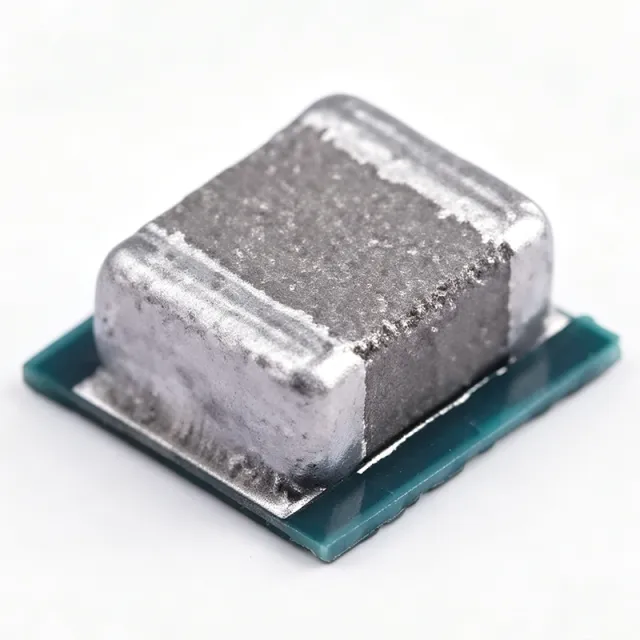
Un convertidor reductor, también llamado convertidor buck, es un regulador de tensión conmutado DC-DC que convierte una tensión de entrada más alta en una tensión de salida más baja con alta eficiencia. Los convertidores buck constituyen un bloque fundamental de las jerarquías de IC de gestión de potencia, junto con los LDO, las bombas de carga y los módulos de potencia. El TPS82130 además integra los FET de conmutación discretos, el inductor y la compensación de lazo en un único micromódulo, reduciendo drásticamente el número de componentes externos y el área de PCB en comparación con los diseños de reguladores discretos que requieren FET externos, un inductor de potencia y componentes de compensación.
Las características clave incluyen el amplio rango de entrada de 3V-17V que admite sistemas de bus de 12V y 5V, salida continua de 3A, salida ajustable de 0,9V-5V mediante un divisor de resistencias externo, frecuencia de conmutación fija de 2,2MHz que permite condensadores externos pequeños, arranque suave interno para limitar la corriente de irrupción, una señal de salida power-good para secuenciación, un pin de habilitación para el control de apagado y protección térmica de apagado. El encapsulado MicroSiP expone un pad térmico inferior que conduce el calor directamente al plano de cobre de la PCB.
Técnicamente, el TPS82130 utiliza control de modo de corriente de pico a frecuencia fija, proporcionando una respuesta transitoria rápida y estabilidad con una capacitancia de salida mínima (típicamente 22uF cerámico). Admite operación con ciclo de trabajo del 100% para baja caída de tensión en relaciones VIN-a-VOUT altas. El inductor blindado integrado reduce las EMI radiadas mientras simplifica el diseño de la PCB, y el bajo perfil de 1,5mm se adapta al ensamblaje automatizado con equipos de montaje superficial estándar.
Las aplicaciones típicas incluyen alimentación point-of-load (POL) para FPGAs, DSPs y ASICs en sistemas industriales, alimentación de sensores en automatización de fábrica, distribución de potencia en el riel de 12V en nodos de borde IoT y equipos de prueba portátiles donde el tamaño reducido de la solución es crítico.
Al diseñar, siga las recomendaciones de la hoja de datos para la capacitancia cerámica de entrada y salida, coloque el módulo cerca de la carga y proporcione un área de cobre generosa bajo el pad térmico, especialmente con corrientes de salida altas. Las referencias de precios aplican a partir del 2026-08-28.
Esta página sintetiza precios de distribuidores, alternativas de reemplazo directo y notas prácticas de diseño que no se encuentran en la hoja de datos del fabricante.
Alternativas directas para TPS82130SILR — mismo encapsulado, compatible pin a pin. Se excluyen las piezas de otro encapsulado que requieren retrabajo de la PCB.
Variantes de esta serie
Modelos de la misma serie compatibles directamente con TPS82130SILR (mismo factor de forma y huella) — difiere en Continuous Output Current, MSL Level, Output Voltage Range, Package, Switching Frequency.
Herramienta de comparación rápida — seleccione piezas alternativas para compararlas lado a lado:
TPS82140SILR
✅ Sustitución directa✓ En stock
$2.45 / unidad
Ver hoja de datos →TPS82150SILR
✅ Sustitución directa📋 Alternativa de referencia (no en el catálogo)
TPS82130SILT
✅ Sustitución directa📋 Alternativa de referencia (no en el catálogo)
TPS82130SILR Valores máximos y características eléctricas
| Topología | Synchronous Buck (Step-Down) |
| Module Type | MicroSiP Power Module (integrated inductor and FETs) |
| Rango de tensión de entrada | 3 V to 17 V |
| Rango de tensión de salida | 0.9 V to 5 V (adjustable) |
| Continuous Output Current | 3 A |
| Frecuencia de conmutación | 2.2 MHz (typical, fixed) |
| Control Mode | Peak Current Mode |
| Efficiency (typical) | >90% at moderate load |
| Arranque suave | Internal |
| Salida Power Good | Yes |
| Patilla de habilitación | Yes (active-high) |
| Apagado térmico | Yes |
| Rango de temperatura de funcionamiento | -40C to +125C |
| Encapsulado | 8-pin uSIP (SIL) 3.0mm x 2.8mm x 1.5mm |
| Tipo de montaje | Surface Mount |
| Nivel MSL | 2 (1 year floor life) |
| Estado RoHS | Compliant |
Configuración de pines de TPS82130SILR
| Pin 1 | VIN — Input supply voltage |
| Pin 2 | GND — Signal ground |
| Pin 3 | EN — Enable input (active high) |
| Pin 4 | PGND — Power ground |
| Pin 5 | FB — Feedback voltage input |
| Pin 6 | VOUT — Regulated output voltage |
| Pin 7 | PG — Power good output flag |
| Pin 8 | AGND — Analog ground |
Aplicaciones típicas
TPS82130SILR es adecuado para 6 aplicacións: FPGA Point-of-Load Power, Industrial Sensor and PLC Supplies, IoT Edge Devices and Gateway Nodes, Portable Test and Measurement Equipment, DSP and ASIC Core Power, Communication Equipment Power.
FPGA Point-of-Load Power
The TPS82130SILR is an ideal point-of-load supply for FPGA core and auxiliary rails in industrial embedded systems. With 3A continuous output, 0.9V to 5V adjustable output range, and a 3.0mm x 2.8mm uSIP footprint, it can power the FPGA core (typically 1.0V-1.2V), auxiliary (1.8V), and I/O (2.5V or 3.3V) rails from a single 12V bus. The 2.2MHz switching frequency avoids interfering with common FPGA clock harmonics around 100-500MHz, eliminating beat-frequency noise issues that plague lower-frequency regulators. Integrated synchronous FETs and shielded inductor eliminate 6-8 discrete components, dramatically reducing PCB area versus discrete buck designs.
Recomendado
Industrial Sensor and PLC Supplies
The TPS82130SILR powers industrial 4-20mA loop transmitters, PLC analog input modules, and 24V-bus sensor conditioning circuits. Its 3V-17V input range directly accepts the 24V industrial bus (after protection/regulation) and 12V backplane rails commonly used in factory automation. The wide operating temperature range of -40C to +125C supports deployment in unconditioned factory environments. With internal thermal shutdown, power-good output, and enable pin for power sequencing, the TPS82130 provides the robustness required for industrial IEC 61010 environments. Typical efficiency above 90% minimizes thermal dissipation in sealed enclosures.
Recomendado
IoT Edge Devices and Gateway Nodes
The TPS82130SILR fits compact IoT edge nodes and gateway designs that require multiple voltage rails in a small footprint. The integrated MicroSiP package occupies 75% less PCB area than equivalent discrete buck designs, freeing space for wireless modules, sensors, and battery management. With 3A peak capability, the TPS82130 can power a small SoC plus Wi-Fi/BLE radio module directly from a 12V or USB-C input. The 2.2MHz switching frequency enables small ceramic output capacitors (typically 22uF), and the internal soft-start limits inrush current that could trip upstream USB current-limit switches.
Recomendado
Portable Test and Measurement Equipment
Handheld oscilloscopes, data loggers, and field test equipment benefit from the TPS82130SILR's compact size, high efficiency, and wide input range. Battery-powered instruments often use a 2-cell or 3-cell Li-ion pack (6V-12.6V) that maps directly to the TPS82130 input range. The 3A continuous capability powers analog front-end ADCs, FPGAs, and display backlight drivers simultaneously. The 1.5mm low-profile uSIP package allows the entire power tree to fit on the back side of small PCBs, leaving the top side for analog signal paths and user interface components. High efficiency above 90% extends battery runtime.
Recomendado
DSP and ASIC Core Power
The TPS82130SILR is well-suited as a POL supply for DSP, ASIC, and high-performance microcontroller core rails. Modern DSPs often require 1.0V to 1.2V at 2-3A peak current with tight transient response - the TPS82130's peak-current-mode control delivers fast transient response with minimal output capacitance. The adjustable output from 0.9V to 5V covers virtually all DSP/ASIC core voltage requirements. The integrated power-good output enables sequencing with other system rails, and the enable pin allows shutdown to microampere-level quiescent current for sleep-mode applications. According to TI datasheet, the device supports 100% duty cycle for low-dropout operation at high VIN-VOUT deltas.
Recomendado
Communication Equipment Power
Networking switches, wireless base stations, and small cell radio units can use the TPS82130SILR to power digital signal processors and baseband chips from 12V backplane rails. The 2.2MHz switching frequency and integrated shielded inductor minimize radiated EMI - critical for communication equipment that must meet FCC and CE conducted/radiated emissions limits. With 3A output capability, the TPS82130 powers baseband SoCs and DDR memory termination rails simultaneously. The small MicroSiP footprint allows power circuits to be placed directly beneath or adjacent to the load IC, minimizing parasitic inductance and improving transient response.
Recomendado
Resumen de productos recomendados
Datos de referencia de ingeniería para TPS82130SILR — comparación, orientación de diseño e información de cumplimiento.
Guía de selección
Comparación con alternativas
| Parámetro | Este producto | TPS82140SILR | TPS82150SILR | TPS82130SILT |
|---|---|---|---|---|
| Package | 8-pin uSIP (SIL) 3.0x2.8mm | 8-pin uSIP (SIL) 3.0x2.8mm - same | 8-pin uSIP (SIL) 3.0x2.8mm - same | 8-pin uSIP (SIL) 3.0x2.8mm - same |
| Brand | Texas Instruments | Texas Instruments | Texas Instruments | Texas Instruments |
| Output Current | 3 A | 2 A | 1 A | 3 A |
| Input Voltage Range | 3 V to 17 V | 3 V to 17 V | 3 V to 17 V | 3 V to 17 V |
| Output Voltage Range | 0.9 V to 5 V | 0.9 V to 5 V | 0.9 V to 5 V | 0.9 V to 5 V |
| Switching Frequency | 2.2 MHz | 2.2 MHz | 2.2 MHz | 2.2 MHz |
| Module Type | MicroSiP (integrated inductor) | MicroSiP (integrated inductor) | MicroSiP (integrated inductor) | MicroSiP (integrated inductor) |
Diferenciadores clave
- Mayor corriente de salida en la familia uSIP TPS821xx (frente a TPS82140SILR)
- Misma huella, menor corriente para diseños de reducción de costos (frente a TPS82150SILR)
- El encapsulado MicroSiP integrado elimina 6-8 componentes discretos (frente a Diseño buck discreto TPS54360)
Notas de diseño
Estimado: Con VIN=12V, VOUT=3,3V y carga de 3A, el TPS82130SILR disipa aproximadamente (12-3,3) x 3 = 26,1 W de potencia. Con un área de cobre adecuada para el pad térmico inferior (la hoja de datos recomienda un patrón de huella mínimo), la resistencia térmica de unión a ambiente es típicamente de alrededor de 30-40 C/W, lo que resulta en un aumento de temperatura de 50-80 C por encima del ambiente. Para operación continua a 3A, siga exactamente el patrón de diseño de referencia de la hoja de datos y use múltiples vías térmicas bajo el pad expuesto del encapsulado para mover el calor hacia las capas internas de la PCB.
Coloque el módulo TPS82130SILR cerca del IC de carga, idealmente dentro de 5-10mm, para minimizar la inductancia parásita en el lazo de salida. Use planos de cobre anchos (al menos 50mil) en VIN, VOUT, PGND y el pad térmico expuesto. Según las pautas de diseño de la hoja de datos de TI, coloque el condensador cerámico de entrada (típicamente 22uF X7R) lo más cerca posible del pin VIN, y coloque el condensador cerámico de salida (típicamente 22uF X7R) directamente en el pin VOUT. El pin AGND debe conectarse al plano PGND en un único punto cerca del retorno de tierra del condensador de salida.
No opere el TPS82130SILR por encima del VIN máximo absoluto de 17V: los transitorios en los buses industriales de 12V pueden superar este valor durante eventos de conexión en caliente. Agregue un diodo TVS o una abrazadera de tensión de entrada si el diseño se conecta a cables externos largos. No omita el condensador de entrada: la conmutación de alto di/dt del TPS82130 requiere un condensador cerámico de entrada de baja ESR para evitar el ringing en VIN. Según la hoja de datos, use condensadores cerámicos X7R/X5R; no sustituya por Y5V, que pierde 60-80% de la capacitancia nominal con polarización DC y temperatura.
Mantenga la traza FB (realimentación) alejada de los nodos de conmutación ruidosos (VIN, PGND, VOUT) y rútela directamente desde la parte superior del condensador de salida hasta el pin FB usando una traza corta y estrecha rodeada de plano de tierra. No coloque las resistencias del divisor de realimentación cerca del inductor: el acoplamiento magnético puede inyectar ruido en la ruta de realimentación y causar rizado de salida o inestabilidad. La salida PG (power-good) es una señal de drenaje abierto y requiere una resistencia de pull-up externa (típicamente 10k-100k) a VOUT o a un riel lógico.
Información de cumplimiento
RoHS and REACH compliant per TI product page. Not AEC-Q100 qualified; choose TPS62150A-Q1 or similar -Q1 part for automotive applications.