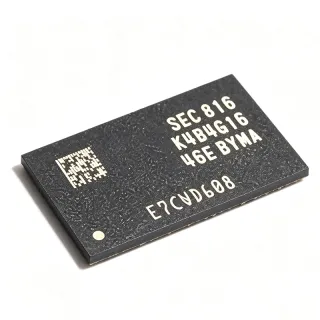
K9MUGY8R4A-CCQ0 - Samsung V-NAND Flash Memory | Samsung Electronics
Référence : K9MUGY8R4A-CCQ0 ✓ Actif| Qté | Prix unitaire | Total |
|---|---|---|
| 1 | $0 | $0,00 |
| 10 | $0 | $0,00 |
| 100 | $0 | $0,00 |
| 500 | $0 | $0,00 |
| 1 000 | $0 | $0,00 |
K9MUGY8R4A-CCQ0 Présentation
NAND flash is a non-volatile memory technology that retains data without power and is organized into pages (the unit of programming and reading) and blocks (the unit of erasure). Within the memory hierarchy, NAND flash sits below DRAM as persistent mass storage and is the dominant storage medium for SSDs, embedded storage, and memory cards. The Samsung K9 series represents Samsung's commodity V-NAND die offerings for OEM storage integration.
Key characteristics of this family include 3-bit-per-cell (triple-level cell, TLC) storage in Samsung's V-NAND process, ONFI-compliant toggle/DDR-style I/O interfaces in the K9 tradition, and power-supply operation in the standard NAND voltage ranges. Precise figures for density, interface speed, program/erase endurance, and supply voltage for this exact orderable part number are not present in the verified data retrieved for this page and are marked accordingly in the specifications table.
Typical applications include enterprise and client SSD controllers, server storage arrays, DVR and surveillance storage, industrial data loggers, and embedded eMMC/UFS-class storage subsystems where high density and low cost per gigabyte are the primary requirements.
A key design consideration with TLC V-NAND is error-rate management: system designers must implement ECC (LDPC), wear leveling, and bad-block management in the host controller, since raw TLC bit error rates are higher than MLC/SLC. Retention and endurance decrease as program/erase cycles accumulate.
This page synthesizes cross-reference data, same-family drop-in alternatives from the Samsung K9xUGY8 family, and sourcing context not found in the manufacturer datasheet alone.
Alternatives de remplacement direct pour K9MUGY8R4A-CCQ0 — même boîtier, compatible broche à broche. Les références à boîtier différent nécessitant une retouche du PCB sont exclues.
Variantes de cette série
Modèles de la même série directement compatibles avec K9MUGY8R4A-CCQ0 (même facteur de forme et même empreinte) — différant par Memory Type, RoHS Status, Cell Type, Product Family, Mounting Type.
Outil de comparaison rapide — sélectionnez des références alternatives pour une comparaison côte à côte :
K9MUGY8R4A-BCQ0
✅ Remplacement direct ⚠️ Spécifications non vérifiées✓ En stock
Contactez-nous pour le prix
Voir la fiche technique →K9LUGY8J7D-CCK0
✅ Remplacement direct ⚠️ Spécifications non vérifiées✓ En stock
Contactez-nous pour le prix
Voir la fiche technique →K9LUGY8J7D-BCK0
✅ Remplacement direct ⚠️ Spécifications non vérifiées✓ En stock
Contactez-nous pour le prix
Voir la fiche technique →K9KUGY8J7C-CCK0
✅ Remplacement direct ⚠️ Spécifications non vérifiées✓ En stock
Contactez-nous pour le prix
Voir la fiche technique →K9KUGY8J7C-BCK0
✅ Remplacement direct ⚠️ Spécifications non vérifiées✓ En stock
$9.55 / unité
Voir la fiche technique →K9MUGY8R4A-CCQ0 Valeurs maximales et caractéristiques électriques
| Manufacturer | Samsung Electronics |
| Product Family | K9 V-NAND (NAND Flash) |
| Memory Technology | V-NAND (vertical NAND flash) |
| Type de montage | Surface Mount |
Guide de configuration des broches du K9MUGY8R4A-CCQ0 standard
Configuration des broches du K9MUGY8R4A-CCQ0 (boîtier standard). Ce circuit intégré numérique comprend des GPIO, des interfaces de communication (UART, SPI, I2C) et des broches d'alimentation. Consultez la fiche technique du fabricant pour les fonctions alternatives des broches et les options de configuration. Indispensable pour la conception de systèmes embarqués et la conception de circuits imprimés.

Aucune donnée de brochage détaillée disponible pour K9MUGY8R4A-CCQ0.
Consultez la fiche technique pour la configuration complète des broches.
Applications typiques
K9MUGY8R4A-CCQ0 convient pour 6 applications: Enterprise SSD Storage, Client SSD and Embedded Storage, Surveillance and DVR Storage, Industrial Data Logging, Networking and Communications Equipment, Aerospace and UAV Data Recorders.
Enterprise SSD Storage
Samsung K9-family V-NAND devices such as K9MUGY8R4A-CCQ0 are core building blocks of enterprise solid-state drives, where high bit density drives cost per gigabyte. The V-NAND vertical-cell architecture delivers the die-level density SSD controllers require when populating multi-terabyte drive platforms. In this role the NAND die interfaces to an SSD controller over the toggle/DDR-style I/O bus, with the controller handling LDPC ECC, wear leveling, and FTL mapping. Designers must match the controller's flash-configuration table to the K9M generation's page and block organization, and budget board area for multiple parallel channels to reach target bandwidth.
Recommandé
Client SSD and Embedded Storage
Client SSDs and embedded storage modules use K9-series V-NAND dies for their balance of density, endurance, and cost. The K9MUGY8R4A-CCQ0 fits client platforms where TLC-class density is preferred over enterprise-optimized endurance, allowing slimmer BOM cost in consumer laptops and desktops. Integration typically places multiple dies in a shared package (multi-die MCP) or on a BGA-footprint module; surface-mount assembly supports standard reflow processes. Performance considerations include configuring the controller for the K9M timing set and verifying thermal envelope, since high-speed toggle I/O under sustained write load raises die temperature and can trigger thermal throttling in thin client enclosures.
Recommandé
Surveillance and DVR Storage
Video surveillance recorders require sustained sequential write throughput and high density at low cost, making Samsung K9-family V-NAND a natural fit. The K9MUGY8R4A-CCQ0 provides the persistent storage layer behind a write-optimized controller that smooths continuous multi-camera video streams into sequential NAND writes. TLC-class V-NAND handles the high write volume with wear-leveling firmware spreading program/erase cycles evenly across blocks. Designers should size endurance headroom to the expected years-of-write workload and implement power-loss protection (capacitor-backed flush) so in-flight pages are committed safely when recorder power is interrupted unexpectedly.
Recommandé
Industrial Data Logging
Industrial loggers and gateways store years of sensor, event, and audit-trail data locally, and K9-series V-NAND gives them gigabyte-to-terabyte capacity on a small surface-mount footprint. The K9MUGY8R4A-CCQ0 is used behind an embedded controller implementing flash translation, ECC, and power-fail recovery. Industrial environments add requirements: extended temperature operation must be confirmed against the datasheet's operating range for this grade suffix, and write endurance must be modeled against the duty cycle of frequent small log writes. Firmware should batch small writes and reserve static over-provisioning to extend usable life in always-on installations.
Recommandé
Networking and Communications Equipment
Routers, switches, and 5G network appliances use NAND flash for firmware images, configuration stores, and logging. Samsung V-NAND dies such as the K9MUGY8R4A-CCQ0 provide the non-volatile layer in these systems, usually paired with NOR flash for boot code and DRAM for runtime buffers. The V-NAND's high density accommodates growing OS images and telemetry logs, while the toggle I/O interface delivers fast image loading at boot. Design considerations include supply-rail sequencing with the system DRAM, EMI-aware routing of the high-speed I/O bus, and dual-bank firmware layouts that keep a validated golden image copy in case an update is interrupted.
Recommandé
Aerospace and UAV Data Recorders
Flight data recorders and UAV mission loggers need maximum capacity per gram and per watt, which drives selection of high-density V-NAND like the K9MUGY8R4A-CCQ0. Multiple dies populate compact recorder boards that capture sensor and telemetry streams, with the storage controller applying strong ECC and interleaved block management to protect data under vibration and radiation-tolerant system constraints. Power budgeting matters: NAND read/write energy per byte is low, but sustained logging on battery-powered UAVs benefits from page-buffer batching and write coalescing. Designers must also verify the commercial-grade suffix's temperature envelope against the mission profile before flight qualification.
Recommandé
Récapitulatif des produits recommandés
Données de référence d'ingénierie pour K9MUGY8R4A-CCQ0 — comparaison, recommandations de conception et informations de conformité.
Guide de sélection
Comparaison avec les alternatives
| Paramètre | Ce produit | K9MUGY8R4A-BCQ0 | K9LUGY8J7D-CCK0 | K9KUGY8J7C-CCK0 |
|---|---|---|---|---|
| Brand | Samsung Electronics | Samsung Electronics | Samsung Electronics | Samsung Electronics |
| Product Generation | K9M generation V-NAND | K9M generation - same | K9L generation | K9K generation |
| Memory Technology | V-NAND (vertical NAND) | V-NAND - same die | V-NAND | V-NAND |
Principaux différenciateurs
- Same-die grade variant availability (vs K9MUGY8R4A-BCQ0)
- V-NAND vertical architecture (vs K9KUGY8J7C-CCK0)
- Generation gap trade-off (vs K9LUGY8J7D-CCK0)
Notes de conception
High-density V-NAND devices use toggle/DDR-style I/O buses whose speeds require careful signal integrity practice: keep DQ and RE#/DQS trace lengths matched within the controller datasheet's skew budget, route the I/O bus on inner layers with solid reference planes, and limit stub lengths when multiple dies share a channel. Series termination on controller outputs and ODT (on-die termination) settings in the NAND configuration registers should be tuned per the Samsung datasheet's signal-integrity section. Verify eye diagrams at maximum rated speed across all channels during bring-up, not just one representative channel.
NAND flash uses separate VCC (core) and VCCQ (I/O) supply rails; both must be within the datasheet range before command sequences are issued, and power sequencing between the rails must follow the Samsung datasheet's power-up requirements to avoid latching issues. Decouple each rail with bulk capacitance plus high-frequency ceramics placed within a few millimeters of each supply pin, since multi-die channels draw transient current bursts during program operations. Implement brown-out detection and a power-fail flush routine in firmware so in-flight pages are recovered after unexpected power loss.
The most common integration failure is controller/NAND configuration mismatch: every Samsung K9 generation has its own page size, block size, timing set (tR, tPROG, tBERS), and ONFI/toggle parameter page. Reusing a K9K or K9L configuration table with a K9M die causes read errors that look like defective flash. Second, never assume a same-family suffix variant is identical - Samsung orderable-code suffixes can encode speed grade, package thickness, or temperature range. Always read the parameter page and validate the exact orderable code against the Samsung ordering-information table before production release.
Informations de conformité
Compliance status was not present in the verified web data retrieved for this part; consult Samsung's official compliance documentation for K9MUGY8R4A-CCQ0.