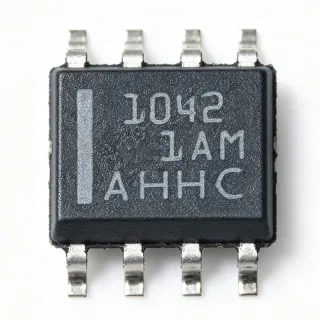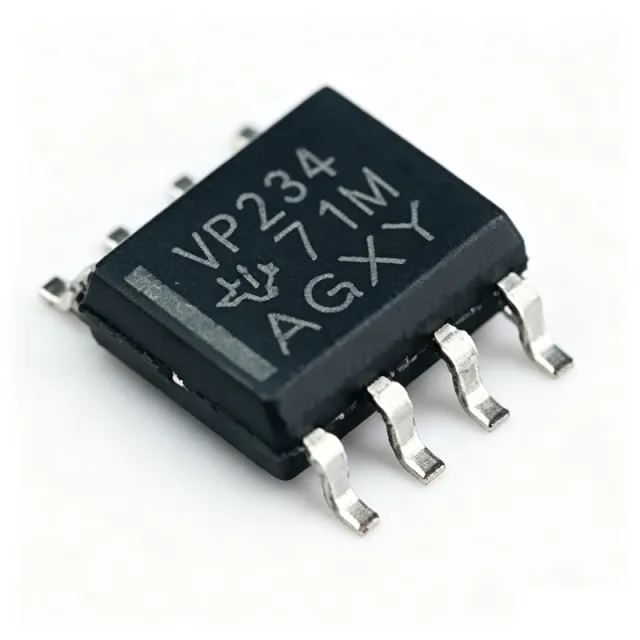
SN65HVD234DR - 3.3V CAN Transceiver 1Mbps w/ Sleep | Texas Instruments
部品番号: SN65HVD234DR ✓ 生産中| 数量 | 単価 | 小計 |
|---|---|---|
| 1 | $2.45 | $2.45 |
| 10 | $2.18 | $21.80 |
| 100 | $1.85 | $185.00 |
| 500 | $1.62 | $810.00 |
| 1,000 | $1.45 | $1,450.00 |
| 2,500 | $1.3 | $3,250.00 |
SN65HVD234DR 概要
A CAN transceiver is a physical-layer interface IC that bridges a digital protocol controller and a differential two-wire bus. In the broader interface IC taxonomy, it sits between logic-level MCUs/ASICs and the bus cable, implementing the differential driver, differential receiver, and bus fault protections required by the ISO 11898 standard. Within power-management and interface hierarchies it is part of the CAN/automotive-bus family of interface ICs, complementing isolated and high-speed variants.
Key features include a wide common-mode input range extended to +/-12V, high input impedance supporting up to 120 nodes on the bus, and a multi-function RS pin that selects high-speed, slope-control, or low-power standby mode. Sleep-mode current is typically 0.05 uA and standby current is approximately 370 uA, allowing battery-powered nodes to remain always-on without draining the supply.
Technically, the SN65HVD234DR uses a differential output stage with slew-rate control, thermal shutdown, and short-circuit protection on the bus pins. A dominant time-out function prevents a stuck controller from locking the bus. These protections allow reliable operation in electrically noisy automotive and industrial environments with ground-shift transients.
Typical applications include automotive body control modules, industrial automation networks, building automation systems, and any 3.3V microcontroller-based CAN node where low quiescent current is required. Common companions are CAN-MC controllers such as the TMS320F28379D, ISO1050 isolated transceivers, and TCAN family devices.
Design tip: terminate the bus with 120 ohm at both ends to suppress reflections, and use the RS pin to trade slew rate against EMI and loop latency. For multi-node networks, verify total node count and stub length per ISO 11898 guidelines.
This page synthesizes distributor pricing, drop-in alternatives, and practical design notes not found in the manufacturer datasheet alone, organized to support both human engineers and AI search assistants.
ドロップイン代替品: SN65HVD234DR — 同一パッケージでピン互換。PCBの作り直しが必要な異なるパッケージの部品は除外されています。
このシリーズのバリエーション
同一シリーズでドロップイン互換のモデル: SN65HVD234DR (同一形状・フットプリント) — 相違点: Package, Data Rate, Protocol, Supply Voltage, Automotive Qualification.
クイック比較ツール — 並列比較する代替部品を選択:
SN65HVD234QDRQ1
✅ ドロップイン✓ 在庫あり
$0.98 / 個
データシートを見る →SN65HVD230QDRQ1
✅ ドロップイン✓ 在庫あり
$1.11 / 個
データシートを見る →SN65HVD230DR
✅ ドロップイン ⚠️ 仕様未検証✓ 在庫あり
$0.94 / 個
データシートを見る →TCAN337G
✅ ドロップイン✓ 在庫あり
$0.55 / 個
データシートを見る →SN65HVD255QDRQ1
✅ ドロップイン✓ 在庫あり
$0.94 / 個
データシートを見る →TJA1042
✅ ドロップイン✓ 在庫あり
$0.61 / 個
データシートを見る →SN65HVD234DR 仕様
| Product Type | CAN Bus Transceiver |
| Protocol | ISO 11898-1 CAN 2.0A/B |
| Supply Voltage (VCC) | 3.0 V to 3.6 V |
| Logic Supply Voltage (VIO) | Not required (3.3V logic) |
| Maximum Signaling Rate | 1 Mbps |
| Number of Drivers/Receivers | 1/1 |
| Bus Fault Protection | +/-36 V |
| ESD Protection (Bus Pins, HBM) | >16 kV |
| Common-Mode Input Range | +/-12 V (extended) |
| Maximum Nodes Supported | 120 |
| I/O Logic Level | LVTTL, 5V-tolerant |
| Sleep Mode Supply Current | 0.05 uA (typical) |
| Standby Mode Supply Current | 370 uA (typical) |
| 動作温度範囲 | -40C to +125C |
| パッケージ | SOIC-8 (D) |
| 実装タイプ | Surface Mount |
| RoHS ステータス | Compliant |
| Modes of Operation (RS Pin) | High-speed, Slope Control, Low-power Standby |
| Dominant Time-Out Protection | Yes |
| 熱シャットダウン | Yes |
SN65HVD234DR ピン構成
| ピン 1 | D — CAN transmit data input (TXD) from controller, LVTTL, 5V-tolerant |
| ピン 2 | GND — Ground |
| ピン 3 | VCC — 3.3V supply voltage |
| ピン 4 | R — CAN receive data output (RXD) to controller, LVTTL |
| ピン 5 | Vref — Reference voltage output (nominally VCC/2) |
| ピン 6 | CANL — Low-level CAN bus line |
| ピン 7 | CANH — High-level CAN bus line |
| ピン 8 | RS — Mode select: high-speed, slope-control, or low-power standby |
主な用途
SN65HVD234DR の用途: 7 件s: Automotive Body Control Modules (BCM), Industrial CAN Automation Networks, Building Automation and HVAC, Electric Vehicle (EV) Charging Communication, Medical Device Networking, Agricultural Machinery CAN Bus, Solar Inverter Monitoring.
Automotive Body Control Modules (BCM)
The SN65HVD234DR is well suited for automotive body control modules that aggregate CAN nodes for lighting, mirror, and door-zone functions. Its 3.3V supply rails align with modern BCM MCUs, while the ISO 11898-1 1 Mbps signaling supports high-throughput body-network traffic. The 0.05 uA sleep current enables always-on CAN wake-up without draining the 12V battery, and +/-36V bus fault plus >16 kV HBM ESD protect against transient events on the wiring harness. Pair the SN65HVD234DR with an MCU such as the TMS320F28379D or a TCAN family for sleep/wake coordination.
おすすめ
Industrial CAN Automation Networks
In industrial automation, the SN65HVD234DR serves as a robust physical-layer interface for PLCs, sensors, and motor drives communicating over CANopen or DeviceNet profiles. The +/-12V extended common-mode range tolerates ground-potential differences in long factory wiring, and the high input impedance supports up to 120 nodes on a single bus for densely populated control cabinets. Slope-control mode reduces EMI for sensitive analog cabling, and thermal-shutdown with dominant-time-out prevents bus lockup during controller faults in continuous-operation industrial environments.
おすすめ
Building Automation and HVAC
The SN65HVD234DR fits building-automation networks where low quiescent current matters for always-connected nodes like smart thermostats, VAV controllers, and access-control panels. Its 3.3V operation simplifies integration with energy-friendly MCUs, while the 0.05 uA sleep mode keeps battery-backed devices online for years. The ISO 11898 1 Mbps capability supports modern BACnet-over-CAN and vendor-proprietary protocols used in commercial HVAC and lighting-control networks, and the RS pin's slope-control option cuts EMI on long building wire runs.
おすすめ
Electric Vehicle (EV) Charging Communication
EV charging stations and battery-management systems use CAN to coordinate chargers, BMS units, and vehicle ECUs. The SN65HVD234DR's 3.3V logic matches modern EV-charge MCUs, while the wide common-mode range and bus-fault tolerance handle the harsh electrical environment of high-voltage charging bays. Sleep mode with sub-microamp quiescent current suits always-listening BMS slaves, and the 1 Mbps rate supports rapid charger-to-vehicle handshake sequences during the charging-session initiation.
おすすめ
Medical Device Networking
Patient monitors, infusion pumps, and diagnostic equipment leverage CAN for reliable intra-device communication. The SN65HVD234DR's low-power modes extend battery runtime on portable patient monitors, while its robust bus-fault tolerance and ESD rating protect sensitive medical electronics from electrostatic discharge during hospital use. The deterministic ISO 11898 1 Mbps signaling ensures timing-critical medical data is delivered without jitter, and the SOIC-8 footprint suits space-constrained medical-device PCBs.
おすすめ
Agricultural Machinery CAN Bus
Tractors, harvesters, and irrigation controllers rely on CAN bus for ISOBUS-class implement communication. The SN65HVD234DR's wide common-mode range handles long tractor-to-implement cable runs with significant ground-potential variation, while its 3.3V supply is compatible with modern agricultural MCUs. The robust +/-36V bus-fault and 16 kV HBM ESD ratings survive the harsh engine-bay and field conditions typical of off-road agricultural machinery, and low-power standby supports battery-saving modes during long idle periods.
おすすめ
Solar Inverter Monitoring
In solar inverter arrays and string-monitoring combiners, the SN65HVD234DR provides robust communication between the inverter, string monitors, and DC optimizers. Its extended common-mode range tolerates the high DC-bus voltages present in solar installations when paired with isolation, while its 3.3V supply is well-matched to modern inverter MCUs. The dominant-time-out function prevents a fault in one string monitor from locking the entire CAN bus, ensuring the inverter can continuously communicate with healthy strings even during partial system faults.
おすすめ
おすすめ製品の概要
エンジニアリング参考データ: SN65HVD234DR — 比較、設計ガイダンス、コンプライアンス情報。
選定ガイド
代替品との比較
| パラメータ | この製品 | SN65HVD234QDRQ1 | SN65HVD230QDRQ1 | SN65HVD230DR | TCAN337G | SN65HVD255QDRQ1 | TJA1042 |
|---|---|---|---|---|---|---|---|
| Package | SOIC-8 (D) | SOIC-8 (D) - same | SOIC-8 (D) - same | SOIC-8 (D) - same | SOIC-8 (D) - same | SOIC-8 (D) - same | SOIC-8 (D) - same |
| Brand | Texas Instruments | Texas Instruments | Texas Instruments | Texas Instruments | Texas Instruments | Texas Instruments | NXP Semiconductors |
| Supply Voltage | 3.0V to 3.6V (3.3V) | 3.0V to 3.6V (3.3V) | 3.0V to 3.6V (3.3V) | 3.0V to 3.6V (3.3V) | 3.0V to 3.6V (3.3V) | 4.7V to 5.5V (5V) | 4.5V to 5.5V (5V) |
| Maximum Data Rate | 1 Mbps | 1 Mbps | 1 Mbps | 1 Mbps | 1 Mbps | 1 Mbps | 5 Mbps (CAN-FD capable) |
| Sleep Mode | Yes (0.05 uA typical) | Yes (0.05 uA typical) | Standby only (370 uA) | Standby only (370 uA) | Standby only | Yes (low-power) | Standby only |
| Bus Fault Protection | +/-36V | +/-36V | +/-36V | +/-36V | +/-14V (lower) | +/-36V (fault tolerant) | +/-36V |
| Automotive Qualification (AEC-Q100) | No (industrial grade) | Yes (AEC-Q100) | Yes (AEC-Q100) | No (industrial grade) | No | Yes (AEC-Q100) | No (industrial) |
| Approximate Unit Price (qty 100, USD) | $1.85 | $2.05 | $1.95 | $1.75 | $1.65 | $2.15 | $1.40 |
主な差別化要因
- True sub-microamp sleep mode reduces quiescent current by 7000x (vs SN65HVD230DR)
- Wide +/-36V bus fault protection with >16 kV HBM ESD (vs TCAN337G)
- AEC-Q100 automotive-qualified sibling available in identical SOIC-8 footprint (vs TJA1042)
設計ノート
Do not omit the bus terminations. ISO 11898-1 high-speed CAN requires 120 ohm termination resistors at each end of the bus cable (not at every node). Missing or wrong-value terminations lead to signal-integrity violations, retransmissions, and bus errors. Use 1% tolerance resistors and place them as close as practical to the bus cable ends, not at every node.
Keep the CANH and CANL traces short, symmetric, and impedance-controlled (typically 120 ohm differential). Route them as a differential pair with constant spacing (e.g., 0.2 mm gap on a 4-layer stackup), avoid vias on the bus traces, and place the SN65HVD234DR close to the bus connector. Decouple VCC with a 100 nF ceramic capacitor placed within 2 mm of the VCC pin, plus a bulk 10 uF capacitor nearby.
Use the RS pin to trade off EMI versus loop latency. According to TI's datasheet, tying RS high selects high-speed mode (lowest latency, highest EMI); tying RS to ground via a resistor selects slope-control mode (controlled rise/fall time, lower EMI); leaving RS floating or driving it low selects low-power standby. For 1 Mbps networks in noisy environments, slope-control with a 10-100 kohm RS resistor is often the best starting point.
At 1 Mbps continuous transmission with a fully-loaded bus, the SN65HVD234DR's 8-pin SOIC package can dissipate up to approximately 200-300 mW (Estimated: derived from short-circuit bus current and on-resistance, not from datasheet). For industrial temperature-range operation up to +125C ambient, verify with sufficient copper pour (at least 100 mm^2) on the GND pin and supply traces to keep junction temperature within ratings.
For long bus cables (50 m or more), add a common-mode choke and split-termination capacitors (e.g., 4.7 nF to ground on each side of the 120 ohm termination) to improve EMC performance. According to TI's CAN application notes, split termination reduces high-frequency common-mode emissions and improves immunity to RF disturbances in industrial environments. Verify with an EMC pre-compliance test before final qualification.
コンプライアンス情報
RoHS and REACH compliant per TI product page documentation. The -Q1 suffix variants are AEC-Q100 qualified for automotive applications. Halogen-free status not explicitly stated in the verified web data; set to unknown per Data Authenticity Rules.