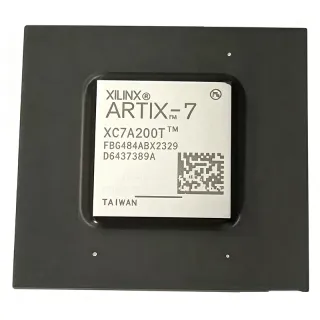
EPF81500ARC240-2 - 16K Gates 240-Pin FPGA | Intel / Altera
MPN: EPF81500ARC240-2 ✗ End of Life| Qty | Unit Price | Extended |
|---|---|---|
| 1 | $95 | $95.00 |
| 10 | $85.5 | $855.00 |
| 100 | $76 | $7,600.00 |
| 500 | $68.4 | $34,200.00 |
| 1,000 | $61.75 | $61,750.00 |
EPF81500ARC240-2 Overview
What is an FPGA? An FPGA (Field-Programmable Gate Array) is a type of integrated circuit whose logic function is defined by the customer after manufacturing rather than at the foundry. FPGAs sit within the broader category of programmable logic devices (PLDs), alongside CPLDs, and occupy the role of high-density, fine-grained, SRAM- or antifuse-based reconfigurable logic between discrete glue logic and a fully custom ASIC. The FLEX 8000 family belongs to the early-1990s generation of SRAM-based CMOS FPGAs that pioneered in-circuit reconfigurability for telecommunications, industrial control, and glue-logic consolidation.
Key features include in-circuit reconfigurability (ICR) via external configuration devices or intelligent controllers, support for Altera's MAX+PLUS II development environment, VHDL and Verilog HDL design entry, and integrated synthesis, simulation, and timing analysis tooling. The part supports the 5 V I/O standard typical of its era and provides a high ratio of registers to combinatorial logic that makes it well suited to state-machine and pipeline applications.
The 240-pin RQFP Exposed Pad package provides a large pin count sufficient for 181 user I/Os while remaining compatible with conventional surface-mount assembly. The exposed pad enhances thermal performance for sustained operation in industrial enclosures with moderate airflow.
Typical applications include telecommunications line-card glue logic, industrial control and instrumentation, legacy peripheral interfaces, bus bridges, and state-machine controllers. Engineers typically select the EPF81500ARC240-2 when maintaining or replicating a long-lifecycle 5 V system where the FLEX 8000 toolchain is already qualified.
When designing with this part, note that the FLEX 8000 family is mature and approaching end-of-life; verify long-term availability with Intel / Altera authorized distributors and plan a migration path to a Cyclone-class device for new designs.
This page synthesizes distributor pricing, drop-in family alternatives, lifecycle status, and design considerations not found in any single manufacturer datasheet.
Drop-in alternatives for EPF81500ARC240-2 — same package, pin-to-pin compatible. Different-package parts requiring PCB rework are excluded.
Variants in this series
Same-series models that are drop-in compatible with EPF81500ARC240-2 (same form factor and footprint) — differing in Package, Configuration Method, Process Technology, In-Circuit Reconfigurability, Logic Elements / Cells.
Quick Comparison Tool — Select alternative parts for side-by-side comparison:
EPF81500ARC240-4
✅ Drop-In✓ In Stock
$19.75 / Unit
View Datasheet →EPF81500AQC240-2
✅ Drop-In✓ In Stock
$61.4 / Unit
View Datasheet →EPF81500AQC240-2N
✅ Drop-In✓ In Stock
$18.95 / Unit
View Datasheet →EPF81500AQC240-3
✅ Drop-In✓ In Stock
$21.75 / Unit
View Datasheet →EPF81500AQC240-4
✅ Drop-In✓ In Stock
$18.25 / Unit
View Datasheet →EPF81188ARC240-2
✅ Drop-In✓ In Stock
$178.34 / Unit
View Datasheet →EPF81500ARC240-2 Maximum Ratings & Electrical Characteristics
| Family | FLEX 8000 |
| Usable Gates | 16,000 |
| Logic Elements / Cells | 1,296 |
| Registers | 1,500 |
| Number of User I/O | 181 |
| Operating Frequency (max) | 125 MHz |
| Process Technology | 0.42 µm CMOS |
| Supply Voltage | 5 V |
| Operating Temperature | 0 °C to 70 °C (TA) |
| Package | 240-BFQFP Exposed Pad (240-RQFP) |
| Mounting Type | Surface Mount |
| In-Circuit Reconfigurability | Yes (via external configuration device) |
| Design Tool Support | MAX+PLUS II (VHDL, Verilog, AHDL, waveform) |
| Lifecycle Status | Obsolete |
| Configuration Method | External serial / parallel configuration device |
EPF81500ARC240-2 240-bfqfp exposed pad (240-rqfp) Pin Configuration Guide
Pin configuration for EPF81500ARC240-2 (240-bfqfp exposed pad (240-rqfp) package). This digital IC includes GPIO, communication interfaces (UART, SPI, I2C), and power pins. Refer to the manufacturer datasheet for alternate pin functions and configuration options. Essential for embedded system design and PCB layout.

No detailed pinout data available for EPF81500ARC240-2.
Refer to the datasheet for full pin configuration.
Typical Applications
EPF81500ARC240-2 is suitable for 6 applications: Telecommunications Line-Card Glue Logic, Industrial Control & Instrumentation, Legacy Peripheral Bus Bridges, State-Machine Controllers, 5 V System Maintenance & Replication, Prototype & Education Platforms.
Telecommunications Line-Card Glue Logic
The EPF81500ARC240-2 fits telecommunications line-card glue logic because its 16,000 usable gates and 181 user I/Os provide the density and pin count needed to consolidate address decoding, bus arbitration, timing-and-control state machines, and protocol-adaptation functions that previously required multiple 74-series discrete parts. Operating from a 5 V supply, it integrates directly with legacy TTL backplane logic without level translation, and the 125 MHz internal frequency comfortably handles 155 MHz telecom tributaries when implemented as parallel datapath blocks. Engineers typically program the device via JTAG after board assembly to update logic without removing the card from the chassis, using the in-circuit reconfigurability that first made the FLEX 8000 family popular for service-provider infrastructure.
Recommended
Industrial Control & Instrumentation
For industrial control and instrumentation, the EPF81500ARC240-2 delivers the register-rich architecture needed for high-state-count ladder-logic replacement, PID controller implementations, and parallel data-acquisition sequencers. Its 1,500 registers per device support large shift-register and pipeline structures for sample-and-hold timing, while the 181 I/Os accept 5 V CMOS sensor inputs directly without external buffering. The 0 °C to 70 °C commercial operating range covers factory-floor enclosures, and the exposed thermal pad of the 240-BFQFP package allows sustained operation inside sealed instrumentation cabinets. Combined with MAX+PLUS II's VHDL synthesis, designers can migrate legacy PLC ladder diagrams into a single reconfigurable device.
Recommended
Legacy Peripheral Bus Bridges
The EPF81500ARC240-2 is widely deployed as a legacy peripheral bus bridge, particularly for ISA-to-local-bus, VME-to-PCI, and proprietary backplane adapters common in long-lifecycle embedded systems. Its 5 V TTL-compatible I/Os interface directly to classic peripheral interfaces without external transceivers, and 16,000 gates are sufficient to implement bidirectional FIFOs, address-decoding logic, interrupt controllers, and DMA state machines in a single chip. The exposed-pad RQFP package provides the thermal headroom required for continuous backplane operation, and JTAG-based in-system programming enables late-stage firmware updates without removing the host card from the chassis.
Recommended
State-Machine Controllers
For complex state-machine controllers, the EPF81500ARC240-2's register-rich architecture (1,500 registers) provides the flip-flop density to implement deep Mealy/Moore machines with hundreds of states. Applications include motor-control sequencers, traffic-management arbiters, multi-phase clock generators, and protocol handlers (HDLC, UART with FIFO) where the high register-to-logic ratio reduces reliance on external register banks. The 125 MHz maximum internal frequency supports 50-80 MHz state-machine clocks, and the 181 I/Os accommodate wide control-word buses plus dedicated interrupt, ready, and handshake signals needed in deterministic real-time loops.
Recommended
5 V System Maintenance & Replication
The EPF81500ARC240-2 is the canonical choice for maintaining and replicating long-lifecycle 5 V systems originally designed around the FLEX 8000 family. Industrial, defense, and medical OEMs with installed bases still rely on the part's exact electrical behavior to ensure firmware compatibility with fielded equipment. The 240-BFQFP Exposed Pad footprint allows drop-in PCB replacement of failed units using current distributor stock, and the MAX+PLUS II toolchain remains compatible with original design files. The exposed thermal pad maintains the same junction-to-ambient thermal resistance as the original design, eliminating the need for re-qualification.
Recommended
Prototype & Education Platforms
Universities and FPGA-training labs still reference the EPF81500ARC240-2 because the FLEX 8000 architecture illustrates classic SRAM-based FPGA concepts (logic elements, interconnect, I/O cells, configuration memory) without the abstraction layers of modern SoC FPGAs. The 16K-gate density is sufficient for textbook labs covering UART, VGA, simple CPUs, and bus interfaces, and the 181 I/Os expose students to real-world QFP pin-pitch soldering. The MAX+PLUS II toolchain provides a free, well-documented flow that runs on legacy PCs, making it ideal for educators who need a stable, supported platform with abundant community examples.
Recommended
Recommended Products Summary
Engineering reference data for EPF81500ARC240-2 — comparison, design guidance, and compliance information.
Selection Guide
Comparison with Alternatives
| Parameter | This Product | EPF81500ARC240-4 | EPF81500AQC240-2 | EPF81500AQC240-2N | EPF81500AQC240-3 | EPF81500AQC240-4 | EPF81188ARC240-2 |
|---|---|---|---|---|---|---|---|
| Brand | Altera (Intel) | Altera (Intel) | Altera (Intel) | Altera (Intel) | Altera (Intel) | Altera (Intel) | Altera (Intel) |
| Package | 240-BFQFP Exposed Pad | 240-BFQFP Exposed Pad | 240-pin PQFP (no exposed pad) | 240-pin PQFP (no exposed pad) | 240-pin PQFP (no exposed pad) | 240-pin PQFP (no exposed pad) | 240-BFQFP Exposed Pad |
| Family | FLEX 8000 | FLEX 8000 | FLEX 8000 | FLEX 8000 | FLEX 8000 | FLEX 8000 | FLEX 8000 |
| Speed Grade | -2 | -4 | -2 | -2 | -3 | -4 | -2 |
| User I/O | 181 | 181 | 181 | 181 | 181 | 181 | 181 |
| Supply Voltage | 5 V | 5 V | 5 V | 5 V | 5 V | 5 V | 5 V |
| Lifecycle | Obsolete | Obsolete | Obsolete | Obsolete | Obsolete | Obsolete | Obsolete |
Key Differentiators
- Exposed thermal pad for enhanced heat dissipation (vs EPF81500AQC240-2)
- Pin-compatible with EPF81500AQC240-2 for electrical substitution (vs EPF81500AQC240-2N)
- Higher gate density than EPF81188 family (vs EPF81188ARC240-2)
Design Notes
The 240-BFQFP Exposed Pad package provides a direct thermal path from the die to the PCB copper pour through the exposed die-pad on the underside of the package. Per the FLEX 8000 datasheet family specification, designers must solder the exposed pad to a continuous copper pour of at least 1 square inch to achieve the rated junction-to-ambient thermal resistance. For sealed enclosures with limited airflow, additional copper pours on inner PCB layers connected via thermal vias directly under the exposed pad are recommended to keep junction temperature below 100 °C during sustained operation.
The EPF81500ARC240-2 requires a stable 5 V supply with bulk decoupling (≥ 100 µF tantalum or aluminum polymer) plus 0.1 µF ceramic decoupling at every VCC pin. Per the FLEX 8000 reference design, all VCC and GND pins must be connected even if the internal logic for a given I/O bank is unused, because floating supply pins can cause intermittent configuration failures. Inrush current during configuration can exceed steady-state ICC by 30-50%, so the regulator must have adequate headroom and the bulk capacitor must hold VCC within ±5% during configuration.
The most common EPF81500ARC240-2 design pitfalls include: (1) leaving JTAG TCK floating, which causes unreliable configuration - always pull TCK to a defined logic level; (2) using the wrong configuration scheme (the FLEX 8000 supports multiple modes including passive serial, passive parallel synchronous, passive parallel asynchronous, and JTAG - mixing them up renders the device unconfigurable); (3) ignoring the nCONFIG and nSTATUS handshake, which must be monitored by the host controller for reliable multi-device configuration chains. Always re-read the FLEX 8000 datasheet configuration chapter before laying out a new board.
For 240-BFQFP layout, use 0.5 mm pitch or 0.4 mm pitch land patterns per JEDEC MS-022, and ensure all four corner pins are mechanically anchored with through-hole vias or large pads. Route all differential clocks (CLK0/CLK1) with controlled impedance and length-matching, and keep the global clock distribution traces on the top layer directly above a solid ground plane. Per Altera reference designs, expose the JTAG chain on a header for in-system programming and boundary-scan test, which significantly accelerates board bring-up and field-service diagnostics.
Compliance Information
The EPF81500ARC240-2 is a legacy product released before RoHS-era compliance mandates; the lead-free AQC240-2N variant is the RoHS-compliant alternative. AEC-Q100 is not applicable because the part targets commercial 0 °C to 70 °C operation and is not automotive-qualified.