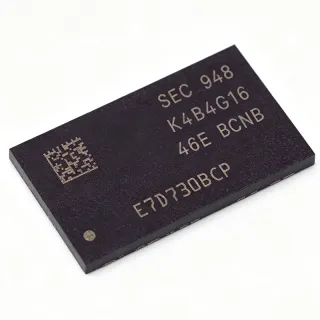
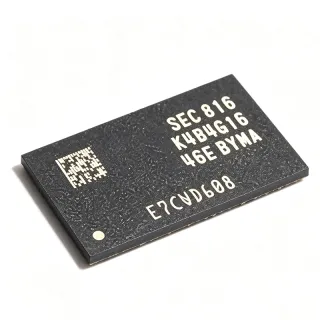
KLM8G1GEUF-B04Q057 - 8GB Automotive eMMC 5.1 | Samsung
MPN: KLM8G1GEUF-B04Q057 ✓ Active| Qty | Unit Price | Extended |
|---|---|---|
| 1 | $41.47 | $41.47 |
| 10 | $41.06 | $410.60 |
| 100 | $40.55 | $4,055.00 |
| 500 | $40.05 | $20,025.00 |
| 1,000 | $39.58 | $39,580.00 |
KLM8G1GEUF-B04Q057 Overview
An eMMC (embedded MultiMediaCard) is a managed NAND flash storage device that bundles raw NAND flash die together with a dedicated flash controller in a single ball-grid-array package. The controller manages wear leveling, bad-block management, error correction code (ECC), and the standardized JEDEC eMMC command interface, so the host processor sees a simple block-addressable storage peripheral rather than raw NAND. In the system hierarchy, eMMC sits between raw NAND flash and full SSDs, providing plug-and-play storage for embedded and mobile platforms.
Key features of the KLM8G1GEUF-B04Q057 include 8GB of storage capacity, the eMMC 5.1 (JEDEC JESD84-B51 class) interface with HS400 mode supporting 200 MHz double-data-rate signaling for high sequential throughput, an automotive operating temperature range of -40C to +105C, and a dual 1.8V/3.3V power supply configuration. Samsung positions its e.MMC family as the definitive choice for flash storage in slim mobile and automotive display designs, citing superior power efficiency and fast speed.
The device uses 64Gb MLC NAND die, stacked within the 153-ball FBGA footprint. Because the controller abstracts NAND management, firmware and host driver integration follow the standard eMMC driver model available in Linux, Android, and RTOS environments, reducing design risk compared with raw NAND solutions. The automotive qualification of the -B04Q grade family makes it suitable for infotainment and cluster platforms subject to elevated thermal stress.
Typical applications include automotive center-information displays and infotainment head units, telematics control units, and industrial/embedded systems requiring managed, bootable flash storage in a compact surface-mount footprint.
A key design consideration is power-rail sequencing: e.MMC devices require defined VCC/VCCQ ramp relationships, and the host must implement proper eMMC bus initialization and HS400 re-training after resume to sustain peak throughput.
This page synthesizes distributor pricing, drop-in alternatives, and practical design notes not found in the manufacturer datasheet.
Drop-in alternatives for KLM8G1GEUF-B04Q057 — same package, pin-to-pin compatible. Different-package parts requiring PCB rework are excluded.
Variants in this series
Same-series models that are drop-in compatible with KLM8G1GEUF-B04Q057 (same form factor and footprint) — differing in Package, Memory Type, Mounting Type, Interface Standard, Max Interface Mode.
Quick Comparison Tool — Select alternative parts for side-by-side comparison:
KLM8G1GEUF-B04Q
✅ Drop-In📋 Reference alternative (not in catalog)
KLM8G1GETF-B041
✅ Drop-In✓ In Stock
$22.02 / Unit
View Datasheet →KLM4G1FETE-B041
✅ Drop-In✓ In Stock
$6.5625 / Unit
View Datasheet →THGBMAG8B4JBAIR
✅ Drop-In📋 Reference alternative (not in catalog)
MTFC8GAKAJCN-4M IT
✅ Drop-In📋 Reference alternative (not in catalog)
SDIN8DE4-8G
✅ Drop-In📋 Reference alternative (not in catalog)
KLM8G1GEUF-B04Q057 Maximum Ratings & Electrical Characteristics
| Memory Type | eMMC (embedded MultiMediaCard) |
| Interface Standard | eMMC 5.1 |
| Capacity | 8 GB |
| NAND Type | MLC (64Gb die) |
| Max Interface Mode | HS400 (200 MHz DDR) |
| Supply Voltage | 1.8 V / 3.3 V (VCCQ / VCC) |
| Operating Temperature | -40C to +105C |
| Grade | Automotive |
| Package | 153-ball FBGA |
| Mounting Type | Surface Mount |
| RoHS Status | Compliant (per JLCPCB listing: ROHS) |
KLM8G1GEUF-B04Q057 153-ball fbga Pin Configuration Guide
Pin configuration for KLM8G1GEUF-B04Q057 (153-ball fbga package). This digital IC includes GPIO, communication interfaces (UART, SPI, I2C), and power pins. Refer to the manufacturer datasheet for alternate pin functions and configuration options. Essential for embedded system design and PCB layout.

No detailed pinout data available for KLM8G1GEUF-B04Q057.
Refer to the datasheet for full pin configuration.
Typical Applications
KLM8G1GEUF-B04Q057 is suitable for 6 applications: Automotive Center Information Displays, Infotainment Head Units, Telematics Control Units, Industrial HMI and Edge Gateways, Digital Cluster Instrumentation, Portable and Slim Embedded Devices.
Automotive Center Information Displays
The KLM8G1GEUF-B04Q057 fits automotive center-information-display (CID) platforms directly: its 8GB capacity stores the QNX/Android bootloader, graphics assets, and map data, while e.MMC 5.1 HS400 mode at 200 MHz DDR supplies the sequential read bandwidth needed for fast boot animation and UI loading. The -40C to +105C operating range covers dashboard thermal environments exposed to solar load, and the automotive grade targets the reliability expectations of tier-1 display programs. The device is soldered as a managed storage peripheral behind the SoC's e.MMC controller; the practical consideration is boot-time optimization, where partition placement on the e.MMC and HS400 bus re-training after warm resume determine cold-boot and resume latency. Sourcing case studies document this exact part number used in automotive display production, making it a reference design anchor for new CID programs.
Recommended
Infotainment Head Units
In IVI (in-vehicle infotainment) head units, the KLM8G1GEUF-B04Q057 serves as boot and application storage for the infotainment SoC. Its 8GB MLC-based e.MMC holds the OS image, navigation database, and media caches, while the e.MMC 5.1 interface's HS400 mode keeps application launch times acceptable. The automotive temperature range of -40C to +105C is essential in head units mounted near the heater core or in the instrument stack, and Samsung's managed controller removes the need for a custom flash translation layer, shrinking software validation scope. Designers should enable the e.MMC's internal boot partitions for the bootloader and configure read-retry/vendor-specific tuning through EXT_CSD registers. A trade-off to plan for is write endurance under logging workloads - MLC e.MMC suits code and media storage better than high-write telematics data logging.
Recommended
Telematics Control Units
The KLM8G1GEUF-B04Q057 provides firmware and data storage for telematics control units (TCUs) that manage 4G/5G modems, eCall, and fleet connectivity. The 8GB capacity accommodates a dual-bank firmware scheme (A/B OTA updates), which the e.MMC's hardware partitioning (boot partitions 1/2, user area, enhanced partitions) supports natively. Automotive -40C to +105C operation matches TCU mounting locations near the vehicle exterior or A-pillar, and the standardized JEDEC e.MMC interface works with automotive SoCs from NXP, TI, and Renesas without custom drivers. Design consideration: TCUs write cellular logs continuously, so enable the controller's wear-leveling health monitoring (EXT_CSD life-time estimation fields) and budget capacity headroom to maximize MLC endurance and field reliability over the vehicle's 10-15 year life.
Recommended
Industrial HMI and Edge Gateways
Industrial human-machine-interface panels and IIoT edge gateways use the KLM8G1GEUF-B04Q057 as boot and storage media for Linux-based systems. The 8GB e.MMC hosts the OS, container images, and local historians, while e.MMC 5.1 HS400 delivers the throughput needed for container startup and log flushing. Although the part is automotive-graded, its -40C to +105C range exceeds typical industrial requirements, providing derating margin in sealed panels without forced airflow. Because e.MMC is a managed device, integrators avoid raw-NAND FTL maintenance across multi-year deployments. A practical tip is to reserve an enhanced-strobe configuration for HS400 stability in electrically noisy factory environments and to use the device's WRITE_PROTECT features to lock the OS partition against field corruption.
Recommended
Digital Cluster Instrumentation
Digital instrument clusters require boot storage that starts reliably across the full automotive temperature envelope - the KLM8G1GEUF-B04Q057's -40C to +105C rating and Samsung automotive-grade qualification address this directly. Its 8GB capacity stores the graphics stack, fonts, and animation assets for GPU-rendered cluster UIs, and HS400 (200 MHz DDR) minimizes cold-boot time, a regulatory and user-experience metric where the cluster must render telltales within seconds of ignition. The e.MMC's boot partitions allow redundant bootloader banks for fail-safe updates, important given the cluster's safety relevance. Design consideration: cluster SoCs typically drive the e.MMC through a dedicated SDIO/e.MMC controller; ensure the reference clock plan supports the HS400 data strobe routing with matched trace lengths to avoid signal integrity issues at 200 MHz.
Recommended
Portable and Slim Embedded Devices
Samsung positions its e.MMC family as the definitive choice for flash storage in slim mobile designs, and the 153-ball FBGA KLM8G1GEUF-B04Q057 exemplifies this: the package is only ~1.0 mm thick and soldered directly to the PCB, saving height versus socketed cards and improving vibration robustness. In portable test equipment, medical handhelds, and smart terminals, the 8GB capacity covers OS plus application data, and the e.MMC 5.1 interface is supported natively by common application processors (NXP i.MX, TI Sitara, Rockchip). Power efficiency highlighted by Samsung reduces battery drain during sustained read workloads. Design consideration: layout the VCC (3.3V) and VCCQ (1.8V) rails with dedicated decoupling at each ball group and follow the datasheet power-up sequencing so the device initializes cleanly into e.MMC 5.1 mode.
Recommended
Recommended Products Summary
Engineering reference data for KLM8G1GEUF-B04Q057 — comparison, design guidance, and compliance information.
Selection Guide
Comparison with Alternatives
| Parameter | This Product | KLM8G1GEUF-B04Q | KLM8G1GETF-B041 | THGBMAG8B4JBAIR | MTFC8GAKAJCN-4M IT | SDIN8DE4-8G |
|---|---|---|---|---|---|---|
| Package | 153-ball FBGA | 153-ball FBGA - same | 153-ball FBGA family variant | 153-ball FBGA | 153-ball FBGA | 153-ball FBGA |
| Brand | Samsung Electronics | Samsung Electronics | Samsung Electronics | Toshiba (Kioxia) | Micron Technology | Western Digital / SanDisk |
| Capacity | 8 GB | 8 GB | 8 GB | 8 GB | 8 GB | 8 GB |
Key Differentiators
- True automotive temperature grade (vs MTFC8GAKAJCN-4M IT)
- Identical-die second source within Samsung (vs KLM8G1GEUF-B04Q)
- eMMC 5.1 HS400 performance with managed NAND simplicity (vs THGBMAG8B4JBAIR)
Design Notes
The KLM8G1GEUF-B04Q057 uses two supply rails: VCC (flash core, nominally 3.3V) and VCCQ (interface, nominally 1.8V). Follow the Samsung datasheet power-ramp requirements for both rails and avoid back-powering through the host's DAT/CMD lines during host power-down - add series resistors or ensure the SoC pins are high-impedance when its rail collapses before VCC/VCCQ. Decouple each rail group with 100 nF ceramics at the ball vias plus 10 uF bulk per rail. Estimated: at HS400 signaling, VCCQ dynamic current is on the order of tens of mA, so rail droop during burst reads must stay within the datasheet tolerance.
HS400 mode runs the data bus at 200 MHz DDR with a dedicated data strobe (DS) ball, so treat the DAT[7:0], DS, and CLK nets as a high-speed bus: match trace lengths within the datasheet skew budget, keep stubs under 2 mm, and route over a continuous reference plane. For HS400 operation the DS line is driven by the device and used by the host for sampling - incorrect DS routing is the most common cause of HS400 training failures. If timing margin is tight, the e.MMC 5.1 enhanced strobe and debug-tuning EXT_CSD fields allow post-silicon window optimization during driver bring-up.
Do not assume cross-vendor e.MMC interchangeability without host re-validation: EXT_CSD register defaults, boot partition sizing, and cache behavior differ between Samsung, Kioxia/Toshiba, Micron, and SanDisk parts even when the 153-ball ball map is JEDEC-standard. Additionally, MLC endurance is finite - avoid placing high-write logs (telematics logs, historian data) on the e.MMC without enabling the life-time estimation EXT_CSD fields in your monitoring stack, and keep 10-20% of the user area unpartitioned so wear leveling has headroom.
Compliance Information
RoHS compliant per JLCPCB part listing (C53199954). Automotive-grade family per Samsung KLM8G1GEUF-B04Q datasheet metadata (datasheet4u); icallin.com case study describes this part as AEC-Q100 verified Samsung memory. REACH and halogen-free status: obtain official Samsung material declarations.