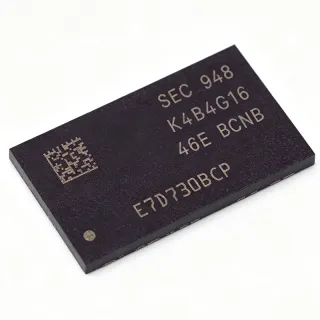
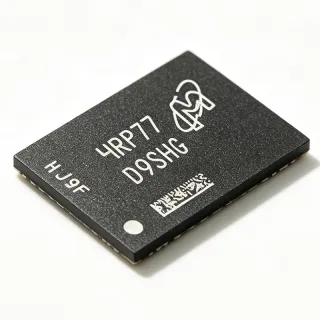
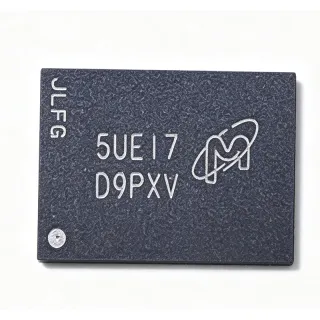
MT53B128M32D1NP-062 - 4Gbit LPDDR4 SDRAM 1.6GHz | Micron
MPN: MT53B128M32D1NP-062 ✓ Active| Qty | Unit Price | Extended |
|---|---|---|
| 1 | $7.73 | $7.73 |
| 10 | $7.27 | $72.70 |
| 100 | $6.85 | $685.00 |
| 500 | $6.45 | $3,225.00 |
| 1,000 | $6.05 | $6,050.00 |
MT53B128M32D1NP-062 Overview
LPDDR4 (Low Power Double Data Rate 4) SDRAM is a member of the JEDEC-defined DDR SDRAM family optimized for mobile and power-sensitive embedded systems. Compared with DDR3L or DDR4, LPDDR4 achieves higher bandwidth per watt by lowering the core supply voltage to 1.1V and using a point-to-point channel architecture. In the memory hierarchy it sits under DRAM -> synchronous DRAM -> mobile SDRAM, and it is the dominant main-memory technology in smartphones, tablets, automotive infotainment, and edge AI platforms.
Key features of this device include 4 Gbit density in a single 32-bit channel organization (128M x 32), 1.6 GHz operation (3200 MT/s data rate class), a low 1.1V core supply, and extended industrial or automotive temperature variants (the AUT:A grade is specified from -40C to +125C TC and qualified to AEC-Q100). The -062 speed grade defines the maximum clock frequency of the part. The WFBGA package uses a ball grid array for improved signal integrity and thermal performance relative to wire-bonded alternatives.
Technically, the MT53B128M32D1NP family integrates Micron's LPDDR4 core with bank-group architecture, enabling fast random row access and efficient burst interleaving. Low-power features such as partial-array self-refresh, deep power-down, and per-bank refresh reduce standby current, which directly extends battery life in portable designs. The 32-bit single-die organization simplifies controller mapping for mid-density systems that do not require a full 64-bit dual-die configuration.
Typical applications include automotive infotainment and instrument cluster memory, industrial human-machine interfaces, edge AI accelerators, networking line cards, and embedded vision systems where 4 Gbit of bandwidth-efficient DRAM is sufficient.
When designing with this device, ensure your memory controller supports the JEDEC LPDDR4 protocol, and account for trace-length matching and termination on the high-speed data bus to meet signal-integrity requirements at 1.6 GHz operation.
This page synthesizes distributor pricing, drop-in alternatives, and practical design notes not found in the manufacturer datasheet, with data verified as of 2026-09-02.
Drop-in alternatives for MT53B128M32D1NP-062 — same package, pin-to-pin compatible. Different-package parts requiring PCB rework are excluded.
Variants in this series
Same-series models that are drop-in compatible with MT53B128M32D1NP-062 (same form factor and footprint) — differing in Clock Frequency, Interface, Memory Type, Package, Speed Grade.
Quick Comparison Tool — Select alternative parts for side-by-side comparison:
MT53B128M32D1DS-062
✅ Drop-In✓ In Stock
$5.45 / Unit
View Datasheet →MT53B128M32D1DS-053 AUT:A
✅ Drop-In✓ In Stock
Contact for price
View Datasheet →MT53B128M32D1NP-062 AUT:A
✅ Drop-In📋 Reference alternative (not in catalog)
MT53B128M32D1NP-062 AAT:A
✅ Drop-In📋 Reference alternative (not in catalog)
MT53B128M32D1NP-062 AIT:A
✅ Drop-In📋 Reference alternative (not in catalog)
MT53B128M32D1NP-062 Maximum Ratings & Electrical Characteristics
| Memory Type | Mobile LPDDR4 SDRAM |
| Density | 4 Gbit |
| Organization | 128M x 32 |
| Clock Frequency | 1.6 GHz |
| Supply Voltage (VDD) | 1.1 V |
| Package | 200-WFBGA (10 x 14.5 mm) |
| Mounting Type | Surface Mount |
| Interface | JEDEC LPDDR4 |
| Speed Grade | -062 |
| Operating Temperature (AUT:A variant) | -40C to +125C (TC) |
| Operating Temperature (AAT:A variant) | -40C to +105C (TC) |
| Automotive Qualification (AUT:A variant) | AEC-Q100 |
| Packaging | Tape & Reel (TR variants) |
MT53B128M32D1NP-062 200-wfbga (10 x 14.5 mm) Pin Configuration Guide
Pin configuration for MT53B128M32D1NP-062 (200-wfbga (10 x 14.5 mm) package). This digital IC includes GPIO, communication interfaces (UART, SPI, I2C), and power pins. Refer to the manufacturer datasheet for alternate pin functions and configuration options. Essential for embedded system design and PCB layout.

No detailed pinout data available for MT53B128M32D1NP-062.
Refer to the datasheet for full pin configuration.
Typical Applications
MT53B128M32D1NP-062 is suitable for 6 applications: Automotive Infotainment and Instrument Cluster, Industrial HMI and Edge Computing, Edge AI Vision Systems, Mobile and Portable Devices, Networking and Communications Equipment, Medical Diagnostic Equipment.
Automotive Infotainment and Instrument Cluster
The MT53B128M32D1NP-062 AUT:A variant fits automotive infotainment head units and digital instrument clusters because it is AEC-Q100 qualified and rated from -40C to +125C (TC), surviving under-dash thermal extremes that exceed consumer DRAM limits. Its 4 Gbit density in 128M x 32 organization provides sufficient buffering for navigation map tiles, media streams, and cluster frame buffers, while the 1.1V core supply reduces heat in fanless cockpit modules. The memory connects to an SoC LPDDR4 controller in a point-to-point topology; at 1.6 GHz, trace-length matching and on-die termination settings from the Micron datasheet are essential. Compared with DDR3L alternatives, LPDDR4 cuts memory power substantially, easing thermal budgets in sealed automotive enclosures.
Recommended
Industrial HMI and Edge Computing
Industrial human-machine interface panels and edge computing gateways use the MT53B128M32D1NP-062 IT:A or AIT:A variants for main memory because 4 Gbit at 1.6 GHz supports Linux-class SoCs running GUI frameworks and protocol stacks. The 128M x 32 organization pairs cleanly with 32-bit LPDDR4 controllers, avoiding the complexity of dual-die 64-bit mapping in mid-range designs. The industrial temperature rating covers -40C to +105C (TC) for the AAT grade, suiting factory-floor enclosures with wide ambient swings. Partial-array self-refresh reduces standby draw in always-on status displays. Layout should use length-matched fly-by clock routing and Micron-recommended termination to maintain signal integrity at full frequency.
Recommended
Edge AI Vision Systems
Edge AI camera modules and vision accelerators benefit from the MT53B128M32D1NP-062's 4 Gbit capacity for frame buffering and neural-network intermediate activations. The 1.6 GHz clock supplies the bandwidth needed to sustain sensor input streams from 1080p or multi-camera setups while the inference engine reads weights and writes results. Its 1.1V supply and LPDDR4 low-power modes (deep power-down, per-bank refresh) matter in thermally limited camera enclosures. The AUT:A variant extends suitability to automotive ADAS cameras requiring AEC-Q100 qualification and -40C to +125C (TC) operation. Designers should reserve refresh-budget headroom in the controller scheduler to avoid frame drops under full bus loading.
Recommended
Mobile and Portable Devices
The MT53B128M32D1NP-062 originates from Micron's mobile LPDDR4 line, making it a natural fit for tablets, portable medical instruments, and handheld test equipment where battery life drives design decisions. The 1.1V supply, deep power-down mode, and partial-array self-refresh minimize idle current, extending battery runtime between charges compared with DDR3L solutions. The compact 200-ball WFBGA (10 x 14.5 mm) footprint fits dense handheld PCBs, and the surface-mount BGA format improves mechanical reliability against shock and vibration versus fine-pitch wire-bond packages. Because the JEDEC LPDDR4 interface is widely supported by mobile-class application processors, controller integration effort is minimal.
Recommended
Networking and Communications Equipment
Switch, router, and 5G small-cell designs use the MT53B128M32D1NP-062 for packet buffering and control-plane memory where 4 Gbit of LPDDR4 provides an efficient balance of density and power. The 32-bit channel supports typical network-processor memory controllers, and the 1.6 GHz operation sustains the burst-heavy traffic profiles of packet forwarding engines. Low-power refresh modes reduce standby consumption in fanless telecom hardware, while the WFBGA package's ball-grid construction handles board-level thermal cycling better than edge-typed packages. For systems with extended ambient requirements, the AUT:A variant rated to +125C (TC) provides margin in sealed outdoor enclosures without active cooling.
Recommended
Medical Diagnostic Equipment
Portable ultrasound, patient monitors, and point-of-care diagnostic instruments deploy the MT53B128M32D1NP-062 as main memory because image buffering requires DRAM-class bandwidth with minimal heat generation near the patient interface. The 1.1V supply keeps total system dissipation low, simplifying the conduction-cooled or fanless enclosure designs mandated for medical hygiene and noise requirements. The AIT:A industrial variant covers wide ambient ranges for mobile carts and ambulance-based systems, and the AEC-Q100-qualified AUT:A variant supplies additional reliability margin where design rules inherit automotive-grade component policies. Careful power sequencing of the 1.1V rail with the SoC core rail per the Micron datasheet is essential for repeatable cold-start behavior.
Recommended
Recommended Products Summary
Engineering reference data for MT53B128M32D1NP-062 — comparison, design guidance, and compliance information.
Selection Guide
Comparison with Alternatives
| Parameter | This Product | MT53B128M32D1DS-062 | MT53B128M32D1DS-053 AUT:A | MT53B128M32D1NP-062 AUT:A |
|---|---|---|---|---|
| Package | 200-WFBGA (10x14.5 mm) | 200-WFBGA (10x14.5) - same | 200-WFBGA (10x14.5) - same | 200-WFBGA (10x14.5) - same |
| Brand | Micron Technology | Micron Technology | Micron Technology | Micron Technology |
| Density | 4 Gbit | 4 Gbit | 4 Gbit | 4 Gbit |
| Organization | 128M x 32 | 128M x 32 | 128M x 32 | 128M x 32 |
| Clock Frequency | 1.6 GHz | 1.6 GHz (-062) | Higher (-053 speed grade) | 1.6 GHz |
| Supply Voltage | 1.1 V | 1.1 V | 1.1 V | 1.1 V |
Key Differentiators
- Automotive qualification available in same footprint (vs MT53B128M32D1NP-062 WT:A)
- Faster speed grade drop-in upgrade path (vs MT53B128M32D1DS-053 AUT:A)
- Single-die 32-bit organization (vs 64-bit dual-die LPDDR4 alternatives)
Design Notes
At 1.6 GHz LPDDR4 operation, the CA and DQ buses require tightly controlled fly-by routing: match trace lengths within the tolerance stated in the Micron LPDDR4 datasheet (typically a few mils skew per bus), maintain controlled impedance per the JEDEC LPDDR4 reference stackup, and use the on-die termination (ODT) settings recommended in the controller vendor's configuration guide. Simulate with IBIS models from Micron's website before finalizing the stackup.
The MT53B128M32D1NP-062 operates from a 1.1V VDD supply. Provide a dedicated low-ripple regulator for VDD and the VDDQ termination rail, sequenced per the Micron datasheet power-ramp requirements. Bulk and high-frequency decoupling (e.g., 10uF bulk plus 0.1uF and 0.01uF ceramics per supply ball group) should be placed within a few millimeters of the BGA ball field. Estimate: active current is frequency-dependent; consult datasheet IDD tables for your usage pattern.
The 200-WFBGA (10 x 14.5 mm) package dissipates heat into the PCB through its balls. Use via-in-pad or dog-bone fanout with thermal via arrays tied to internal ground planes. For the AUT:A variant operating up to +125C (TC), maximize copper pour area on layers near the memory to keep the package temperature within spec - the PCB effectively becomes the heatsink in BGA mobile DRAM designs.
Do not mix temperature-grade suffixes within one production build - WT, IT, AUT, and AAT variants differ in qualification and TC range even though the die is identical. Also, LPDDR4 controllers require per-die training; if swapping between NP and DS family variants, re-run memory training validation even though the footprint is unchanged, as die-stepping differences can shift read/write margins.
Compliance Information
AEC-Q100 qualification applies to the AUT:A and AAT:A variants per Microchip USA and Mouser listings. RoHS/REACH status should be confirmed via Micron's material declaration for the specific orderable suffix.