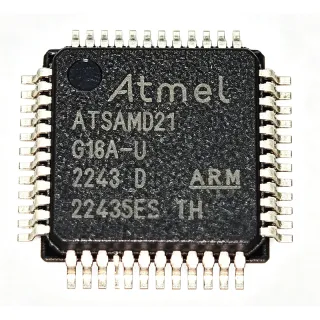
RTAX1000SL-CQ352V - 1M-Gate Rad-Tolerant FPGA | Microchip
MPN: RTAX1000SL-CQ352V ✓ Active| Qty | Unit Price | Extended |
|---|---|---|
| 1 | $0 | $0.00 |
| 10 | $0 | $0.00 |
| 100 | $0 | $0.00 |
| 500 | $0 | $0.00 |
| 1,000 | $0 | $0.00 |
RTAX1000SL-CQ352V Overview
A radiation-tolerant FPGA is a field-programmable gate array engineered to survive the ionizing radiation environments of low-Earth-orbit and deep-space missions, where commercial FPGAs would suffer single-event effects and total ionizing dose degradation. Within the power-management-of-systems hierarchy, the RTAX-S/SL family sits in the space-grade programmable logic tier above commercial FPGA families, alongside QML Class V qualified devices. The RTAX-SL family descends from the commercial Axcelerator architecture, inheriting its performance while adding radiation-hardening-by-design and processing.
Key features include true single-chip form factor thanks to non-volatile antifuse programming, live-at-power-up operation that eliminates configuration boot time, and low static power consumption - all cited by Microchip as reasons RTAX-S is the FPGA of choice for space designers. The 581 MHz toggle capability and embedded SRAM blocks with built-in FIFO control logic support demanding onboard processing workloads.
Technically, the antifuse fabric is one-time programmable: configuration is permanent, immune to configuration upsets (no SEU in configuration memory), which dramatically reduces TID/SEU mitigation overhead compared with SRAM FPGAs. Segmentable clock resources and chip-wide I/O features support high-reliability system integration.
Typical applications include spacecraft onboard data handling, satellite payload processing and bus avionics, where live-at-power-up behavior and single-chip integration reduce parts count and board complexity.
Design consideration: because the antifuse is one-time programmable, prototype extensively using the footprint-compatible prototyping methodology described in the Microchip datasheet before programming flight units.
This page synthesizes distributor data, drop-in alternatives, and practical design notes not found in the manufacturer datasheet.
Drop-in alternatives for RTAX1000SL-CQ352V — same package, pin-to-pin compatible. Different-package parts requiring PCB rework are excluded.
Variants in this series
Same-series models that are drop-in compatible with RTAX1000SL-CQ352V (same form factor and footprint) — differing in Package, Logic Cells, Configuration, Equivalent System Gates, Family.
Quick Comparison Tool — Select alternative parts for side-by-side comparison:
RTAX1000SL-1CQ352V
✅ Drop-In✓ In Stock
$810 / Unit
View Datasheet →RTAX1000SL-CQ352
✅ Drop-In📋 Reference alternative (not in catalog)
RTAX1000S-CQ352V
✅ Drop-In ⚠️ Specs Unverified📋 Reference alternative (not in catalog)
RTAX1000SL-1CQ352
✅ Drop-In ⚠️ Specs Unverified📋 Reference alternative (not in catalog)
RTAX1000SL-CQ352V Maximum Ratings & Electrical Characteristics
| Family | RTAX-SL (RTAX-S/SL Radiation-Tolerant FPGAs) |
| Equivalent System Gates | 1,000,000 |
| CLBs (Logic Modules) | 12,096 |
| Logic Cells | 18,144 |
| Maximum Toggle Frequency | 581 MHz |
| Process Technology | 0.15 um CMOS |
| Core Voltage | 1.5 V |
| Programming Technology | Antifuse (one-time programmable) |
| Radiation Tolerance | Radiation-tolerant, space-flight qualified family |
| Power-Up Behavior | Live at power-up (non-volatile) |
| Configuration Upset Immunity | No SEU in configuration memory (antifuse) |
| Embedded Memory | Embedded SRAM with built-in FIFO control logic |
| Package | 352-pin Ceramic CQFP (CQ352V) |
| Mounting Type | Surface Mount |
RTAX1000SL-CQ352V 352-pin ceramic cqfp (cq352v) Pin Configuration Guide
Pin configuration for RTAX1000SL-CQ352V (352-pin ceramic cqfp (cq352v) package). This digital IC includes GPIO, communication interfaces (UART, SPI, I2C), and power pins. Refer to the manufacturer datasheet for alternate pin functions and configuration options. Essential for embedded system design and PCB layout.

No detailed pinout data available for RTAX1000SL-CQ352V.
Refer to the datasheet for full pin configuration.
Typical Applications
RTAX1000SL-CQ352V is suitable for 6 applications: Spacecraft Onboard Data Handling, Satellite Payload Processing, Launch Vehicle Avionics, Deep-Space Instrumentation, Small-Sat / CubeSat Bus Electronics, High-Reliability Industrial & Test Flight Equipment.
Spacecraft Onboard Data Handling
The RTAX1000SL-CQ352V fits spacecraft onboard data handling (OBDH) because its 1M-gate antifuse fabric is live at power-up - critical for satellites that must accept telecommands immediately after deployment - and it cannot suffer configuration-memory upsets, removing the scrubber hardware an SRAM FPGA would require. Its 12,096 CLBs and 18,144 logic cells host CCSDS telemetry/telecommand framing, memory controllers, and bus interfaces, while the 581 MHz toggle capability supports high-rate downlink framing. Implemented between the spacecraft computer and the RF chain with the 1.5V core drawing low static power, it consolidates glue logic into a single hermetic ceramic CQFP, reducing board parts count and improving system reliability in orbit.
Recommended
Satellite Payload Processing
Payload signal-processing chains benefit directly from the RTAX1000SL-CQ352V's 581 MHz toggle rate and Axcelerator-derived architecture with embedded SRAM featuring built-in FIFO control logic, which simplifies buffering between ADC front ends and downlink formatters. The 1M-gate capacity accommodates FIR filters, FFT engines, and packetization pipelines for LEO imaging or communications payloads. Because the antifuse fabric is immune to configuration upsets, payload processing continues uncorrected through single-event strikes, a decisive advantage over SRAM alternatives that must pause for scrubbing. Designers typically pair it with space-grade ADCs and memory; the 352-pin ceramic CQFP provides the I/O count for wide parallel data buses while maintaining hermeticity for the space environment.
Recommended
Launch Vehicle Avionics
Launch vehicles need flight computers and sequencing logic that are operational within milliseconds of battery activation - exactly what the RTAX1000SL-CQ352V's live-at-power-up antifuse technology guarantees, with no configuration load time. The 1M-gate fabric implements redundancy management, discrete I/O, timer/scheduler functions, and bus protocol interfaces for avionics pods. Its 0.15um CMOS process at a 1.5V core yields low dynamic power, easing battery sizing during boost phase. The hermetic 352-pin ceramic CQFP withstands the vibration and thermal profiles of launch when properly mounted, and the absence of configuration readback eliminates a category of single-event functional interrupts that SRAM-based flight FPGAs must otherwise mitigate.
Recommended
Deep-Space Instrumentation
For deep-space missions where total ionizing dose accumulates over years and repair is impossible, the RTAX1000SL-CQ352V offers the radiation-tolerant processing backbone for instrument control, data compression, and science-data formatting. The antifuse configuration cannot be corrupted by configuration upsets, and the family's radiation qualification data supports mission TID budgets when verified against the Microchip radiation report. Its 18,144 logic cells implement lossless compressors, science packetizers, and instrument sequencing state machines, while the segmented clock architecture supports multiple asynchronous instrument interfaces. Engineers should cross-check the mission's TID and SEE environment against family data during PDR, and program flight devices only after full verification because antifuse programming is irreversible.
Recommended
Small-Sat / CubeSat Bus Electronics
Small satellites and CubeSats gain outsized benefit from the RTAX1000SL-CQ352V's true single-chip form factor: no external configuration flash, no scrubber microcontroller, and no boot sequence - all of which save board area and eliminate failure modes in tightly packed avionics stacks. The 1M-gate class integrates the full bus controller, EPS sequencing logic, and ADCS interface glue in one hermetic package, and the 581 MHz capability supports software-defined radio front ends common in modern smallsats. Low static power of the antifuse fabric helps missions with tight power budgets in eclipse. The 352-pin CQFP suits medium-volume smallsat production, and identical footprints across speed grades simplify second-source procurement within the RTAX-SL family.
Recommended
High-Reliability Industrial & Test Flight Equipment
Ground support equipment, flight-spares testers, and engineering-model benches frequently reuse flight FPGA designs; the RTAX1000SL-CQ352V can be paired in test systems with commercial Axcelerator devices using Microchip's documented footprint-compatible adaptor board and EDIF netlist/pinout conversion methodology. This lets teams validate RTL on commercial silicon at commercial cost before committing one-time-programmable, flight-priced antifuse devices. In the test system, the RTAX device reproduces exact flight timing including live-at-power-up behavior, enabling realistic sequence testing of the spacecraft unit under test. Engineers should reserve identical speed grades between bench and flight units where timing margin analysis matters, and log device programming files under configuration control.
Recommended
Recommended Products Summary
Engineering reference data for RTAX1000SL-CQ352V — comparison, design guidance, and compliance information.
Selection Guide
Comparison with Alternatives
| Parameter | This Product | RTAX1000SL-1CQ352V | RTAX1000SL-CQ352 | RTAX1000S-CQ352V | RTAX1000SL-1CQ352 |
|---|---|---|---|---|---|
| Brand | Microchip Technology | Microchip Technology | Microchip Technology | Microchip Technology | Microchip Technology |
| Package | 352-pin Ceramic CQFP (CQ352V) | 352-pin Ceramic CQFP (CQ352V) - same | 352-pin Ceramic CQFP (CQ352) - same footprint | 352-pin Ceramic CQFP (CQ352V) - same | 352-pin Ceramic CQFP (CQ352) - same footprint |
| Equivalent Gates | 1,000,000 | 1,000,000 | 1,000,000 | 1,000,000 | 1,000,000 |
| Logic Cells | 18,144 | 18,144 | 18,144 | 18,144 | 18,144 |
| Speed Grade | Standard | -1 (faster) | Standard | Standard | -1 (faster) |
| Programming Technology | Antifuse (OTP) | Antifuse (OTP) | Antifuse (OTP) | Antifuse (OTP) | Antifuse (OTP) |
| Core Voltage | 1.5 V | 1.5 V | 1.5 V | 1.5 V | 1.5 V |
Key Differentiators
- Live-at-power-up with no configuration device (vs RTAX1000SL-1CQ352V)
- Enhanced SL silicon over first-generation RTAX-S (vs RTAX1000S-CQ352V)
- Configuration-upset immunity versus SRAM space FPGAs (vs SRAM-based space FPGAs (e.g., XQR Virtex class))
Design Notes
Antifuse programming is permanent. Never program a flight RTAX1000SL-CQ352V before completing gate-level simulation, timing closure, and board-level verification. Microchip's documented methodology uses a footprint-compatible adaptor board with the corresponding commercial Axcelerator device, converting the EDIF netlist and pinout for easy migration - see the application note 'Prototyping for RTAX-S and RTAX-SL Devices'. Budget at least one prototype iteration and reserve flight units with margin, since a design error after programming scraps a flight-priced component with long replacement lead times.
The RTAX1000SL uses a 1.5V core; I/O bank supplies follow your selected standards per the datasheet electrical tables. Because antifuse fabric static power is very low, worst-case dynamic and I/O current dominates - derive it from post-place-and-route vectorless or vector activity analysis in Libero, then apply your program's derating policy when sizing radiation-tolerant point-of-load converters. Decouple every VCC/ground pin pair of the CQ352 package with ceramic capacitors at the datasheet-assigned power pins; do not share a single bulk capacitor across a high pin-count ceramic package.
The 352-pin ceramic CQFP requires careful land-pattern design and inspection: follow the mechanical drawing in the RTAX-S/SL datasheet (DS2169) for lead pitch and courtyard dimensions, and verify your assembly house can handle the fine lead geometry and coplanarity of hermetic CQFPs. Provide fiducials on all four sides, and support the stiff ceramic body during reflow to prevent lead stress. For flight boards, add provision for X-ray or visual inspection of all 352 joints, and confirm thermal expansion mismatch between the ceramic package and your flight PCB laminate during qualification testing.
With 300+ user I/O and a 581 MHz toggle capability, manage flight return currents by assigning a solid ground reference plane under every I/O bank and grouping switching outputs by bank. Use the RTAX-SL segmented clock resources per the datasheet clocking chapter; keep high-fanout clocks on dedicated clock resources rather than general routing. Simulate flight flight-line termination schemes for interfaces above roughly 50 MHz toggle, and confirm SEU-sensitive registered I/O strategies (e.g., triple modular redundancy on critical outputs) at the RTL level before netlist conversion.
Compliance Information
Environmental compliance data not stated in retrieved sources. As a space-grade hermetic ceramic CQFP device, aerospace/defense RoHS exemptions may apply; obtain the material declaration and certificate of conformance from Microchip for program-level environmental review.