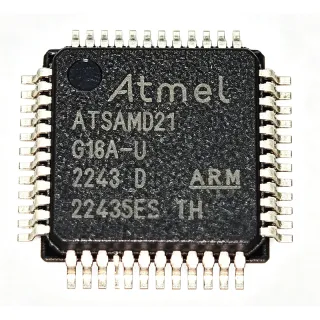
RTAX4000S-1LG1272V - Rad-Tolerant FPGA 4M Gates | Microchip
MPN: RTAX4000S-1LG1272V ✓ Active| Qty | Unit Price | Extended |
|---|---|---|
| 1 | $12950 | $12,950.00 |
| 10 | $11890 | $118,900.00 |
| 100 | $10900 | $1,090,000.00 |
| 500 | $9950 | $4,975,000.00 |
| 1,000 | $9300 | $9,300,000.00 |
RTAX4000S-1LG1272V Overview
A radiation-tolerant FPGA is a programmable logic device qualified to survive the ionizing radiation environment of space, where conventional commercial FPGAs would suffer single-event effects and total ionizing dose degradation. Within the programmable logic hierarchy, the RTAX-S family sits at the top tier: FPGA -> radiation-tolerant FPGA -> space-grade semiconductor -> aerospace electronic component.
Key features include densities of up to four million equivalent system gates, embedded SRAM blocks with built-in FIFO control logic, segmentable clock resources, and chip-wide highway routing. The device is based on the commercial Microsemi Axcelerator family architecture and uses anti-fuse programmable interconnect, giving true single-chip form factor and live-at-power-up operation without external configuration storage - a decisive advantage for launch-critical space systems where configuration SEU vulnerability must be eliminated.
Architecturally, the RTAX4000S provides logic modules with high-speed carry chains, embedded FIFOs, and I/O banks supporting multiple standards. The V suffix denotes qualification screening for flight programs; the -1 speed grade balances performance and timing yield across the military temperature range of -55C to +125C with a nominal 1.5V core supply.
Typical applications include satellite payload data processing, spacecraft bus controllers, telemetry and telecommand interfaces, and radiation-tolerant glue logic consolidation replacing multiple ASIC or SSI devices on orbital platforms.
Design consideration: prototype using the equivalent commercial Axcelerator device with Microchip Extender adaptor boards, then transfer the verified netlist to the RTAX-S device for flight production; budget long lead times for V-grade screened parts.
This page synthesizes verified distributor data, same-family drop-in alternatives, and practical space-design guidance not consolidated in the manufacturer datasheet.
Drop-in alternatives for RTAX4000S-1LG1272V — same package, pin-to-pin compatible. Different-package parts requiring PCB rework are excluded.
Variants in this series
Same-series models that are drop-in compatible with RTAX4000S-1LG1272V (same form factor and footprint) — differing in Package, Configuration, Family, Equivalent System Gates, Radiation Tolerance.
Quick Comparison Tool — Select alternative parts for side-by-side comparison:
RTAX4000SL-1LG1272V
✅ Drop-In✓ In Stock
Contact for price
View Datasheet →RTAX4000SL-1LG1272EV
✅ Drop-In✓ In Stock
Contact for price
View Datasheet →RTAX4000SL-LG1272V
✅ Drop-In✓ In Stock
Contact for price
View Datasheet →RTAX4000S-LG1272V
✅ Drop-In✓ In Stock
$9600 / Unit
View Datasheet →RTAX4000S-1LG1272PROTO
✅ Drop-In✓ In Stock
Contact for price
View Datasheet →RTAX4000SL-1LG1272E
✅ Drop-In✓ In Stock
Contact for price
View Datasheet →RTAX4000S-1LG1272V Maximum Ratings & Electrical Characteristics
| Equivalent System Gates | 4,000,000 gates |
| Logic Cells | 60480 |
| CLBs (Logic Modules) | 40320 |
| ASIC Gate Equivalent Option | 500,000 gates |
| Family | RTAX-S Radiation-Tolerant FPGA |
| Supply Voltage (Core) | 1.5 V (nominal) |
| Speed Grade | -1 |
| Package | LG1272 (1272-ball ceramic column grid array) |
| Operating Temperature | -55C to +125C |
| Technology | CMOS, anti-fuse, one-time programmable |
| Configuration | Live at power-up, single chip, no external boot device |
| Embedded SRAM | Yes, with built-in FIFO control logic |
| Clocking | Segmentable clocks, chip-wide highway routing |
| Screening Level | V (space flight qualification per datasheet flow) |
| Mounting Type | Surface Mount |
RTAX4000S-1LG1272V lg1272 (1272-ball ceramic column grid array) Pin Configuration Guide
Pin configuration for RTAX4000S-1LG1272V (lg1272 (1272-ball ceramic column grid array) package). This digital IC includes GPIO, communication interfaces (UART, SPI, I2C), and power pins. Refer to the manufacturer datasheet for alternate pin functions and configuration options. Essential for embedded system design and PCB layout.

No detailed pinout data available for RTAX4000S-1LG1272V.
Refer to the datasheet for full pin configuration.
Typical Applications
RTAX4000S-1LG1272V is suitable for 6 applications: Satellite Payload Data Processing, Spacecraft Bus Controller Logic, Telemetry and Telecommand Interfaces, Glue Logic Consolidation, High-Reliability Industrial and Defense Electronics, FPGA Prototyping and Design Flow Development.
Satellite Payload Data Processing
The RTAX4000S-1LG1272V delivers 4,000,000 equivalent gates and 60,480 logic cells, the largest density in the RTAX-S family, making it suitable for onboard payload processing such as image compression, channel coding, and protocol offload on Earth-observation and communications satellites. Its embedded SRAM with built-in FIFO control logic absorbs high-rate data streams from ADCs or imaging sensors without external FIFO chips, reducing board area and mass. Because the anti-fuse fabric is live at power-up and immune to configuration-memory SEU, the payload becomes operational during launch and early orbit phase without a separate configuration device. Designers typically clock segmentable domains at different rates for the sensor interface and downlink chain, exploiting chip-wide highway routing for clean cross-domain paths. The 1.5V core keeps dynamic power manageable under orbital thermal constraints.
Recommended
Spacecraft Bus Controller Logic
Spacecraft attitude control, power management, and telemetry/telecommand subsystems require deterministic logic that survives a multi-year radiation environment. The RTAX4000S-1LG1272V implements MIL-STD-1553-style bus interfaces, redundant command decoders, and watchdog functions within its 40,320 CLBs while operating from -55C to +125C. Live-at-power-up anti-fuse configuration means the bus controller is active the instant avionics power is applied, a critical property for autonomous safe-mode recovery after a power cycle. The V screening flow provides flight-level electrical and visual assurance, and triple-modular-redundancy techniques are implemented directly in the fabric at the RTOS-visible logic level. Compared with a rad-hard ASIC, the FPGA path avoids NRE and allows late design changes, while offering up to 500,000 ASIC gate equivalence for future migration of proven designs.
Recommended
Telemetry and Telecommand Interfaces
Telemetry encoders, frame formatters, and command decoders map naturally onto the RTAX4000S-1LG1272V's logic modules and embedded FIFOs. The -1 speed grade comfortably handles standard space-link telemetry rates while preserving timing margin across the full -55C to +125C military range at 1.5V nominal supply. Embedded SRAM with FIFO control logic buffers asynchronous data between the downlink formatter and the baseband processor without external FIFO devices, and chip-wide highway routing carries long-haul clock and data buses with predictable delay. Because the anti-fuse configuration cannot be corrupted by heavy-ion hits in the configuration memory, the telemetry chain remains structurally sound; designers apply TMR only to state registers that matter. The LG1272 ceramic column package provides the high pin count (1272 I/O positions) needed to bond multiple redundant subsystem interfaces onto a single flight board.
Recommended
Glue Logic Consolidation
Many spacecraft boards accumulate discrete PAL/GAL devices and SSI glue across program generations; replacing them with a single RTAX4000S-1LG1272V cuts component count, solder joints, and board real estate while adding radiation immunity. With 4,000,000 gates and 60,480 logic cells, a single device absorbs address decoding, bus arbitration, interrupt control, and interface adaptation that previously consumed dozens of packages. Live-at-power-up operation is essential here: decode logic must be valid the moment power arrives, unlike SRAM FPGAs that need configuration time. The LG1272 footprint supports dense bonding of many I/O standards, and the 1.5V core plus military temperature rating keeps the consolidated design compliant with spacecraft environmental requirements. Consolidation also simplifies radiation analysis because a single qualified V-level device replaces multiple unscreened legacy parts with inconsistent lot genealogy.
Recommended
High-Reliability Industrial and Defense Electronics
Beyond orbital platforms, the RTAX4000S-1LG1272V serves high-altitude aircraft, launch vehicles, and strategic defense electronics where the -55C to +125C range and 4M-gate density exceed commercial FPGA capability. The -1 speed grade and Axcelerator-derived architecture deliver high clock rates for radar preprocessing, software-defined radio channelization, and secure communications equipment. Anti-fuse one-time programming provides strong design-protection semantics valued in defense programs, since the configuration cannot be read out of a configuration memory. The 1.5V nominal core supply reduces dynamic power in conduction-cooled chassis, and the ceramic LG1272 column grid array withstands thermal cycling and vibration profiles typical of launch environments. Programs commonly prototype on commercial Axcelerator parts with Extender boards before committing screened RTAX-S silicon, protecting schedule when flight lots have long lead times.
Recommended
FPGA Prototyping and Design Flow Development
The RTAX4000S-1LG1272V anchors a structured prototyping flow: designers first target the equivalent commercial Axcelerator device, verify functionality and timing with Microchip Extender adaptor boards that map the commercial package to the LG1272 footprint, and finally transfer the netlist to flight silicon. For reprogrammable iteration, Aldec and Microchip jointly offer a flash-based ProASIC3E prototyping adaptor that emulates RTAX-S designs, and Microchip supplies the RTAX4000S-1LG1272PROTO part in the identical 1272-ball footprint for system-level bring-up with prototyping screening. This staged flow de-risks one-time-programmable commit decisions: timing closure, pin assignment, and SEU-hardened RTL are all proven before V-grade flight units are ordered. Given multi-quarter lead times for screened parts, building the prototyping plan into the program schedule as early as possible is a decisive cost and schedule advantage.
Recommended
Recommended Products Summary
Engineering reference data for RTAX4000S-1LG1272V — comparison, design guidance, and compliance information.
Selection Guide
Comparison with Alternatives
| Parameter | This Product | RTAX4000SL-1LG1272V | RTAX4000SL-1LG1272EV | RTAX4000SL-LG1272V | RTAX4000S-LG1272V | RTAX4000S-1LG1272PROTO |
|---|---|---|---|---|---|---|
| Package | LG1272 (1272-ball ceramic column grid array) | LG1272 - same | LG1272 - same | LG1272 - same | LG1272 - same | LG1272 - same |
| Brand | Microchip Technology (Actel/Microsemi) | Microchip Technology | Microchip Technology | Microchip Technology | Microchip Technology | Microchip Technology |
| Equivalent Gates | 4,000,000 | 4,000,000 | 4,000,000 | 4,000,000 | 4,000,000 | 4,000,000 |
| Logic Cells | 60480 | 60480 | 60480 | 60480 | 60480 | 60480 |
| Speed Grade | -1 | -1 | -1 | Standard | Standard | -1 |
| Process / Power | RTAX-S (original S process) | RTAX-SL (lower static power) | RTAX-SL (lower static power) | RTAX-SL (lower static power) | RTAX-S (original S process) | RTAX-S (original S process) |
| Screening Level | V (flight) | V (flight) | E/V (engineering/flight) | V (flight) | V (flight) | PROTO (prototyping) |
| Core Supply | 1.5 V nominal | 1.5 V nominal | 1.5 V nominal | 1.5 V nominal | 1.5 V nominal | 1.5 V nominal |
| Operating Temperature | -55C to +125C | -55C to +125C | -55C to +125C | -55C to +125C | -55C to +125C | -55C to +125C |
Key Differentiators
- Flight (V) screening on the largest RTAX-S die (vs RTAX4000S-1LG1272PROTO)
- Lower-power drop-in available on the same footprint (vs RTAX4000SL-1LG1272V)
- Single-chip live-at-power-up configuration (vs SRAM-based space FPGAs (e.g., Virtex-class parts))
- Avoids RTAX-DSP package mismatch (vs RTAX4000D-1CG1152V-class parts)
Design Notes
Do not assume the RTAX4000D (RTAX-DSP) CG1272/LG1272 package is mechanically identical: Microchip's official support article states the RTAX-DSP package body is slightly larger than the CG/LG1272 body used on RTAX4000S/SL devices. Substituting a DSP variant onto an RTAX4000S land pattern requires dimensional verification. Likewise, verify screening-level suffixes (V, EV, E, PROTO) against program flow requirements - a PROTO or E part must never fly on a program requiring V screening.
With 1272 bond positions, simultaneous switching noise on the LG1272 package is a real risk in high fan-out designs. Assign switching outputs across multiple I/O banks, use the reduced-noise I/O standards where full swing is not required, and reserve chip-wide highway routing for critical clock distribution rather than loading it with data. Validate timing across the full -55C to +125C range with Microchip timing models at the -1 speed grade, including derating for board-level transmission line loading on flight harnesses.
Estimated: RTAX-S static current (ICCA) rises with temperature and is the exact parameter screened at 125C final electrical test to separate S from SL parts. For an RTAX4000S design with a tight power budget, consider the RTAX4000SL-1LG1272V drop-in, which uses the SL low-power process for lower static power at identical density and footprint. Budget core supply at 1.5V nominal and perform a thermal analysis of the ceramic column package against your conduction-cooled chassis before finalizing switching activity estimates.
The LG1272 ceramic column grid array uses solder column attachment; per the Microchip/Microsemi datasheet flow, only QA electrical and mechanical visual inspection are performed after column attachment. On the board side, design the land pattern per the manufacturer package drawing, support column compliance with appropriate pad geometry, and define rework procedures early - column devices are less forgiving than BGA balls. Sequence assembly so X-ray or visual inspection can verify all 1272 columns after mounting.
Compliance Information
Space-grade ceramic-column packaged FPGA; RoHS/REACH declarations are not typically published for screened flight devices. Consult Microchip space products compliance documentation for the specific lot.