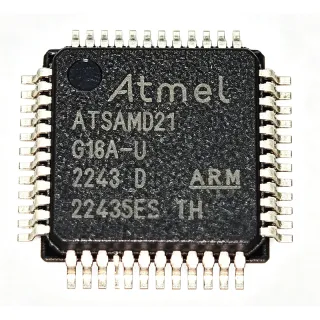
RTAX2000DL-CQ352V - 2M-Gate Rad-Tolerant FPGA | Microchip
MPN: RTAX2000DL-CQ352V ✓ Active| Qty | Unit Price | Extended |
|---|---|---|
| 1 | $0 | $0.00 |
| 10 | $0 | $0.00 |
| 100 | $0 | $0.00 |
| 500 | $0 | $0.00 |
| 1,000 | $0 | $0.00 |
RTAX2000DL-CQ352V Overview
A radiation-tolerant FPGA is a field-programmable gate array engineered to survive the ionizing radiation environment of space. Within the semiconductor hierarchy, it sits under programmable logic devices alongside SRAM-based and flash-based FPGAs; the RTAX family is distinguished by its nonvolatile antifuse interconnect, which is programmed once and cannot be upset by a single charged particle, giving the device live-at-power-up operation without an external configuration flash.
Key features of the RTAX2000DL variant include up to 120 DSP mathblocks performing 18-bit x 18-bit multiply-accumulate operations at up to 125 MHz, up to 540 kbits of embedded SRAM with optional EDAC protection, and a maximum combinatorial delay of 1.100 ns. Total ionizing dose capability is rated at 300 krad (functional), with a 200 krad specification also cited in the datasheet family data.
The device is fabricated in advanced CMOS technology and operates from a 1.5V nominal core supply (1.425V to 1.575V range) across a military temperature range of -55C to +125C. The DL suffix denotes the DSP-enhanced (mathblock-rich) die; the metal-sealed ceramic CQFP-352 package provides the hermeticity required for space-flight assembly flows.
Typical applications include satellite payload processing, onboard signal processing, spacecraft bus control, and radiation-exposed instrumentation where single-event upset immunity and true single-chip form factor matter.
When designing with this device, plan programming via the standard antifuse programming flow (one-time programmable) and validate timing against the 1.5V supply corner conditions.
This page synthesizes distributor listings, family datasheet data, and drop-in alternatives within the RTAX CQFP-352 ecosystem not consolidated in the manufacturer datasheet.
Drop-in alternatives for RTAX2000DL-CQ352V — same package, pin-to-pin compatible. Different-package parts requiring PCB rework are excluded.
Variants in this series
Same-series models that are drop-in compatible with RTAX2000DL-CQ352V (same form factor and footprint) — differing in Package, Configuration, Technology, Embedded Memory, Equivalent System Gates.
Quick Comparison Tool — Select alternative parts for side-by-side comparison:
RTAX2000DL-1CQ352V
✅ Drop-In✓ In Stock
$2950 / Unit
View Datasheet →RTAX2000DL-CQ352B
✅ Drop-In✓ In Stock
Contact for price
View Datasheet →RTAX2000DL-1CQ352B
✅ Drop-In✓ In Stock
$3420 / Unit
View Datasheet →RTAX2000D-CQ352V
✅ Drop-In✓ In Stock
$2560 / Unit
View Datasheet →RTAX2000D-1CQ352V
✅ Drop-In✓ In Stock
$3950 / Unit
View Datasheet →RTAX2000DL-CQ352V Maximum Ratings & Electrical Characteristics
| Equivalent System Gates | 2,000,000 |
| Logic Cells | 29,568 |
| CLBs | 19,712 |
| Technology | CMOS, antifuse (nonvolatile, one-time programmable) |
| Core Supply Voltage | 1.5 V nominal (1.425 V to 1.575 V) |
| DSP Mathblocks | Up to 120 (18-bit x 18-bit MAC, up to 125 MHz) |
| Embedded Memory | Up to 540 kbits SRAM with optional EDAC |
| Maximum Combinatorial Delay | 1.100 ns |
| Total Ionizing Dose (TID) | 300 krad (functional); 200 krad (per family data) |
| Package | CQFP-352, hermetically sealed ceramic, metal-sealed cofired |
| Terminal Pitch | 0.500 mm |
| Mounting Type | Surface Mount |
| Operating Temperature | -55C to +125C |
| Configuration | Live-at-power-up (antifuse, no external boot device) |
| Family | RTAX-DSP (RTAX-S/SL and RTAX-DSP radiation-tolerant FPGAs) |
RTAX2000DL-CQ352V cqfp-352, hermetically sealed ceramic, metal-sealed cofired Pin Configuration Guide
Pin configuration for RTAX2000DL-CQ352V (cqfp-352, hermetically sealed ceramic, metal-sealed cofired package). This digital IC includes GPIO, communication interfaces (UART, SPI, I2C), and power pins. Refer to the manufacturer datasheet for alternate pin functions and configuration options. Essential for embedded system design and PCB layout.

No detailed pinout data available for RTAX2000DL-CQ352V.
Refer to the datasheet for full pin configuration.
Typical Applications
RTAX2000DL-CQ352V is suitable for 6 applications: Satellite Payload Signal Processing, Spacecraft Bus Control and Avionics, Radiation-Exposed Instrumentation, High-Reliability Defense and Aerospace Electronics, Onboard Data Storage and Formatting, Launch Vehicle and Missile Electronics.
Satellite Payload Signal Processing
The RTAX2000DL-CQ352V fits satellite payload processing because its up to 120 DSP mathblocks deliver 18-bit x 18-bit multiply-accumulate at up to 125 MHz, sufficient for FFT, digital filtering, and modulation chains in communications and Earth-observation payloads. Its antifuse fabric is configuration-upset immune and operates live at power-up, eliminating external boot-flash failure modes that matter in orbit. Implemented between ADC front ends and downlink formatters, the 540 kbits of embedded SRAM with optional EDAC buffers sample streams while designer-applied TMR protects control logic. The trade-off versus SRAM FPGAs is one-time programmability, requiring thorough pre-flight verification in Libero.
Recommended
Spacecraft Bus Control and Avionics
For spacecraft bus control, the RTAX2000DL-CQ352V provides 2,000,000 gates of glueless integration for telemetry, telecommand, attitude-control interfaces, and error-corrected memory controllers in a single hermetic CQFP-352 device. Live-at-power-up antifuse configuration means control logic is functional the instant spacecraft power is applied - critical during launch and safe-mode events. Operating from a 1.5V nominal core (1.425V to 1.575V) across -55C to +125C, it tolerates bus-voltage and thermal variation. Because the fabric is one-time programmable, designers should freeze interface standards (MIL-STD-1553, SpaceWire companions) early and verify timing at both supply corners.
Recommended
Radiation-Exposed Instrumentation
Scientific instruments on interplanetary probes and Earth-orbiting platforms use the RTAX2000DL-CQ352V to perform detector interfacing, time-tagging, and on-board data reduction. The family datasheet cites 300 krad (functional) total ionizing dose capability, adequate for many LEO and MEO missions, and antifuse interconnect eliminates configuration-memory single-event upset as a failure mode. Embedded SRAM with optional EDAC protects accumulated science data, while the 1.100 ns maximum combinatorial delay supports fast coincidence logic. The principal design consideration is TID margin: missions approaching the 300 krad limit should apply derating or confirm lot-level qualification data with Microchip.
Recommended
High-Reliability Defense and Aerospace Electronics
Defense programs leverage the RTAX2000DL-CQ352V where the -55C to +125C military temperature range, hermetic metal-sealed ceramic CQFP-352 package, and known-good single-chip integration simplify qualification to military screening flows. The DSP mathblocks accelerate radar pulse processing, electronic-warfare channelization, and secure-communications encoding at up to 125 MHz MAC rates. Unlike SRAM FPGAs, the bitstream is never stored externally, reducing reverse-engineering and upset risks in contested environments. Design teams should note the one-time-programmable antifuse flow: prototype on the RTAX250SL-CQ352V or commercial ProASIC3 equivalents before committing flight devices to programming.
Recommended
Onboard Data Storage and Formatting
Solid-state recorders and payload-data formatters use the RTAX2000DL-CQ352V's 540 kbits of embedded SRAM (with built-in FIFO control logic and optional EDAC) alongside external SDRAM controllers implemented in the 19,712-CLB fabric. The device performs lossless compression pre-processing, CCSDS framing, and Reed-Solomon encoding using its DSP mathblocks, offloading the spacecraft computer. Running at a nominal 1.5V core keeps static power low for eclipse operation. Designers should reserve EDAC-protected blocks for metadata and apply TMR to the external-memory controller, since SEU mitigation in user logic remains the designer's responsibility on this antifuse architecture.
Recommended
Launch Vehicle and Missile Electronics
Flight-control and sequencing electronics in launch vehicles benefit from the RTAX2000DL-CQ352V's deterministic, single-chip implementation: antifuse configuration is present at power application with zero boot latency, timing is fixed once programmed (1.100 ns maximum combinatorial delay simplifies worst-case analysis), and the hermetic CQFP-352 survives high-shock, thermal-cycling environments. The -55C to +125C operating range covers externally mounted avionics bays. Typical designs implement redundant voter logic, sequencer state machines, and telemetry encoders with triple-modular redundancy. Because the part is one-time programmable, hardware-in-the-loop testing must conclude before flight-lot programming commits the design.
Recommended
Recommended Products Summary
Engineering reference data for RTAX2000DL-CQ352V — comparison, design guidance, and compliance information.
Selection Guide
Comparison with Alternatives
| Parameter | This Product | RTAX2000DL-1CQ352V | RTAX2000D-CQ352V | RTAX2000D-1CQ352V |
|---|---|---|---|---|
| Package | CQFP-352 ceramic, 0.500 mm pitch | CQFP-352 - same | CQFP-352 - same | CQFP-352 - same |
| Brand | Microchip Technology | Microchip Technology | Microchip Technology | Microchip Technology |
| Equivalent Gates | 2,000,000 | 2,000,000 | 2,000,000 | 2,000,000 |
| Logic Cells / CLBs | 29,568 / 19,712 | 29,568 / 19,712 | 29,568 / 19,712 | 29,568 / 19,712 |
| DSP Mathblocks | Up to 120 (18x18 MAC, 125 MHz) | Up to 120 (18x18 MAC, 125 MHz) | Non-DL die (fewer/no mathblocks) | Non-DL die (fewer/no mathblocks) |
| Speed Grade | Standard | -1 (faster) | Standard | -1 (faster) |
| Core Supply Voltage | 1.5 V nominal (1.425-1.575 V) | 1.5 V nominal (1.425-1.575 V) | 1.5 V nominal (1.425-1.575 V) | 1.5 V nominal (1.425-1.575 V) |
| Max Combinatorial Delay | 1.100 ns | Lower than standard grade (-1 speed) | 1.100 ns | Lower than standard grade (-1 speed) |
| Embedded Memory | Up to 540 kbits with EDAC | Up to 540 kbits with EDAC | Up to 540 kbits with EDAC | Up to 540 kbits with EDAC |
Key Differentiators
- DSP-enhanced die with up to 120 mathblocks (vs RTAX2000D-CQ352V)
- Identical footprint with faster speed-grade option (vs RTAX2000DL-1CQ352V)
- Configuration-upset-immune antifuse fabric (vs SRAM-based space FPGAs (e.g., Virtex-QV class))
Design Notes
Power the 1.5V core rail within the 1.425V to 1.575V window across all temperature and load conditions; timing is specified against this rail and violations at the low corner can break static timing closure. Estimate static and dynamic current from Libero SmartPower reports before sizing the rail - DSP-mathblock-heavy designs switching at 125 MHz dominate dynamic power. Decouple with a network of ceramic capacitors distributed across the 352-terminal package, and sequence I/O banks per the datasheet power-up requirements to avoid latch-up during spacecraft power transients.
The RTAX2000DL-CQ352V is one-time programmable: there is no rework path once the antifuse array is blown. Complete full hardware verification - ideally prototyping logic on a commercial ProASIC3 (A3PE) device or an RTAX evaluation board such as the RTAX2000S-CG624PROTO - before programming flight devices. Also confirm speed-grade ordering: '-1' parts are faster than standard grade, and substituting a slower standard-grade part (this MPN) for a '-1' design without re-running static timing analysis in Libero will cause field failures discovered only at integration.
Lay out the CQFP-352 land pattern to the 0.500 mm terminal pitch with gull-wing leads supporting visual solder-joint inspection required by high-reliability assembly flows. Place 0.1 uF decoupling capacitors within a few millimeters of power/ground terminal pairs around the package perimeter, and keep configuration-JTAG and programming-access traces routed for post-assembly programming access. For space boards, follow the datasheet thermal pad guidance and verify junction temperature at -55C to +125C extremes; the metal-sealed ceramic package conducts heat primarily through its leads and ground planes.
Compliance Information
Compliance data not stated in provided distributor listings. Space-grade ceramic-package devices often use gold lead finishes and may fall under RoHS exemptions; request material declarations from Microchip during quotation.