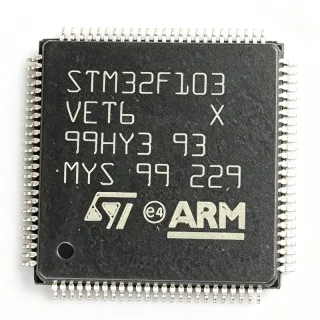
STM32F437IIH6 - 180MHz Cortex-M4F MCU 2MB Flash | STMicroelectronics
MPN: STM32F437IIH6 ✓ Active| Qty | Unit Price | Extended |
|---|---|---|
| 1 | $18.46 | $18.46 |
| 10 | $17.12 | $171.20 |
| 100 | $15.2 | $1,520.00 |
| 500 | $13.45 | $6,725.00 |
| 1,000 | $11.95 | $11,950.00 |
| 3,000 | $10.6 | $31,800.00 |
STM32F437IIH6 Overview
An ARM Cortex-M4F microcontroller is a 32-bit embedded processor core designed for applications demanding a balance of performance, power efficiency, and real-time digital signal processing. The 'F' suffix denotes the inclusion of a single-precision hardware floating-point unit (IEEE 754), which accelerates transcendental and fractional arithmetic commonly required in control loops, audio codecs, and DSP filters. In the system hierarchy, the STM32F437IIH6 sits at the application processor tier, above Cortex-M0+ sensor nodes but below Cortex-A application processors, often serving as the central controller in industrial, consumer, medical, and IoT-edge systems.
Key differentiating features of the STM32F437IIH6 include a Cortex-M4F core delivering 225 DMIPS / 2.14 CoreMark/MHz, dual-bank Flash supporting read-while-write firmware upgrades, an integrated TFT-LCD controller capable of XGA-class resolutions, an 8/14-bit parallel camera interface, and hardware accelerators for AES-128/192/256, DES/3DES, and SHA-1/MD5/SHA-2 hash functions. Connectivity is extensive: USB 2.0 OTG HS/FS, 10/100 Ethernet MAC with IEEE 1588, two CAN 2.0B, three I2C, six SPI, four USART plus four UART, and an SDIO interface.
Technically, the device is fabricated on a 90 nm CMOS process and integrates an adaptive real-time (ART) memory accelerator that effectively eliminates Flash wait states at the full 180 MHz clock. The 1.8 V to 3.6 V supply range supports direct battery and USB-bus operation. The integrated 12-bit ADC (up to 3 MSPS, three channels of 1 MSPS each) and dual 12-bit DAC channels simplify mixed-signal designs. Multiple low-power modes (Sleep, Stop, Standby with RTC) draw as little as 2.4 µA in Standby with the RTC running.
Typical applications include industrial motor-control inverters, human-machine interface (HMI) panels with TFT displays, medical patient monitors, networked IoT gateways, and high-end consumer audio/graphics products. In an HMI panel, for instance, the TFT-LCD controller drives the display directly while the Chrom-ART engine handles 2D rendering, freeing the Cortex-M4F for application logic and communication stacks.
When designing with the STM32F437IIH6, pay attention to power-supply decoupling: a 100 nF ceramic capacitor close to every VDD pin and a 4.7 µF bulk capacitor at the regulator output are mandatory. Route the USB and Ethernet differential pairs per the 90 Ω impedance guideline in RM0090. For low-power RTC retention, connect VBAT to a backup battery or super-capacitor; without this the backup registers and RTC lose state on power loss.
This page synthesises distributor pricing, drop-in same-family alternatives, and practical layout guidance not found in the manufacturer datasheet alone, helping engineers select and qualify the part faster.
Drop-in alternatives for STM32F437IIH6 — same package, pin-to-pin compatible. Different-package parts requiring PCB rework are excluded.
Variants in this series
Same-series models that are drop-in compatible with STM32F437IIH6 (same form factor and footprint) — differing in Package, Core, Flash Memory, Mounting Type, Communication Interfaces.
Quick Comparison Tool — Select alternative parts for side-by-side comparison:
STM32F439IIH6
✅ Drop-In📋 Reference alternative (not in catalog)
STM32F429IIH6
✅ Drop-In✓ In Stock
Contact for price
View Datasheet →STM32F427IIH6
✅ Drop-In✓ In Stock
$8.1 / Unit
View Datasheet →STM32F437IIH6 Maximum Ratings & Electrical Characteristics
| Core | ARM Cortex-M4F (32-bit, with FPU + DSP) |
| Maximum CPU Frequency | 180 MHz |
| Core Performance | 225 DMIPS / 2.14 CoreMark/MHz |
| Flash Memory | 2 MB (dual-bank, read-while-write) |
| SRAM | 256 KB |
| Supply Voltage | 1.8 V to 3.6 V |
| Operating Temperature | -40 C to +85 C (industrial grade) |
| Package | UFBGA-176 (10x10 mm) |
| Mounting Type | Surface Mount (BGA) |
| USB | 1x USB 2.0 OTG HS/FS (with internal HS PHY) |
| Ethernet | 10/100 MAC with IEEE 1588 (MII/RMII) |
| CAN | 2x CAN 2.0B |
| SPI / I2C / USART / UART | 6 / 3 / 4 / 4 |
| ADC / DAC | 12-bit ADC up to 3 MSPS, dual 12-bit DAC |
| Display / Camera | TFT-LCD controller (up to XGA), parallel camera interface, Chrom-ART Accelerator |
| Cryptographic Acceleration | AES-128/192/256, DES/3DES, SHA-1, MD5, SHA-2 |
| Standby Current (RTC running) | 2.4 µA typical |
| RoHS Status | Compliant |
| Lead-Free / Halogen-Free | Yes / Yes |
STM32F437IIH6 ufbga-176 (10x10 mm) Pin Configuration Guide
Pin configuration for STM32F437IIH6 (ufbga-176 (10x10 mm) package). This digital IC includes GPIO, communication interfaces (UART, SPI, I2C), and power pins. Refer to the manufacturer datasheet for alternate pin functions and configuration options. Essential for embedded system design and PCB layout.

No detailed pinout data available for STM32F437IIH6.
Refer to the datasheet for full pin configuration.
Typical Applications
STM32F437IIH6 is suitable for 6 applications: Industrial HMI Panels with TFT-LCD, Industrial Motor Control and Inverters, Medical Patient Monitoring Devices, IoT Edge Gateways and Networked Sensors, High-End Consumer Audio and Graphics Products, Smart Home Hub and Building Automation.
Industrial HMI Panels with TFT-LCD
The STM32F437IIH6 drives TFT-LCD panels up to XGA resolution directly via its integrated TFT-LCD controller, eliminating the need for an external display controller and reducing BOM cost. The Chrom-ART Accelerator offloads 2D fill, copy, and alpha-blend operations from the Cortex-M4F core, freeing 180 MHz of CPU bandwidth for application logic and protocol stacks. Its 256 KB SRAM buffers display frames comfortably, while the 2 MB dual-bank Flash supports rich GUIs and read-while-write OTA updates. Designed into HMI panels for factory automation, the part handles touch input polling, Modbus/TCP, and real-time control loop computation concurrently without DMA contention.
Recommended
Industrial Motor Control and Inverters
The STM32F437IIH6's single-precision FPU accelerates PID and field-oriented control (FOC) math at 180 MHz, while the integrated advanced timers generate centre-aligned PWM with sub-microsecond dead-time insertion for 3-phase inverter stages. The 12-bit ADC at up to 3 MSPS samples phase currents simultaneously with hardware triggering tied to timer events, minimising CPU jitter. Its 1.8-3.6 V supply and -40 C to +85 C industrial range suit drives operating from 24 V bus rails. The dual-bank Flash enables safe in-field firmware upgrades without halting the motor, critical for high-availability industrial equipment such as servo drives and pump controllers.
Recommended
Medical Patient Monitoring Devices
The STM32F437IIH6 suits portable patient monitors by combining 180 MHz Cortex-M4F performance for ECG/EEG DSP filtering with low-power Stop/Standby modes that extend battery life between charges. Its 12-bit ADC at 3 MSPS captures multi-lead ECG front-end signals with sufficient resolution for diagnostic-grade analysis, while the hardware AES/SHA accelerators secure patient data stored in the 2 MB Flash or transmitted over USB/Ethernet. The integrated USB OTG HS/FS enables direct tethered charging and data sync with clinical PCs. The industrial -40 C to +85 C temperature range ensures reliable operation in ambulance and clinical environments where thermal stress is common.
Recommended
IoT Edge Gateways and Networked Sensors
The STM32F437IIH6's integrated 10/100 Ethernet MAC with IEEE 1588 hardware timestamping makes it ideal as a protocol-conversion gateway between industrial fieldbuses (CAN, RS-485) and TCP/IP networks. The dual CAN 2.0B controllers aggregate sensor data from vehicle or industrial buses, while the six SPI and three I2C ports connect to local sensor hubs. The hardware AES/SHA accelerators offload TLS/DTLS handshake crypto for MQTT-SN or CoAP stacks. With 2 MB Flash, large embedded web servers and protocol stacks fit without external memory, simplifying PCB layout in compact DIN-rail or wall-mount IoT gateways.
Recommended
High-End Consumer Audio and Graphics Products
The STM32F437IIH6 serves as the central processor in high-end consumer audio products, where the hardware FPU accelerates Biquad, FIR, and IIR filter computations for parametric equalisers and surround decoders in real time. Its dual 12-bit DAC channels drive line outputs directly, while the I2S interfaces connect to external high-fidelity DACs for premium playback paths. The TFT-LCD controller and Chrom-ART engine render touch-screen UIs with smooth 60 fps animation. The 2 MB Flash stores firmware, voice prompts, and preset libraries without external memory, keeping the BOM lean for compact consumer enclosures.
Recommended
Smart Home Hub and Building Automation
The STM32F437IIH6 functions as a smart home hub aggregating Zigbee/Thread border-router data via SPI-connected radios, while its Ethernet MAC bridges to the home IP network for cloud connectivity. The TFT-LCD controller drives wall-mounted touch panels for room climate control with rich graphical feedback, and the USB OTG HS port supports firmware upgrade via USB stick for technicians. The 2 MB Flash accommodates Z-Wave, KNX, and proprietary RF protocol stacks concurrently, while the hardware AES engine secures OTA updates. Its -40 C to +85 C range handles basement and attic hub installations with temperature swings.
Recommended
Recommended Products Summary
Engineering reference data for STM32F437IIH6 — comparison, design guidance, and compliance information.
Selection Guide
Comparison with Alternatives
| Parameter | This Product | STM32F439IIH6 | STM32F429IIH6 | STM32F427IIH6 |
|---|---|---|---|---|
| Brand | STMicroelectronics | STMicroelectronics | STMicroelectronics | STMicroelectronics |
| Package | UFBGA-176 (10x10 mm) | UFBGA-176 (10x10 mm) - same | UFBGA-176 (10x10 mm) - same | UFBGA-176 (10x10 mm) - same |
| Core | Cortex-M4F @ 180 MHz | Cortex-M4F @ 180 MHz | Cortex-M4F @ 180 MHz | Cortex-M4F @ 180 MHz |
| Flash | 2 MB dual-bank | 2 MB dual-bank | 2 MB dual-bank | 2 MB dual-bank |
| SRAM | 256 KB | 256+4 KB (CCM) | 256+4 KB (CCM) | 256+4 KB (CCM) |
| Ethernet MAC | Yes (10/100 + IEEE 1588) | Yes (10/100 + IEEE 1588) | Yes (10/100 + IEEE 1588) | Yes (10/100 + IEEE 1588) |
| TFT-LCD Controller | Yes (up to XGA) | Yes (up to XGA) + SDRAM IF | Yes (up to XGA) + SDRAM IF | No |
| Chrom-ART Accelerator | Yes | Yes | Yes | No |
| SDRAM Interface | No | Yes | Yes | No |
Key Differentiators
- TFT-LCD controller + Chrom-ART integrated (vs STM32F427IIH6)
- Ethernet focus without SDRAM trade-off (vs STM32F429IIH6)
- Industrial-grade -40 C to +85 C operation (vs Consumer-grade STM32F401 variants)
Design Notes
Place a 100 nF ceramic decoupling capacitor close to every VDD pin and a 4.7 µF bulk capacitor at the regulator output. Connect VBAT to a backup battery or super-capacitor if RTC retention is required during power loss; without it, RTC and backup registers reset. The 1.8-3.6 V supply supports direct Li-Ion battery operation but requires a regulator for 5 V USB-bus power.
Route the USB DP/DM and Ethernet MII/RMII differential pairs to 90 Ω differential impedance per the layout guidelines in RM0090. The UFBGA-176 package at 0.65 mm pitch requires 4-layer PCB with via-in-pad or dog-bone fan-out for reliable assembly and rework. Keep the crystal traces short and symmetric, with the load capacitors within 5 mm of the OSC pins.
Do not enable the TFT-LCD controller pins as GPIO after bootloader configuration, or peripheral conflicts will appear. Ensure the BOOT0 pin state is correct before reset, otherwise the part boots into System Memory bootloader instead of user Flash. When using dual-bank Flash for OTA, configure the BFB2 bit correctly to avoid bricking on bad firmware.
Estimated: At maximum CPU activity (180 MHz, all peripherals active, VDD=3.3 V), internal core dissipation stays below 300 mW for the UFBGA-176 package, which is comfortably within the 4-layer PCB thermal envelope. For continuous industrial ambient operation up to 85 C, no heatsink is required, but ensure copper pour around the BGA thermal balls is unbroken to maintain the package theta_JA.
Compliance Information
Industrial grade -40 C to +85 C; not AEC-Q100 qualified. RoHS and REACH compliance per ST product page.