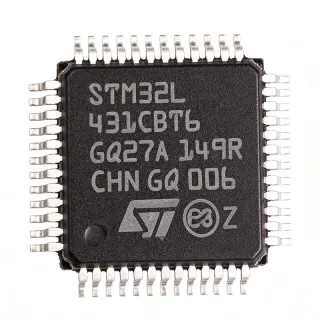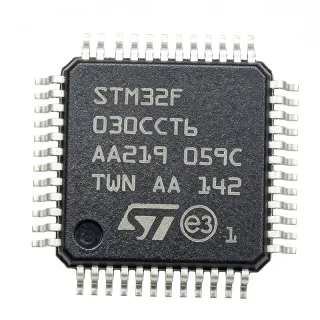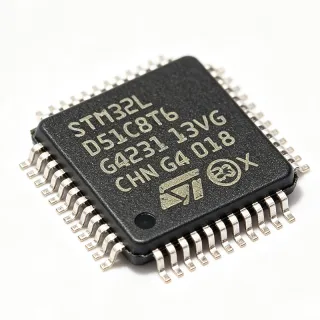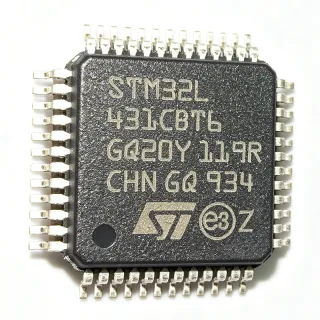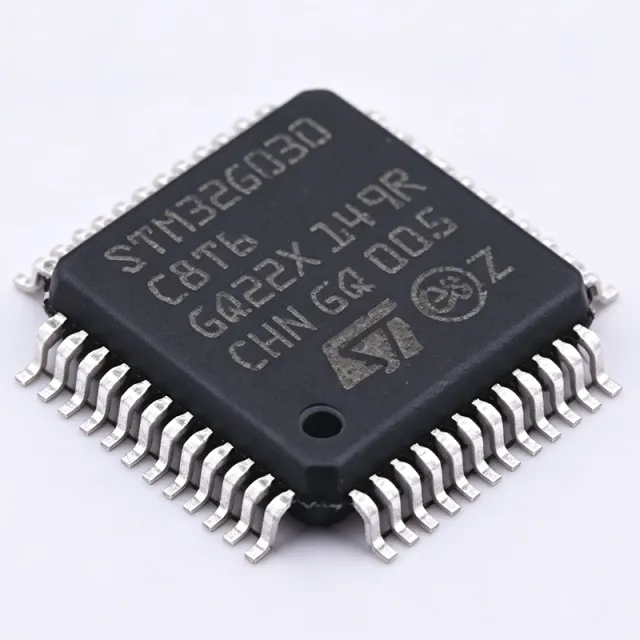
STM32G030C8T6 - 64KB Flash ARM Cortex-M0+ MCU | STMicroelectronics
MPN: STM32G030C8T6 ✓ Active| Qty | Unit Price | Extended |
|---|---|---|
| 1 | $2.15 | $2.15 |
| 10 | $1.93 | $19.30 |
| 100 | $1.72 | $172.00 |
| 500 | $1.55 | $775.00 |
| 1,000 | $1.47 | $1,470.00 |
STM32G030C8T6 Overview
What is a microcontroller? A microcontroller (MCU) is a compact integrated circuit containing a processor core, memory, and programmable input/output peripherals on a single chip. It is the brain of embedded systems, executing instructions to control devices such as sensors, motors, and displays. In the system hierarchy, a microcontroller falls under embedded processors, which are part of the broader category of integrated circuits. The STM32G030C8T6 is a mainstream MCU, balancing performance, power consumption, and cost for a wide range of applications.
Key features include a 12-bit ADC with up to 19 channels, multiple timers (including advanced-control timers), and a rich set of communication interfaces: I2C, SPI, USART, and low-power UART. The device supports a supply voltage range of 2.0V to 3.6V and offers multiple low-power modes (Sleep, Stop, Standby) to optimize energy consumption. It also includes a DMA controller, CRC calculation unit, and a real-time clock (RTC).
The STM32G030C8T6 is built on a high-performance ARM Cortex-M0+ core with a single-cycle multiplier and a nested vectored interrupt controller (NVIC). It features a memory protection unit (MPU) for enhanced security and reliability. The device is supported by ST's comprehensive ecosystem, including the STM32CubeMX configuration tool and the STM32CubeG0 firmware library, which accelerate development.
Typical applications include industrial control systems, consumer electronics, IoT devices, home automation, and battery-powered equipment. Its low power consumption and rich peripheral set make it suitable for sensor hubs, motor control, and human-machine interfaces (HMI).
When designing with this MCU, ensure proper decoupling of the power supply pins with 100nF capacitors placed close to the VDD pins. For low-power applications, utilize the Stop and Standby modes to reduce current consumption to microamp levels. The device is RoHS compliant and available in tape and reel packaging for automated assembly.
Drop-in alternatives for STM32G030C8T6 — same package, pin-to-pin compatible. Different-package parts requiring PCB rework are excluded.
Variants in this series
Same-series models that are drop-in compatible with STM32G030C8T6 (same form factor and footprint) — differing in ADC, Flash Memory, Package, SRAM, Timers.
Quick Comparison Tool — Select alternative parts for side-by-side comparison:
STM32G031C8T6
✓ In Stock
$1.82 / Unit
View Datasheet →STM32G030K8T6
✓ In Stock
$1.02 / Unit
View Datasheet →STM32G030F6P6
✓ In Stock
$0.75 / Unit
View Datasheet →STM32G030C8T6TR
📋 Reference alternative (not in catalog)
LPC824M201JHI33
📋 Reference alternative (not in catalog)
STM32G030C8T6 Maximum Ratings & Electrical Characteristics
| Core | ARM Cortex-M0+ |
| Max Clock Frequency | 64 MHz |
| Flash Memory | 64 KB |
| SRAM | 8 KB |
| Supply Voltage | 2.0 V to 3.6 V |
| Package | LQFP-48 (7x7 mm) |
| ADC | 12-bit, 19 channels |
| Timers | Advanced-control, general-purpose, basic |
| Communication Interfaces | I2C, SPI, USART, LPUART |
| DMA | Yes, 5 channels |
| RTC | Yes |
| Low-Power Modes | Sleep, Stop, Standby |
| Operating Temperature | -40C to +85C |
| RoHS | Compliant |
| Mounting Type | Surface Mount |
STM32G030C8T6 Pin Configuration
| Pin 1 | VBAT — Battery backup supply for RTC |
| Pin 2 | PC13 — GPIO, tamper, RTC output |
| Pin 3 | PC14 — GPIO, OSC32_IN |
| Pin 4 | PC15 — GPIO, OSC32_OUT |
| Pin 5 | PF0 — GPIO, OSC_IN |
| Pin 6 | PF1 — GPIO, OSC_OUT |
| Pin 7 | NRST — Reset (active low) |
| Pin 8 | VDD — Digital power supply |
| Pin 9 | VSS — Ground |
| Pin 10 | PA0 — GPIO, ADC_IN0, TIM2_CH1 |
| Pin 11 | PA1 — GPIO, ADC_IN1, TIM2_CH2 |
| Pin 12 | PA2 — GPIO, ADC_IN2, TIM2_CH3, USART2_TX |
| Pin 13 | PA3 — GPIO, ADC_IN3, TIM2_CH4, USART2_RX |
| Pin 14 | PA4 — GPIO, ADC_IN4, SPI1_NSS |
| Pin 15 | PA5 — GPIO, ADC_IN5, SPI1_SCK |
| Pin 16 | PA6 — GPIO, ADC_IN6, SPI1_MISO |
| Pin 17 | PA7 — GPIO, ADC_IN7, SPI1_MOSI |
| Pin 18 | PB0 — GPIO, ADC_IN8, TIM3_CH3 |
| Pin 19 | PB1 — GPIO, ADC_IN9, TIM3_CH4 |
| Pin 20 | PB2 — GPIO, BOOT1 |
| Pin 21 | PB10 — GPIO, I2C2_SCL, USART3_TX |
| Pin 22 | PB11 — GPIO, I2C2_SDA, USART3_RX |
| Pin 23 | PB12 — GPIO, SPI2_NSS, I2C2_SCL |
| Pin 24 | PB13 — GPIO, SPI2_SCK, I2C2_SDA |
| Pin 25 | PB14 — GPIO, SPI2_MISO, TIM1_CH2N |
| Pin 26 | PB15 — GPIO, SPI2_MOSI, TIM1_CH3N |
| Pin 27 | PC14 — GPIO, OSC32_IN |
| Pin 28 | PC15 — GPIO, OSC32_OUT |
| Pin 29 | PA8 — GPIO, MCO, TIM1_CH1 |
| Pin 30 | PA9 — GPIO, USART1_TX, TIM1_CH2 |
| Pin 31 | PA10 — GPIO, USART1_RX, TIM1_CH3 |
| Pin 32 | PA11 — GPIO, USART1_CTS, CAN_RX |
| Pin 33 | PA12 — GPIO, USART1_RTS, CAN_TX |
| Pin 34 | PA13 — GPIO, SWDIO |
| Pin 35 | PA14 — GPIO, SWCLK |
| Pin 36 | PA15 — GPIO, JTDI |
| Pin 37 | PB3 — GPIO, JTDO |
| Pin 38 | PB4 — GPIO, NJTRST |
| Pin 39 | PB5 — GPIO, I2C1_SMBA |
| Pin 40 | PB6 — GPIO, I2C1_SCL, USART1_TX |
| Pin 41 | PB7 — GPIO, I2C1_SDA, USART1_RX |
| Pin 42 | PB8 — GPIO, I2C1_SCL, CAN_RX |
| Pin 43 | PB9 — GPIO, I2C1_SDA, CAN_TX |
| Pin 44 | VDD — Digital power supply |
| Pin 45 | VSS — Ground |
| Pin 46 | VDDA — Analog power supply |
| Pin 47 | VREF+ — ADC reference voltage |
| Pin 48 | VSSA — Analog ground |
Typical Applications
STM32G030C8T6 is suitable for 6 applications: Industrial Control, IoT Devices, Consumer Electronics, Home Automation, Battery-Powered Equipment, Motor Control.
Industrial Control
The STM32G030C8T6 is ideal for industrial control systems such as PLCs, motor drives, and factory automation. Its 64 MHz Cortex-M0+ core provides sufficient processing power for real-time control loops, while the advanced timers generate precise PWM signals for motor control. The 12-bit ADC enables accurate current and voltage sensing, and the multiple communication interfaces (UART, SPI, I2C) allow seamless integration with sensors and actuators. The wide operating temperature range (-40C to +85C) ensures reliable operation in harsh industrial environments. Additionally, the low-power modes help reduce energy consumption in always-on systems.
Recommended
IoT Devices
For IoT applications, the STM32G030C8T6 offers a perfect balance of performance and power efficiency. Its low-power modes (Sleep, Stop, Standby) enable battery-powered operation for years, making it suitable for wireless sensor nodes, smart home devices, and asset trackers. The integrated RTC allows time-stamping of data, and the communication interfaces (UART, SPI, I2C) connect to Wi-Fi, Bluetooth, or LoRa modules. The 64 KB Flash provides ample space for firmware and protocol stacks. With its small LQFP-48 package, it fits into compact PCB designs, and the STM32Cube ecosystem accelerates development with ready-to-use drivers and examples.
Recommended
Consumer Electronics
The STM32G030C8T6 is widely used in consumer electronics such as smart appliances, remote controls, and gaming peripherals. Its rich peripheral set includes multiple timers for PWM dimming of LEDs, UART for communication with other devices, and I2C for interfacing with EEPROMs or sensors. The 12-bit ADC can read analog inputs like potentiometers or touch sensors. The device's low cost and small footprint make it ideal for high-volume consumer products. Additionally, the STM32G030C8T6 supports firmware updates via bootloader, enabling field upgrades. Its robust design ensures reliable operation in everyday use.
Recommended
Home Automation
In home automation, the STM32G030C8T6 serves as the central controller for smart lighting, thermostats, and security systems. Its low-power modes allow battery-operated devices like smart locks and sensors to run for extended periods. The device supports multiple communication protocols, enabling integration with Zigbee, Z-Wave, or Wi-Fi modules. The advanced timers can generate PWM signals for dimming lights, and the ADC can monitor battery voltage or sensor readings. The STM32G030C8T6's small size and low cost make it ideal for distributed home automation nodes. With STM32CubeMX, developers can quickly configure peripherals and generate initialization code, reducing development time.
Recommended
Battery-Powered Equipment
The STM32G030C8T6 is optimized for battery-powered equipment such as portable medical devices, fitness trackers, and remote controls. Its low-power modes reduce current consumption to microamps in Standby mode, extending battery life. The device operates from 2.0V to 3.6V, allowing direct connection to lithium-ion batteries. The integrated RTC can wake the system at scheduled intervals for periodic measurements. The 12-bit ADC is useful for monitoring battery voltage, and the communication interfaces enable data logging or wireless transmission. The small LQFP-48 package and low cost make it a popular choice for portable devices.
Recommended
Motor Control
The STM32G030C8T6 is well-suited for motor control applications, including brushless DC (BLDC) motors, stepper motors, and DC motors. Its advanced-control timers can generate complementary PWM signals with dead-time insertion, essential for driving H-bridges or three-phase inverters. The 12-bit ADC with multiple channels allows simultaneous sampling of phase currents and DC bus voltage. The device's 64 MHz clock ensures fast control loop execution. Communication interfaces like UART or CAN (via external transceiver) enable connection to a host controller. The STM32G030C8T6's robust design and wide temperature range make it reliable for industrial motor drives.
Recommended
Recommended Products Summary
Engineering reference data for STM32G030C8T6 — comparison, design guidance, and compliance information.
Selection Guide
Comparison with Alternatives
| Parameter | This Product | STM32G031C8T6 | STM32G030C8T6TR | STM32G030K8T6 | STM32G030F6P6 | LPC824M201JHI33 |
|---|---|---|---|---|---|---|
| Package | LQFP-48 | LQFP-48 (same) | LQFP-48 (same) | LQFP-32 (different) | TSSOP-20 (different) | HVQFN-33 (different) |
| Brand | STMicroelectronics | STMicroelectronics | STMicroelectronics | STMicroelectronics | STMicroelectronics | NXP Semiconductors |
| Core | ARM Cortex-M0+ | ARM Cortex-M0+ | ARM Cortex-M0+ | ARM Cortex-M0+ | ARM Cortex-M0+ | ARM Cortex-M0+ |
| Max Clock Frequency | 64 MHz | 64 MHz | 64 MHz | 64 MHz | 64 MHz | 30 MHz |
| Flash Memory | 64 KB | 64 KB | 64 KB | 64 KB | 32 KB | 32 KB |
| SRAM | 8 KB | 8 KB | 8 KB | 8 KB | 4 KB | 8 KB |
| ADC | 12-bit, 19 channels | 12-bit, 19 channels | 12-bit, 19 channels | 12-bit, 19 channels | 12-bit, 19 channels | 12-bit, 12 channels |
| Communication Interfaces | I2C, SPI, USART, LPUART | I2C, SPI, USART, LPUART | I2C, SPI, USART, LPUART | I2C, SPI, USART, LPUART | I2C, SPI, USART, LPUART | I2C, SPI, USART |
Key Differentiators
- Cost-optimized STM32G0 series MCU (vs STM32G031C8T6)
- Wide supply voltage range (2.0V to 3.6V) (vs LPC824M201JHI33)
- Higher clock frequency (64 MHz vs 30 MHz) (vs LPC824M201JHI33)
Design Notes
Decouple each VDD pin with a 100nF ceramic capacitor placed as close to the pin as possible. Additionally, place a 4.7uF or larger bulk capacitor on the main power rail. For VDDA, use a 1uF capacitor and a ferrite bead to isolate analog noise. Ensure VREF+ is connected to VDDA or a clean reference voltage for accurate ADC readings.
For the LQFP-48 package, ensure proper solder paste stencil design to avoid bridging between pins. Use a 0.2mm stencil thickness and follow IPC-7525 guidelines. Provide a ground plane under the MCU to reduce EMI and improve thermal performance. Route high-speed signals away from the crystal oscillator pins to minimize noise coupling.
Do not leave unused GPIO pins floating; configure them as outputs or enable internal pull-ups/pull-downs to avoid excessive current consumption. When using the RTC, ensure VBAT is connected to a battery or a capacitor to maintain timekeeping during power loss. Also, verify that the BOOT0 pin is properly configured to avoid accidental bootloader entry.
Compliance Information
RoHS compliant per STMicroelectronics product page. Not AEC-Q100 qualified; for automotive, consider STM32G0 series with AEC-Q100 qualification.