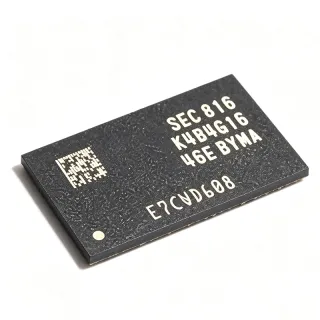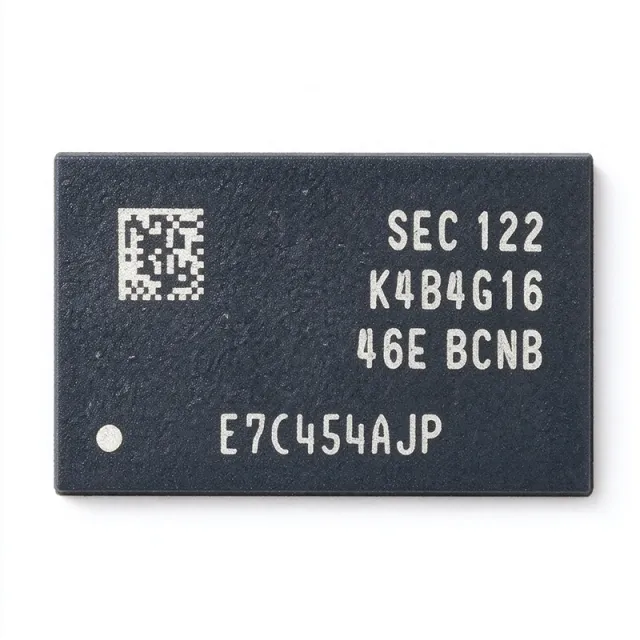
K4B4G1646E-BCNB - 4Gb DDR3L SDRAM 256Mx16 1.35V | Samsung
N.º da peça: K4B4G1646E-BCNB ✓ Ativo| Qtd. | Preço unitário | Total |
|---|---|---|
| 1 | $14.93 | $14,93 |
| 10 | $13.8 | $138,00 |
| 100 | $12.6 | $1.260,00 |
| 500 | $11.4 | $5.700,00 |
| 1.000 | $10.5 | $10.500,00 |
K4B4G1646E-BCNB Visão geral
DDR3L SDRAM (Double Data Rate 3 Low Voltage synchronous dynamic random-access memory) is a JEDEC-standard memory category within the broader DRAM hierarchy: DRAM -> synchronous DRAM (SDRAM) -> DDR SDRAM -> DDR3L. It transfers data on both rising and falling clock edges, doubling effective bandwidth relative to SDR memory, while the L suffix denotes operation at 1.35V (backwards compatible with 1.5V DDR3) for reduced dynamic power.
Key features of the K4B4G1646E include Samsung E-die technology, a 16-bit data interface for parallel transfer, an auto precharge function, an asynchronous reset function, dynamic on-chip termination (ODT), a ZQ calibration function, and a data mask (DM) function, as listed on LCSC and the Samsung datasheet. The operating temperature range is 0C to +95C, suiting commercial and embedded environments.
Architecturally, the device uses an 8-internal-bank DDR3 core with burst lengths of 8 (BL8), on-die termination, and ZQ output calibration to maintain signal integrity at high data rates onFly-by-command-addressed PCB topologies. The E-die process lowers operating and standby current versus earlier 4Gb generations, which matters in battery-powered and thermally constrained enclosures.
Typical applications include single-board computers and ARM SoC platforms (the part ships in Samsung Artik-based designs), industrial PLCs, medical data-logging devices, networking equipment, and automotive infotainment - anywhere a compact 4Gb x16 DDR3L with mainstream availability is required.
Design consideration: verify that the host memory controller supports DDR3L-1866 timing (CL13 at 1.35V) and that the 96-ball FBGA footprint and fly-by routing with per-byte ZQ resistors match the Samsung datasheet layout guidelines.
This page synthesizes verified distributor pricing, drop-in same-package alternatives from Samsung, Winbond, ISSI and Alliance Memory, and practical design notes not found in the manufacturer datasheet alone.
Alternativas drop-in para K4B4G1646E-BCNB — mesmo encapsulamento, compatível pino a pino. Peças de encapsulamento diferente que exigem retrabalho na PCB são excluídas.
Ferramenta de comparação rápida — selecione peças alternativas para comparação lado a lado:
K4B4G1646E-BYK0
✓ Em estoque
$1.8 / unidade
Ver ficha técnica →K4B4G1646E-BYMA
✓ Em estoque
$14.3182 / unidade
Ver ficha técnica →K4B4G1646E-BMMA
✓ Em estoque
$16.0781 / unidade
Ver ficha técnica →K4B4G1646E-BMK0
✓ Em estoque
$6.5 / unidade
Ver ficha técnica →K4B4G1646D-BCK0
✓ Em estoque
$2.3 / unidade
Ver ficha técnica →W634GU6RB11I
✓ Em estoque
$1.95 / unidade
Ver ficha técnica →IS43TR16256AL-125KBL
✓ Em estoque
$5.6 / unidade
Ver ficha técnica →AS4C256M16D3C-93BCN
📋 Alternativa de referência (fora do catálogo)
K4B4G1646E-BCNB Classificações máximas e características elétricas
| Tipo de memória | DDR3L SDRAM |
| Memory Capacity | 4 Gbit |
| Organização da memória | 256M x 16 |
| Taxa de dados | 1866 Mbps |
| Tensão de alimentação | 1.35 V (1.283 V to 1.45 V DDR3L) |
| Interface | Parallel |
| Encapsulamento | 96-ball FBGA |
| Tipo de montagem | Surface Mount |
| Temperatura de operação | 0C to +95C |
| Auto Precharge | Yes |
| Asynchronous Reset | Yes |
| On-Chip Termination | Dynamic ODT |
| ZQ Calibration | Yes |
| Data Mask Function | Yes |
| Die Technology | Samsung E-die |
| Status RoHS | Compliant |
| Speed Grade Suffix | BCN (DDR3L-1866 bin, per Samsung ordering code) |
Guia de Configuração de Pinos do K4B4G1646E-BCNB 96-ball fbga
Configuração de pinos para K4B4G1646E-BCNB (pacote 96-ball fbga). Este CI digital inclui GPIO, interfaces de comunicação (UART, SPI, I2C) e pinos de alimentação. Consulte o datasheet do fabricante para funções alternativas dos pinos e opções de configuração. Essencial para projeto de sistemas embarcados e layout de PCB.

Nenhum dado detalhado de pinagem disponível para K4B4G1646E-BCNB.
Consulte a ficha técnica para a configuração completa dos pinos.
Aplicações típicas
K4B4G1646E-BCNB é adequado para 6 aplicaçãos: Single-Board Computers and ARM SoC Platforms, Industrial PLCs and Factory Automation, Networking and Communication Equipment, Medical Data-Logging Devices, Smart Home and IoT Hubs, Automotive Infotainment (Aftermarket).
Single-Board Computers and ARM SoC Platforms
The K4B4G1646E-BCNB is the main system memory for single-board computers and ARM SoC platforms such as Samsung Artik-based designs. Its 4Gb (512 MB) 256M x16 organization matches the 16-bit DDR3L memory controllers common on mid-range application processors, and the 1866 Mbps data rate provides roughly 3.7 GB/s of peak bandwidth on a single x16 channel - sufficient for Linux-class embedded computing. The 1.35V DDR3L operation cuts dynamic memory power roughly 15-20% versus 1.5V DDR3, which matters in passively cooled and battery-backed boards. Layout follows the standard fly-by command/address topology with ZQ calibration, and the 96-ball FBGA footprint keeps the BOM compact.
Recomendado
Industrial PLCs and Factory Automation
Programmable logic controllers and factory-automation gateways use the K4B4G1646E-BCNB for program memory buffering, retentive data logging, and HMI frame buffers. Its 0C to +95C operating range covers typical control-cabinet environments, and features like asynchronous RESET# let the PLC watchdog reinitialize memory cleanly after a fault. The E-die's lower IDD current reduces heat inside sealed enclosures where airflow is limited. Because DDR3 is JEDEC-standardized, designers can dual-source with Alliance Memory or ISSI pin-compatible parts to guarantee a decade of supply continuity, and the same 96-ball FBGA footprint enables drop-in qualification across vendors.
Recomendado
Networking and Communication Equipment
Switches, routers, and WAN access equipment deploy the K4B4G1646E-BCNB as packet-buffer and control-plane memory. The 1866 Mbps data rate sustains line-rate packet buffering for fast-Ethernet-class designs, while the data-mask (DM) function allows partial writes of packet headers without read-modify-write cycles. Dynamic ODT and ZQ calibration maintain signal integrity on the dense, fly-by-routed DDR3 topologies typical of networking boards with multiple load points. The 96-ball FBGA package suits the compact, high-density layout constraints of managed switch and CPE mainboards, and RoHS compliance aligns with telecom environmental requirements.
Recomendado
Medical Data-Logging Devices
Patient monitors and portable diagnostic instruments use the K4B4G1646E-BCNB to buffer waveforms, images, and audit logs before upload. The device's deterministic DDR3 timing and asynchronous RESET# support the fail-safe data retention strategies required in medical data logging, and the low 1.35V supply reduces battery drain in portable equipment. Its 0C to +95C range covers typical clinical ambient conditions. Because E-die lowers standby current, battery-powered monitor designs benefit from longer sleep-mode endurance. Designers should qualify second sources such as ISSI or Winbond to secure long product lifecycles, as medical platforms often stay in production for 7-10 years.
Recomendado
Smart Home and IoT Hubs
IoT gateways, smart speakers, and home-automation hubs use the K4B4G1646E-BCNB as main memory for local processing, protocol stacks, and edge-AI inference buffers. The 4Gb capacity supports Linux-based hubs, and 16-bit organization keeps cost and PCB layers down versus x32 or dual-x8 configurations. DDR3L's 1.35V operation suits always-on devices where standby power is regulated, and E-die improves low-current retention. The 96-ball FBGA is reflow-compatible with standard SMT lines used in high-volume consumer manufacturing. Controllers in this segment (e.g., mid-range ARM SoCs) commonly support the DDR3L-1866 bin of this component.
Recomendado
Automotive Infotainment (Aftermarket)
Aftermarket and tier-2 automotive infotainment head units and display modules use the K4B4G1646E-BCNB for graphics frame buffers and application memory. The 1866 Mbps rate supports smooth rendering on WVGA-class displays, and the 0C to +95C range fits in-cabin electronics with appropriate enclosure thermal design. DDR3L operation reduces the memory subsystem's share of total unit heat, easing fanless dashboard designs. Note that this commercial-grade BCNB SKU is not AEC-Q100 qualified; for a qualified automotive path, use an I-temperature Samsung variant or an automotive-grade DDR3/DDR4 part such as K4A8G085WB-BICR, keeping memory-controller configuration in mind.
Recomendado
Resumo dos produtos recomendados
Dados de referência de engenharia para K4B4G1646E-BCNB — comparação, orientação de projeto e informações de conformidade.
Guia de seleção
Comparação com alternativas
| Parâmetro | Este produto | K4B4G1646E-BYK0 | K4B4G1646D-BCK0 | W634GU6RB11I | AS4C256M16D3C-93BCN |
|---|---|---|---|---|---|
| Package | 96-ball FBGA | 96-ball FBGA - same | 96-ball FBGA - same | 96-ball FBGA - same | 96-ball FBGA - same |
| Brand | Samsung Electronics | Samsung Electronics | Samsung Electronics | Winbond | Alliance Memory |
| Capacity | 4 Gbit | 4 Gbit | 4 Gbit | 4 Gbit | 4 Gbit |
| Organization | 256M x 16 | 256M x 16 | 256M x 16 | 256M x 16 | 256M x 16 |
| Supply Voltage | 1.35 V (DDR3L) | 1.35 V (DDR3L) | 1.35 V (DDR3L) | 1.35 V (DDR3L) | 1.5 V (DDR3) |
| Die / Technology | Samsung E-die | Samsung E-die | Samsung D-die | Winbond DDR3L process | Alliance (Nanya-fab) DDR3 |
| Lifecycle Priority | Active (Samsung DDR3 mature phase) | Active | Mature/D-die phase-out risk | Long-lifecycle industrial | Long-lifecycle second source |
Principais diferenciais
- Lower power with E-die process (vs K4B4G1646D-BCK0)
- Industrial temperature option in same footprint (vs W634GU6RB11I)
- DDR3L 1.35V native operation (vs AS4C256M16D3C-93BCN)
- 1866 Mbps speed bin headroom (vs IS43TR16256AL-125KBL)
Notas de projeto
DDR3 x16 at 1866 Mbps requires fly-by command/address routing with per-DQS write leveling. Keep command/address length skew within 100 mils across loads and route DQ/DQS as tightly coupled 40-50 ohm pairs with matched intra-pair lengths. Enable dynamic ODT on writes and ZQ calibration at initialization; place the ZQ ball's 240-ohm 1% resistor on a quiet ground island per the Samsung datasheet layout guide. Avoid routing DDR3 traces over board plane splits, which cause impedance discontinuities and eye collapse.
Estimated: with VDD=1.35V and a typical 1866 Mbps read/write mix, per-die current for a 4Gb E-die part is on the order of a few hundred milliamps (consult the datasheet IDD tables for exact ICC values per condition). Budget VDD and VDDQ rails separately, decouple each FBGA ball pair with at least one 0.1 uF ceramic plus bulk 22-47 uF per device. DDR3L is backward-compatible with 1.5V DDR3 controllers, but only within the 1.283-1.45 V DDR3L window - never run it above 1.45V.
A frequent sourcing error is confusing 4 Gb with 4 GB - this part stores 512 MB. Also verify the controller supports the BCN (DDR3L-1866) speed bin; if it tops out at DDR3L-1600, the part runs fine at a relaxed CL but the timing register set must match. Finally, when second-sourcing with Alliance AS4C256M16D3C-93BCN, note that part is 1.5V DDR3, not DDR3L - confirm your regulator and controller before dropping it in, or select the Alliance DDR3L 'D3L' variants instead.
Informações de conformidade
RoHS compliant per Samsung/LCSC listing. Not an automotive AEC-Q100 qualified grade; select an I-temperature variant for automotive paths. REACH/halogen-free status not stated in provided data.