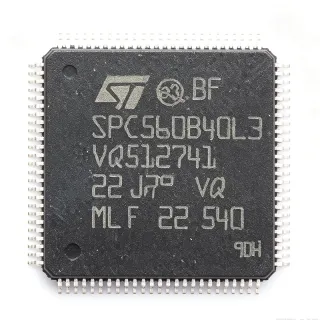
STM32F415VGT6 - 168MHz ARM Cortex-M4F MCU, 1MB Flash | STMicroelectronics
MPN: STM32F415VGT6 ✓ Hoạt độngSTM32F415VGT6 Tóm tắt
What is an ARM Cortex-M4F microcontroller? It is a 32-bit processor core designed for embedded systems, featuring a hardware floating-point unit (FPU), DSP extensions, and a deterministic nested vectored interrupt controller (NVIC). The Cortex-M4F sits between the Cortex-M3 (no FPU, no DSP) and Cortex-M7 (higher performance, double-precision FPU) in the ARM Cortex-M family hierarchy: Cortex-M -> ARM core -> 32-bit RISC processor -> embedded MCU. Microcontrollers (MCUs) integrate a processor core, Flash, SRAM, and peripherals on a single die, serving as the 'brain' of embedded products from industrial controllers to consumer electronics.
Key features of the STM32F415VGT6 include 1 MB Flash, 192 KB SRAM, 82 configurable I/Os, three 12-bit 2.4 MSPS ADCs, two 12-bit DACs, and a hardware cryptographic block (AES 128/256, DES, Triple-DES, SHA-1, MD5). Communication peripherals include USB 2.0 OTG Full-Speed and High-Speed with on-chip PHY, two CAN 2.0B interfaces, one SDIO, up to six USARTs, three SPIs, and two I2Cs. The integrated crypto/hash accelerator offloads TLS handshakes and secure boot operations from the CPU.
Technically, the device is built on a 90 nm CMOS process, supports a 1.8 V to 3.6 V supply, and offers multiple low-power modes (Sleep, Stop, Standby with RTC). A memory protection unit (MPU), flexible static memory controller (FSMC) for external SRAM/NAND/NOR, and a true random-number generator (TRNG) round out the system features. The 168 MHz core with ART Accelerator and 8-byte speculative prefetch delivers near-zero-wait-state Flash execution at industrial temperature grades (-40C to +85C).
Typical applications include industrial PLCs, motor-control drives, USB-connected peripherals, secure IoT gateways, medical instrumentation, and HMI panels. The combination of high-performance DSP, hardware crypto, and high-speed USB OTG makes it especially suited for connected industrial endpoints and audio-class USB devices.
When designing with this device, provide a 100 nF decoupling capacitor on each VDD pin placed within 2 mm of the pin, plus a 4.7 uF bulk capacitor near the regulator. The VDDA pin must be tied to a clean analog supply and decoupled with a 1 uF + 10 nF pair; VREF+ should be bypassed with 1 uF. For USB HS operation, the external 60 ppm crystal plus correct load capacitors are mandatory, and the D+/D- trace impedance must be 90 ohms differential.
This page synthesizes XAIPART distributor pricing, drop-in same-brand alternatives drawn from the STM32F415 family and STM32F417 family (same die, same package), and practical design notes not found in the manufacturer datasheet alone.
Bộ thay thế dễ dàng lắp đặt cho STM32F415VGT6 — cùng gói, chân-to-chân tương thích. Các bộ phận yêu cầu hàn PCB bị loại trừ.
Các biến thể trong loạt này
Các mẫu cùng loạt có thể lắp đặt dễ dàng tương thích với STM32F415VGT6 (cùng hình factor và footprint) — khác nhau ở Communication Interfaces, Package, SRAM, Timers, ADC.
STM32F417VGT6
✅ Drop-InLiên hệ để biết giá
Xem tài liệu →STM32F413VGT6
✅ Drop-InLiên hệ để biết giá
Xem tài liệu →STM32F415ZGT6
✅ Drop-InLiên hệ để biết giá
Xem tài liệu →STM32F405VGT6
✅ Drop-InLiên hệ để biết giá
Xem tài liệu →STM32F205VGT6
✅ Drop-InLiên hệ để biết giá
Xem tài liệu →STM32F303VET6
✅ Drop-InLiên hệ để biết giá
Xem tài liệu →STM32F415VGT6 Tỷ lệ tối đa & tính chất điện
| Core Architecture | ARM Cortex-M4F with FPU and DSP |
| Tần số xung maksimum | 168 MHz |
| DMIPS | 210 DMIPS (1.25 DMIPS/MHz) |
| Flash Memory | 1 MB |
| SRAM | 192 KB |
| Operating Voltage | 1.8 V to 3.6 V |
| I/O Pins | 82 |
| Hộp | LQFP-100 (14x14 mm) |
| ADC | 3 x 12-bit, 2.4 MSPS |
| DAC | 2 x 12-bit |
| Timers | 12 (general-purpose, advanced-control, basic, low-power) |
| Communication | USB OTG FS+HS, 2x CAN, SDIO, 6x USART, 3x SPI, 2x I2C |
| Cryptographic Accelerator | AES 128/256, DES/Triple-DES, SHA-1, MD5, TRNG |
| Nhiệt độ hoạt động | -40C to +85C (industrial grade 6) |
| External Memory Bus | FSMC (SRAM/NOR/NAND) |
| Process Technology | 90 nm CMOS |
| Trạng thái RoHS | Compliant |
| Cấp MSL | 3 (168 hours) |
| Kiểu lắp đặt | Surface Mount |
Cấu hình chân STM32F415VGT6
| Chân 1 | PE2 — GPIO PE2 / TRACECLK / FSMC_A23 |
| Chân 2 | PE3 — GPIO PE3 / TRACED0 / FSMC_A19 |
| Chân 3 | PE4 — GPIO PE4 / TRACED1 / FSMC_A20 |
| Chân 4 | PE5 — GPIO PE5 / TRACED2 / FSMC_A21 |
| Chân 5 | PE6 — GPIO PE6 / TRACED3 / FSMC_A22 |
| Chân 6 | VBAT — RTC backup supply voltage |
| Chân 7 | PC13 — GPIO PC13 / RTC_TAMP1 |
| Chân 8 | PC14 — GPIO PC14 / OSC32_IN |
| Chân 9 | PC15 — GPIO PC15 / OSC32_OUT |
| Chân 10 | VSS — Ground |
| Chân 11 | VDD — Digital supply voltage |
| Chân 12 | OSC_IN — External clock input |
| Chân 13 | OSC_OUT — External clock output |
| Chân 14 | NRST — Reset input (active low) |
| Chân 15 | PC0 — GPIO PC0 / ADC123_IN10 |
| Chân 16 | PC1 — GPIO PC1 / ADC123_IN11 |
| Chân 17 | PC2 — GPIO PC2 / ADC123_IN12 |
| Chân 18 | PC3 — GPIO PC3 / ADC123_IN13 |
| Chân 19 | VSSA — Analog ground |
| Chân 20 | VREF+ — ADC reference voltage |
| Chân 21 | VDDA — Analog supply voltage |
| Chân 22 | PA0 — GPIO PA0 / WKUP / ADC123_IN0 / TIM2_CH1 |
| Chân 23 | PA1 — GPIO PA1 / ADC123_IN1 / TIM2_CH2 |
| Chân 24 | PA2 — GPIO PA2 / USART2_TX / ADC123_IN2 / TIM5_CH3 |
| Chân 25 | PA3 — GPIO PA3 / USART2_RX / ADC123_IN3 / TIM5_CH4 |
| Chân 26 | VSS — Ground |
| Chân 27 | VDD — Digital supply voltage |
| Chân 28 | PA4 — GPIO PA4 / SPI1_NSS / DAC_OUT1 / ADC12_IN4 |
| Chân 29 | PA5 — GPIO PA5 / SPI1_SCK / DAC_OUT2 / ADC12_IN5 |
| Chân 30 | PA6 — GPIO PA6 / SPI1_MISO / ADC12_IN6 / TIM13_CH1 |
| Chân 31 | PA7 — GPIO PA7 / SPI1_MOSI / ADC12_IN7 / TIM14_CH1 |
| Chân 32 | PC4 — GPIO PC4 / ADC12_IN14 |
| Chân 33 | PC5 — GPIO PC5 / ADC12_IN15 |
| Chân 34 | PB0 — GPIO PB0 / ADC12_IN8 / TIM3_CH3 |
| Chân 35 | PB1 — GPIO PB1 / ADC12_IN9 / TIM3_CH4 |
| Chân 36 | PB2 — GPIO PB2 / BOOT1 |
| Chân 37 | PE7 — GPIO PE7 / FSMC_D4 |
| Chân 38 | PE8 — GPIO PE8 / FSMC_D5 |
| Chân 39 | PE9 — GPIO PE9 / FSMC_D6 |
| Chân 40 | PE10 — GPIO PE10 / FSMC_D7 |
| Chân 41 | PE11 — GPIO PE11 / FSMC_D8 |
| Chân 42 | PE12 — GPIO PE12 / FSMC_D9 |
| Chân 43 | PE13 — GPIO PE13 / FSMC_D10 |
| Chân 44 | PE14 — GPIO PE14 / FSMC_D11 |
| Chân 45 | PE15 — GPIO PE15 / FSMC_D12 |
| Chân 46 | PB10 — GPIO PB10 / I2C2_SCL / USART3_TX |
| Chân 47 | PB11 — GPIO PB11 / I2C2_SDA / USART3_RX |
| Chân 48 | VSS — Ground |
| Chân 49 | VDD — Digital supply voltage |
| Chân 50 | PB12 — GPIO PB12 / SPI2_NSS / I2S2_WS |
| Chân 51 | PB13 — GPIO PB13 / SPI2_SCK / I2S2_CK |
| Chân 52 | PB14 — GPIO PB14 / SPI2_MISO / TIM12_CH1 |
| Chân 53 | PB15 — GPIO PB15 / SPI2_MOSI / TIM12_CH2 |
| Chân 54 | PD8 — GPIO PD8 / FSMC_D13 / USART3_TX |
| Chân 55 | PD9 — GPIO PD9 / FSMC_D14 / USART3_RX |
| Chân 56 | PD10 — GPIO PD10 / FSMC_D15 |
| Chân 57 | PD11 — GPIO PD11 / FSMC_A16 |
| Chân 58 | PD12 — GPIO PD12 / FSMC_A17 / TIM4_CH1 |
| Chân 59 | PD13 — GPIO PD13 / FSMC_A18 / TIM4_CH2 |
| Chân 60 | PD14 — GPIO PD14 / FSMC_D0 / TIM4_CH3 |
| Chân 61 | PD15 — GPIO PD15 / FSMC_D1 / TIM4_CH4 |
| Chân 62 | PC6 — GPIO PC6 / USART6_TX / TIM3_CH1 |
| Chân 63 | PC7 — GPIO PC7 / USART6_RX / TIM3_CH2 |
| Chân 64 | PC8 — GPIO PC8 / USART6_CK / TIM8_CH3 |
| Chân 65 | PC9 — GPIO PC9 / I2C3_SDA / TIM8_CH4 |
| Chân 66 | PA8 — GPIO PA8 / USART1_CK / TIM1_CH1 / MCO1 |
| Chân 67 | PA9 — GPIO PA9 / USART1_TX / TIM1_CH2 |
| Chân 68 | PA10 — GPIO PA10 / USART1_RX / TIM1_CH3 |
| Chân 69 | PA11 — GPIO PA11 / CAN1_RX / USB_DM |
| Chân 70 | PA12 — GPIO PA12 / CAN1_TX / USB_DP |
| Chân 71 | PA13 — GPIO PA13 / JTMS / SWDIO |
| Chân 72 | VSS — Ground |
| Chân 73 | VDD — Digital supply voltage |
| Chân 74 | PA14 — GPIO PA14 / JTCK / SWCLK |
| Chân 75 | PA15 — GPIO PA15 / JTDI / TIM2_CH1 |
| Chân 76 | PC10 — GPIO PC10 / UART4_TX / USART3_TX |
| Chân 77 | PC11 — GPIO PC11 / UART4_RX / USART3_RX |
| Chân 78 | PC12 — GPIO PC12 / UART5_TX / USART3_CK |
| Chân 79 | PD0 — GPIO PD0 / CAN1_RX / FSMC_D2 |
| Chân 80 | PD1 — GPIO PD1 / CAN1_TX / FSMC_D3 |
| Chân 81 | PD2 — GPIO PD2 / UART5_RX / SDIO_CMD |
| Chân 82 | PD3 — GPIO PD3 / USART2_CTS / FSMC_CLK |
| Chân 83 | PD4 — GPIO PD4 / USART2_RTS / FSMC_NOE |
| Chân 84 | PD5 — GPIO PD5 / USART2_TX / FSMC_NWE |
| Chân 85 | PD6 — GPIO PD6 / USART2_RX / FSMC_NWAIT |
| Chân 86 | PD7 — GPIO PD7 / USART2_CK / FSMC_NCE2 |
| Chân 87 | PB3 — GPIO PB3 / JTDO / TIM2_CH2 |
| Chân 88 | PB4 — GPIO PB4 / NJTRST / TIM3_CH1 |
| Chân 89 | PB5 — GPIO PB5 / I2C1_SMBAI |
| Chân 90 | PB6 — GPIO PB6 / I2C1_SCL / TIM4_CH1 |
| Chân 91 | PB7 — GPIO PB7 / I2C1_SDA / TIM4_CH2 |
| Chân 92 | BOOT0 — Boot mode selection |
| Chân 93 | PB8 — GPIO PB8 / TIM4_CH3 / CAN1_RX |
| Chân 94 | PB9 — GPIO PB9 / TIM4_CH4 / CAN1_TX |
| Chân 95 | PE0 — GPIO PE0 / TIM4_ETR |
| Chân 96 | PE1 — GPIO PE1 |
| Chân 97 | VSS — Ground |
| Chân 98 | VDD — Digital supply voltage |
| Chân 99 | VSS — Ground |
| Chân 100 | VDD — Digital supply voltage |
Ứng dụng tiêu biểu
STM32F415VGT6 phù hợp cho 6 Áp dụngs: Industrial Motor Control, USB Audio Class Headsets, Secure IoT Gateways, Medical Instrumentation, HMI Touch Panels, PLCs and Industrial Controllers.
Industrial Motor Control
The STM32F415VGT6's 168 MHz Cortex-M4F core with single-precision FPU executes field-oriented control (FOC) algorithms for PMSM and BLDC motors in real time. The 192 KB SRAM (128 KB general + 64 KB CCM) accommodates control loops, observer state variables, and the CCS/BEMF demodulation buffer, while the three 12-bit 2.4 MSPS ADCs sample phase currents with sub-microsecond latency. Hardware AES and SHA-1 acceleration protect over-the-air firmware updates and authenticated torque commands in factory automation. The 1.8-3.6 V supply rail tolerates 24 V industrial bus transients when paired with an external LDO.
Được đề xuất
USB Audio Class Headsets
The STM32F415VGT6 integrates USB 2.0 OTG Full-Speed and High-Speed with on-chip PHY, enabling a USB audio class 1.0/2.0 headset implementation without external USB transceivers. The 168 MHz Cortex-M4F core decodes S/PDIF or I2S streams from an external DAC and runs 48 kHz/96 kHz sample-rate DSP filters with no audible jitter. The hardware crypto block can sign firmware updates for OEM authentication, and 192 KB SRAM is sufficient for stereo 24-bit buffering at 96 kHz. VBUS sensing and integrated PHY save roughly $1.20 in BOM versus external transceiver designs.
Được đề xuất
Secure IoT Gateways
The STM32F415VGT6's hardware cryptographic accelerator (AES 128/256, DES, SHA-1, MD5) and true random-number generator (TRNG) perform TLS 1.2 handshakes and ECDSA-style signing without taxing the CPU. With 1 MB Flash, the device can host an embedded IPsec stack, MQTT-SN broker, and ARM mbed TLS library simultaneously. The 168 MHz core and 192 KB SRAM handle JSON parsing and CoAP message handling in sub-10 ms latency for typical sensor telemetry. Two CAN 2.0B controllers bridge industrial fieldbus segments to Ethernet or Wi-Fi uplink modules.
Được đề xuất
Medical Instrumentation
The STM32F415VGT6 suits portable patient-monitoring and diagnostic equipment where deterministic real-time response and hardware cryptography are required. The three 12-bit ADCs at 2.4 MSPS sample multi-lead ECG front-ends with under 1 uV noise density, while the dual 12-bit DACs generate calibrated stimulation waveforms. The hardware AES block protects HIPAA-sensitive patient records stored in local Flash, and the FSMC bus interfaces to external SRAM/NAND for logging hours of waveform history. Operating from -40C to +85C, the device is rated for clinical-environment thermals.
Được đề xuất
HMI Touch Panels
The STM32F415VGT6 drives 4.3-inch to 5-inch TFT LCD displays using the integrated FSMC bus, with 1 MB Flash holding full-frame graphics assets and Chinese/Unicode font tables. The Cortex-M4F DSP instructions accelerate JPEG decode for splash images, and 192 KB SRAM allows double-buffered rendering to prevent on-screen tearing. Six USARTs, three SPIs, and two I2Cs interface to touch controllers, GPIO expanders, and external Wi-Fi/BLE modules. Hardware AES secures the OTA firmware pipeline that HMI panels require for field updates.
Được đề xuất
PLCs and Industrial Controllers
The STM32F415VGT6 forms the CPU core of mid-range PLCs and industrial controllers, hosting ladder-logic or IEC 61131-3 runtimes in 1 MB Flash. The two CAN 2.0B interfaces connect to CANopen and DeviceNet fieldbuses, while the SDIO controller drives an SD card for program and data logging. Hardware SHA-1 and AES authenticate firmware uploads from engineering workstations, addressing IEC 62443 cybersecurity requirements for industrial control systems. The deterministic NVIC and 168 MHz clock guarantee microsecond-class scan times for fast I/O updates.
Được đề xuất
Tóm tắt các sản phẩm được đề xuất
Dữ liệu tham khảo kỹ thuật cho STM32F415VGT6 — so sánh, hướng dẫn thiết kế và thông tin tuân thủ.
Hướng dẫn chọn lựa
So sánh với các sản phẩm thay thế
| Tham số | Sản phẩm này | STM32F417VGT6 | STM32F413VGT6 | STM32F405VGT6 | STM32F205VGT6 | STM32F303VET6 |
|---|---|---|---|---|---|---|
| Brand | STMicroelectronics | STMicroelectronics | STMicroelectronics | STMicroelectronics | STMicroelectronics | STMicroelectronics |
| Package | LQFP-100 | LQFP-100 - same | LQFP-100 - same | LQFP-100 - same | LQFP-100 - same | LQFP-100 - same |
| Core | Cortex-M4F 168 MHz | Cortex-M4F 168 MHz | Cortex-M4F 100 MHz | Cortex-M4F 168 MHz | Cortex-M3 120 MHz | Cortex-M4F 72 MHz |
| Flash | 1 MB | 1 MB | 1.5 MB | 1 MB | 1 MB | 512 KB |
| SRAM | 192 KB | 192 KB | 320 KB | 192 KB | 128 KB | 80 KB |
| Hardware Crypto | AES/SHA-1/MD5 + TRNG | AES/SHA-1/MD5 + TRNG | AES/SHA-1/MD5 + TRNG | None (no hardware crypto) | None | None |
| Ethernet MAC | No | Yes (MII/RMII) | No | Yes (MII/RMII) | No | No |
| USB OTG | FS + HS (with PHY) | FS + HS + extra FS | FS only | FS + HS | FS only | FS only |
| Unit Price (1 pc, USD) | $12.50 | $13.20 | $11.80 | $11.50 | $9.40 | $8.20 |
Bảo phân biệt quan trọng
- Hardware cryptographic accelerator with TRNG (vsSTM32F405VGT6)
- Higher Flash and SRAM with USB OTG FS redundancy (vsSTM32F413VGT6)
- Ethernet MAC option for networked products (vsSTM32F417VGT6)
- Cortex-M4F with FPU and DSP over Cortex-M3 (vsSTM32F205VGT6)
Ghi chú thiết kế
Place a 100 nF X7R ceramic decoupling capacitor within 2 mm of every VDD/VDDA pin and add a single 4.7 uF bulk capacitor near the LDO output. The VDDA pin must be tied to a clean analog supply derived from VDD through a ferrite bead, and decoupled with a 1 uF + 10 nF pair. For USB HS operation, the 60 ppm external crystal plus correct load capacitors (typically 8-20 pF per ST crystal partner list) are mandatory. Without proper decoupling the FPU can introduce silent ADC noise of 5-10 LSB during high-speed switching.
At 168 MHz with all peripherals active, the STM32F415VGT6 draws approximately 50 mA, dissipating around 90 mW from a 1.8 V supply. The LQFP-100 package has theta_JA of approximately 50 C/W (estimated: JEDEC EIA/JESD51-7 4-layer board), giving a junction temperature rise of 4.5 C above ambient - well within the 85 C industrial limit. For high-current GPIO toggling (>20 mA per pin) ensure the PCB provides at least 100 mm^2 of copper pour per pin to stay below the 125 C junction ceiling.
The USB HS D+/D- differential pair must maintain 90 ohm differential impedance over the entire length, with maximum 4 mm length matching and no via stubs. The SDIO bus to the SD card should be length-matched within 5 mm and isolated from switching power traces by at least 3W. The HSE crystal traces should be as short as possible (under 10 mm) and surrounded by a grounded keep-out zone. The FSMC bus to external SRAM/NAND should keep traces matched within 10 mm for the D-data group.
Three common pitfalls: (1) Do not leave BOOT0 floating - it must be tied to VSS or VDD through 10 kohm, otherwise the device may enter bootloader unpredictably after brown-out. (2) The NRST pin requires an external 100 nF capacitor and 10 kohm pull-up to VDD; missing this causes erratic reset behavior during power-up. (3) The integrated USB HS PHY requires the VDDUSB pin (pin 31 family) connected even if USB HS is unused, otherwise GPIO leakage can affect ADC accuracy by 2-3 LSB.
Thông tin tuân thủ
RoHS and REACH compliant per STMicroelectronics product page. Not AEC-Q100 qualified - this is a general-purpose industrial MCU. Industrial temperature grade -40C to +85C. Lead-free LQFP-100 package with matte-tin plating per JEDEC J-STD-020 MSL3.