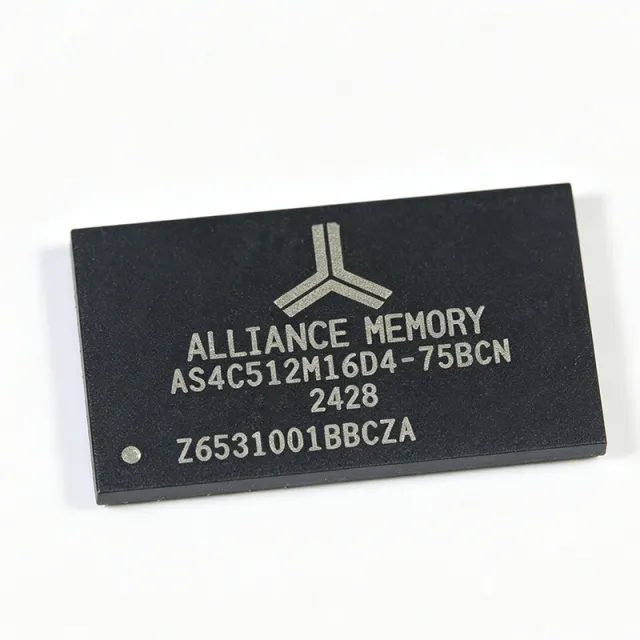
AS4C512M16D4-75BCNTR - 8Gb DDR4 SDRAM 2666Mbps | Alliance Memory
MPN: AS4C512M16D4-75BCNTR ✓ 啟用中| 數量 | 單價 | 小計 |
|---|---|---|
| 1 | $12.5 | $12.50 |
| 10 | $11.25 | $112.50 |
| 100 | $9.8 | $980.00 |
| 500 | $8.75 | $4,375.00 |
| 1,000 | $7.9 | $7,900.00 |
AS4C512M16D4-75BCNTR 概覽
DDR4 SDRAM (fourth-generation Double Data Rate Synchronous Dynamic Random-Access Memory) is a volatile memory technology that transfers data on both clock edges, doubling bandwidth relative to DDR3 at the same clock. In the memory hierarchy it sits as the main-system-memory component below CPU caches, and is a core element of the power-management-aware computing platform. DDR4 lowers the core supply from 1.5V (DDR3) to 1.2V, cutting dynamic power while increasing bank count to sixteen internal banks.
Key features of this device include the 8Gbit density in a x16 organization, the 8n prefetch architecture that enables the 2666 Mbps data rate, on-die termination (ODT), programmable read and write latencies, and both auto-refresh and self-refresh modes. The -75 speed grade provides an 18 ns access time and 15 ns write cycle time, suited to mainstream DDR4-2666 memory controllers.
Technically, the device is built on a 20nm-class DRAM process, balancing density, speed, and power efficiency. Sixteen internal banks reduce bank-conflict penalties, pseudo-differential DQS strobes improve signal integrity at 2666 Mbps, and the commercial temperature rating (0C to +95C case) covers standard enterprise environments. The 96-ball FBGA shortens ball-to-die interconnects, minimizing parasitic inductance on the data bus.
Typical applications include enterprise servers and storage controllers, networking switches and routers, industrial computing platforms, and high-performance embedded systems where 8Gbit-per-component density reduces component count versus 4Gb parts.
A key design consideration: at DDR4-2666 speeds, signal integrity dominates - follow the datasheet fly-by routing for address/command, terminate per the ODT guidelines, and place decoupling capacitors directly at the VDD/VDDQ balls; the 1.14V to 1.26V supply window requires a tight regulation budget.
This page adds value beyond the manufacturer datasheet by synthesizing distributor pricing tiers, drop-in alternatives within the Alliance Memory family, cross-reference guidance, and practical DDR4 layout notes in one citable resource.
直接替換替代品,適用於 AS4C512M16D4-75BCNTR — 相同封裝,腳位對腳位相容。需重新設計 PCB 的不同封裝零件不列入。
此系列的變體
與下列產品可直接替換的同系列型號: AS4C512M16D4-75BCNTR (相同外形與佔位) — 差異在於 Data Rate, Package, CAS Latency, Interface, Supply Voltage.
快速比較工具 — 選擇替代零件進行並排比較:
AS4C512M16D4-75BCN
✅ 直接替換✓ 有庫存
$7.75 / 單位
查看資料表 →AS4C512M16D4-75BIN
✅ 直接替換聯絡詢價
查看資料表 →AS4C512M16D4B-62BCNTR
✅ 直接替換聯絡詢價
查看資料表 →AS4C512M16D4A-62BCNTR
✅ 直接替換聯絡詢價
查看資料表 →AS4C512M16D4A-62BCN
✅ 直接替換聯絡詢價
查看資料表 →AS4C512M16D4A-62BIN
✅ 直接替換聯絡詢價
查看資料表 →AS4C512M16D4-75BCNTR 最大額定值與電氣特性
| 記憶體類型 | DDR4 SDRAM |
| Density | 8 Gbit |
| 組織 | 512M x 16 |
| Clock Frequency | 1.333 GHz |
| 資料速率 | 2666 Mbps per pin |
| Access Time | 18 ns |
| Write Cycle Time | 15 ns |
| Supply Voltage (VDD) | 1.2 V (range 1.14 V to 1.26 V) |
| 介面 | Parallel |
| Prefetch Architecture | 8n |
| Internal Bank Count | 16 banks |
| 封裝 | 96-ball FBGA (7.5 x 13 mm) |
| 工作溫度範圍 | 0C to +95C (case, commercial) |
| Process Technology | 20nm-class DRAM |
| Termination | On-die termination (ODT) |
| Refresh Modes | Auto-refresh and self-refresh |
| 安裝類型 | Surface Mount |
| Packaging Option | Tape & Reel (TR suffix) |
| RoHS 狀態 | Compliant |
| Lead-Free | Yes |
AS4C512M16D4-75BCNTR 96-ball fbga (7.5 x 13 mm) 腳位配置指南
AS4C512M16D4-75BCNTR(96-ball fbga (7.5 x 13 mm) 封裝)的腳位配置。 此數位 IC 包含 GPIO、通訊介面(UART、SPI、I2C)與電源腳位。替代腳位功能與配置選項請參閱製造商資料表。對嵌入式系統設計與 PCB 佈局至關重要。

無詳細腳位定義資料: AS4C512M16D4-75BCNTR.
請參閱 資料表 以查看完整腳位配置。
典型應用
AS4C512M16D4-75BCNTR 適用於 6 應用s: Enterprise Servers and Storage, Networking Switches and Routers, Industrial Computing, High-Performance Embedded Systems, Data Center and Cloud Computing Memory, Networking Appliances and Firewalls.
Enterprise Servers and Storage
The AS4C512M16D4-75BCNTR provides 8Gbit per component at DDR4-2666, letting server and storage mainboards reach high densities with fewer DRAM packages. The 512Mx16 organization pairs efficiently with 64-bit memory controllers using two components per rank, and the 1.2V supply reduces per-bit power versus DDR3 at equivalent bandwidth. With sixteen internal banks, bank-conflict stalls under random-access workloads common in database and virtualization traffic are reduced. The commercial 0C to +95C case rating matches climate-controlled data-center environments, and auto/self-refresh modes support power-capped server profiles. Decoupling at the VDDQ balls and fly-by address routing per the datasheet keep signal integrity within JEDEC-style DDR4-2666 margins.
推薦
Networking Switches and Routers
Networking line cards need deep packet buffers and large flow tables, making the 8Gbit AS4C512M16D4-75BCNTR well suited: its 2666 Mbps per pin data rate sustains high packet-throughput buffering, while the x16 bus reduces component count versus x8 parts. The 18 ns access time keeps latency predictable for QoS queuing, and on-die termination simplifies multi-drop-ish topologies on dense line cards. Pseudo-differential DQS preserves read capture margins at DDR4-2666 despite long trace runs typical of switch mainboards. The commercial case temperature range fits managed telecom closets, and self-refresh supports warm-standby low-power states between traffic bursts.
推薦
Industrial Computing
Industrial PCs, HMIs, and edge controllers benefit from the AS4C512M16D4-75BCNTR's 8Gbit density and low 1.2V power draw, extending thermal budgets in fanless enclosures. For deployments below 0C or above standard office ambients, the pin-identical AS4C512M16D4-75BIN industrial variant drops onto the same PCB with zero layout rework - a supply-chain and qualification advantage of the Alliance Memory family. Sixteen banks handle the mixed read/write patterns of data logging and protocol conversion, while self-refresh supports the standby states mandated by industrial energy codes. Follow datasheet ODT and length-matching rules to hold DDR4-2666 margins on 4-8 layer industrial stacks.
推薦
High-Performance Embedded Systems
Embedded vision, AI inference at the edge, and test-and-measurement platforms need memory bandwidth without the complexity of discrete DIMMs. Soldering the AS4C512M16D4-75BCNTR directly on the baseboard provides 8Gbit in one 96-ball FBGA with 2666 Mbps per pin, feeding SoCs with DDR4 controllers at DDR4-2666. The 8n prefetch architecture and 15 ns write cycle keep burst transactions efficient for frame buffers and neural-network weight storage. Tape-and-reel packaging supports automated SMT assembly in volume production. Layout discipline - matched DQ/DQS groups, fly-by address/command with ODT, and solid 1.14V-1.26V rails - is essential to meet eye-mask margins at this data rate.
推薦
Data Center and Cloud Computing Memory
Cloud server motherboards and memory daughter-cards scale capacity by populating multiple 8Gb components per channel; the AS4C512M16D4-75BCNTR's 512Mx16 organization lets a 64-bit channel achieve 16 Gbit with just two packages per rank, simplifying BOM and placement. The 1.2V rail and 20nm-class process cut watts-per-gigabyte, directly reducing data-center operating expense at fleet scale. On-die termination reduces external termination components on multi-rank buses. Refresh management via auto and self-refresh modes balances retention with availability during power management events. The commercial temperature rating and RoHS compliance align with standard hyperscale build requirements.
推薦
Networking Appliances and Firewalls
Security appliances performing deep packet inspection need working memory sized for session tables and reassembly buffers. The AS4C512M16D4-75BCNTR offers 8Gbit per package at DDR4-2666, giving designers headroom to grow table sizes without redesigning around higher densities. Its x16 bus maps cleanly onto typical 32/64-bit SoC DDR4 controllers, and the 96-ball FBGA's short ball interconnects limit parasitic inductance on switching-heavy data traffic. Sixteen banks reduce contention when IPS engines interleave table lookups with buffer management. For appliances rated to industrial ambient, the same-footprint -75BIN variant provides -40C capability without PCB changes.
推薦
推薦產品摘要
工程參考資料,適用於 AS4C512M16D4-75BCNTR — 比較、設計指引及合規資訊。
選型指南
與替代品比較
| 參數 | 本產品 | AS4C512M16D4-75BCN | AS4C512M16D4-75BIN | AS4C512M16D4B-62BCNTR | AS4C512M16D4A-62BCNTR |
|---|---|---|---|---|---|
| Package | 96-FBGA (7.5x13 mm) | 96-FBGA (7.5x13 mm) - same | 96-FBGA (7.5x13 mm) - same | 96-FBGA (7.5x13 mm) - same | 96-FBGA (7.5x13 mm) - same |
| Brand | Alliance Memory | Alliance Memory | Alliance Memory | Alliance Memory | Alliance Memory |
| Density / Organization | 8 Gbit, 512M x 16 | 8 Gbit, 512M x 16 | 8 Gbit, 512M x 16 | 8 Gbit, 512M x 16 | 8 Gbit, 512M x 16 |
| Speed Grade | -75 (DDR4-2666, 18 ns access) | -75 (DDR4-2666) | -75 (DDR4-2666) | -62 (DDR4-3200 class) | -62 (DDR4-3200 class) |
| Supply Voltage | 1.2 V (1.14-1.26 V) | 1.2 V (1.14-1.26 V) | 1.2 V (1.14-1.26 V) | 1.2 V (1.14-1.26 V) | 1.2 V (1.14-1.26 V) |
| Temperature Range | Commercial (0C to +95C case) | Commercial (0C to +95C) | Industrial (-40C to +95C) | Commercial (0C to +95C) | Commercial (0C to +95C) |
| Packaging | Tape & Reel (TR) | Tray | Tape & Reel | Tape & Reel | Tape & Reel |
| Internal Banks / Prefetch | 16 banks, 8n prefetch | 16 banks, 8n prefetch | 16 banks, 8n prefetch | 16 banks, 8n prefetch | 16 banks, 8n prefetch |
主要差異化特點
- Industrial temperature drop-in available (對比AS4C512M16D4-75BIN)
- Higher-bandwidth drop-in option (對比AS4C512M16D4B-62BCNTR)
- 8Gbit density reduces component count (對比4Gbit DDR4 alternatives)
設計說明
At DDR4-2666 (2666 Mbps per pin), DQ/DQS skews and ISI dominate margins. Route each x16 DQ byte group with length matching to its pseudo-differential DQS pair within the controller's skew spec, avoid stubs on strobe and clock nets, and use fly-by routing for address/command with per-die ODT enabled. Verify eye masks at the controller's DDR4-2666 operating point; the Alliance Memory datasheet AC tables define tDQSS, tDS/tDH windows that your stackup must support.
Supply rails must hold 1.14V to 1.26V under refresh-burst and read/write transients. Place bulk capacitance (e.g., 47uF class) near each component plus 0.1uF ceramics directly at the VDD/VDDQ FBGA balls. Estimated: a 16-bit DDR4-2666 interface at typical activity draws on the order of a few hundred mA per component - a low-impedance PDN plane under the package is the primary defense against droop-induced tDQSS errors. Confirm actual rail design with your PMIC/controller reference design.
Do not mix the commercial (-75BCN, 0C to +95C case) part into a design that must cold-start below 0C - use the -75BIN industrial variant instead, which is pin-identical. Also confirm your memory controller supports the die revision in use; Alliance publishes a comparison document (AS4C512M16D4-75BCN vs AS4C512M16D4B-62BCN) for migration between the standard and B-revision dies. Schedule controller re-training when swapping speed grades even within the same footprint.
合規資訊
RoHS compliant and lead-free per Alliance Memory product data and internal database. REACH, halogen-free, and conflict-minerals statements not stated in the provided data.