Interface ICs
ژێرپۆلەکان
بەرهەمەکان (560+)

ADM2491EBRWZ - Isolated 16Mbps RS-485/422 Transceiver | Analog Devices
The Analog Devices ADM2491EBRWZ is an isolated, high-speed, full-/half-duplex RS-485/RS-422 transceiver integrating Analog Devices' iCoupler® digital isolator with a differential line transceiver in a single 16-lead wide-body SOIC (RW-16) package. It delivers 5000 Vrms galvanic isolation, ±8 kV ESD protection on the RS-485 bus pins, and supports data rates up to 16 Mbps over the operating range of -40°C to +105°C. The logic-side supply is 3.0 V to 5.5 V and the bus-side is supplied from an integrated isolated DC/DC derived from VDD. A digital isolator is a semiconductor device that transfers digital signals across a galvanic isolation barrier using chip-scale transformers, giant magnetoresistance (GMR), or RF-coupled techniques. In RS-485 systems, the isolator breaks ground loops between the host controller and the fieldbus, allowing common-mode voltages of hundreds of volts to exist between nodes without damaging low-voltage controller ICs. The ADM2491E sits at the intersection of the digital isolator hierarchy (digital isolator -> isolator -> interface IC) and the line transceiver hierarchy (RS-485 transceiver -> transceiver -> interface IC), replacing a discrete opto-isolated RS-485 implementation with a single chip. Key specifications include a 25 kV/µs common-mode transient immunity (CMTI), low loop latency, 1 unit-load (allowing up to 256 nodes on the bus), current limiting and thermal shutdown on the driver outputs, and compliance with ANSI TIA/EIA RS-485-A-1998 and ISO 8482:1987(E). The differential driver outputs (Y, Z) and differential receiver inputs (A, B) can be externally tied for half-duplex operation. The wide-body SOIC-16 footprint provides the required 7.5 mm minimum clearance and creepage across the isolation barrier. The internal architecture pairs a differential RS-485 driver/receiver pair with an iCoupler transformer-based isolation channel, eliminating the optocoupler LED aging, current-transfer-ratio (CTR) drift, and slow edges typical of optoisolated RS-485 designs. The integrated isolated DC/DC converter provides power to the bus side, so only a single 3.3 V or 5 V supply is required on the controller side. This reduces board area, BOM count, and the multi-channel timing skew inherent in discrete optocoupler designs. Typical applications include isolated PROFIBUS, Modbus RTU, and other RS-485 fieldbus nodes in industrial automation; isolated motor-drive communication links (e.g., encoder feedback, drive-to-controller UART); building-automation HVAC and lighting control buses; and any microcontroller/UART port that must survive large ground potential differences or harsh electrical environments. The high CMTI and on-chip ESD protection make it well suited to long-cable installations near variable-frequency drives or switching power supplies. When designing with the ADM2491E, observe the 7.5 mm creepage/clearance requirement on the SOIC-16 footprint, place 0.1 µF decoupling capacitors close to VDD and VISO pins, and provide a low-impedance ground return on each side of the barrier. For half-duplex operation, externally short Y to A and Z to B; for full-duplex leave the four pins independent. This page synthesizes distributor pricing, drop-in compatible alternatives, and practical design notes that extend the information in the manufacturer datasheet.

ADM2582EBRWZ - Isolated RS-485 Transceiver | Analog Devices
The ADM2582EBRWZ from Analog Devices is a fully integrated signal and power isolated RS-485/RS-422 transceiver with ±15 kV ESD protection, designed for high-speed communication on multipoint transmission lines. It integrates a 2.5 kVrms isolation barrier and an isoPower DC-to-DC converter, eliminating the need for an external isolated power supply. The device supports data rates up to 16 Mbps and features a high common-mode transient immunity of 25 kV/µs, making it suitable for industrial and harsh environments. It is available in a 20-lead wide-body SOIC package (SOIC-20W) and operates over the industrial temperature range of -40°C to +85°C. An isolated RS-485 transceiver is a type of interface IC that combines a differential bus transceiver with galvanic isolation, protecting the host side from ground loops, voltage spikes, and noise on the bus. It is part of the broader category of digital isolators and interface ICs, which are essential in industrial automation, motor control, and building automation systems where reliable data transmission over long distances is required. The ADM2582E integrates the isolation barrier and power conversion, simplifying design and reducing board space compared to discrete solutions. Key features include a 2.5 kVrms isolation rating, ±15 kV ESD protection on the bus pins, and a wide supply voltage range of 3.3V to 5V. The transceiver is configurable as full or half duplex, with a driver output capable of driving up to 64 nodes on the bus. The isoPower technology uses high-frequency switching to transfer power across the isolation barrier, providing a regulated output for the bus side. The device also includes thermal shutdown and short-circuit protection, ensuring robust operation in fault conditions. Technically, the ADM2582E uses Analog Devices' proprietary isoPower and iCoupler technologies, which integrate the transformer and isolation capacitors into the package. This results in a compact solution with high reliability. The device has a typical propagation delay of 50 ns and a skew of 5 ns, ensuring precise timing for high-speed communication. The common-mode transient immunity of 25 kV/µs prevents data corruption in noisy environments. Typical applications include industrial fieldbus networks, PROFIBUS, Modbus, and other RS-485/RS-422 communication links in factory automation, HVAC systems, and motor drives. The integrated power isolation makes it ideal for applications where a separate isolated supply is impractical. The device is also suitable for building automation and security systems where long cable runs and ground potential differences are common. When designing with the ADM2582E, ensure proper PCB layout with adequate spacing for the isolation barrier and use recommended decoupling capacitors on both sides. The device requires an external transformer for the isoPower converter, which must be selected according to the datasheet guidelines. Also, consider the maximum data rate and cable length to maintain signal integrity.
ADM2582EBRWZ-RL7 - Isolated RS-485 Transceiver | Analog Devices
The ADM2582EBRWZ-RL7 from Analog Devices is a fully integrated signal and power isolated RS-485/RS-422 transceiver that combines iCoupler and isoPower technologies into a single 20-lead SOIC_W package. It provides 2500Vrms isolation and supports data rates up to 16Mbps, eliminating the need for an external DC-to-DC converter. The device features ±15kV ESD protection on the bus pins, making it robust for industrial environments. An isolated RS-485 transceiver is a component that integrates a differential bus transceiver with galvanic isolation, allowing data communication between systems with different ground potentials. It typically includes an integrated isolated power supply, such as isoPower, to provide power to the secondary side without an external transformer. This category sits within the broader hierarchy of interface ICs, specifically under RS-485/RS-422 transceivers, and is essential for industrial automation, building control, and instrumentation where ground loops and noise immunity are critical. Key features include a 2.5kVrms isolation rating, 16Mbps data rate, ±15kV ESD protection, and a common-mode transient immunity (CMTI) of 25kV/µs. The device operates from a single 5V supply and includes an integrated transformer driver, eliminating the need for external components. It supports both full-duplex and half-duplex operation, with a wide operating temperature range of -40°C to +85°C. The ADM2582E uses Analog Devices' proprietary iCoupler technology for signal isolation and isoPower for isolated power transfer. This architecture provides reliable isolation with low power consumption and high data integrity. The integrated DC-to-DC converter simplifies PCB design and reduces board space compared to discrete isolation solutions. Typical applications include industrial fieldbus networks, PROFIBUS, Modbus, building automation, and motor control systems. The high CMTI and ESD protection make it suitable for harsh environments where transient voltages and ground potential differences are common. When designing with this device, ensure proper PCB layout with adequate creepage and clearance distances for the isolation barrier. The integrated power supply requires careful decoupling on both sides of the isolation barrier to maintain performance.
ADM2587EBRWZ - 2.5kV Isolated RS-485 Transceiver | Analog Devices
The ADM2587EBRWZ from Analog Devices is a fully integrated signal and power isolated RS-485/RS-422 transceiver with ±15 kV ESD protection. It combines a 2-channel digital isolator, a 3-state differential line driver, and a differential input receiver into a single 20-lead wide-body SOIC package. The device operates from a single 5V or 3.3V supply and includes an integrated isolated DC-DC converter, eliminating the need for a separate isolated power supply. It supports data rates up to 500 kbps and provides 2.5 kVrms isolation with 25 kV/µs common-mode transient immunity (CMTI). The ADM2587E is suitable for high-speed communication on multipoint transmission lines and is fully specified over the industrial temperature range of -40°C to +85°C. An isolated RS-485 transceiver is a device that combines a differential bus transceiver with galvanic isolation, typically using magnetic or capacitive coupling, to protect the host system from ground loops, voltage spikes, and noise on the communication bus. It is a critical component in industrial automation, building control, and instrumentation systems where long cable runs and harsh electrical environments are common. The isolation barrier separates the logic side from the bus side, preventing dangerous voltages from reaching the microcontroller or other sensitive circuitry. Key features of the ADM2587EBRWZ include an integrated isolated DC-DC converter that provides a regulated output voltage for the bus side, eliminating the need for an external isolated power supply. The device offers full-duplex and half-duplex operation, with an active-high driver enable and an active-low receiver enable. It also features current limiting and thermal shutdown protection against output short circuits and bus contention. The ±15 kV ESD protection on the bus pins ensures robust operation in harsh industrial environments. The ADM2587E uses Analog Devices' isoPower technology, which employs high-frequency switching elements to transfer power across the isolation barrier through a transformer. This integrated approach reduces component count and board space compared to discrete isolation solutions. The device is available in a 20-lead wide-body SOIC package (RW-20), which provides excellent thermal performance and is compatible with standard surface-mount assembly processes. Typical applications include industrial fieldbus networks, building automation systems, HVAC controllers, and remote sensor interfaces. The ADM2587EBRWZ is ideal for systems requiring reliable data communication over long distances with galvanic isolation to protect against ground potential differences and electrical noise. When designing with the ADM2587EBRWZ, it is important to provide adequate decoupling on both the logic and bus-side power pins. The integrated DC-DC converter requires an external transformer and rectifier diodes, which must be placed close to the device to minimize parasitic inductance. Proper PCB layout is critical to achieve the specified CMTI and ESD performance.
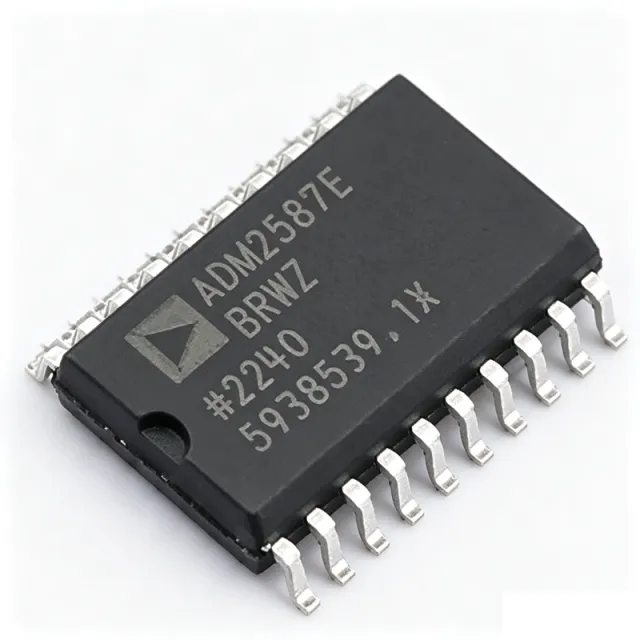
ADM2587EBRWZ-REEL7 - Isolated RS-485 Transceiver | Analog Devices
The ADM2587EBRWZ-REEL7 from Analog Devices is a fully integrated signal and power isolated RS-485/RS-422 transceiver with ±15 kV ESD protection, designed for high-speed communication on multipoint transmission lines. It integrates an isoPower isolated DC-to-DC converter, eliminating the need for an external isolated power supply, and provides 2500 Vrms isolation between the logic side and the bus side. The device operates from a single 5 V or 3.3 V supply and supports data rates up to 500 kbps, making it suitable for industrial automation, building control, and instrumentation networks. An isolated RS-485 transceiver is a type of interface IC that combines a differential line driver and receiver with galvanic isolation, protecting the host system from ground loops, common-mode voltages, and electrical noise. It sits within the hierarchy of interface ICs, specifically under RS-485/RS-422 transceivers, which are part of the broader category of serial communication interfaces. The integrated DC-DC converter and signal isolation in a single package simplify PCB design and reduce board space compared to discrete isolation solutions. Key features include 2500 Vrms isolation, ±15 kV ESD protection on the RS-485 pins, high common-mode transient immunity of >25 kV/µs, and compliance with ANSI/TIA/EIA-485-A-98 and ISO 8482:1987(E). The device supports up to 256 nodes on one bus, has open- and short-circuit fail-safe receiver inputs, and includes thermal shutdown protection. The wide-body 20-lead SOIC package (0.295" width) is suitable for industrial temperature ranges. Technically, the ADM2587E uses Analog Devices' isoPower technology, which integrates a push-pull DC-DC converter with a transformer-based isolation barrier, providing isolated power and data in one chip. The transceiver features a full-duplex or half-duplex operation, with a driver enable pin and receiver enable pin for bus control. The high CMTI ensures reliable operation in noisy industrial environments where fast voltage transients occur. Typical applications include industrial fieldbus networks, building automation systems, HVAC controllers, and remote sensor data acquisition. The integrated isolation and power make it ideal for systems where ground potential differences exist between nodes, such as in motor drives and power inverters. When designing with this device, ensure proper PCB layout with adequate creepage and clearance distances for the isolation barrier, and place decoupling capacitors close to the VCC and VISO pins. The integrated DC-DC converter requires an external transformer and rectifier circuit, as specified in the datasheet, to generate the isolated supply voltage.
ADM2682EBRIZ - 5kV Isolated RS-485 Transceiver | Analog Devices
The ADM2682EBRIZ from Analog Devices is a fully integrated 5 kV rms signal and power isolated RS-485/RS-422 transceiver with ±15 kV ESD protection, designed for high-speed communication on multipoint transmission lines. It integrates a DC-to-DC converter, eliminating the need for an external isolated power supply, and supports data rates up to 16 Mbps. The device is housed in a 16-lead SOIC-W (wide body) package, providing a compact solution for industrial and instrumentation applications. An isolated RS-485 transceiver is a device that combines a differential bus transceiver with galvanic isolation, typically using an integrated DC-DC converter and digital isolators. It allows communication between systems with different ground potentials, preventing ground loops and protecting against common-mode voltage differences. In the hierarchy of interface ICs, it falls under RS-485 transceivers, which are part of the broader category of serial communication interfaces used in industrial automation, building control, and process control networks. Key features include 5 kV rms isolation, 16 Mbps data rate, 25 kV/µs common-mode transient immunity (CMTI), and ±15 kV ESD protection on the bus pins. The integrated isolated DC-DC converter provides up to 200 mA output current, simplifying power supply design. The device operates from a single 5V supply and features thermal shutdown protection. The wide-body SOIC-16 package ensures adequate creepage and clearance for high-voltage isolation. Technically, the ADM2682E uses Analog Devices' proprietary iCoupler technology for signal isolation and an integrated transformer for power isolation. The CMTI of 25 kV/µs ensures reliable operation in noisy industrial environments. The transceiver is fully compliant with TIA/EIA RS-485 and RS-422 standards, supporting up to 256 nodes on a bus. The device also includes a logic-side supply (VDD1) and bus-side supply (VDD2) that can be independently powered, offering flexibility in system design. Typical applications include industrial fieldbus networks, PROFIBUS, Modbus, building automation, and isolated data acquisition systems. The high isolation voltage and ESD protection make it ideal for harsh environments where ground potential differences and electrical noise are prevalent. The integrated power isolation reduces board space and component count, improving reliability. When designing with the ADM2682EBRIZ, ensure proper PCB layout with adequate creepage distance under the SOIC-16 package. Place decoupling capacitors close to the VDD1 and VDD2 pins, and consider the thermal dissipation of the integrated DC-DC converter. The device requires a minimum of 3.3V on VDD1 and VDD2, and the bus side can operate from 3.3V or 5V, allowing interface with various logic levels.
ADM2682EBRIZ-RL7 - 16Mbps Isolated RS-485 Transceiver | Analog Devices
The ADM2682EBRIZ-RL7 from Analog Devices is a fully integrated, 5 kV rms signal and power isolated RS-485/RS-422 transceiver with 15 kV ESD protection. It combines a 3-channel digital isolator, an RS-485 transceiver, and an integrated isolated DC-DC converter in a single 16-lead wide-body SOIC package. This device supports data rates up to 16 Mbps and features a high common-mode transient immunity (CMTI) of 25 kV/µs, making it ideal for harsh industrial environments where ground loops and noise are concerns. An isolated RS-485 transceiver is a component that provides both electrical isolation and differential data communication. It integrates a transceiver with digital isolators and often an isolated power supply, allowing data transmission across a galvanic isolation barrier. This is essential in industrial automation, motor control, and building management systems where different ground potentials can cause damaging ground currents. The ADM2682E belongs to the family of isolated interface ICs, which are part of the broader category of interface and isolation products. Key features include 5 kV rms isolation voltage, 16 Mbps data rate, 15 kV ESD protection on the bus pins, and an integrated isolated DC-DC converter that eliminates the need for a separate isolated power supply. The device operates from a single 5V supply and provides a regulated 5V isolated output. It is fully specified over the industrial temperature range of -40°C to +85°C and is available in a wide-body SOIC-16 package with >8 mm creepage and clearance. The ADM2682E uses Analog Devices' iCoupler technology for signal isolation and isoPower technology for isolated power transfer. The isoPower technology uses high-frequency switching elements to transfer power through a transformer, providing a compact and efficient solution. The device features a thermal shutdown and a logic-level fault output, enhancing system reliability. Typical applications include industrial fieldbus networks, PROFIBUS, Modbus, building automation, and motor control systems. The integrated isolation and power make it ideal for space-constrained designs where board area is at a premium. When designing with this device, ensure proper PCB layout with adequate creepage and clearance distances, and place decoupling capacitors close to the supply pins. The integrated DC-DC converter requires careful attention to the external transformer and rectifier components as specified in the datasheet.
ADM2687EBRIZ - 5kV Isolated RS-485 Transceiver | Analog Devices
The ADM2687EBRIZ from Analog Devices is a fully integrated, 5 kV rms signal and power isolated RS-485/RS-422 transceiver with ±15 kV ESD protection. It combines a 3-channel digital isolator, a differential transceiver, and an integrated isoPower DC-to-DC converter in a single 16-lead SOIC-W package. This device supports data rates up to 500 kbps and provides 25 kV/µs common-mode transient immunity (CMTI), making it ideal for industrial communication networks where ground loops and noise are concerns. An isolated RS-485 transceiver is a component that combines a differential bus transceiver with galvanic isolation, allowing data transmission between systems with different ground potentials. It typically includes a digital isolator for signal isolation and an integrated DC-to-DC converter for isolated power, eliminating the need for separate isolated power supplies. This integration simplifies PCB design and reduces component count, making it a key building block in industrial automation, building control, and instrumentation systems. Key features include 5 kV rms isolation, ±15 kV ESD protection on the RS-485 pins, compliance with ANSI/TIA/EIA-485-A-98 and ISO 8482:1987(E), and a configurable half- or full-duplex interface. The integrated isoPower converter provides up to 500 mW of isolated power, and the device operates from a single 5V supply. The wide operating temperature range of -40°C to +85°C ensures reliability in harsh environments. The ADM2687E uses Analog Devices' proprietary isoPower technology, which integrates a DC-to-DC converter using chip-scale transformers, eliminating the need for external isolated power modules. The device also features a thermal shutdown and a watchdog timer for enhanced system protection. Its high CMTI of 25 kV/µs ensures reliable operation in noisy industrial environments. Typical applications include industrial fieldbus networks, PROFIBUS, Modbus, building automation, and HVAC systems. The device is also suitable for isolated data acquisition systems and motor control interfaces. Its integrated power and signal isolation make it a compact solution for space-constrained designs. When designing with the ADM2687EBRIZ, ensure proper PCB layout with adequate creepage and clearance distances for the 5 kV isolation rating. Place the isolation barrier components carefully to maintain isolation integrity. Also, consider the thermal dissipation of the integrated DC-to-DC converter, especially at high data rates and loads.
ADM2687EBRIZ-RL7 - 5kV Isolated RS-485 Transceiver | Analog Devices
The ADM2687EBRIZ-RL7 from Analog Devices is a fully integrated 5 kV rms signal and power isolated RS-485/RS-422 transceiver with ±15 kV ESD protection. It is designed for high-speed communication on multipoint transmission lines and includes an integrated isolated DC-to-DC converter, eliminating the need for an external power supply. The device operates at data rates up to 500 kbps and provides 25 kV/µs common-mode transient immunity (CMTI), ensuring robust performance in noisy industrial environments. Housed in a 16-lead wide-body SOIC package (0.295" width), it is suitable for space-constrained applications. An isolated RS-485 transceiver is a type of digital isolator that combines a differential line driver and receiver with galvanic isolation, allowing data transmission across a potential difference while protecting the system from ground loops and high-voltage transients. It is a key component in industrial automation, building control, and instrumentation systems where reliable long-distance communication is essential. The ADM2687E integrates the isolation barrier and power conversion into a single package, simplifying design and improving system reliability. Key features include 5 kV rms isolation, ±15 kV ESD protection on the RS-485 pins, and compliance with ANSI/TIA/EIA-485-A-98 and ISO 8482:1987 (E) standards. The device supports both half-duplex and full-duplex configurations, making it versatile for various bus topologies. The integrated isoPower DC-to-DC converter provides a regulated output, reducing external component count and board space. Technically, the ADM2687E uses Analog Devices' proprietary iCoupler technology for signal isolation and isoPower for isolated power transfer. This architecture ensures high reliability and low power consumption. The device operates over a wide temperature range of -40°C to +85°C, making it suitable for industrial applications. The wide-body SOIC package offers excellent thermal performance and is compatible with standard reflow soldering processes. Typical applications include industrial fieldbus networks, building automation systems, HVAC controllers, and motor control drives. The ADM2687E is also ideal for solar inverters and power monitoring systems where galvanic isolation is critical for safety and noise immunity. When designing with this device, ensure proper PCB layout with adequate creepage and clearance distances for the isolation barrier. Place decoupling capacitors close to the power pins and follow the recommended layout guidelines in the datasheet to achieve optimal EMC performance.
ADM3050EBRWZ-RL7 - 5.7kV Isolated CAN FD Transceiver | Analog Devices
The ADM3050EBRWZ-RL7 is a 5.7 kV rms isolated controller area network (CAN) physical layer transceiver with a high performance, basic feature set, manufactured by Analog Devices. It integrates a 2-channel digital isolator and a CAN transceiver into a single 16-lead SOIC package using Analog Devices' iCoupler technology. The device fully meets the CAN flexible data rate (CAN FD) ISO 11898-2:2016 requirements and supports data rates up to 12 Mbps, making it suitable for industrial and automotive networking applications. A CAN transceiver is a device that provides the physical layer interface between a CAN controller and the differential bus lines. It converts the digital signals from the controller into differential signals for transmission over the twisted-pair bus and vice versa. In isolated CAN transceivers, galvanic isolation is provided between the controller side and the bus side to protect against ground potential differences, noise, and transient voltages. The ADM3050E belongs to the family of isolated CAN transceivers, which are essential in harsh environments where safety and reliability are critical. Key features of the ADM3050EBRWZ-RL7 include 5.7 kV rms isolation voltage, integrated DC-to-DC converter for isolated power, and compliance with ISO 11898-2:2016. It supports CAN FD data rates up to 12 Mbps, ensuring high-speed communication. The device also passes EN 55022 Class B radiated emissions by 6 dB on a simple 2-layer PCB, eliminating the need for stitching capacitance or high-voltage SMT safety capacitors. This simplifies PCB layout and reduces BOM cost. Technically, the ADM3050E employs iCoupler technology, which uses chip-scale transformers to provide isolation, offering superior performance compared to optocouplers in terms of speed, reliability, and power consumption. The integrated DC-to-DC converter provides isolated power to the bus side, eliminating the need for an external isolated power supply. The device operates over a wide temperature range and includes thermal shutdown and current limiting protection. Typical applications include industrial fieldbus networks, building automation, motor control, and automotive electronics. The high isolation voltage and robust EMC performance make it ideal for systems where ground loops and noise are concerns. The ADM3050EBRWZ-RL7 is available in tape and reel packaging, suitable for high-volume production. When designing with this device, ensure proper PCB layout to maintain isolation creepage and clearance distances. The integrated DC-to-DC converter requires careful placement of external components to minimize noise. Refer to the ADM3050E datasheet for detailed application information.

ADM3051BRWZ - High Speed Industrial CAN Transceiver | Analog Devices
The ADM3051BRWZ is a high-speed industrial Controller Area Network (CAN) physical layer transceiver from Analog Devices. It operates from a 5 V supply (VCC) and complies with the ISO 11898 standard, enabling data rates up to 1 Mbps. The device is housed in a 14-lead SOIC (BRWZ) package and is designed for robust industrial communication, supporting connection of 110 or more nodes on a single bus. Key features include short-circuit protection on CANH and CANL against shorts to power or ground in 24 V systems, slope control for reduced EMI, thermal shutdown protection, and a low current standby mode. Unpowered nodes do not disturb the bus, ensuring system reliability during power cycling. A CAN transceiver is a physical layer device that interfaces between a CAN protocol controller and the differential bus lines (CANH and CANL). It converts the digital signals from the controller into differential signals for transmission over the twisted-pair bus and vice versa. The transceiver is a critical component in the CAN network hierarchy, which spans from the application layer down to the physical layer. The ADM3051BRWZ specifically implements the physical layer, providing the necessary drive strength, receiver sensitivity, and protection features required for robust communication in harsh industrial environments. Key features of the ADM3051BRWZ include its compliance with ISO 11898, which ensures interoperability with other standard CAN devices. The device supports data rates up to 1 Mbps, making it suitable for high-speed industrial control applications. Its short-circuit protection on CANH and CANL against shorts to power or ground in 24 V systems enhances robustness in industrial settings where wiring faults are common. The slope control feature allows the designer to reduce electromagnetic interference (EMI) by controlling the slew rate of the output signals, which is particularly useful in applications with stringent EMC requirements. Thermal shutdown protection prevents damage from excessive power dissipation, and the low current standby mode reduces power consumption when the bus is idle. From a technical perspective, the ADM3051BRWZ is designed to handle the electrical stresses of industrial environments. Its differential output voltage and receiver input sensitivity are optimized for reliable communication over long bus lengths (up to 1 km) and with many nodes. The device's common-mode input range accommodates ground potential differences between nodes, which is common in distributed systems. The transceiver's propagation delay and loop delay are carefully controlled to ensure timing compliance with the CAN protocol, even at 1 Mbps. The device also features a silent mode (via the RS pin) that disables the transmitter, allowing for bus monitoring without driving the bus. Typical applications for the ADM3051BRWZ include industrial automation, building automation, automotive electronics (non-safety critical), and any system requiring robust CAN communication. In industrial automation, it is used in PLCs, sensors, and actuators to provide reliable data exchange over long distances. In building automation, it enables communication between HVAC controllers, lighting systems, and access control panels. The device's high-speed capability and robustness make it ideal for these applications. When designing with the ADM3051BRWZ, it is important to consider proper bus termination (typically 120 ohms at each end) and to use twisted-pair cabling to minimize EMI. The slope control pin (RS) can be used to adjust the slew rate for EMI reduction, but this also limits the maximum data rate. For 1 Mbps operation, the slope control should be set to high-speed mode (RS connected to ground). Additionally, the VCC supply should be decoupled with a 100 nF capacitor close to the VCC pin to ensure stable operation.
ADM3052BRWZ - Isolated CAN Transceiver with Regulator | Analog Devices
The ADM3052BRWZ from Analog Devices is an isolated controller area network (CAN) physical layer transceiver with an integrated high-voltage, bus-side linear regulator. It complies with the ISO 11898 standard and employs iCoupler® technology to combine a 3-channel isolator, a CAN transceiver, and a linear regulator in a single 16-lead SOIC-W package. The device supports data rates up to 1 Mbps and operates from a 3.3V or 5V logic-side supply, while the bus-side regulator accepts inputs from 5V to 27V, providing a regulated 5V output for the bus-side circuitry. An isolated CAN transceiver is a component that provides galvanic isolation between the CAN protocol controller and the physical bus, protecting the logic side from high common-mode voltages, ground loops, and electrical noise. It integrates a digital isolator, a CAN transceiver, and often a DC-DC converter or regulator to power the isolated side. In the hierarchy of CAN interface components, it sits above a standard transceiver by adding isolation, which is critical in industrial, automotive, and building automation systems where long bus lengths and differing ground potentials are common. Key features include a 5 kVrms isolation rating, a bus-side linear regulator with 5V output, and compliance with ISO 11898-2. The device offers a common-mode voltage range of -12V to +12V and a common-mode transient immunity of 25 kV/µs, ensuring robust operation in noisy environments. It also features thermal shutdown protection and a logic-side supply range of 3.0V to 5.5V, making it versatile for various controller interfaces. Technically, the ADM3052 integrates a 3-channel iCoupler digital isolator for the TXD, RXD, and a control signal, eliminating the need for a separate isolation barrier. The integrated linear regulator simplifies power supply design by generating the isolated 5V bus supply from a higher input voltage, reducing component count and board space. The device is specified for the industrial temperature range of -40°C to +85°C and is available in a 16-lead SOIC-W package. Typical applications include industrial fieldbus networks, building automation systems, automotive diagnostics, and any CAN bus requiring galvanic isolation. The integrated regulator is particularly useful in systems where a 24V supply is available, as it can directly power the bus side without an external DC-DC converter. When designing with the ADM3052, ensure proper PCB layout with adequate creepage and clearance for the isolation barrier, and place decoupling capacitors close to the VCC and V+ pins. The bus-side regulator requires an output capacitor for stability, and the input voltage must not exceed the absolute maximum rating of 27V.
ADM3053BRWZ - Isolated CAN Transceiver with isoPower | Analog Devices
The ADM3053BRWZ from Analog Devices is a signal and power isolated controller area network (CAN) physical layer transceiver with an integrated isolated DC-to-DC converter. It combines a 2-channel isolator, a CAN transceiver, and Analog Devices isoPower DC-to-DC converter into a single 20-lead SOIC surface mount package. The device complies with the ISO 11898 standard and supports high-speed data rates up to 1 Mbps. It operates with a 5 V supply on VCC and either 5 V or 3.3 V on VIO, providing flexibility for interfacing with different logic levels. The ADM3053BRWZ features 2.5 kV rms signal and power isolation, making it ideal for applications requiring galvanic isolation in industrial, automotive, and instrumentation systems. An isolated CAN transceiver is a device that provides the physical layer interface between a CAN controller and the differential bus, while also providing electrical isolation between the two sides. This isolation protects the low-voltage logic side from high-voltage transients, ground loops, and common-mode noise that can occur on the bus. The integration of an isolated DC-to-DC converter eliminates the need for a separate isolated power supply, simplifying design and reducing board space. The ADM3053BRWZ is part of the broader family of isolated interface ICs, which includes isolated RS-485 transceivers and isolated digital isolators, all leveraging Analog Devices' iCoupler technology. Key features of the ADM3053BRWZ include its compliance with ISO 11898, high-speed data rates up to 1 Mbps, and the ability to connect 110 or more nodes on the bus. It also offers slope control for reduced EMI, thermal shutdown protection, and high common-mode transient immunity. The device supports unpowered nodes, meaning that nodes without power do not disturb the bus, which is critical for fault-tolerant systems. The integrated isoPower DC-to-DC converter provides up to 500 mW of isolated power, which can be used to power the transceiver itself or external circuitry on the isolated side. Technically, the ADM3053BRWZ uses iCoupler technology to achieve isolation, which uses chip-scale transformers to transmit data and power across the isolation barrier. This approach provides reliable isolation with high data rates and low power consumption compared to traditional optocoupler-based solutions. The device also features an internal split paddle lead frame on the bus side, which helps with thermal management and reduces parasitic inductance. The operating temperature range is -40°C to +125°C, making it suitable for harsh environments. Typical applications include industrial fieldbus networks, building automation, automotive diagnostics, and medical equipment. In industrial automation, the ADM3053BRWZ is used to connect sensors and actuators to a CAN bus while providing isolation to protect the control system from electrical noise. In automotive applications, it is used for in-vehicle networking and diagnostics, where isolation is required to prevent ground loops and protect sensitive electronics. When designing with the ADM3053BRWZ, it is important to place a low inductance ceramic capacitor close to the VCC and VIO pins, with the total lead length between the capacitor and the power supply pin not exceeding 10 mm. This ensures stable operation and minimizes noise. Additionally, the bus side should be properly terminated to match the characteristic impedance of the bus to prevent signal reflections.

ADM3053BRWZ-RL7 - Isolated CAN Transceiver with isoPower | Analog Devices
The ADM3053BRWZ-RL7 is a signal and power isolated CAN (Controller Area Network) physical layer transceiver with an integrated isolated DC-to-DC converter, manufactured by Analog Devices. It complies with the ISO 11898 standard and is available in a 20-lead wide-body SOIC package. The device operates from a single 5 V supply on VCC and supports 5 V or 3.3 V operation on VIO, enabling interface to different logic levels. It provides 2.5 kV rms signal and power isolation, making it suitable for industrial and automotive applications where galvanic isolation is required. A CAN transceiver is a device that interfaces between a CAN controller and the physical bus, providing differential transmit and receive capabilities. The ADM3053 integrates the transceiver with an isolated DC-to-DC converter using Analog Devices' iCoupler and isoPower technologies, eliminating the need for a separate isolated power supply. This integration reduces PCB footprint and simplifies design, as the device provides fully isolated power and data in a single package. Key features include high-speed data rates up to 1 Mbps, support for connecting 110 or more nodes on the bus, slope control for reduced EMI, thermal shutdown protection, and high common-mode transient immunity. The integrated isoPower converter uses high-frequency switching elements to transfer power through an internal transformer, requiring careful PCB layout to meet emissions standards. The ADM3053 is fully specified over the industrial temperature range and is available in a 20-lead wide-body SOIC package. It is designed for harsh environments where noise immunity and isolation are critical. The device's unpowered nodes do not disturb the bus, ensuring reliable operation in multi-node networks. Typical applications include industrial automation, building automation, automotive electronics, and any system requiring isolated CAN communication. The integrated isolation simplifies design and reduces component count, making it ideal for space-constrained applications. When designing with the ADM3053, special attention must be paid to PCB layout to minimize emissions from the isoPower converter. Following the manufacturer's layout guidelines is essential for meeting EMC standards.
ADM3054BRWZ - 5kVrms Isolated CAN Transceiver | Analog Devices
The ADM3054BRWZ is a 5 kV rms signal isolated controller area network (CAN) physical layer transceiver from Analog Devices. It integrates a 3-channel digital isolator and a CAN transceiver using Analog Devices' iCoupler technology, providing a complete isolated CAN solution in a 16-lead SOIC package. The device complies with the ISO 11898 standard and supports data rates up to 1 Mbps, making it suitable for industrial and automotive CAN networks. A CAN transceiver is a device that interfaces between the CAN controller (e.g., a microcontroller with built-in CAN) and the physical differential bus. It converts the digital logic levels of the controller to the differential voltages required on the CAN bus and vice versa. Isolation is critical in harsh environments to protect the controller and users from high voltages, ground loops, and noise. The ADM3054 provides galvanic isolation up to 5 kV rms, ensuring safe and reliable communication in industrial automation, motor control, and electric vehicle applications. Key features include 5 kV rms isolation, integrated DC-to-DC converter (for the BRWZ variant, it includes an integrated isolated power supply), bus protection up to ±58 V, and thermal shutdown. The device operates from a single 5 V supply on the logic side and a 5 V or 3.3 V supply on the bus side, with a typical data rate of 1 Mbps. It also features a high common-mode transient immunity of 25 kV/µs, ensuring robust operation in noisy environments. The ADM3054 uses iCoupler technology, which uses chip-scale transformers to isolate signals, providing superior performance compared to optocouplers in terms of speed, power consumption, and reliability. The integrated DC-to-DC converter eliminates the need for an external isolated power supply, simplifying design and reducing board space. The device also includes a VIO pin for logic-level translation, allowing interface with 3.3 V or 5 V microcontrollers. Typical applications include industrial fieldbus networks, motor control, HVAC systems, electric vehicle charging, and battery management systems. The high isolation voltage and robust bus protection make it ideal for applications where safety and reliability are paramount. When designing with the ADM3054BRWZ, ensure proper PCB layout with adequate creepage and clearance distances for the isolation barrier. Place decoupling capacitors close to the VCC and VIO pins, and follow the recommended layout in the datasheet to achieve the specified isolation performance.
ADM3054BRWZ-RL7 - 5kVrms Isolated CAN Transceiver | Analog Devices
The ADM3054BRWZ-RL7 is a 5 kV rms signal isolated controller area network (CAN) physical layer transceiver from Analog Devices. It integrates a 3-channel digital isolator and a CAN transceiver into a single 16-pin SOIC-W package using Analog Devices' iCoupler technology. The device complies with the ISO 11898 standard and supports data rates up to 1 Mbps, making it suitable for industrial and automotive CAN bus applications. A CAN transceiver is a device that provides the physical layer interface between a CAN controller and the differential bus lines. It converts the digital signals from the controller into differential signals for transmission over the twisted-pair bus and vice versa. The ADM3054 adds galvanic isolation, protecting the logic side from high voltages and ground loops on the bus side, which is critical in harsh industrial environments. Key features include 5 kV rms isolation voltage, a wide supply range of 3.3 V or 5 V on the logic side (VDD1) and 5 V on the bus side (VDD2), and a data rate of up to 1 Mbps. The device also features bus protection against short circuits and thermal shutdown, ensuring robust operation. The SOIC-16 package provides a compact footprint for space-constrained designs. The ADM3054 uses iCoupler technology, which employs chip-scale transformers to provide isolation, eliminating the need for optocouplers and external components. This results in higher reliability, lower power consumption, and better timing accuracy compared to traditional isolation methods. The device also includes a VREF output for bus biasing and a silent mode for listen-only operation. Typical applications include industrial fieldbus networks, motor control systems, building automation, and automotive body electronics. The high isolation rating and compliance with ISO 11898 make it ideal for systems requiring robust communication in noisy environments. When designing with the ADM3054, ensure proper PCB layout with adequate creepage and clearance distances for the isolation barrier. Place decoupling capacitors close to the VDD1 and VDD2 pins, and consider the thermal dissipation of the device under high data rates.
ADM3055EBRWZ - 5kV Isolated CAN FD Transceiver | Analog Devices
The ADM3055EBRWZ is a 5 kV rms signal and power isolated CAN transceiver with an integrated isoPower DC-to-DC converter, designed for CAN FD networks. It combines a 3-channel iCoupler isolator, a CAN transceiver, and an isolated DC-to-DC converter into a single 20-lead SOIC-W package, enabling a fully isolated CAN solution powered from a single 5 V supply. A CAN transceiver is the physical layer interface between a CAN controller and the differential bus lines (CANH and CANL). It converts the controller's logic-level signals to differential signals for transmission and receives differential signals back to logic levels. In industrial and automotive environments, galvanic isolation is often required to protect controllers from ground loops, voltage transients, and noise. The ADM3055E integrates this isolation, eliminating the need for external isolation components and simplifying PCB design. Key features include 5 kV rms isolation, compliance with ISO 11898-2:2016 for CAN FD, data rates up to 12 Mbps, a VIO pin for 1.7 V to 5.5 V logic levels, extended common-mode range of ±25 V, and bus fault protection of ±40 V on CANH and CANL pins. The device also supports low-power standby with remote wake request, making it suitable for power-sensitive nodes. The ADM3055E uses Analog Devices' iCoupler and isoPower technologies, which use chip-scale transformers to transmit data and power across the isolation barrier. This approach provides reliable isolation with low propagation delay (150 ns maximum loop) and high common-mode transient immunity. The integrated DC-to-DC converter eliminates the need for a separate isolated power supply, reducing component count and board space. Typical applications include industrial fieldbus networks, building automation, automotive diagnostics, and any system requiring robust, isolated CAN communication. The wide logic-level range and high data rate make it versatile for both legacy CAN and newer CAN FD designs. When designing with this device, ensure proper PCB layout for the isolation barrier and provide adequate decoupling on both the logic and bus sides. The integrated converter requires careful thermal management at high data rates and loads.
ADM3055EBRWZ-RL7 - 5kV Isolated CAN Transceiver | Analog Devices
The ADM3055EBRWZ-RL7 is a 5 kV rms signal and power isolated CAN transceiver with an integrated isoPower isolated DC-to-DC converter, designed for CAN FD networks. It complies with the ISO 11898-2:2016 standard and supports data rates up to 12 Mbps, making it suitable for industrial and automotive applications requiring robust, isolated communication. The device is available in a 16-lead SOIC-W package and operates over a wide temperature range. A CAN transceiver is a physical layer device that connects a CAN controller to the differential bus lines (CANH and CANL). It converts the digital signals from the controller into differential signals for transmission and vice versa. Isolation in a CAN transceiver provides galvanic isolation between the bus side and the logic side, protecting sensitive electronics from ground loops, voltage spikes, and noise. The ADM3055E integrates the isolation barrier and DC-to-DC converter, eliminating the need for external isolated power supplies. Key features include 5 kV rms isolation, an integrated isolated DC-to-DC converter, a VIO pin for 1.7 V to 5.5 V logic levels, low maximum loop propagation delay of 150 ns, extended common-mode range of ±25 V, and bus fault protection of ±40 V on CANH and CANL pins. It also supports low power standby with remote wake, making it ideal for power-sensitive nodes. The ADM3055E uses Analog Devices' isoPower technology, which integrates a DC-to-DC converter with the signal isolation, providing a complete isolated CAN solution in a single package. This reduces board space and component count compared to discrete isolation solutions. The device is designed to meet the stringent requirements of CAN FD, ensuring reliable communication at high data rates. Typical applications include industrial automation, building automation, motor control, and automotive electronics. The integrated isolation and DC-to-DC converter simplify design and improve reliability in harsh environments. The device is also suitable for battery management systems and other applications requiring isolated CAN communication. When designing with the ADM3055E, ensure proper PCB layout for the isolation barrier and provide adequate decoupling on the VIO and VCC pins. The integrated DC-to-DC converter requires careful consideration of the external components, such as the transformer and rectifier, to achieve optimal performance.

ADM3061EARZ - 500 kbps Half-Duplex RS-485 Transceiver | Analog Devices
The Analog Devices ADM3061EARZ is a half-duplex RS-485 interface transceiver operating from 3.0 V to 5.5 V, with a 500 kbps data rate and IEC ESD protection up to ±12 kV in an 8-lead SOIC package. It combines a differential RS-485 driver, differential receiver, and half-duplex control interface for robust bidirectional communication over industrial cabling. An RS-485 transceiver is an interface IC that converts logic-level signals into differential bus voltages and reconstructs digital data from those differential signals. This device belongs to the RS-485 transceiver family within the broader communication-interface and industrial-transceiver hierarchy. Differential signaling improves common-mode noise immunity and allows reliable data transmission across longer cable runs when the bus is correctly terminated and biased. The ADM3061E family provides a 500 kbps maximum signaling rate, a 3.0 V to 5.5 V supply range, and enhanced ESD protection rated to ±12 kV. Its half-duplex architecture supports a shared A and B bus pair, while the receiver output and driver-enable path support controlled bus direction. The 8-lead SOIC package also has an evaluation-board footprint described by Analog Devices for rapid circuit evaluation. The 500 kbps operating rate makes the transceiver suitable for moderate-speed industrial links rather than the highest-speed data buses. Its protection capability is particularly useful in factory automation, instrumentation, building controls, and communications equipment where connected cables may be exposed to electrostatic discharge. Designers must still provide appropriate bus protection, grounding, and cable-signal-rate engineering for the complete interface. Typical uses include industrial RS-485 gateways, sensor and actuator networks, process-control equipment, factory-floor controllers, building-management interfaces, and isolated or ruggedized communication modules. The device can also support legacy peripheral buses where an existing host controller uses TTL or CMOS logic and the external wiring requires an RS-485 physical layer. For a new board, follow the Analog Devices ADM3061E datasheet for pin assignment, recommended decoupling, bus termination, failsafe behavior, and layout guidance. Keep the A and B differential pair routed together over a controlled ground plane, place termination and protection components near the connector, and account for the logic level on DI, DE, and RO when connecting the transceiver to the host controller. This page combines the exact ADM3061EARZ device specifications, sourcing information, documented drop-in alternatives, comparison data, and practical PCB-design guidance to support faster component selection and implementation in industrial RS-485 systems.

ADM3061EBRMZ - 3.0-5.5V Half-Duplex RS-485 Transceiver | Analog Devices
The ADM3061EBRMZ is a half-duplex RS-485 transceiver from Analog Devices, operating from a 3.0 V to 5.5 V supply. It features IEC ESD protection of ±12 kV on the A and B bus pins, making it robust for industrial environments. The device supports data rates up to 500 kbps, suitable for long-distance, low-speed communication networks. It is available in an 8-lead MSOP package, ideal for space-constrained designs. RS-485 is a standard for serial communication systems that allows multiple devices to communicate over long distances using differential signaling. It is widely used in industrial automation, building control, and instrumentation networks. The ADM3061E is part of a family of RS-485 transceivers that includes full-duplex and higher-speed variants, providing design flexibility. Key features include a wide supply voltage range, low quiescent current, and thermal shutdown protection. The transceiver is designed for half-duplex operation, with a driver and receiver sharing the same bus lines. The ±12 kV IEC ESD protection ensures reliability in harsh environments, reducing the need for external protection components. The ADM3061E uses a standard RS-485 architecture with a differential driver and receiver. It includes a fail-safe receiver that guarantees a logic-high output when the bus is open, shorted, or idle, preventing false data. The device also features a 1/8 unit load, allowing up to 256 transceivers on a single bus, which is critical for large networks. Typical applications include industrial control systems, building automation, HVAC controllers, and remote sensor networks. The wide supply range and robust ESD protection make it suitable for factory floors and outdoor installations. The half-duplex interface simplifies wiring, reducing cost and complexity. When designing with the ADM3061EBRMZ, ensure proper termination resistors (120 Ω) at both ends of the bus to minimize reflections. The fail-safe feature eliminates the need for external bias resistors, simplifying the design. For higher data rates, consider the ADM3062E or ADM3063E variants.

ADM3061EBRMZ-RL7 - 500kbps RS-485 Transceiver | Analog Devices
The ADM3061EBRMZ-RL7 is a half-duplex RS-485 transceiver from Analog Devices, designed for industrial communication networks requiring robust data transmission. It operates from a 3.0 V to 5.5 V supply and supports data rates up to 500 kbps. The device features ±12 kV IEC ESD protection on the A and B bus pins, ensuring reliability in harsh environments. Housed in an 8-lead MSOP package, it is suitable for space-constrained applications. RS-485 is a standard for multipoint communication systems, allowing multiple devices to share a two-wire bus. The ADM3061E is a transceiver that converts UART signals to differential RS-485 levels, enabling long-distance, noise-immune data transfer. It is part of the interface IC family, specifically designed for industrial automation, building control, and instrumentation. Key features include a 1/1 driver/receiver configuration, half-duplex operation, and a receiver hysteresis of 30 mV for noise immunity. The device supports a wide operating temperature range of -40°C to +125°C, making it suitable for industrial environments. The MSOP-8 package offers a compact footprint, and the tape-and-reel packaging (RL7) facilitates automated assembly. The ADM3061E uses a standard RS-485 architecture with a differential driver and receiver. The driver outputs are short-circuit protected, and the receiver has a fail-safe feature that ensures a high output when the bus is open, shorted, or idle. The device also features thermal shutdown protection to prevent damage from excessive power dissipation. Typical applications include industrial control systems, building automation, HVAC controllers, and remote sensor networks. The wide supply range and ESD protection make it ideal for factory floor installations where electrical noise and transient voltages are common. When designing with this device, ensure proper termination resistors (120 Ω) at both ends of the bus to minimize reflections. The A and B pins should be biased to a known state to avoid undefined receiver outputs when the bus is idle.

ADM3062EBRMZ - 500kbps RS-485 Transceiver | Analog Devices
The ADM3062EBRMZ is a half-duplex RS-485 transceiver from Analog Devices, designed for industrial and instrumentation applications requiring robust, low-power serial communication. It operates from a 3.0 V to 5.5 V supply and features a separate VIO pin for logic-level interfacing, allowing direct connection to 1.8 V, 2.5 V, or 3.3 V microcontrollers without external level shifters. The device supports data rates up to 500 kbps and is fully compliant with the Profibus standard, delivering a 2.1 V differential bus voltage at VCC ≥ 4.5 V for enhanced noise immunity. RS-485 transceivers are essential components in industrial networks, enabling reliable data transmission over long distances (up to 1200 meters) and in harsh electrical environments. They convert UART logic signals to differential voltages on a twisted-pair bus, providing common-mode rejection and allowing multiple devices to share the same bus. The ADM3062E family is part of Analog Devices' robust interface portfolio, offering integrated IEC ESD protection and wide supply voltage flexibility. Key features include ±12 kV IEC ESD protection on the bus pins, a wide common-mode input range of -7 V to +12 V, and a low quiescent current of 1.5 mA (typical). The device also features a thermal shutdown and short-circuit protection, ensuring safe operation under fault conditions. The half-duplex architecture uses a single differential pair, simplifying wiring and reducing cable cost. The ADM3062EBRMZ is available in a 10-lead MSOP package, which is ideal for space-constrained designs. The package has a small footprint (3 mm x 3 mm) and is suitable for automated assembly. The device operates over the industrial temperature range of -40°C to +125°C, making it suitable for harsh environments. Typical applications include industrial automation, building automation, HVAC systems, and motor control. The device is also used in instrumentation and data acquisition systems where reliable long-distance communication is required. The VIO pin allows seamless integration with low-voltage logic, reducing system complexity. When designing with the ADM3062EBRMZ, ensure proper termination resistors (120 Ω) at both ends of the bus to minimize reflections. The A and B bus pins should be biased to a known state when the bus is idle to prevent undefined receiver outputs. The VIO pin must be connected to the logic supply voltage, and decoupling capacitors (0.1 µF) should be placed close to the VCC and VIO pins.
ADM3062EBRMZ-RL7 - 500kbps RS-485 Transceiver | Analog Devices
The ADM3062EBRMZ-RL7 is a half-duplex RS-485 transceiver from Analog Devices, operating from a 3.0 V to 5.5 V supply. It features ±12 kV IEC ESD protection on the bus pins, making it robust for industrial environments. The device supports data rates up to 500 kbps and includes a VIO logic supply pin for flexible digital interface levels down to 1.62 V. It is available in a 10-lead MSOP package, suitable for space-constrained designs. RS-485 is a standard for multipoint communication networks, allowing multiple transceivers to share a two-wire bus. The ADM3062E is part of a family of RS-485 transceivers that provide enhanced ESD protection and wide supply voltage range, ensuring reliable data transmission over long distances. This transceiver is essential in industrial automation, building control, and instrumentation systems where noise immunity and robustness are critical. Key features include a half-duplex interface with a single driver and receiver, a VIO pin for logic-level translation, and thermal shutdown protection. The device also offers a wide common-mode input range, allowing operation in noisy environments. The low quiescent current makes it suitable for power-sensitive applications. The ADM3062E uses a standard RS-485 architecture with a differential bus, providing high noise immunity and long-distance communication. The integrated ESD protection ensures the device can withstand electrostatic discharges without damage, reducing field failures. The VIO pin allows direct interfacing with low-voltage microcontrollers, simplifying system design. Typical applications include industrial control networks, building automation, and instrumentation. The device is also used in HVAC systems, security systems, and remote sensor networks. Its robust ESD protection and wide supply range make it ideal for harsh environments. When designing with this transceiver, ensure proper termination resistors on the bus to minimize reflections. The VIO pin should be connected to the logic supply voltage to ensure correct logic levels. Place decoupling capacitors close to the VCC and VIO pins for stable operation.
ADM3063EBRMZ - 500kbps RS-485 Transceiver | Analog Devices
The ADM3063EBRMZ is a half-duplex, low-speed RS-485/RS-422 transceiver from Analog Devices, designed for industrial and building automation networks. It operates from a 3.0V to 5.5V supply and supports data rates up to 500 kbps, making it ideal for long cable runs. The device features IEC ESD protection of ±30 kV on the bus pins, full hot-swap support with glitch-free power-up/power-down, and receiver fail-safe for open, shorted, or idle bus conditions. It is available in a 10-lead MSOP package (RMZ suffix) and operates over the extended temperature range of -40°C to +125°C. RS-485 is a differential serial communication standard that enables robust data transmission over long distances and in noisy industrial environments. The ADM3063E belongs to the family of RS-485 transceivers, which are part of the broader category of interface ICs. These devices convert logic-level signals to differential voltages, allowing multiple nodes to share a two-wire bus. The ADM3063E is specifically a half-duplex transceiver, meaning it can either transmit or receive, but not simultaneously, which is sufficient for many industrial protocols like PROFIBUS. Key features of the ADM3063EBRMZ include a wide supply range of 3.0V to 5.5V, a low-speed 500 kbps data rate for long cables, and full receiver fail-safe protection. The device is PROFIBUS compliant at VCC ≥ 4.5V, ensuring compatibility with industrial automation networks. It also offers full hot-swap support, preventing glitches on the bus during power-up or power-down, which is critical in live systems. The extended temperature range up to 125°C makes it suitable for harsh environments. Technically, the ADM3063E uses a differential bus architecture with a common-mode input voltage range of -7V to +12V, allowing it to handle ground potential differences between nodes. The driver output is short-circuit protected, and the receiver has a 1/8 unit load, allowing up to 256 transceivers on the bus. The device also features a thermal shutdown and a logic-level enable pin for controlling the driver and receiver independently. Typical applications include industrial control systems, building automation, HVAC controllers, and PROFIBUS networks. The low-speed 500 kbps data rate is ideal for long cable runs where signal integrity is a concern, and the robust ESD protection ensures reliability in harsh environments. When designing with the ADM3063EBRMZ, it is important to terminate the bus properly with 120Ω resistors at both ends to minimize reflections. Also, ensure that the common-mode voltage stays within the specified range to avoid damage to the device.