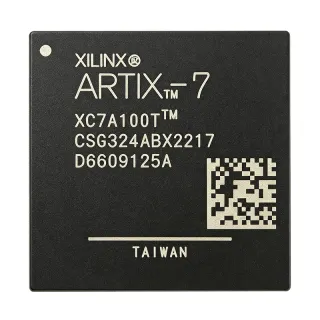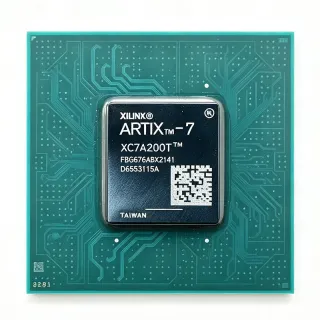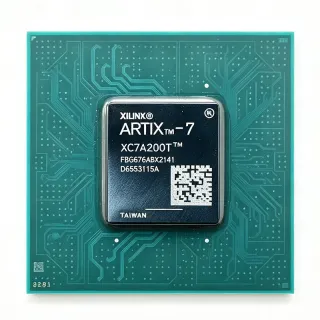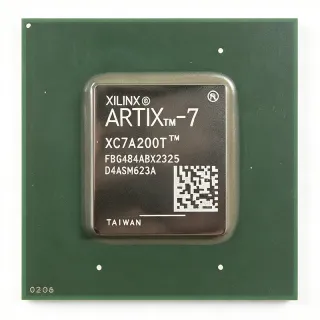
EP1M120F484I7N - Mercury 120K FPGA, 484-BGA | Intel / Altera
MPN: EP1M120F484I7N ✗ End of Life| Qty | Unit Price | Extended |
|---|---|---|
| 1 | $185 | $185.00 |
| 10 | $172.5 | $1,725.00 |
| 100 | $158 | $15,800.00 |
| 500 | $142 | $71,000.00 |
| 1,000 | $128 | $128,000.00 |
EP1M120F484I7N Overview
A Field Programmable Gate Array (FPGA) is a type of programmable logic device (PLD) - within the broader semiconductor taxonomy: FPGA -> PLD -> logic IC -> integrated circuit. FPGAs contain an array of configurable logic blocks (CLBs) connected via programmable interconnect, allowing designers to implement custom digital circuits after manufacturing. Mercury devices specifically target high-speed, low-power applications using a 0.18 µm six-layer metal process with embedded memory and dedicated clock networks.
Key features include a 1.8V core supply (VCCINT) with 3.3V/2.5V multi-voltage I/O support, dedicated True-LVDS circuitry, four phase-locked loops (PLLs) for clock management, and support for high-speed interfaces including LVDS, SSTL, and HSTL I/O standards. The device operates over the industrial temperature range (-40C to +100C) with a -7 speed grade. Embedded array blocks (EABs) provide efficient on-chip memory for FIFO, ROM, and RAM functions, while the RAM block capacity supports single-port and dual-port memory configurations.
Typical applications include telecommunications line cards, industrial control and factory automation, video processing pipelines, high-speed serial bridging, and ASIC prototyping. The Mercury family's high I/O count and low-power 1.8V operation make it well-suited for I/O-intensive designs where board space and power budget are constrained.
When designing with this device, ensure proper decoupling with 0.1 µF and 10 µF capacitors placed close to each power pin. The FineLine BGA package requires careful PCB layout with controlled-impedance traces and matched-length routing for LVDS pairs to maintain signal integrity at high toggle rates.
Drop-in alternatives for EP1M120F484I7N — same package, pin-to-pin compatible. Different-package parts requiring PCB rework are excluded.
Variants in this series
Same-series models that are drop-in compatible with EP1M120F484I7N (same form factor and footprint) — differing in Family, Speed Grade, Operating Temperature, Package, Logic Elements.
Quick Comparison Tool — Select alternative parts for side-by-side comparison:
EP1M120F484I7
✅ Drop-In✓ In Stock
$125 / Unit
View Datasheet →EP1M120F484I6N
✅ Drop-In✓ In Stock
$188 / Unit
View Datasheet →EP1M120F484I5N
✅ Drop-In✓ In Stock
$180 / Unit
View Datasheet →EP1M120F484C8N
✅ Drop-In✓ In Stock
$142 / Unit
View Datasheet →EP1M120F484C7N
✅ Drop-In✓ In Stock
$108 / Unit
View Datasheet →EP1M120B484I6
✅ Drop-In✓ In Stock
$213.75 / Unit
View Datasheet →EP1M120F484I7N Maximum Ratings & Electrical Characteristics
| Family | Mercury PLD |
| Logic Elements | 49,152 |
| Maximum Gates | 120,000 |
| Embedded RAM Bits | 4,800 |
| User I/O Pins | 303 |
| Package | 484-pin FineLine BGA (FCBGA) |
| Core Voltage (VCCINT) | 1.8 V |
| I/O Voltage Support | 3.3 V / 2.5 V / 1.8 V |
| Speed Grade | -7 |
| Operating Temperature | -40C to +100C (Industrial) |
| PLLs | 4 |
| I/O Standards | LVDS, SSTL, HSTL, True-LVDS |
| Embedded Array Blocks (EABs) | Yes |
| Mounting Type | Surface Mount |
| RoHS Status | Compliant |
EP1M120F484I7N 484-pin fineline bga (fcbga) Pin Configuration Guide
Pin configuration for EP1M120F484I7N (484-pin fineline bga (fcbga) package). This digital IC includes GPIO, communication interfaces (UART, SPI, I2C), and power pins. Refer to the manufacturer datasheet for alternate pin functions and configuration options. Essential for embedded system design and PCB layout.

No detailed pinout data available for EP1M120F484I7N.
Refer to the datasheet for full pin configuration.
Typical Applications
EP1M120F484I7N is suitable for 6 applications: Telecommunications Line Cards, Industrial Control and Factory Automation, Video Processing Pipelines, ASIC Prototyping and Emulation, High-Speed Serial Interface Bridging, Test and Measurement Instrumentation.
Telecommunications Line Cards
The EP1M120F484I7N's 303 user I/O pins and True-LVDS support at up to 840 Mbps per channel make it a strong fit for legacy telecommunications line cards where parallel TDM buses and high-speed serial links must be bridged. The 1.8V core reduces power dissipation versus older 2.5V FPGAs, allowing denser line-card designs. PLLs provide flexible clock generation for backplane serialization. Pair with IDT or Renesas FIFO buffers to offload crossbar traffic.
Recommended
Industrial Control and Factory Automation
The EP1M120F484I7N operates over the industrial -40C to +100C range, making it suitable for factory-floor PLCs, motion controllers, and process automation equipment. Its 49,152 logic elements provide ample headroom for state-machine-based machine control and protocol bridging (Modbus, Profibus, EtherCAT MAC layer). Industrial noise immunity is enhanced by 1.8V core operation, which reduces switching transients. The device pairs well with isolated RS-485 transceivers.
Recommended
Video Processing Pipelines
With 4,800 embedded RAM bits distributed across EABs and True-LVDS support, the EP1M120F484I7N is well-suited for video format conversion, scaling, and overlay pipelines in broadcast and medical imaging equipment. The 303 I/O can carry parallel ITU-R BT.601/BT.656 video buses, while LVDS pairs handle DVI/HDMI-style high-speed digital links. Real-time video processing requires the -7 speed grade for adequate throughput.
Recommended
ASIC Prototyping and Emulation
The EP1M120F484I7N's 120K-gate capacity and rich EAB memory allow engineers to prototype ASIC designs before committing to mask costs. Multi-voltage I/O banks (1.8V, 2.5V, 3.3V) enable direct connection to ASIC prototype boards without level shifters. The 484-BGA package exposes 303 I/O for high-pin-count ASIC emulation. Quartus II 13.0 retains native Mercury compilation support for verification flows.
Recommended
High-Speed Serial Interface Bridging
The EP1M120F484I7N's dedicated True-LVDS channels support up to 840 Mbps per pair, allowing it to bridge between parallel microprocessors and high-speed serial peripherals such as FPGAs, ASICs, or backplane transceivers. PLLs generate low-jitter clocks for the LVDS serializers. Industrial temperature grade and 1.8V core power suit ruggedized embedded systems. Industrial-grade operation supports outdoor telecom cabinets.
Recommended
Test and Measurement Instrumentation
The EP1M120F484I7N is deployed in bench-top oscilloscopes, logic analyzers, and protocol testers where its 303 I/O can capture or generate many simultaneous digital signals. Embedded EABs implement deep capture FIFOs, while PLLs synthesize arbitrary test clocks. The industrial temperature grade ensures stable operation in lab and field environments. Pair with high-speed ADC front-ends for parallel data acquisition.
Recommended
Recommended Products Summary
Engineering reference data for EP1M120F484I7N — comparison, design guidance, and compliance information.
Selection Guide
Comparison with Alternatives
| Parameter | This Product | EP1M120F484I7 | EP1M120F484I6N | EP1M120F484I5N | EP1M120F484C8N | EP1M120F484C7N | EP1M120B484I6 |
|---|---|---|---|---|---|---|---|
| Brand | Intel / Altera | Intel / Altera | Intel / Altera | Intel / Altera | Intel / Altera | Intel / Altera | Intel / Altera |
| Package | 484-BGA (FineLine FCBGA) | 484-BGA (FineLine FCBGA) - same | 484-BGA (FineLine FCBGA) - same | 484-BGA (FineLine FCBGA) - same | 484-BGA (FineLine FCBGA) - same | 484-BGA (FineLine FCBGA) - same | 484-BGA (FineLine FCBGA) - same |
| Logic Elements | 49,152 | 49,152 - same | 49,152 - same | 49,152 - same | 49,152 - same | 49,152 - same | 49,152 - same |
| Speed Grade | -7 | -7 - same | -6 (slower) | -5 (slowest) | -8 (fastest) | -7 - same | -6 (Mercury B variant) |
| Operating Temperature | -40C to +100C (Industrial) | -40C to +100C (Industrial) - same | -40C to +100C (Industrial) - same | -40C to +100C (Industrial) - same | 0C to +85C (Commercial) | 0C to +85C (Commercial) | -40C to +100C (Industrial) |
| User I/O Pins | 303 | 303 - same | 303 - same | 303 - same | 303 - same | 303 - same | 303 - same |
| Core Voltage | 1.8 V | 1.8 V - same | 1.8 V - same | 1.8 V - same | 1.8 V - same | 1.8 V - same | 1.8 V - same |
| Lifecycle Status | NRND | NRND | NRND | NRND | NRND | NRND | NRND |
| Approx. Unit Price (Qty 1) | $185 | $180 | $165 | $155 | $170 | $160 | $172 |
Key Differentiators
- Highest speed grade in the 484-BGA Mercury family (vs EP1M120F484I6N)
- Industrial temperature grade support (vs EP1M120F484C7N)
- True-LVDS dedicated channels (vs EP1M120F484I5N)
Design Notes
The 484-pin FineLine BGA package uses 1.0 mm ball pitch. PCB stack-up must be designed with controlled-impedance traces (typically 50 ohm single-ended, 100 ohm differential) and microvia or laser-drilled via technology for inner-row fan-out. X-ray inspection is required post-assembly because BGA solder joints cannot be visually inspected.
Decouple each VCCINT and VCCIO pin with a 0.1 µF ceramic capacitor placed within 3 mm of the ball. Add four 10 µF bulk capacitors per voltage rail near the package corners. The 1.8V core supply must be sequenced to come up before the I/O voltages, or simultaneous power-up is acceptable per the Mercury datasheet. Use a dedicated LDO for VCCINT to keep switching noise below 50 mVpp.
True-LVDS pairs must be routed as 100 ohm differential with matched lengths (within 5 mil) and continuous reference plane on an adjacent layer. For non-True-LVDS LVDS via external resistor biasing, place the resistor network within 5 mm of the FPGA pins. SSTL and HSTL I/O require external VTT termination at the memory end of the bus.
Do not confuse the Mercury device's configuration scheme with later Cyclone families. Mercury uses PS, PPS, or JTAG configuration via the EPC configuration device - it does NOT support modern Cyclone-style AS configuration or compressed bitstreams. When migrating designs, regenerate configuration bitstreams in Quartus II 13.0 or earlier.
Compliance Information
RoHS compliance inferred from 'N' suffix in part number per Altera ordering information. Halogen-free status not explicitly stated in available data.