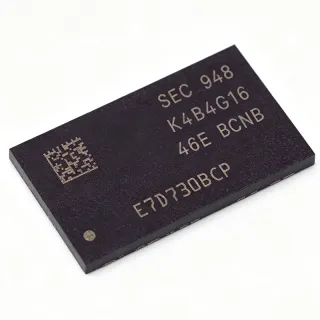
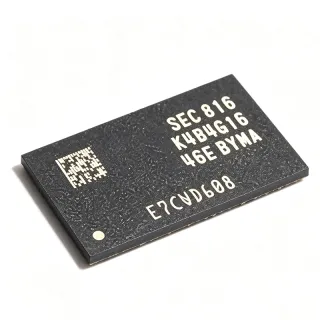
K4B4G1646E-BYK000 - 4Gb DDR3L SDRAM 256Mx16 | Samsung
MPN: K4B4G1646E-BYK000 ✓ Active| Qty | Unit Price | Extended |
|---|---|---|
| 1 | $0.72 | $0.72 |
| 10 | $0.65 | $6.50 |
| 100 | $0.6 | $60.00 |
| 500 | $0.58 | $290.00 |
| 1,000 | $0.5619 | $561.90 |
K4B4G1646E-BYK000 Overview
DDR3 SDRAM (Double Data Rate 3 Synchronous Dynamic Random Access Memory) is the third generation of the JEDEC DDR memory family. A DDR3 SDRAM transfers data on both rising and falling clock edges, doubling effective bandwidth relative to SDR memory at the same clock frequency. Within the memory hierarchy, this device sits as a main-memory / working-memory component below CPU caches and above storage in embedded systems, industrial controllers, set-top boxes, and networking equipment.
Key features include the 4 Gbit density in a x16 organization with 8 internal banks, support for DDR3-1600 data rates, and programmable CAS latency per the JEDEC DDR3 specification. The device provides auto precharge, asynchronous reset, ZQ calibration, dynamic on-chip termination (ODT), and data mask (DM) functions for byte-wise write masking, all listed on the Samsung product family datasheet.
Technically, the K4B4G1646E uses Samsung's E-die, which lowered operating voltage to 1.35 V while retaining compatibility with 1.5 V DDR3 systems. This reduces I/O and core power compared with first-generation DDR3, important for thermally constrained and battery-backed designs. The 96-ball FBGA package minimizes parasitic inductance, supporting clean signal integrity at 1600 MT/s.
Typical applications include embedded main memory for ARM- or MIPS-based SoCs, industrial human-machine interfaces, network switches and routers buffering packets, set-top box and smart-TV memory, and test instrumentation requiring nonvolatile-free working DRAM.
A key design consideration is DDR3 controller training: the memory controller must support write leveling and ZQ calibration, and fly-by address/command routing with on-die termination should be used per JEDEC DDR3 design guidance. Power-distribution design must handle simultaneous switching noise on the data bus.
This page synthesizes distributor pricing, verified drop-in alternatives, and practical design notes not found in the manufacturer datasheet, with all pricing data as of 2026-09-01.
Drop-in alternatives for K4B4G1646E-BYK000 — same package, pin-to-pin compatible. Different-package parts requiring PCB rework are excluded.
Variants in this series
Same-series models that are drop-in compatible with K4B4G1646E-BYK000 (same form factor and footprint) — differing in Package, Data Rate, Operating Temperature, Supply Voltage, Memory Size.
Quick Comparison Tool — Select alternative parts for side-by-side comparison:
K4B4G1646E-BYK0
✅ Drop-In✓ In Stock
$1.8 / Unit
View Datasheet →K4B4G1646I-BYK0
✅ Drop-In✓ In Stock
$1.75 / Unit
View Datasheet →K4B4G1646E-BYMA
✅ Drop-In✓ In Stock
$14.3182 / Unit
View Datasheet →K4B4G1646D-BYK0
✅ Drop-In ⚠️ Specs Unverified✓ In Stock
$2.9 / Unit
View Datasheet →MT41K256M16HA-125
✅ Drop-In✓ In Stock
$6.3636 / Unit
View Datasheet →PRB4G1646D
✅ Drop-In📋 Reference alternative (not in catalog)
K4B4G1646E-BYK000 Maximum Ratings & Electrical Characteristics
| Memory Type | DDR3L SDRAM |
| Memory Size | 4 Gbit |
| Organization | 256M x 16 |
| Speed Grade | DDR3-1600 (1.25 ns clock cycle) |
| Clock Frequency | 800 MHz |
| Supply Voltage (VDD) | 1.35 V (DDR3L), 1.5 V compatible (DDR3) |
| Die Process | Samsung E-die |
| Package | 96-FBGA (BYK) |
| Mounting Type | Surface Mount |
| Interface | Parallel |
| Features | Auto precharge, asynchronous reset, ZQ calibration, dynamic on-chip termination, data mask |
| Access Time | 1.25 ns |
K4B4G1646E-BYK000 96-fbga (byk) Pin Configuration Guide
Pin configuration for K4B4G1646E-BYK000 (96-fbga (byk) package). This digital IC includes GPIO, communication interfaces (UART, SPI, I2C), and power pins. Refer to the manufacturer datasheet for alternate pin functions and configuration options. Essential for embedded system design and PCB layout.

No detailed pinout data available for K4B4G1646E-BYK000.
Refer to the datasheet for full pin configuration.
Typical Applications
K4B4G1646E-BYK000 is suitable for 6 applications: Embedded Main Memory for ARM/MIPS SoCs, Industrial HMI and Panel PCs, Networking Switches and Routers, Set-Top Box and Smart TV Memory, Test and Measurement Instrumentation, Automotive Infotainment and Telematics (Off-Network).
Embedded Main Memory for ARM/MIPS SoCs
The K4B4G1646E-BYK000 serves as main working memory for ARM Cortex-A and MIPS-based SoCs in embedded systems. Its 4 Gbit density and DDR3-1600 bandwidth (up to 3.2 GB/s on a x16 bus) comfortably support Linux-class applications, while the 1.35 V DDR3L operation reduces core power versus 1.5 V DDR3, cutting junction temperature in sealed enclosures. The device is connected via a point-to-point or single-rank fly-by topology with the controller's DDR3 interface; write leveling and ZQ calibration are performed at boot per JEDEC training requirements. The 96-ball FBGA package fits tight board real estate typical of SOMs and gateways. Trade-off: DRAM content is volatile, so boot code must reside in separate NOR/NAND flash.
Recommended
Industrial HMI and Panel PCs
Industrial human-machine interfaces require multi-gigabyte working memory for GUI composition, data logging, and protocol stacks. The K4B4G1646E-BYK000 fits this role with DDR3-1600 throughput and Samsung E-die reliability; its x16 organization keeps bus width and PCB layer count manageable in cost-sensitive panels. For designs spanning -40 C to +95 C, the family's industrial bin (e.g., K4B4G1646E-BMMA class) should be selected, while the standard grade suits 0 C to +70 C cabinets. ZQ calibration and dynamic on-die termination maintain signal integrity across long fly-by traces typical of panel PCBs. The FBGA package withstands vibration better than TSOP alternatives, an important factor in factory environments.
Recommended
Networking Switches and Routers
Packet buffering and control-plane memory in network equipment benefit from the K4B4G1646E-BYK000's combination of density and bandwidth. At DDR3-1600, a x16 part delivers up to 3.2 GB/s of burst bandwidth, sufficient for queuing descriptors and fast-path buffers in managed switches up to multi-gigabit class. The asynchronous reset input permits quick re-initialization after watchdog events, and auto-precharge reduces controller overhead in random-access buffering patterns. On-die termination (dynamic ODT) supports multi-drop loading on control buses in two-rank designs. Designers should budget refresh power: at 4 Gb density the refresh interval shortens above 85 C, raising standby current per JEDEC DDR3 temperature-compensated refresh rules.
Recommended
Set-Top Box and Smart TV Memory
Set-top boxes and smart TVs use 4 Gb DDR3L as the primary working memory for the SoC, video decoders, and middleware. The K4B4G1646E-BYK000's 1.35 V operation directly reduces system standby power - a regulatory requirement for these consumer platforms - while 800 MHz operation sustains 1080p-class decode buffers. Samsung E-die parts are widely pre-validated on mainstream STB SoCs, shortening platform bring-up because controller training parameters and mode-register scripts are often published by the SoC vendor. The 96-ball FBGA reflows on standard lead-free profiles, and the data-mask function simplifies partial-line writes used by display engines. Cost is the decisive advantage: commodity DDR3L pricing from $0.5619 at volume (LCSC, 2026-09-01).
Recommended
Test and Measurement Instrumentation
Oscilloscopes, data loggers, and signal generators need deep capture memory where the K4B4G1646E-BYK000's 4 Gbit x16 organization provides high-bandwidth streaming. DDR3-1600 burst throughput of 3.2 GB/s supports real-time waveform streaming to acquisition memory, and 1.35 V DDR3L operation lowers the thermal load inside sealed instrument chassis with fanless designs. The asynchronous reset allows the host to recover the memory subsystem deterministically between acquisitions. Multi-rank arrangements (two or four devices on a fly-by bus) use dynamic ODT to keep signal integrity within JEDEC margins. Designers should validate write-leveling across trace-length skew and implement temperature-compensated refresh for instruments operating near the upper temperature limit.
Recommended
Automotive Infotainment and Telematics (Off-Network)
Although the standard BYK grade is not AEC-Q100 qualified, the K4B4G1646E family architecture is used in non-safety automotive applications such as aftermarket infotainment, telematics dongles, and display modules where industrial-grade binning suffices. The 4 Gbit density covers map buffering and media caches, and 1.35 V DDR3L aligns with the low standby budgets demanded by always-on telematics units connected to battery-backed rails. Designers must verify the industrial temperature variant (I-suffix, e.g., K4B4G1646I-BYK0) for extended ambient conditions and perform their own qualification, since commodity DRAM lacks automotive documentation. For safety-relevant nodes, select an explicitly AEC-Q100 qualified DDR memory instead.
Recommended
Recommended Products Summary
Engineering reference data for K4B4G1646E-BYK000 — comparison, design guidance, and compliance information.
Selection Guide
Comparison with Alternatives
| Parameter | This Product | K4B4G1646E-BYK0 | K4B4G1646I-BYK0 | K4B4G1646E-BYMA | MT41K256M16HA-125 | PRB4G1646D |
|---|---|---|---|---|---|---|
| Brand | Samsung Electronics | Samsung Electronics | Samsung Electronics | Samsung Electronics | Micron Technology | NexDie |
| Package | 96-FBGA (BYK) | 96-FBGA (BYK) - same | 96-FBGA (BYK) - same | 96-FBGA (BYK) - same | 96-FBGA (BYK-compatible JEDEC ballout) - same footprint | 96-FBGA (BYK-compatible) - same footprint |
| Memory Size / Organization | 4 Gbit, 256M x 16 | 4 Gbit, 256M x 16 | 4 Gbit, 256M x 16 | 4 Gbit, 256M x 16 | 4 Gbit, 256M x 16 | 4 Gbit, 256M x 16 |
| Supply Voltage | 1.35 V (DDR3L), 1.5 V compatible | 1.35 V (DDR3L) | 1.35 V (DDR3L) | 1.35 V (DDR3L) | 1.35 V (DDR3L) | 1.35 V (DDR3L) |
| Die / Revision | Samsung E-die | Samsung E-die - same | Alternate die revision | Samsung E-die | Micron die | NexDie die |
| Key Features | Auto precharge, async reset, ZQ cal, dynamic ODT, data mask | Same feature set | Same feature set | Same feature set (per LCSC) | Same JEDEC feature set | JEDEC DDR3L feature set |
Key Differentiators
- E-die power efficiency (vs K4B4G1646D-BYK0)
- Lowest commodity cost in family (vs K4B4G1646E-BYMA)
- Second-source security via JEDEC standardization (vs MT41K256M16HA-125)
- Honest trade-off: no automotive qualification (vs MT41K256M16HA-125 (industrial variants))
Design Notes
Route the DDR3 address/command bus in fly-by topology per JEDEC DDR3 guidance, with on-die termination (dynamic ODT) enabled on both the controller and the K4B4G1646E-BYK000. Length-match data lanes to within +/-25 mils and keep each DQS/DQ pair matched tightly. Use ODT settings from the Samsung datasheet's recommended mode-register values and re-run write leveling at every firmware revision, since die revisions can shift timing windows slightly.
Provide separate VDD (1.35 V), VDDQ, and VTT rails. VTT must track VDDQ/2 with a sinking-sourcing LDO or switching terminator rated for transient currents during simultaneous bus switching; a 4 Gb x16 device can pull significant peak VTT current on 16 data lines plus strobes. Place bulk (100 uF) and high-frequency (0.1 uF per supply pin group) decoupling close to the ballout. Estimated: at DDR3L, I/O power scales with (V^2 x f); running 1.35 V instead of 1.5 V saves roughly 19% of dynamic I/O power at equal activity.
Do not assume all BYK-suffix parts are identical: speed bin (BYK0 vs BYMA) and temperature grade (commercial vs I-suffix industrial) differ within the same footprint. Confirm your memory controller supports ZQ calibration and write leveling before adopting any drop-in substitute; some legacy controllers with fixed mode-register scripts fail on newer die revisions. Also remember refresh interval must be halved above 85 C per JEDEC DDR3 rules - a common cause of field failures in hot enclosures.
Follow Samsung's reference layout guidance for 96-FBGA DDR3: escape the ball field with via-in-pad or dog-bone fanout on at least 4 layers, keep a solid reference plane under all DDR3 nets, and avoid splitting the ground return under data lanes. Series termination resistors (22-33 ohm) on address/command help damp reflections on fly-by topology; data lines typically rely on ODT and series 22-33 ohm resistors only where traces exceed 3 inches.
Compliance Information
No explicit compliance statements appeared in the provided verified data. Samsung commodity DDR3 is typically RoHS compliant, but this must be confirmed from the official Samsung product page before use. Not AEC-Q100 qualified based on the commercial/industrial product family classification.